
What Are Newton's Laws?
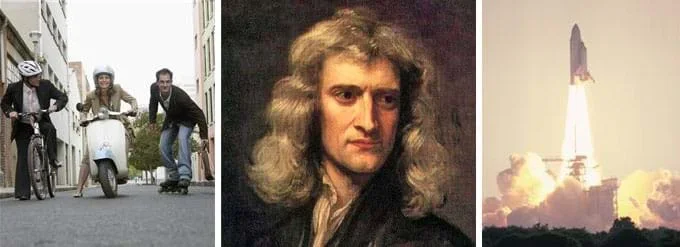 Newton's laws of motion explain the movement of everyday objects and are important to engineers who design machines, structures and products.Copyright (left, right) 2004 Microsoft Corporation, One Microsoft Way, Redmond, WA 98052-6399 USA. All rights reserved; (middle) 1689 Sir Godfrey Kneller, Wikimedia Commons http://office.microsoft.com/en-us/images/results.aspx?qu=scooter&ex=1#ai:MP900425518|
http://commons.wikimedia.org/wiki/File:GodfreyKneller-IsaacNewton-1689.jpg
http://office.microsoft.com/en-us/images/results.aspx?qu=vehicle&ex=1#ai:MP900414117|mt:2|
Newton's laws of motion explain the movement of everyday objects and are important to engineers who design machines, structures and products.Copyright (left, right) 2004 Microsoft Corporation, One Microsoft Way, Redmond, WA 98052-6399 USA. All rights reserved; (middle) 1689 Sir Godfrey Kneller, Wikimedia Commons http://office.microsoft.com/en-us/images/results.aspx?qu=scooter&ex=1#ai:MP900425518|
http://commons.wikimedia.org/wiki/File:GodfreyKneller-IsaacNewton-1689.jpg
http://office.microsoft.com/en-us/images/results.aspx?qu=vehicle&ex=1#ai:MP900414117|mt:2|
Newton's first law of motion: Unless an unbalanced force acts on an object, an object at rest stays at rest and an object in motion stays in motion.
Newton's second law of motion: Force = mass x acceleration (aka F=ma)
Newton's third law of motion: For every action, there is an equal and opposite reaction.
Engineers apply basic physics concepts such as Newton's laws of motion in a wide range of situations such as designing all sorts of stationary and moving objects, from the massive to the delicate. This includes structures, vehicles and objects such as bridges, rockets, aircraft, seat belts, door knobs and medicine delivery systems. To design objects that perform as we want and are safe, engineers must fully understand the workings of the natural physical laws. Learning how Newton's laws apply in everyday situations and devices enables students to be able to describe how objects move and prepares them for the study of more complex physics concepts.
- MS-PS2-2 Plan an investigation to provide evidence that the change in an object's motion depends on the sum of the forces on the object and the mass of the object.
Grades 6-8
Do you agree with this alignment?
- MS-PS2-2 Plan an investigation to provide evidence that the change in an object's motion depends on the sum of the forces on the object and the mass of the object.
Grades 6-8
This resource focuses on the following Three Dimensional Learning aspects of NGSS:
Science & Engineering Practices- Plan an investigation individually and collaboratively, and in the design: identify independent and dependent variables and controls, what tools are needed to do the gathering, how measurements will be recorded, and how many data are needed to support a claim.Do you agree with this alignment?
- Science knowledge is based upon logical and conceptual connections between evidence and explanations.Do you agree with this alignment?
Disciplinary Core Ideas- The motion of an object is determined by the sum of the forces acting on it; if the total force on the object is not zero, its motion will change. The greater the mass of the object, the greater the force needed to achieve the same change in motion. For any given object, a larger force causes a larger change in motion.Do you agree with this alignment?
- All positions of objects and the directions of forces and motions must be described in an arbitrarily chosen reference frame and arbitrarily chosen units of size. In order to share information with other people, these choices must also be shared.Do you agree with this alignment?
Crosscutting Concepts- Explanations of stability and change in natural or designed systems can be constructed by examining the changes over time and forces at different scales.Do you agree with this alignment?
Do you agree with this alignment? - Plan an investigation individually and collaboratively, and in the design: identify independent and dependent variables and controls, what tools are needed to do the gathering, how measurements will be recorded, and how many data are needed to support a claim.
Each lesson and activity is designed to take 60-minutes, for a total of four 60-minute sessions for the unit. The teaching style, depth of instruction and student level may cause the lessons to take more or less time.
The suggested order to conduct the lessons and activity in the unit:
Day 1: What Is Newton's First Law?
Day 2: What Is Newton's Second Law?
Day 3: What Is Newton's Third Law?
Day 4: Sliding Textbooks
The San Francisco Exploratorium provides a list of 17 classroom demonstrations of Newton's laws of motion that you may want to incorporate into the unit, in addition to those already provided. See http://www.exo.net/~donr/activities/Newton's_Laws_Demonstrations.pdf
Contributors
Elizabeth Anthony; Scott Strobel; Jacob Teter
Supporting Program
RESOURCE GK-12 Program, College of Engineering, University of California Davis
Acknowledgements
The contents of this digital library curriculum were developed by the Renewable Energy Systems Opportunity for Unified Research Collaboration and Education (RESOURCE) project in the College of Engineering under National Science Foundation GK-12 grant no. DGE 0948021. However, these contents do not necessarily represent the policies of the National Science Foundation, and you should not assume endorsement by the federal government.
Copyright
2014 by Regents of the University of Colorado; original © 2013 University of California Davis