
What Is Newton's First Law?
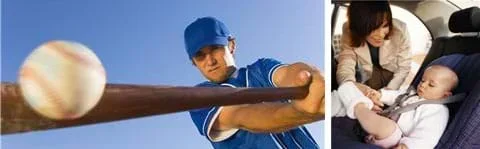 Newton's laws explain the movement of everyday objects.Copyright 2004 Microsoft Corporation, One Microsoft Way, Redmond, WA 98052-6399 USA. All rights reserved. http://office.microsoft.com/en-us/images/results.aspx?qu=baseball&ex=1#ai:MP900430569|
http://office.microsoft.com/en-us/images/results.aspx?qu=seatbelt&ex=1#ai:MP900422802|
Newton's laws explain the movement of everyday objects.Copyright 2004 Microsoft Corporation, One Microsoft Way, Redmond, WA 98052-6399 USA. All rights reserved. http://office.microsoft.com/en-us/images/results.aspx?qu=baseball&ex=1#ai:MP900430569|
http://office.microsoft.com/en-us/images/results.aspx?qu=seatbelt&ex=1#ai:MP900422802|
Students are introduced to the concepts of force, inertia and Newton's first law of motion: objects at rest stay at rest and objects in motion stay in motion unless acted upon by an unbalanced force. Examples of contact and non-contact types of forces are provided, specifically applied, spring, drag, frictional forces, and magnetic, electric, gravitational forces. Students learn the difference between speed, velocity and acceleration, and come to see that the change in motion (or acceleration) of an object is caused by unbalanced forces. They also learn that engineers consider and take advantage of these forces and laws of motion in their designs. Through a PowerPoint® presentation and some simple teacher demonstrations these fundamental science concepts are explained and illustrated. This lesson is the first in a series of three lessons that are intended to be taught as a unit.
Engineers apply basic physics concepts such as Newton's laws of motion to a wide range of problem-solving situations, including the design of structures and vehicles. For example, engineers design the seat belts in cars to keep passengers from being thrown from vehicles in the event of a crash, which occurs as a consequence of Newton's first law. Learning how Newton's laws apply in everyday situations enables students to describe how objects move and helps prepare them for the study of more complex physics concepts.
After this lesson, students should be able to:
- State and explain Newton's first law of motion.
- Identify and give examples of (types of) forces.
- Compare and contrast speed, velocity and acceleration.
- Apply Newton's first law to explain the effect of applying a force on an object.
- MS-PS2-2 Plan an investigation to provide evidence that the change in an object's motion depends on the sum of the forces on the object and the mass of the object.
Grades 6-8
Do you agree with this alignment?
- Students will develop an understanding of the relationships among technologies and the connections between technology and other fields of study.
Grades K-12
Do you agree with this alignment?
- MS-PS2-2 Plan an investigation to provide evidence that the change in an object's motion depends on the sum of the forces on the object and the mass of the object.
Grades 6-8
This resource focuses on the following Three Dimensional Learning aspects of NGSS:
Science & Engineering Practices- Plan an investigation individually and collaboratively, and in the design: identify independent and dependent variables and controls, what tools are needed to do the gathering, how measurements will be recorded, and how many data are needed to support a claim.Do you agree with this alignment?
- Science knowledge is based upon logical and conceptual connections between evidence and explanations.Do you agree with this alignment?
Disciplinary Core Ideas- The motion of an object is determined by the sum of the forces acting on it; if the total force on the object is not zero, its motion will change. The greater the mass of the object, the greater the force needed to achieve the same change in motion. For any given object, a larger force causes a larger change in motion.Do you agree with this alignment?
- All positions of objects and the directions of forces and motions must be described in an arbitrarily chosen reference frame and arbitrarily chosen units of size. In order to share information with other people, these choices must also be shared.Do you agree with this alignment?
Crosscutting Concepts- Explanations of stability and change in natural or designed systems can be constructed by examining the changes over time and forces at different scales.Do you agree with this alignment?
Do you agree with this alignment? - Plan an investigation individually and collaboratively, and in the design: identify independent and dependent variables and controls, what tools are needed to do the gathering, how measurements will be recorded, and how many data are needed to support a claim.
Students should be familiar with the concepts of mass, properties of matter (eight, density, volume), and basic algebraic equations.
Teacher Preparation
- Be ready to show students the Forces and Newton's First Law Presentation (an 11-slide PowerPoint® presentation) to teach the lesson.
- (optional) Have ready a computer/projector with Internet access to show students two online videos as part of the presentation.
- For two class demonstrations, have handy the following materials: whiteboard marker, wooden embroidery hoop, 2-liter soda bottle (or Nalgene bottle) full of sand, gravel or water (for stability), and 2 eggs, 1 raw, 1 hardboiled. Practice the demos (slides 2 and 10) in advance. Note: Use a light-weight wooden hoop, sometimes called an embroidery or crochet hoop. Alternatively, use a metal hose clamp with the tightening mechanism removed. Most impressive is when the marker is only a few millimeters less in diameter then the bottle opening. Any number of setups work well; just get one that works and practice a few times in advance. Alternatively, show students an online video of the hoop demo; two website addresses are provided in the Additional Multimedia Support section.
- In advance, make copies of Newton's First Law Exit Ticket (PDF) (one per student).


Background Concepts
 Copyright 2004 Microsoft Corporation, One Microsoft Way, Redmond, WA 98052-6399 USA. All rights reserved. http://office.microsoft.com/en-us/images/results.aspx?qu=ball&ex=1#ai:MP900430588|mt:2|
Newton's laws of motion are fundamental concepts of macro-scale physics. Forces explain the motion of objects. A force is a push or pull on an object, resulting from an interaction with another object. If two objects interact, then a force is always acting on each object. Once the interaction ends, the force acting on the objects also comes to an end. This can be demonstrated through many examples even as simple as a rock resting on the ground until it is pushed by something. Gravitational forces can be demonstrated by dropping objects. Magnetic forces can be demonstrated with two magnets.
Newton's first law states that "an object at rest will stay at rest unless acted on by an unbalanced external force." This concept is commonly referred to as inertia and was first hypothesized by Galileo Galilei in the late 1500s. Newton first stated this as "Every body persists in its state of being at rest or of moving uniformly straight forward, except insofar as it is compelled to change its state by force impressed." This physical law explains myriad everyday phenomena, such as why we wear seatbelts. It can also be demonstrated by the movement of objects in sports—such as kicking or hitting a ball or tackling other players.
Forces and Newton's First Law of Motion Presentation Outline (slides 1-11)
Open the Forces and Newton's First Law Presentation (PPTX) for all students to view and present the lesson content, guided by the script below and text in the slide notes. The slides are animated so clicking brings up the next text/image/answer.
Objective: To understand that the change in motion (or acceleration) of an object is caused by unbalanced forces.
(slide 2) Introduce the concept of inertia through a short class demonstration. Balance a hoop on the top of a weighted bottle, and a marker on the hoop, as shown in the drawing on the slide. Ask students: What do you think will happen when I knock the hoop from the bottle? After student discussion and predictions, quickly knock the hoop from its location between the bottle and the marker. If done correctly, the marker falls straight into the bottle (as shown by the slide animation). Explain that this demonstrates inertia; the marker resists changing direction when the hoop is knocked away.
(slide 3) This slide is a primer on speed, velocity and acceleration. Even though the entire lesson could be devoted to this topic, the goal here is a quick introduction (or review) of the concepts.
Briefly review the concept of speed: speed is the distance traveled divided by time. Reinforce this with an example problem: if a racecar is traveling at 120 mph, how much time does it take to travel one mile? (Answer: 30 seconds.)
In order to know the racecar's velocity, one needs to know not only its speed, but also the direction in which it is traveling. We know the car's speed (120 mph) from the speedometer, but we need to define the car's direction. Direction can be a compass direction (north, south, northeast, etc.), up and down, or positive and negative (as in the integer number line). Let's start by assigning a compass direction to the racecar. Given the orientation of the compass, the racecar is traveling east. So, the racecar's velocity in this case is 120 miles per hour to the east.
Next, introduce positive and negative as directions. These will be used later on in the lesson as well. In this case, the racecar's velocity is now 120 mph in the positive direction. If the driver was driving the car in reverse, the car's velocity would be 120 mph in the negative direction, or -120 mph.
Use the speedometer to introduce acceleration as a change in velocity. Imagine the racecar initially at rest (0 mph), then the driver presses the gas pedal and the car begins to move in the positive direction. The change in velocity is the acceleration. Have you ever heard someone declare that a really powerful car can "go zero to 60 mph in (for example) 4 seconds"? This description is a measure of acceleration. Also, remember that since velocity consists of both speed AND direction, acceleration might entail changing the speed OR the direction OR both.
Run through some practice examples. For example, "If you are walking north at 3 miles an hour, is this your speed or velocity? How do you know?" (Answer: Velocity, because both direction [north] and speed [3 miles per hour] are provided.)
To make the concept more tangible, call on a few student volunteers to walk—with increase or decreasing speed—to illustrate the concepts of velocity and acceleration, including magnitude + direction / vector vs. scalar quantities.
(slide 4) A force is a push or pull on an object resulting from the object's interaction with another object. That interaction can be due to contact or being nearby, a distinction we will talk about later. Whenever two objects are interacting, then some force is acting upon each of the objects. When the interaction stops, the two objects no longer experience any force between them. If an object is not interacting with any other objects, then no forces are acting upon it. Forces only exist as a result of interactions.
A force acting on an object may cause that object's velocity to change. This is the same as saying that forces may cause an object to accelerate. (The condition here is that the object must be experiencing an unbalanced force in order to accelerate, but more on that later.) The acceleration of an object is not only based on the force acting on it, but also on its mass.
In the left photograph, a hockey player applies a force to make the ball move forward. In the middle photograph, a soccer player's foot applies a force to the ball, which causes the ball to accelerate. Pulling on a rope in a game of tug of war (as depicted in the right image) can cause an entire system to accelerate. (Note: This may be a good time for a tug of war demonstration to illustrate systems experiencing balanced and unbalanced forces to further explain Newton's first law.) As a transition to the next slide, mention that the three images all depict contact forces.
(slide 5) Introduce students to different types of forces through simple demonstrations. Give brief descriptions of each type of force (direct students to write these definitions in their notebooks), and perform a simple demonstration of each one. The goal is for students to be able to distinguish between contact and non-contact forces and gain exposure to the variety of forces, not to master the intricacies of friction or magnetism.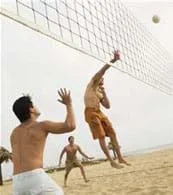 Copyright 2004 Microsoft Corporation, One Microsoft Way, Redmond, WA 98052-6399 USA. All rights reserved. http://office.microsoft.com/en-us/images/results.aspx?qu=hit&ex=1#ai:MP900430614|mt:2|
Contact forces are interactions that occur between objects when they are touching. Applied force, spring force, drag force and frictional force are all different types of contact forces. An applied force is a force that a person or object applies to another object or person. For example, a swinging baseball bat applies a force to a baseball. A spring force is exerted when a mechanical spring is compressed or stretched. When an object moves through a fluid (such as water or gas), contact between the object and the fluid molecules creates a drag force that opposes the motion of the object. A parachute takes advantage of drag force to slow an object's descent. When two solids are in contact, a frictional force opposes the movement of one object past the other. When a textbook is slid across a table, it is the frictional force that slows down its motion.
Non-contact forces are interactions that occur even when a distance exists between objects. Examples of non-contact forces include magnetic, electric and gravitational forces. With each of these, objects need not be touching in order to experience a non-contact force between them. For example, a magnet can attract or repel another magnet, causing a change in motion without the magnets touching. Similarly, an electrically charged balloon can make person's hair stand up without touching the hair. And, as Isaac Newton famously proposed, an apple falls to the ground and the moon revolves around the Earth due to the action of a gravitational force. In all of these cases, the strength of the force depends on the distance between the objects.
While looking at all the force examples illustrated on the slide, ask students: What forces might engineers use to their advantage? How might they do this? For example, engineers take advantage of drag forces when designing parachutes.
(slide 6) Introduce Newton's first law of motion by helping students translate Newton's original language into "sixth grade language." Make sure students do not confuse "every body," meaning "every object," with "everybody." Have students translate Newton's wording into the more common definition: "Unless an unbalanced force acts on an object, an object at rest stays at rest and an object in motion, stays in motion."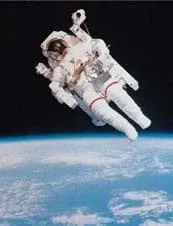 Copyright 2004 Microsoft Corporation, One Microsoft Way, Redmond, WA 98052-6399 USA. All rights reserved. http://office.microsoft.com/en-us/images/results.aspx?qu=astronaut&ex=1#ai:MP900178714|mt:2|
(slide 7) An object only accelerates if an unbalanced force acts on it (net force ≠ 0). If the forces acting on an object are balanced (or no forces are acting on the object), then the object maintains its velocity (if non-zero). Reinforce the concept with examples; ask students to explain how each picture on the slide illustrates Newton's first law of motion.
- The pyramid is a massive object that does not move; no unbalanced forces.
- In space, when astronauts move, they continue moving (think of footage from the international space station).
- If a biker's front wheel hits a barrier (such as a log or curb), they will fly over the handlebars.
(optional) Discuss the invisible bicycle helmet, a cool engineering invention, and show a 3:36-minute video about it. The video can be interpreted to demonstrate Newton's first law in the event of a bike crash; video at https://www.youtube.com/watch?v=A9wGA9Bno68.
(slide 8) Provide an elementary explanation of vectors, with the emphasis being that forces are additive. Use the animated diagram on this slide as an example of unbalanced forces. Begin with a discussion of the integer number line, which students have seen in math class. Then orient that line vertically with positive pointing down. Consider the umbrella shown on the slide; a 3 N force acts in the negative direction and a 7N force acts in the positive direction. The two forces acting upon the umbrella are unbalanced because they do not add to zero. Because the force of air resistance is less than the force of gravity, a net force in the positive direction results, and the umbrella accelerates in that direction.
Move into a discussion of air resistance and what would happen in its absence. In a situation with no air resistance, if two objects are dropped from the same height at the same time, they hit the ground at the same time. (optional) Show students the 47-second video, Feather & Hammer Drop on Moon of an Apollo astronaut doing a demo on a space walk in 1971 at: https://www.youtube.com/watch?v=5C5_dOEyAfk. This is an example of what happens when no drag force exists; the hammer and feather hit the ground at the same time, as predicted by Galileo's theory that all objects in a given gravity field fall at the same rate, regardless of mass—in the absence of resistance of the medium through which they fall.
(slide 9) Return to the concept of inertia. Inertia was first described by Galileo Galilei, "the father of modern physics." Inertia describes the same principle as Newton's first law of motion but was stated as "A body moving on a level surface will continue in the same direction at constant speed unless disturbed."
(slide 10) Conduct another simple class demonstration; use two eggs to demonstrate inertia. Spin both a hardboiled egg and a raw egg. Stop each with your finger, then quickly let go. The hardboiled egg remains still, while the raw egg spins again (the yolk kept spinning inside the shell). Explain to students that the (unseen, soft) yolk continued to rotate.
(slide 11) Review the concepts from the day's lesson. Conclude the presentation with a quick review of the key concepts, as listed on the slide, with blanks for students to supply the answers. The take-home message for students is that unbalanced forces cause an object's motion to change. Recap that a variety of different forces exist, and that engineers consider and take advantage of these forces in their designs.
Conclude the lesson by administering the exit ticket and homework assignment, as described in the Assessment section.
 Copyright 2004 Microsoft Corporation, One Microsoft Way, Redmond, WA 98052-6399 USA. All rights reserved. http://office.microsoft.com/en-us/images/results.aspx?qu=boxes&ex=1#ai:MP900446477|
Engineers apply basic physics concepts of inertia and force in a variety of situations, such as in designing structures and vehicles of all shapes and sizes. Understanding these concepts is necessary to accurately explain the movement—or lack of movement—of objects.
A force is a push, pull or twist on an object. All forces can be identified as either contact or non-contact. Contact forces result from interactions between objects that touch. Examples of contact forces include applied, spring, drag, friction and normal forces. Non-contact forces attract or repel objects from a distance, including magnetic, electric and gravitational forces. An applied force can cause an object to accelerate, which means a change in the object's velocity happens. The acceleration of an object depends on the force acting on the object, as well as the object's mass.
Sir Isaac Newton stated in Principia Mathematica, a book he wrote in 1687, that "Every body persists in its state of being at rest of moving uniformly straight forward, except insofar as it is compelled to change its state by force impressed." (He wrote "every body," meaning "every object," not "everybody.") Today we know this as Newton's first law of motion and simply state this natural physical law as "objects at rest stay at rest and objects in motion stay in motion unless acted upon by an unbalanced force." Let's think of an example. Imagine a student on a skateboard. If no force acts on the student on the skateboard—such as another student pushing them forward—then the student remains motionless. However, if pushed forward, the student accelerates. Once moving, the force of friction acts on the skateboard to slow the skateboard and the student, until stopped again.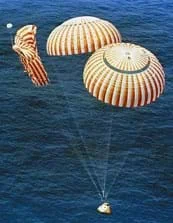 Copyright 1971 NASA, Wikimedia Commons http://commons.wikimedia.org/wiki/File:Apollo_15_descends_to_splashdown.jpg
Newton's first law is also often referred to as the law of inertia. Galileo Galilei first wrote about this concept stating: "A body moving on a level surface will continue in the same direction at a constant speed unless disturbed." Simply put, inertia is an object's resistance to changing its motion.
The key for an object to accelerate is that it is acted on by an unbalanced force. Typically, objects are acted on by multiple forces at the same time. For example, a box sitting on the ground is acted on by a gravitational force pulling it down and a normal force pushing it up. These forces balance so no acceleration occurs. On the other hand, an object falling through the air, such as a parachute is acted on by two forces, but they are unbalanced. A gravitational force pulls the parachute downwards, while a drag force pushes it up. However, the gravitational force is greater than the drag force so the parachute moves downward, albeit more slowly than if no drag force was acting on it.
(Continue by showing the presentation and delivering the content in the Lesson Background section.)
- acceleration
- The amount of change in an object's velocity.
- force
- A push, pull or twist of an object.
- inertia
- An object's resistance to changing its motion.
- newton's first law
- Unless an unbalanced force acts on an object, an object at rest stays at rest and an object in motion stays in motion.
- speed
- The distance traveled divided by time.
- velocity
- The speed and direction of an object.
Pre-Lesson Assessment
Predictions: In conjunction with the inertia hoop demonstration (slide 2), ask students what they think will happen to the marker once the hoop is snatched away. Expect students with an understanding of inertia to predict the marker to fall straight down, while those unfamiliar with inertia to predict the marker to be pulled in the direction in which the hoop was removed. Student answers reveal their base knowledge of the concept.
Post-Introduction Assessment
Embedded Questions: Informally gauge students' depth of understanding by their responses to questions throughout the Forces and Newton's First Law Presentation (PPTX) slides and script. For example, on slide 8, expect students to be able to identify the forces acting on the umbrella.
Lesson Summary Assessment
Concept Review: At lesson end, ask students the six review questions on slide 11. Ask them to supply the answers for the blanks in the sentences. Student answers reveal their comprehension of the concepts presented.
Exit Ticket: As a final exercise for the day, have students fill in the blanks on the Newton's First Law Exit Ticket (PDF). Use this exit ticket after full review of the relevant properties of matter—mass, weight, density, volume—and after covering the topic of forces and Newton's first law. The questions require students to distinguish between speed, velocity and acceleration. Review students' answers to gauge their individual depth of comprehension.
Homework
Experiment Planning: Assign students to design an experiment that would test whether an object's motion depends on the forces acting on it and its mass. In doing so, direct them to consider what they learned in this lesson, including the various types of forces that can act on an object and the demonstrations they observed. Remind students to think through all the forces that will be present in their experiments and how they might test the effect of an object's mass. Since the experiment will not actually be performed, encourage students to be very creative in its design. This homework helps prepare students for the next lesson on Newton's second law.
Coming Up: After presentation of the next lesson on Newton's second law, a homework assignment is provided as an attachment to that lesson, Newton's First and Second Laws Homework, in which students demonstrate what they learned from both lessons.
The hoop demo is also available online to help in practicing it before class or to show students.
- Home Experiment: Newton's First Law/Law of Inertia (55-second video; good for practicing) at https://www.youtube.com/watch?v=uOSBC0SXVR4
- Inertia Hoop Demo (1:06-minute video; good for students) at https://www.youtube.com/watch?v=--MDILG7Znk
Louviere, Georgia. "Newton's Laws of Motion." 2006. Rice University. Accessed April 1, 2014. http://teachertech.rice.edu/Participants/louviere/Newton/index.html
"Newton's Laws." 2014. Physics Tutorial, The Physics Classroom. Accessed April 1, 2014. http://www.physicsclassroom.com/class/newtlaws
- What Are Newton's Laws?
- What Is Newton's First Law?
- What Is Newton's Second Law?
- What Is Newton's Third Law?
Browse the NGSS Engineering-aligned Physics Curriculum hub for additional Physics and Physical Science curriculum featuring Engineering.
Contributors
Elizabeth Anthony; Scott Strobel; Jacob Teter
Supporting Program
RESOURCE GK-12 Program, College of Engineering, University of California Davis
Acknowledgements
The contents of this digital library curriculum were developed by the Renewable Energy Systems Opportunity for Unified Research Collaboration and Education (RESOURCE) project in the College of Engineering under National Science Foundation GK-12 grant no. DGE 0948021. However, these contents do not necessarily represent the policies of the National Science Foundation, and you should not assume endorsement by the federal government.
Copyright
2014 by Regents of the University of Colorado; original © 2013 University of California Davis