
Is It Shocking?
To better understand electricity, students investigate the properties of materials based on their ability to dispel static electricity. They complete a lab worksheet, collect experimental data, and draw conclusions based on their observations and understanding of electricity. The activity provides hands-on learning experience to safely explore the concept of static electricity, learning what static electricity is and which materials best hold static charge. Students learn to identify materials that hold static charge as insulators and materials that dispel charge as conductors. The class applies the results from their material tests to real-world engineering by identifying the best of the given materials for moving current in a solar panel.
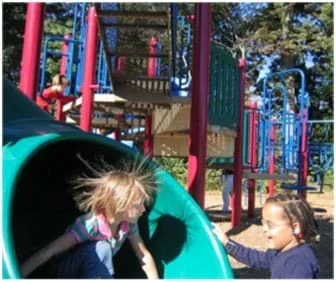 "What's going on with your hair?" Contact with the plastic slide has left this child's hair positively charged so that individual hairs repel one another. The hair may also be attracted to the negatively charged slide surface.Copyright Ctd 2005, Flicker http://www.flickr.com/photos/49196923@N00/48616367/
Electrical engineers must understand the electrical properties of materials in order to select appropriate materials to use in designing devices and projects. One everyday example is a typical electrical cord: the inside of the cord and the prongs are conductors in order to permit the flow of electricity while the outside is an insulator in order to protect people touching the cord from electric shock. In the activity, students act as engineers tasked to find materials that do not hold static charge and permit electricity to flow easily. Based on what they learned in the associated lesson, students understand that they are looking for a conductor; an analysis of their testing observations determines the best conductor out of the provided materials.
After this activity, students should be able to:
- Explain that static electricity is the buildup of a charge (either net positive or net negative) over a surface.
- Correlate the buildup of static electricity in a material to its properties (identify whether it is a conductor or insulator).
- Explain why it is important for engineers to choose the best material for electrical jobs.
- 5-PS1-1 Develop a model to describe that matter is made of particles too small to be seen.
Grade 5
Do you agree with this alignment? - 5-PS1-3 Make observations and measurements to identify materials based on their properties.
Grade 5
Do you agree with this alignment?
- 6-8.RS.9 Compare and contrast the information gained from experiments, simulations, video or multimedia sources with that gained from reading a text on the same topic.
Grades 6-8
Do you agree with this alignment?
- Students will develop an understanding of the relationships among technologies and the connections between technology and other fields of study.
Grades K-12
Do you agree with this alignment?
- 5-PS1-1 Develop a model to describe that matter is made of particles too small to be seen.
Grade 5
This resource focuses on the following Three Dimensional Learning aspects of NGSS:
Science & Engineering Practices- Develop a model to describe phenomena.Do you agree with this alignment?
Disciplinary Core Ideas- Matter of any type can be subdivided into particles that are too small to see, but even then the matter still exists and can be detected by other means. A model showing that gases are made from matter particles that are too small to see and are moving freely around in space can explain many observations, including the inflation and shape of a balloon and the effects of air on larger particles or objects.Do you agree with this alignment?
Crosscutting Concepts- Natural objects exist from the very small to the immensely large.Do you agree with this alignment?
Do you agree with this alignment? - Develop a model to describe phenomena.
- 5-PS1-3 Make observations and measurements to identify materials based on their properties.
Grade 5
This resource focuses on the following Three Dimensional Learning aspects of NGSS:
Science & Engineering Practices- Make observations and measurements to produce data to serve as the basis for evidence for an explanation of a phenomenon.Do you agree with this alignment?
Disciplinary Core Ideas- Measurements of a variety of properties can be used to identify materials. (Boundary: At this grade level, mass and weight are not distinguished, and no attempt is made to define the unseen particles or explain the atomic-scale mechanism of evaporation and condensation.)Do you agree with this alignment?
Crosscutting Concepts- Standard units are used to measure and describe physical quantities such as weight, time, temperature, and volume.Do you agree with this alignment?
Do you agree with this alignment? - Make observations and measurements to produce data to serve as the basis for evidence for an explanation of a phenomenon.
- 5-PS1-3 Make observations and measurements to identify materials based on their properties.
Grade 5
Do you agree with this alignment?
Each group needs (*reusable items):
- small pieces of paper confetti or 1 piece of wrapping tissue
- 2 cloths or towels, for rubbing objects*
- 1 balloon, inflated
- 1 empty plastic bottle*
- 1 plastic bottle filled with water*
- 1 wooden pencil or dowel*
- 1 rubber eraser*
- 1 metal tube or dowel, preferably made of copper*
- Electricity Review (PDF), one per student
- Is It Shocking? Worksheet (PDF), one per student
- access to the Internet for worksheet research
Students should be familiar with different forms of energy and have an understanding of matter and the structure of atoms (including electrons, protons and neutrons). Students must also have an introductory understanding of electricity, conductors, insulators, current and static charge, such as presented in the associated lesson.
For most of human existence, the available ways to communicate were either by speaking or writing on paper or stone. Then came the telegram, telephone and Internet—which all rely upon electricity.
The invention of the electrical telegraph was in 1837 by William Fothergill Cooke and Charles Wheatstone. Next, the invention of the telephone was a culmination of work done by many people in the last half of the 1800s. Today it seems that the Internet is the favorite method of communication. The U.S. government's Advanced Research Projects Agency (ARPA) developed the Internet and the first computer-to-computer communication happened in 1969. All of these forms of communication and information transfer happen through electrical signals.
Imagine what your life would be like without rapid electronic-based communication. How would this change your communication with other people? With whom would you have less communication? (Listen to student answers; possible examples: relatives and friends that live far away, access to newspapers and new information on the Internet.)
Do you know how computers talk to each other? (See what students know.) Computers send information through electrical signals, which is really the movement of electrons.
Today we're going to explore static charge and we will learn what materials are good for sending electrical signals (conductors) and which materials are good for storing electrical charge (insulators). Working in teams, you are going to act as if you are electrical engineers. Your challenge is to find a material that does not hold a static charge and permits electricity to flow easily.
Background
During this activity, student groups look for conductors by testing the following materials: inflated balloon, empty plastic bottle, plastic bottle filled with water, wooden pencil or dowel, rubber eraser, metal tube or dowel (preferable made of copper). They are guided in their experimentation by a worksheet, which provides tables for data collection and questions for results analysis.
Before testing begins, prompt students to make predictions. Make sure students can correctly charge the items by rubbing the items with a cloth or on their hair. Let students know that not all objects may hold static charge; these are the conductors. Of the test materials, the conductor is the metal tube. The rest are insulators. The wooden pencils/dowels are very hard to charge and the bottle filled with water will not charge well, so these are insulators. As a class and as necessary, help students review their results and formulate conclusions.
Before the Activity:
- Gather materials and make copies of the Electricity Review (PDF) and Is It Shocking? Worksheet (PDF), one each per student.
- Consider administering the five-question electricity review before the activity begins so you have a chance to look at student answers and be ready to clarify any misconceptions or knowledge gaps at the beginning of the activity.
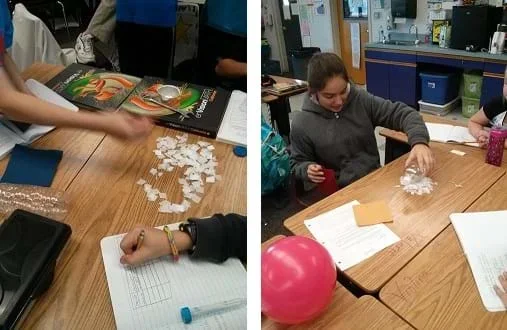 Copyright 2013 RESOURCE GK-12 Program, College of Engineering, University of California
With the Students
- Administer the five-question pre-activity electricity review to verify students' understanding of the pre-requisite concepts related to electricity, electrons, charge, conductors and insulators. Clarify any misconceptions or knowledge gaps.
- Present the Introduction/Motivation content to the class.
- Divide the class into groups of four to six students each. Hand out a worksheet to each student.
- State the engineering challenge: As if you are engineers, work together with your classmates to find a material that permits electricity to flow. This material will be used for making solar panels that conduct electricity.
- Direct students to answer the first two worksheet questions based on the introduction content and their understanding of the activity. Have a few students share their answers to make sure that everyone in the class understands that they are looking for a conductor. Make sure they also understand that a conductor is a material in which electrons flow easily.
- Before any testing begins, direct students to record on the worksheet (on page 1, first column of the table) their predictions about which materials they expect will move the tissue paper.
- Then prior to handing out supplies, demonstrate the activity by following these steps with a random item in the classroom, one that is not on the Materials List:
- Rub the material with the cloth/towel.
- Float the material over the tissue paper or confetti.
- If the tissue paper moves, the material still holds static electricity; thus, it is an insulator.
- Distribute the lab materials to each lab group.
- Have students rub each object thoroughly with a cloth or their hair to create a static charge on the material. Then have them hover the charged object over the tissue paper (or confetti) to see if the paper moves.
- For each experiment, record observations in the worksheet table. Did it move the tissue paper? Is it a good conductor?
- As a class, have students share their observations and postulate why some objects were better at moving the paper/confetti than others, based on their conductivities. Which material do you identify as the best one for moving current in a solar panel?
- Have students finish the remaining sections of the worksheet, writing a conclusion and answering the application questions, which requires some Internet research.
- atom
- The basic unit of all elements of matter.
- conductor
- A substance that allows the easy movement of electricity.
- current
- Something that flows, such as a stream of water, air or electrons, in a definite direction.
- electricity
- The presence or movement of electric charges. Electric charge occurs when a net difference in charged particles (such as proton or electrons) exists.
- electron
- A particle in an atom that has a negative charge, and acts as the primary carrier of electricity.
- insulator
- A substance that does not allow the easy movement of electricity.
- proton
- A particle located in the nucleus of an atom that has a positive electrical charge.
- static electricity
- A stationary electric charge buildup on an insulating material.
Pre-Activity Assessment
Concept Review: Have students complete the Electricity Review (PDF) to verify their understanding of pre-requisite topics learned in the associated lesson, including electricity, electrons, charge, conductors and insulators. Answers are provided in the Electricity Review Answer Key. (PDF)
Activity Embedded Assessment
Worksheet and Questions: To guide the activity, have students use and complete the Is It Shocking? Worksheet (PDF). In addition, ask groups the Investigating Questions during the activity.
Post-Activity Assessment
Discussion: As a class, review students' observations, results and answers from the Is It Shocking? Worksheet (PDF). Have students share their predictions and explain whether they were correct or not. If their results were not correct, discuss why they got those results and how they would modify their responses. Review students' completed worksheets to gauge their depth of comprehension.
Application of Principles: Ask students to respond to the following scenarios to test their ability to apply newfound knowledge. Conduct as an in-class exercise or take-home assignment.
- Based on your knowledge of static electricity from the activity, how would you test household items? Write how you would test the items and describe how you would know if an item was a conductor or insulator.
- What types of materials—insulators or conductors—would you use to create an incandescent light bulb? A) From what you learned from your experiment or from the patterns you noticed from the experiment, what would be the best material for the filament? (Answer: You would need a conductor because it must conduct electricity.) B) What about the base that screws into the lamp? (Answer: You would need a conductor because you want to conduct electricity to the filament.) C) What about the material that prevents the filament from moving? (Answer: For this job, you want an insulator, because you do not want electricity to flow away from the filament.)
Warn students to not apply static charge to electrical devices such as phones and computers.
The wooden pencil/dowel and plastic bottle are often hard to charge. Objects will charge particularly well if the weather is dry and windy.
"Electricity." Encyclopaedia Britannica. Encyclopaedia Britannica Online. Encyclopædia Britannica Inc. Accessed August 11, 2014. http://www.britannica.com/EBchecked/topic/182915/electricity
Headlam, Catherine (ed.). The Kingfisher Science Encyclopedia. New York, NY: Kingfisher Books, 1993.
"Internet." Encyclopedia Britannica. Encyclopedia Britannica Online. Encyclopedia Britannica Inc. Accessed August 11, 2014. http://www.britannica.com/EBchecked/topic/291494/Internet
Muir, Hazel. Science in Seconds: 200 Key Concepts Explained in an Instant. New York, NY: Quercus, 2013.
"Telegraph." Encyclopaedia Britannica. Encyclopaedia Britannica Online. Encyclopædia Britannica Inc. Accessed August 11, 2014. http://www.britannica.com/EBchecked/topic/585850/telegraph
"Telephone." Encyclopaedia Britannica. Encyclopaedia Britannica Online. Encyclopædia Britannica Inc. Accessed August 11, 2014. http://www.britannica.com/EBchecked/topic/585993/telephone
- What Is Electricity?
- Is It Shocking?
Contributors
Lauren Jabusch; Cristian Heredia; Andrew Palermo
Supporting Program
RESOURCE GK-12 Program, College of Engineering, University of California Davis
Acknowledgements
The contents of this digital library curriculum were developed by the Renewable Energy Systems Opportunity for Unified Research Collaboration and Education (RESOURCE) project in the College of Engineering under National Science Foundation GK-12 grant no. DGE 0948021. However, these contents do not necessarily represent the policies of the National Science Foundation, and you should not assume endorsement by the federal government.
Copyright
2014 by by Regents of the University of Colorado; original © 2013 University of California Davis