
What Is Electricity?
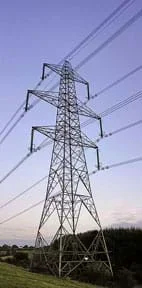 An electricity transmission tower.Copyright 2006 Yummifruitbat, Wikimedia Commons http://commons.wikimedia.org/wiki/File:Pylon_ds.jpg
Students are introduced to the concept of electricity by identifying it as an unseen, but pervasive and important presence in their lives. They are also introduced to the idea of engineers making, controlling and distributing electricity. The main concepts presented are the science of electricity and the careers that involve an understanding of electricity. Students first review the structure of atoms and then learn that electrons are the particles behind electrical current and the motivation for electron movement. They compare conductors and insulators based on their capabilities for electron flow. Then water and electrical systems are compared as an analogy to electrical current. They learn the differences between static and dynamic forms of electricity. A PowerPoint® presentation is included, with review question/answer slides, as well as assessment handouts to practice using electricity-related terms through storytelling and to research electricity-related and electrical engineering careers.
An understanding of electricity is important for general technological literacy. In addition, many engineering careers require a fundamental knowledge of electricity in order to invent and design technologies and products that we depend upon every day. Electricity is present everywhere in our modern lives and engineers who specialize in electricity (electrical engineers) make that possible.
After this lesson, students should be able to:
- Relate the flow of electrons to current.
- Correlate the flow of water with the flow of electricity in a system.
- Explain that static electricity is the buildup of a charge (either net positive or net negative) over a surface.
- Compare and contrast two forms of electricity—current and static.
- Name a few engineering careers that involve electricity.
- 5-PS1-1 Develop a model to describe that matter is made of particles too small to be seen.
Grade 5
Do you agree with this alignment? - MS-PS1-1 Develop models to describe the atomic composition of simple molecules and extended structures.
Grades 6-8
Do you agree with this alignment?
- 6-8.RS.9 Compare and contrast the information gained from experiments, simulations, video or multimedia sources with that gained from reading a text on the same topic.
Grades 6-8
Do you agree with this alignment?
- STEL-3G Explain how knowledge gained from other content areas affects the development of technological products and systems.
Grades 6-8
Do you agree with this alignment?
- 5-PS1-1 Develop a model to describe that matter is made of particles too small to be seen.
Grade 5
This resource focuses on the following Three Dimensional Learning aspects of NGSS:
Science & Engineering Practices- Develop a model to describe phenomena.Do you agree with this alignment?
Disciplinary Core Ideas- Matter of any type can be subdivided into particles that are too small to see, but even then the matter still exists and can be detected by other means. A model showing that gases are made from matter particles that are too small to see and are moving freely around in space can explain many observations, including the inflation and shape of a balloon and the effects of air on larger particles or objects.Do you agree with this alignment?
Crosscutting Concepts- Matter is transported into, out of, and within systems.Do you agree with this alignment?
Do you agree with this alignment? - Develop a model to describe phenomena.
- MS-PS1-1 Develop models to describe the atomic composition of simple molecules and extended structures.
Grades 6-8
This resource focuses on the following Three Dimensional Learning aspects of NGSS:
Science & Engineering Practices- Develop a model to predict and/or describe phenomena.Do you agree with this alignment?
Disciplinary Core Ideas- Substances are made from different types of atoms, which combine with one another in various ways. Atoms form molecules that range in size from two to thousands of atoms.Do you agree with this alignment?
- Solids may be formed from molecules, or they may be extended structures with repeating subunitsDo you agree with this alignment?
Crosscutting Concepts- Time, space, and energy phenomena can be observed at various scales using models to study systems that are too large or too small.Do you agree with this alignment?
Do you agree with this alignment? - Develop a model to predict and/or describe phenomena.
- MS-PS2-3 Ask questions about data to determine the factors that affect the strength of electric and magnetic forces.
Grade 6
Do you agree with this alignment?
- What Is Electricity? Presentation (pptx)
- What Is Electricity? Presentation (pdf)
- Particle Pen Pals Assignment (docx)
- Particle Pen Pals Assignment (pdf)
- Particle Pen Pals Example Answer (docx)
- Particle Pen Pals Example Answer (pdf)
- Electrical Careers Research Project Handout (docx)
- Electrical Careers Research Project Handout (pdf)
Students should be familiar with different forms of energy, including exposure to the term "electrical energy," the basics of matter, and the structure of an atom.
Prepare to show students the 19-slide What Is Electricity? Presentation (PPTX), a PowerPoint® file, guided by the slide notes below. Note the critical thinking questions/answers included in the notes for slides 8, 10 and 12. For two simple classroom demos, have handy water and containers, and some inflated balloons.
Electricity is the flow or presence of charged particles (usually electrons). Remind students of the two types of charged particles in an atom (protons and electrons). Expect students to already have an appreciation for the importance of electricity, which can be cultivated by discussing as a class or creatively writing about what a day without electricity might be like (as provided on slides 1-2).
(Slide 1) While students are looking at the images of an electrical transmission tower and a wall of televisions in a store, ask them: How would your life be different with no electricity?
(Slide 2) Prompt: A power outage has just happened in your city. What actions from your daily life would not be possible without electricity? Use this hypothetical scenario to start a class discussion or creative writing exercise. For example, brainstorm as a class and then give students 15-20 minutes to write on their own.
Why do we bother learning about electricity? The point of the hooks in the first two slides is to emphasize that we constantly use electricity and that our lives would be dramatically different if we did not have access to electricity. Thus, understanding electricity is important in our daily lives.
(Slide 3) Topic preview: electricity, conductors, insulators, current, static charge.
(Slide 4) What are atoms? Expect the structure of an atom to be a review for students. If not, spend more time on this topic. Atoms are the basic unit of all elements of matter. They are made of electrons, protons and neutrons. The center nucleus contains the protons and neutrons.
(Slide 5) What are electrons? Electric charge is the physical property of matter that causes it to experience a force when near other electrically charged matter. Two types of electric charges exist—positive and negative. Positively charged substances are repelled from other positively charged substances, but attracted to negatively charged substances; negatively charged substances are repelled from negatively charged substances and attracted to positively charged substances. An object is negatively charged if it has an excess of electrons; otherwise, it is positively charged or uncharged (neutral).
(Slide 6) Students may not have an understanding of flow. As necessary, clarify with a simple demo: Have students pour water from one container to another to provide a tangible understanding of the concept of flow. The key point is that flow is movement! Technically, electricity is the flow of any charged particles. The mnemonic device of "ELECTRicity and ELECTRons" may help students remember.
(Slide 7) Conductors are materials that are good at conducting electricity! In conductors, electrons are free to move around and flow easily. This is not true for insulators, in which the electrons are more tightly bound to the nuclei (which we'll discuss next). When current is applied, electrons move in the same direction.
In preparation for review questions, ask students to think of other metals they know about. You may want to discuss the properties of metals (bendable/ductile, metallic in color) to review students' knowledge of materials.
(Slide 8) Metals, such as copper, are conductors. Copper is an excellent conductor of electricity.
Critical thinking question: How would we test whether something is a good conductor? Answer: By connecting a wire of the material we want to test to a low-voltage battery with a light bulb connected to it. (It may be helpful to draw a sketch of this setup on the classroom board.) If the tested wire is a good conductor, the bulb lights up.
(Slide 9) In insulators, the electrons are more tightly bound to the nuclei (plural for nucleus) of the atoms. So in these materials, the electrons do not flow easily. What are some everyday examples? For example, most of our homes have fiberglass insulation that prevents inside heat from FLOWING outside through the walls of our houses, and the foam cozy that keeps soda from warming in the hot summer air temperatures.
Think about safety measures for electricians. Where would you want to put insulators? (Answer: Anywhere around conductors that you might touch, such as wires that carry electricity.)
Are the words "conductor" and "insulator" antonyms or synonyms? (Answer: Antonyms, or opposites.)
Are insulators such as glass, wood and rubber considered metals or nonmetals? Think of the periodic table and the primary elemental components of these materials (silicon for glass, carbon for wood, and carbon and oxygen for rubber). (Answer: Nonmetals.)
(Slide 10) Rubber is an example of a good insulator. Critical thinking question: We know that insulators and conductors are opposites. Do you think rubber is a good or poor conductor? Why? (Answer: Since rubber is a good insulator, it must be a poor conductor because they are opposite properties.) When students answer correctly, click to reveal the "poor conductor" bullet.
(Slide 11) Is the photograph labeled correctly with which is the conductor and which is the insulator? (Answer: Yes, this picture is labeled correctly. Copper is a metal; most metals make good conductors. Current does not flow easily through rubber, which makes it a good insulator to wrap around the copper wire.)
(Slide 12) Next we'll discuss current, which is the flow of electricity/electrons. We often use water to understand electrical systems because of their similarities. For example, water can build up pressures, like in a dam, and flow like in a river. Electricity acts the same way.
Critical thinking question: What are some examples of how we use analogies to explain more complex scientific phenomena? Examples: Humans use stories like the Greek myths to explain seasons and sunrise/sunset. We often think of materials and animals as having human "personalities" and behaviors, like saying that conductors "direct" and move electrons.
(Slide 13) In water systems, current is the flow of water. In electrical systems, current is the flow of electrons. Refer to the drawings on this slide as you relate back to the water flow demo.
(Slide 14) Let's consider static charge. How can it be explained in our water system analogy? Dammed water collects (like in a dam), but cannot flow. Static charge, or static electricity, collects charge, but cannot flow. It may help to think of the mnemonic device of: "STATIc electricity is STATIonary"—it does not move. A situation when electrons are unable to move between atoms. Thus, charge collects in a similar way to how water collects behind a dam.
(Slide 15) While showing this slide, direct students to rub inflated balloons on the hair on their heads. Ask them: What makes your hair stand up? Objects may gain or lose electrons. Rubbing the balloon on hair causes more electrons to go onto the balloon from the hair. The hair loses electrons, thus becoming positively charged (net positive charge). The balloon becomes negatively charged (net negative charge). What does the term "net" mean? (Answer: "Net" means "total.")
(Slide16) Let's go through some review questions and answers. (Note: Click to reveal the answers.) Do you think electrical current flows more easily in conductors or insulators? (Answer: Electrical current flows more easily in conductors because electrons move better in conductors. Static electricity builds up more easily in insulators because electrons cannot move well in insulators.)
(Slide 17) What do we call the flow of charged particles? (Answer: Electricity.) Does it matter if the particles are positive or negative? (Answer: No, but typically electricity is the flow of electrons—negative charge.)
(Slide 18) We have shown that copper is a conductor. Name three more conductors. (Answers: Gold, silver and aluminum.) Where would an electrician use an insulator? What type of material would it be? Why would an electrician use an insulator? (Answer: Electricians use insulator material around electrical wires and the handles of tools and other equipment. Often, electricians use rubber as the material. Insulators protect electricians from electrical shock because current does not travel very well through insulators.)
(Slide 19) If you wanted to design an electrical system that stored static electricity, would you use a conductor or an insulator? Why? (Answer: To build a static electricity storage system, you would want to use an insulator, because insulators reduce electron flow.)
(If students have had exposure to analogies, which is part of the sixth-grade curriculum in many states, use the analogy question. If not, students may need assistance on how analogies work.) Finish the analogy: River IS TO water molecules AS wire is to ______. (Answer: Electrons.)
(Write the following sentences on the classroom board, or ask a few students to do so.)
- Astrid turned on the computer.
- When someone shuffles their feet on the carpet, their hair gets crazy and stands up.
- I need to charge my cell phone battery.
- Lightning struck during the last storm.
- The engineer wired the circuit board.
- A lot of power is made in the desert using solar panels.
- After someone slides down the slide, they can shock you.
What do all these sentences have in common? (Give students some time to consider; listen to their ideas.) All these sentences involve electricity.
We use electricity every day, but you may not know what it is, how it works and how we can control it. So that you understand electricity, this lesson will build on the science you already know, such as energy, the parts of an atom and types of materials.
How many of these sentences involved an engineer or engineered technology? (See if students can figure it out; answer: 1, 3, 5 and 6.)
Everyone, take a moment to write a sentence that relates engineering and electricity? (Give students some time; then ask a few students to share their answers. As desired, provide additional information on the topic, such as: engineers make, control and give us ways to use electricity.)
Many fields of engineering require that people have a good understanding of electricity. For example, chemical engineers study the reactions responsible for producing charged particles to create electricity. Material engineers make many substances that serve as conductors and insulators. Electrical engineers are able to control electricity by changing the current or resistivity. This lesson covers the basics of electricity and materials so when we conduct the associated activity Is It Shocking? you can act as if you are engineers to select the best materials for retaining and releasing electricity.
After completing the associated static electricity activity, have students recap the activity using scientific terms to explain what happened. Then re-emphasize the water analogy to cement the connection. Ask a few additional real-world application questions:
- Describe how engineers might control electricity in a television: What if they wanted more electricity? (Answer: Increase the current.)
- What if they wanted to protect themselves and you from electrocution? (Answer: Use an insulator.)
- atom
- The basic unit of all elements of matter.
- conductor
- A substance that allows the easy movement of electricity.
- current
- Something that flows, such as a stream of water, air or electrons, in a definite direction.
- electricity
- The presence or movement of electric charges. Electric charge occurs when a net difference in charged particles (such as proton or electrons) exists.
- electron
- A particle in an atom that has a negative charge, and acts as the primary carrier of electricity.
- insulator
- A substance that does not allow the easy movement of electricity.
- proton
- A particle located in the nucleus of an atom that has a positive electrical charge.
- static electricity
- A stationary electric charge buildup on an insulating material.
Pre-Lesson Assessment
Discussion: As presented in the Introduction/Motivation section, guide students to realize that the five sentences on the classroom board all involve electricity. Further, have students pick out which of the sentences involve engineers and electricity. Then, have students write their own scenarios involving electricity and engineers. It may be helpful to prompt that engineers think of, design, make and control ways to use electricity.
Post-Introduction Assessment
Critical Thinking Questions: As part of the What Is Electricity? Presentation (PPTX), critical thinking questions and answers are included in the notes for slides 8, 10 and 12. They are also suitable as classroom board questions or handwritten quiz questions.
Review Questions: Test students' understanding of electricity basics by asking them the seven review questions at the end of the What Is Electricity? Presentation (PPTX) (slides 16-19). Click to reveal the answer after each question. Alternatively, similar questions are provided in the pre-activity Electricity Review Worksheet attachment in the associated activity.
Lesson Summary Assessment
Tiny Pen Pals: To test for understanding of electrical terms, give students the Particle Pen Pals Assignment (PDF), which asks them to use terms learned in the lesson in context to describe electricity through storytelling: Pretend you are an electron and you are writing a letter to your favorite proton telling him/her that you are moving away. In this creative writing exercise, students are asked to use at least four of the following terms provided in a word bank on the handout: electricity, atom, static electricity, proton, neutron, electron, conductor, insulator and current.
Assign students to investigate and research different professions in electricity and/or involving knowledge of electrical systems, as outlined in the Electrical Careers Research Project Handout (PDF). Have students present their summary paragraphs to the rest of the class.
"Electricity." Encyclopaedia Britannica. Encyclopaedia Britannica Online. Encyclopædia Britannica Inc. Accessed August 11, 2014. http://www.britannica.com/EBchecked/topic/182915/electricity
Headlam, Catherine (ed.). The Kingfisher Science Encyclopedia. New York, NY: Kingfisher Books, 1993.
Muir, Hazel. Science in Seconds:200 Key Concepts Explained in an Instant. New York, NY: Quercus, 2013.
- What Is Electricity?
Contributors
Lauren Jabusch; Cristian Heredia; Andrew Palermo
Supporting Program
RESOURCE GK-12 Program, College of Engineering, University of California Davis
Acknowledgements
The contents of this digital library curriculum were developed by the Renewable Energy Systems Opportunity for Unified Research Collaboration and Education (RESOURCE) project in the College of Engineering under National Science Foundation GK-12 grant no. DGE 0948021. However, these contents do not necessarily represent the policies of the National Science Foundation, and you should not assume endorsement by the federal government.
Copyright
2014 by by Regents of the University of Colorado; original © 2013 University of California Davis