
Keep It Hot!
Student teams design insulated beverage bottles with the challenge to test them to determine which materials (and material thicknesses) work best at insulating hot water to keep it warm for as long as possible. Students test and compare their designs in still air and under a stream of moving air from a house fan.
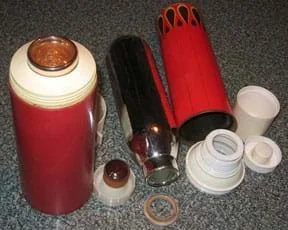 The components of an insulated thermos bottle.Copyright 2006 Julo, Wikimedia Commons http://commons.wikimedia.org/wiki/File:Termosy-elementy.jpg
Development of insulated vessels is important in engineering, especially in the fields of mechanical, chemical and biological engineering. What students (and engineers) learn about the design and construction of insulated beverage containers can be applied to the design of insulation for houses, clothing and appliances such as refrigerators and ovens.
After this activity, students should be able to:
- Identify materials that are good or poor thermal insulators.
- List modes of heat transfer and identify where conduction and convection occur in an insulated container.
- Describe the effect of insulation thickness on heat transfer.
- 6.NS.3 Fluently add, subtract, multiply, and divide multi-digit decimals using the standard algorithm for each operation.
Grade 6
Do you agree with this alignment?
- MS-ETS1-3 Analyze data from tests to determine similarities and differences among several design solutions to identify the best characteristics of each that can be combined into a new solution to better meet the criteria for success.
Grades 6-8
Do you agree with this alignment? - MS-ETS1-4 Develop a model to generate data for iterative testing and modification of a proposed object, tool, or process such that an optimal design can be achieved.
Grades 6-8
Do you agree with this alignment? - MS-PS3-3 Apply scientific principles to design, construct, and test a device that either minimizes or maximizes thermal energy transfer.
Grades 6-8
Do you agree with this alignment?
- CCSS.Math.Content.6.NS.B.3 Fluently add, subtract, multiply, and divide multi-digit decimals using the standard algorithm for each operation.
Grade 6
Do you agree with this alignment?
- STEL-7I Apply the technology and engineering design process.
Grades 3-5
Do you agree with this alignment? - STEL-7J Evaluate designs based on criteria, constraints, and standards.
Grades 3-5
Do you agree with this alignment? - STEL-7S Create solutions to problems by identifying and applying human factors in design.
Grades 6-8
Do you agree with this alignment?
- MS-ETS1-3 Analyze data from tests to determine similarities and differences among several design solutions to identify the best characteristics of each that can be combined into a new solution to better meet the criteria for success.
Grades 6-8
This resource focuses on the following Three Dimensional Learning aspects of NGSS:
Science & Engineering Practices- Analyze and interpret data to determine similarities and differences in findings.Do you agree with this alignment?
Disciplinary Core Ideas- There are systematic processes for evaluating solutions with respect to how well they meet the criteria and constraints of a problem.Do you agree with this alignment?
- Sometimes parts of different solutions can be combined to create a solution that is better than any of its predecessors.Do you agree with this alignment?
- Although one design may not perform the best across all tests, identifying the characteristics of the design that performed the best in each test can provide useful information for the redesign process—that is, some of the characteristics may be incorporated into the new design.Do you agree with this alignment?
Do you agree with this alignment? - Analyze and interpret data to determine similarities and differences in findings.
- MS-ETS1-4 Develop a model to generate data for iterative testing and modification of a proposed object, tool, or process such that an optimal design can be achieved.
Grades 6-8
This resource focuses on the following Three Dimensional Learning aspects of NGSS:
Science & Engineering Practices- Develop a model to generate data to test ideas about designed systems, including those representing inputs and outputs.Do you agree with this alignment?
Disciplinary Core Ideas- Models of all kinds are important for testing solutions.Do you agree with this alignment?
- The iterative process of testing the most promising solutions and modifying what is proposed on the basis of the test results leads to greater refinement and ultimately to an optimal solution.Do you agree with this alignment?
Do you agree with this alignment? - Develop a model to generate data to test ideas about designed systems, including those representing inputs and outputs.
- MS-PS3-3 Apply scientific principles to design, construct, and test a device that either minimizes or maximizes thermal energy transfer.
Grades 6-8
This resource focuses on the following Three Dimensional Learning aspects of NGSS:
Science & Engineering Practices- Apply scientific ideas or principles to design, construct, and test a design of an object, tool, process or system.Do you agree with this alignment?
Disciplinary Core Ideas- The more precisely a design task's criteria and constraints can be defined, the more likely it is that the designed solution will be successful. Specification of constraints includes consideration of scientific principles and other relevant knowledge that is likely to limit possible solutions.Do you agree with this alignment?
- A solution needs to be tested, and then modified on the basis of the test results in order to improve it. There are systematic processes for evaluating solutions with respect to how well they meet criteria and constraints of a problem.Do you agree with this alignment?
- Temperature is a measure of the average kinetic energy of particles of matter. The relationship between the temperature and the total energy of a system depends on the types, states, and amounts of matter present.Do you agree with this alignment?
- Energy is spontaneously transferred out of hotter regions or objects and into colder ones.Do you agree with this alignment?
Crosscutting Concepts- The transfer of energy can be tracked as energy flows through a designed or natural system.Do you agree with this alignment?
Do you agree with this alignment? - Apply scientific ideas or principles to design, construct, and test a design of an object, tool, process or system.
Each group needs:
- 4 beverage bottles, 12 oz. (355 ml) glass or rigid plastic with tight fitting lids; see the Troubleshooting Tips section for an alternative setup using beakers and Styrofoam plates
- aluminum foil, ~12-in x 12-in piece (30-cm x 30-cm)
- bubble-wrap, ~12-in x 12-in piece
- construction paper or tag board/card stock, ~8.5-in x 11-in sheet (22-cm x 28-cm)
- felt, ~8.5-in x 11-in piece
- scissors
- clear tape
- other potential insulation materials that students bring from home that they wish to test
- thermometers; one per bottle is ideal (share among the groups if not enough)
- (optional) graph paper, one sheet per student (if students graph their data; see the Activity Extensions section)
- Keep It Hot! Handout (PDF), one per student
- Keep It Hot! Post-Quiz (PDF), one per student
To share with the entire class:
- house fan
- hot water in a container with a spout, either from the tap, microwaved or a mix of boiling water and cool tap water
Students need a good understanding of thermal energy, heat and heat transfer, including the concepts of conduction, convection and insulation, as provided by the What Is Heat? associated lesson. Students also should know how to read thermometers and record data.
Who likes a cold drink on a hot day? How about hot soup on a cold day? How do you keep a cold drink cold and a hot drink hot? Imagine a picnic in the park on a hot summer day. Where do you keep your cold drinks? (Expect students to name ice chests and coolers.) What if you want to bring hot soup to school on a cold day? What would you use to keep it hot? (Expect students to suggest using a thermos bottle.) Over the years, engineers have spent a lot of time trying to come up with creative ways to keep some things hot and other things cool. Today, we are going to act as if we are engineers and explore ways to keep something hot.
We learned in our heat lesson that thermal energy is transferred in three different ways. Can you name all three? (Listen to student answers and make sure they name conduction, convection and radiation.)
Who can remember the difference between conduction and convection? (Give students time to recall the differences and/or review their notes.)
What is conduction? (Call on students until a clear definition of is provided: heat transfer within or between solid objects.) Can anyone give me an example of conduction?
What is convection? (Call on students until a clear definition of is provided: heat transfer into or out of fluids.) Can anyone give an example of convection?
What do we call materials that slow down heat transfer? (Call on students someone says: insulators.)
Today, we are going to see conduction and convection in action and see what sorts of materials make good insulators so that we can keep something hot for as long as possible. In engineering teams, you will design and construct insulated bottles to hold hot drinks. We will put hot water in the bottles and then take temperature measurements to see which design keeps the water hottest over time.
Timing & Schedule
Plan on this activity taking about 200 minutes total over four days. Suggested schedule:
- Day 1: Preparation and design (30 minutes)
- Day 2: Build and test without a fan (60 minutes)
- Day 3: Test with a fan (50 minutes)
- Day 4: Results/discussion, writing, assessment (60 minutes)
The procedures below include a pacing guide; timing is given as cumulative elapsed time for each day. For example, "minutes 5-10" means from the fifth to the tenth minute of the activity.
Before the Activity
- Invite students to bring in materials from home to test as insulators for their bottles.
- Gather materials and make copies of the Keep It Hot! Handout (PDF) and Keep It Hot! Post-Quiz (PDF), one each per student.
- Prepare a pitcher(s) of hot water. Keep in mind that the higher the initial temperature of the water in the bottles, the more noticeable the temperature drop will be; however, severe burns may occur if students come in contact, even briefly, with water of greater than 140 ˚F (~60 ˚C). A 1:1 mixture of boiling water with cool tap water yields approximately this temperature.
With the Students
Day 1: Engineering Challenge Preparation and Design
- (minutes 0-5) Have students complete their handouts up to the activity description, which includes the Introduction portion on the first page and the questions on the second page.
- (minutes 5-10) Have students read through (aloud) the engineering challenge activity overview, the design description, and the materials list on the third page of the handout. Ensure that students understand that during Day 2 and Day 3 of the activity, each group is responsible to do the following:
- Prepare 4 bottles: 1 control bottle with no insulation and 3 other bottles, each with different types of insulation attached.
- Test designs for two 10-minute periods (this is flexible). In the first period, the bottles do not experience forced air movement, so any convection that occurs is natural convection. In the second period, place the bottles under airflow provided by a fan in order to see the effect of forced air on heat transfer.
- (minutes 10-25) Have students work in teams to decide what materials they want to test and the thickness of those materials to be applied. To engage thinking on this topic, have students address the two questions at the bottom of page three of the handout. Encourage students to brainstorm and research on what might be good or bad insulation materials.
- (minutes 25-30) Have students read through the procedure (aloud) for what they will be doing the next day. Let them know that they are responsible for bringing in any additional materials to test and that the activity will start promptly the next time they assemble.
Day 2: Build and Test 1 - Cooling with No Fan
- (minutes 0-5) Briefly review the activity procedure on the handout and check in with groups who brought materials to ensure that they are suitable for the task at hand. (Can the material be applied to a bottle; if so, how?)
- (minutes 5-7) Pass out the materials (or enlist students to do so). It is best if groups that brought test materials forego using the teacher-supplied insulation test materials because trying to test more than four bottles per group is usually too much to manage.
- (minutes 7-20) In this design phase, groups prepare their insulated bottles by applying a different insulating material to each bottle. This may include experimentation with applying more than one layer of material. Have students bring completed bottles to a central location (such as a back counter). Have them place a thermometer in one of their bottles.
- (minutes 20-25) As groups bring to the back counter their bottles, fill them with hot water and have one student read the thermometer. At this point, all bottle contents are the same temperature so it is only necessary to measure one. Have students record this value for all bottles in the handout's Day 2 data collection table. Immediately after measuring the temperature, cap all bottles tightly. Let them sit undisturbed for ~10 minutes (it need not be exact for all groups because all of their bottles will receive the same treatment).
- (minutes 25-35) During the 10-minute wait, engage the groups in a vocabulary review or quiz about the different modes of heat transfer. Help students bridge the comprehension gap of what they learned in prior lesson(s) about heat, and the activity at hand.
- (minutes 35-60) Have students read and record the water temperatures in their bottles. This can be done efficiently, by having group 1 go to the back counter and record the temperature readings off the four thermometers in its four bottles that the instructor placed in the bottles. Then have group 1 move the four thermometers to the bottles of group 2. Then group 2 goes back and records its values. Group 2 moves the thermometers to group 3's bottles and so on. Have groups calculate the temperature differences for each bottle and answer the discussion question on page four of the handout.
- Have groups empty their bottles and set them aside for Day 3.
Day 3: Test 2 - Cooling with Fan
- (minutes 0-5) Briefly review the activity procedure and the goal for today's testing. Encourage students to make predictions about how the fan will affect the cooling of the bottles.
- (minutes 5-10) Direct the groups to reposition their bottles in front of a household fan. Re-fill the bottles with hot water and take the initial temperature readings for students (to save time). Have students record this temperature as their initial temperatures in the handout's "fan on" Day 3 data collection table on page five.
- (minutes 10-20) Turn on the fan and let the bottles sit in the air stream for 10 minutes.
- (minutes 20-45) Using the same method as before, have groups read the temperatures in their bottles, recording results in the handout's Day 3 table. Have groups calculate the temperature differences for each bottle and attempt the discussion questions, as time permits.
- (minutes 45-50) Wrap up by explaining that next time, the focus will be on answering the discussion questions.
Day 4: Discussion and Conclusion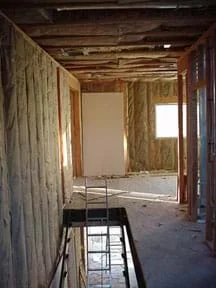 Insulation fills the exterior wall and ceiling cavities of this under-construction house as a way to slow the rate of heat transfer.Copyright 2003 Denise W. Carlson. Used with permission.
- (minutes 0-2) Explain the plan for today. We will complete the handout discussion questions and then take a short quiz on heat transfer.
- (minutes 2-10) Expect many students to have already have answered the first discussion question. Take a few minutes to have a few students share their results to develop a class consensus on what materials worked well as insulators. Write these on the board. Did thickness matter? For groups with small temperature changes, how many layers of material did they apply?
- (minutes 10-45) Have students answer the remaining discussion questions, pausing between them to discuss answers as a class and gauge student understanding of key concepts. Additional discussion suggestions:
- Reinforce the connection between heat and real world problems by asking students to think of other devices or situations that might involve heat flow and the need to either increase or decrease heat flow. (Such as wearing winter jacket.)
- One example that involves the control of heat flow is house construction and insulation. A home with poor thermal insulation requires the use of additional energy to heat in the winter and cool in the summer, increasing its environmental impact. Insulation beyond a certain thickness might not be warranted if the added construction costs are not offset by energy savings. Some insulation materials might be toxic (such as asbestos) or environmentally hazardous (like foam with CFCs that can destroy the ozone layer). Based on the results of each group, what insulation might the class use to insulate a new house?
- (minutes 45-60) Administer the post-quiz.
- conduction
- Heat transfer within or between solid objects.
- convection
- Heat transfer into or out of fluids.
- heat
- Thermal energy that flows due to a difference in temperature. Heat flows from hot to cold.
- heat transfer
- A method by which heat flows (conduction, convection, radiation).
- insulation
- A material that slows down heat transfer.
- radiation
- Heat transfer due to packets of energy called photons that can travel through many substances, even empty space.
Pre-Activity Assessment
Heat Review and Activity Intro: On Day 1, have students answer the questions on the first two pages of the Keep It Hot! Handout (PDF). Glance at their answers to make sure their base knowledge of thermal energy, heat and heat transfer is adequate and correct.
Activity Embedded Assessment
Handout: On Days 2-4 have students complete the remainder of the handout, which includes answering questions about materials, recording data and answering the Results and Discussion questions.
Discussion: During the activity, students answer the questions provided on the handout. At key times, such as during the design process and after testing designs (see below), lead class discussions to review their answers and explore their understanding of the concepts. Answers are provided in the Keep It Hot! Post-Quiz Answer Key (PDF).
Prior to building (during the design process on Day 1):
- The goal is to prevent heat from leaving your bottle. What types of materials do you think would be good at this? List them below.
- Does the thickness of your insulation matter? Explain what you think would happen if you double the amount of insulation used on each bottle.
After testing designs (on Day 4):
- What material kept the water hottest? Is this what you expected?
- Did heat transfer occur faster or slower when the fan was turned on? (Expect that heat transfer occurred faster, as evidenced by the water temperature dropping more quickly with the fan turned on, especially in the bottle without insulation.)
- What kinds of heat transfer occurred when the fan was on? Explain where each type was occurring. (Conduction occurred through the wall of the bottle and through the insulation; forced convection occurred in the air surrounding the bottle.)
- What kinds of heat transfer occurred when the fan was off? (Conduction, as well as convection in the air of the surrounding bottle.)
- Suggest a modification you would make to your best insulation to reduce heat transfer even more. Would this change the cost of manufacturing your bottle?
Post-Activity Assessment
Post-Quiz: At activity end, administer the four-question multiple-choice Keep It Hot! Post-Quiz (PDF). Review students' answers to gauge their comprehension of the concepts.
- To prevent burns, do not overheat the water, especially if microwaving. Check the water temperature!
Beakers may be used instead of closed topped bottles. In this case, hold the thermometer in the heated water by pushing them each through a Styrofoam plate placed on top of the beaker.
The activity can be modified to reduce the number of days required. Rather than having two separate testing days—with and without a fan—have half of the groups test with a fan and the rest of the groups test without a fan during one testing day. This approach also helps the two sides of the class to compare their results, facilitating the communication of their findings.
If beakers are used instead of closed topped bottles (as mentioned in the Troubleshooting Tips section), have students record the water temperature every 30 seconds during the 10-minute testing time. Once students have completed the two 10-minute testing sessions, have them graph the data for each tested beaker, water temperature vs. time. Make sure students clearly label the axes and create descriptive titles. It works well if students plot data for all the tested beakers on one graph, using different color markers or pencils to indicate data for each beaker and creating a color key. This process provides students with a better visual representation of heat flow.
After observing the results from initial testing, have students make further iterations to modify and test their bottle designs in order to implement improvements.
Have students apply their understanding of heat transfer to design and build ice chests or other insulated containers and test their effectiveness at keeping ice from melting when left overnight or for several hours.
- What Is Heat?
- Keep It Hot!
Contributors
Travis Smith; Brendan Higgins; Nadia Richards; Duff Harrold
Supporting Program
RESOURCE GK-12 Program, College of Engineering, University of California Davis
Acknowledgements
The contents of this digital library curriculum were developed by the Renewable Energy Systems Opportunity for Unified Research Collaboration and Education (RESOURCE) project in the College of Engineering under National Science Foundation GK-12 grant no. DGE 0948021. However, these contents do not necessarily represent the policies of the National Science Foundation, and you should not assume endorsement by the federal government.
Copyright
2014 by Regents of the University of Colorado; original © 2013 University of California Davis