
What Is Heat?
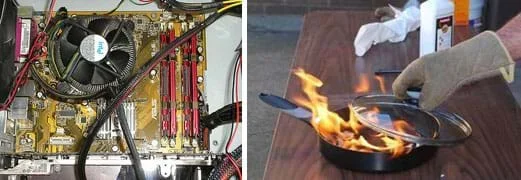 The fan inside this CPU is one example of why heat is so important to engineering and the design of engineered systems, as well as our everyday lives.Copyright (left) 2008 atteSmythe, Flickr (CC); (right) 2010 Portland Fire and Rescue, City of Portland, OR http://www.flickr.com/photos/attesmythe/2926574819/ http://www.portlandoregon.gov/fire/article/310471?archive=2010-07
Students learn about the definition of heat as a form of energy and how it exists in everyday life. They learn about the three types of heat transfer—conduction, convection and radiation—as well as the connection between heat and insulation. Their learning is aided by teacher-led class demonstrations on thermal energy and conduction. A PowerPoint® presentation and quiz are provided. This prepares students for the associated activity in which they experiment with and measure what they learned in the lesson by designing and testing insulated bottles.
Understanding heat transfer is essential knowledge for the engineering of mechanical, chemical and biological systems. Design of internal combustion engines, air conditioning and heating systems, chemical and biological reactors and even clothing technology requires an understanding of heat transfer. Design of insulating materials for homes, buildings and even beverage containers also requires an understanding of heat transfer.
After this lesson, students should be able to:
- Explain that heat is the flow of energy from hot materials to cold materials.
- Describe that molecules in a material begin to vibrate (or move) more quickly when the material is heated.
- Identify conduction as heat transfer within and between solids.
- Identify convection as heat transfer involving gases or liquids.
- Identify radiation as heat transfer carried by little packets of energy that can travel through almost any material—even empty space.
- List examples of each type of heat transfer.
- MS-PS1-4 Develop a model that predicts and describes changes in particle motion, temperature, and state of a pure substance when thermal energy is added or removed.
Grades 6-8
Do you agree with this alignment?
- STEL-3G Explain how knowledge gained from other content areas affects the development of technological products and systems.
Grades 6-8
Do you agree with this alignment?
- MS-PS3-5 Construct, use, and present arguments to support the claim that when the kinetic energy of an object changes, energy is transferred to or from the object.
Grades 6-8
This resource focuses on the following Three Dimensional Learning aspects of NGSS:
Science & Engineering Practices- Construct, use, and present oral and written arguments supported by empirical evidence and scientific reasoning to support or refute an explanation or a model for a phenomenon.Do you agree with this alignment?
- Science knowledge is based upon logical and conceptual connections between evidence and explanations.Do you agree with this alignment?
Disciplinary Core Ideas- When the motion energy of an object changes, there is inevitably some other change in energy at the same time.Do you agree with this alignment?
Crosscutting Concepts- Energy may take different forms (e.g. energy in fields, thermal energy, energy of motion).Do you agree with this alignment?
Do you agree with this alignment? - Construct, use, and present oral and written arguments supported by empirical evidence and scientific reasoning to support or refute an explanation or a model for a phenomenon.
A familiarity with basic concepts about energy and its different forms, as well as a basic understanding of temperature.
Demonstration Materials: A few simple and powerful demonstrations are suggested for this lesson. A thermal energy demonstration requires two transparent containers that are capable of holding hot water, plus hot water, ice water and a few drops of food coloring. The conduction demonstration requires one candle, matches three small nails/thumb tacks, an oven mitt, and a hacksaw blade or metal rod (not stainless steel). An additional quick conduction demonstration requires five to 10 inflated balloons. Demo preparation and presentation instructions are provided on the slides and notes of slides 4 and 14.
The Additional Background Material section (below) provides a very detailed discussion about heat. While this material is generally above the sixth-grade level, it presents key background information for the teacher so they are able to answer advanced student questions.
Use the 21-slide What Is Heat? Presentation (PPTX), a Microsoft PowerPoint® file, to directly deliver the lesson content, using the guidance provided below; alternatively, use the presentation to inform other teaching methods. Note that each slide includes background and discussion information in the notes sections that is not provided below and is unavailable in the PDF version. In addition, the slides are animated, so clicking brings up the next text or component on the slide.
(Slide 1) What is heat? Do the images on this slide give you any hints? Heat is energy that has something to do with temperature and is an important concept used by engineers to design many of the products we use every day.
(Slide 2) Open a discussion about what will happen to the temperature of the beverage in each case (hot chocolate, iced tea) when left unattended for 30 minutes. Why do some things get warmer while other things get colder when they are left out? Given time, both eventually become room temperature. The hot drink releases energy; the cold drink absorbs energy.
(Slide 3) Remind students about energy and some of its different forms. Expect them to recall that moving objects have kinetic energy. Show the animation to help visualize the relationship between temperature and kinetic energy: https://commons.wikimedia.org/wiki/File:Translational_motion.gif.

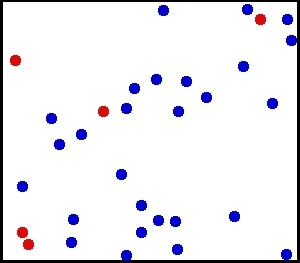 Motion of gas moleculesCopyright 1995 Greg L.,Creative Commons Attribution-Share Alike 3.0 Unported https://commons.wikimedia.org/wiki/File:Translational_motion.gif
(Slide 4) Conduct a class demonstration to show temperature and kinetic energy using food coloring: Prepare separate transparent cups of hot and cold water (ice water is best; remove the ice for the demo). Into each cup, place a drop of food coloring and direct students to observe what happens. Expect them to notice that the food coloring in the hot water spreads out more quickly than that in the cold water. It is helpful to repeat this experiment after explaining the mechanism. Alternative: If conducting this demo is not possible, show a 2:52-minute video, "Moving Water Molecules" (link also provided in the Additional Multimedia Support section).
(Slide 5) Talk about what students observed in the demo. The faster jiggling hot water dispersed the dye more quickly. Then show the animation of Brownian Motion at https://commons.wikimedia.org/wiki/File:Brownian_motion_large.gif. We can think of the small dots as water molecules, and the yellow dot as a much larger dye molecule being bounced around by the water molecules' thermal jiggling. This was discovered by Scottish botanist Robert Brown, who used a microscope to look at pollen samples in water. He could not see the water molecules, but noticed that pollen in hotter water jiggled around more than in colder water. The phenomenon was named in his honor: Brownian Motion.

(Slide 6) Make the point that thermal energy is in everything—even if it is something we consider cold.
(Slide 7) Explain the definition of heat as flowing thermal energy and clarify the direction of heat flow—from the hotter object to the cooler object. Energy transfers always occur from higher to lower states of energy.
(Slides 8-13) Use the provided images of a hot cup of coffee, an ice cream cone and a tea kettle on a burner as examples to talk about the direction of heat flow. Have students draw arrows to show the direction of heat flow; circulate around the room to verify their understanding. Make sure students realize that 1) heat is a form of energy that is transferred by a difference in temperature; a difference in temperature is needed for heat to flow, 2) heat always flows from hot to cold, or more precisely, heat flows from higher temperature to lower temperature, and 3) the units of heat are Joules, just like kinetic energy. The three different types of heat transfer (the movement of thermal energy) are conduction, convection and radiation. The "thought experiments" on slide 13 using the examples of hot soup and snowballs give students practice in using correct terminology and full sentences to explain how heat flows. Make sure students are able to realize that no heat transfer occurs between objects of the same temperature.
(Slide 14) Introduce the first type of heat transfer, conduction, which is heat transfer within or between solid objects. With our hands, we experience heat transfer by conduction any time we touch something that is hotter or colder than our skin.
At this point, present a conduction demonstration that you have prepared in advance. Before the activity, use drops of candle wax to "glue" two or three small nails or thumb tacks to a hacksaw blade or metal rod. Space the nails about 1 inch apart, with the first one located one to two inches from the end of the blade/rod. Hold the other end of the blade/rod with an oven mitt or nail it to a block of wood. Heat the end of the rod with a candle flame. As heat conducts down, the wax holding the nails melts and drops the nails, one by one, in sequence. This shows students the heat traveling down the rod.
Then conduct another class demonstration on heat conduction. Give each of five to 10 student volunteers an inflated balloon and have them hold them together, touching, in a line. Start to jiggle one end of the line and observe how this jiggling travels down the line of balloons.
(Slides 15-19) Introduce and go over the other two ways heat can move from one object to another: convection and radiation. Each slide starts with a discussion and examples and then gives a definition that can be used for building students' vocabulary.
(Slide 20) Introduce the concept of insulation, which is important in heat transfer and necessary background to understand the associated activity Keep It Hot! . Besides the oven mitt and pop can cozy, other examples of insulation include the walls and roof of houses, multi-pane windows, beverage thermos, insulation around car engines to keep passengers cool, inside a jet engine, material on the outside of the space shuttle, plastic casing on wires, a sweater or jacket, and refrigerator and oven walls.
(Slide 21) Wrap up with a brief review of key terms: heat, conduction, convection, radiation, insulation, and that heat flows from hot (or higher temperature) to cold (or lower temperature).
Additional Background Material
Heat in Engineering: Heat is the flow of thermal energy that arises from temperature differences. Whenever two things of different temperatures are near one another, thermal energy flows. This flowing energy is called heat. The fans heard whirring in computers are designed to remove heat generated by the electronics. Without these fans, computers would melt or create fires. On a winter morning, we put on coats to stay warm. Heat and how it flows within and between objects is something we experience every day and a fundamental engineering concern.
Thermal Energy and Heat: Every object in the universe has thermal energy stored within it. Thermal energy is the energy embodied in the vibrations, rotations and translations of atoms and molecules. This motion is extremely fast, significantly faster than indicated in the animations typically shown, and significantly faster than bulk translation (such as the flow of water molecules in a river). Expect the presence of energy in a system of jiggling, bouncing, molecules to be very obvious to students who already understand the concept of kinetic energy; indeed, the underlying physical mechanism is similar.
The energy contained in thermal "jiggling" is a function of many factors such as the mass of the particles and the speed of their motion. However, for a given material, faster molecular movement means more thermal energy is present.
Thermal energy is almost impossible to confine to a location. Rather, it can be causally observed every day. A cup of tea left on the counter cools off. Touching a hot pot lid burns one's hand. Objects that are in thermal contact tend towards thermal equilibrium, that is, they exchange thermal energy until both objects have the same temperature. When thermal energy moves around, the flowing thermal energy is called heat. This is somewhat confused by the engineering terminology of "heat transfer" (the study of just how that heat is moved around), which is somewhat redundant since the word "heat" already conveys the motion of thermal energy. In this document, "heat," "heat flow" and "heat transfer" all mean the flow of thermal energy.
One common example of thermal equilibrium is a cup of hot tea. Thermal energy in hot tea will flow (as heat) into the air because the tea temperature is higher than the air temperature. Heat leaving the tea causes the tea's temperature to decrease. Heat going into the air causes the air's temperature to increase. This process continues until the temperature of the tea and air is exactly the same, that is, until thermal equilibrium has been reached and no more impetus exists for thermal energy to move as heat. This is discussed further in the presentation using the analogy of a skier on a hill.
The mechanism of heat flow can be understood by remembering thermal "jiggling." Imagine placing a room temperature pot on a hot stove. Initially, the pot is 25 °C while the cooking element might be 600 °C. We know that heat is flowing from the element to the pot, because the pot's temperature increases. If we had a sufficiently powerful microscope, we could observe the atoms in the element and the pot. The lower temperature pot atoms would be jiggling around much more slowly than the atoms in the element. Since the two are touching, eventually a vigorously jiggling element atom collides with a slower jiggling pot atom. Just as a fast-moving cue ball collides with an eight ball and transfers some of its kinetic energy, the element transfers its thermal energy to the pot through countless such collisions.
The following is a very subtle point. The slowly jiggling pot atoms in the previous example might collide with the swiftly jiggling element atoms and transfer some kinetic energy FROM THE POT TO THE ELEMENT. This is quite the opposite from the established direction of heat transfer, that is, from high temperature to low temperature (or "hot to cold" in the easier-to-repeat shorthand phrase). Although this "opposite" mechanism may occur in isolated interactions, averaging the flow of heat over billions and billions of collisions always results in the "hot to cold" direction with which we are all familiar. Thermal equilibrium is reached when these collisions (again on average) involve the same amount of energy flowing into and out of the pot. At this point, both items are at the same temperature, and heat ceases to flow. Along these lines, "cold" is not a substance that flows. What happens when holding an icy soda can is NOT "cold flowing into my hand." The person holding the can experiences the sensation of a cold hand because the thermal energy in the hand has flowed, as heat, into the lower temperature soda can and given enough time, the two reach thermal equilibrium.
Types of Heat Transfer: Heat flows from objects of higher temperature to objects of lower temperature, and occurs in three forms, referred to by engineers as heat transfer: conduction, convection and radiation.
Conduction is heat flow in or between solid objects. If one touched the top edge of the pot in a previously described example, they would be burned. It is well known that heat flows from the bottom of a pot and into the upper edge, lid and handle. The mechanism of this heat flow is just as described in the pot and element example. Atoms in the bottom of the pot are jiggled by the hotter element atoms. The "front line" pot atoms then collide with their neighbors and then the next neighbors, eventually transferring thermal energy all through the pot.
A cast iron pan, left on the stove long enough, requires an oven mitt to handle. Heat flows from the element, into the pan, up the edge and along the handle. A pan with a wooden or plastic handle does not suffer from this problem because those materials have much lower thermal conductivity (the materials property that describes how well something conducts thermal energy) than the iron pot handle. Insulators such as wool, wood and Styrofoam have low thermal conductivity and are useful for slowing the flow of heat. Materials with high thermal conductivity such as copper, aluminum and glass are used to help heat move more quickly. As evidenced in the choice of materials used for electrical conductors and insulators, most materials with high electrical conductivity also have high thermal conductivity.
Convection is the flow of heat in gases or liquids; both are called "fluids" by engineers. A hair drier provides an excellent example of convection. Just as in the stove element, a piece of metal inside a hair drier is heated with electricity. Imagine if no fans were included inside hair driers. The air molecules near the hot elements atoms would be collided with, and heat would flow into them. In the case of the solid pot, the pot atoms are prevented from large movements because the pot is a solid. The pot atoms might jiggle and vibrate, but cannot go flying off across the room (unless heated to a very high temperature indeed). In the hair drier, the gaseous air molecules are much freer to move. They do this naturally in a process called free convection, which can be described by the familiar mechanism of "hot air rises." The rising hot air allows fresh cold air molecules to come into contact with the hot element atoms. Forced convection is what occurs in the hair drier—a fan blows high-speed air molecules over the hot element. In both cases of convection, the jiggling air molecules continue their jiggling when pushed away from the element. Depending on how fast the new air molecules are pushed past the element, convection can move heat over much larger distances, and much more quickly than conduction. The best remedy for a burned finger is to put it under flowing tap water. The subtleties of forced vs. free convection are beyond the scope of a sixth-grade class. The presentation simply refers to all heat transfer in liquids and gases as convection, with examples of the simpler fan-driven forced convection provided.
Radiation is the flow of heat carried by little packets of energy called photons. Radiation can transfer heat between two objects even in empty space, which is how the energy from the Sun gets to Earth. Although radiation does not need air to travel, it can travel through gases, liquids and even some solids. The cause of radiation is fairly complex. When a charged particle is accelerated, it emits a bit of radiation called a photon. Everything in the universe emits radiation because thermal energy causes electrons to accelerate and emit radiation (everything in the universe has some thermal energy). The amount of radiation an object emits is proportional to its temperature to the fourth power, so radiation is the dominant form of heat transfer only at fairly high temperatures. Just as before, the mechanism of heat flow through radiation can be imagined with the billiard ball collision example (although this is not as accurate an explanation of the underlying physics with radiation, it suffices). A photon from a high-temperature object strikes an atom in a lower-temperature object, causing it to jiggle more, raising the cooler object's temperature. Just as with the aside in the original pot/element discussion, some subtlety exists. Since all objects (even -400 °F comets) emit some radiation, an ice cube next to a red hot piece of iron is transferring energy from itself to the iron through radiation. But, for every one photon from the ice cube that strikes an iron atom, many thousands of photons transfer heat from the iron to the ice. So, on average, heat flows from hot to cold.
All three forms of heat flow occur at the same time, though some typically dominate, which permits engineers to ignore the others. Blowing a large fan over a 100 °C piece of metal involves almost entirely convection, but a little conduction (into the ground say) and a little radiation (heating the walls of the room) does occur.
Raise your hand if you ever put on a jacket? Or turned on a heater? Or melted an ice cube in your hand? (Expect every student to raise their hand.)
You probably appreciate heat on a cold day. But today, and over the next couple of days, we are going to talk about how scientists and engineers think about heat.
(After the associated activity) We have discussed that heat is simply the flow of thermal energy that always goes from ________ to ________. (Expect everyone to chant out loud "from hot to cold.") We also know the three ways that heat can be transferred, which are _____________. (Answer: Conduction, convection and radiation.) Now, putting it all together and using what we understand about insulators, write and explain one way you can stay cool in the summertime and one way you can keep warm in the wintertime.
- conduction
- Heat transfer within or between solid objects.
- convection
- Heat transfer into or out of fluids.
- heat
- Thermal energy that flows due to a difference in temperature. Heat flows from hot to cold.
- heat transfer
- A method by which heat flows (conduction, convection, radiation).
- insulation
- A material that slows down heat transfer.
- radiation
- Heat transfer due to packets of energy called photons that can travel through many substances, even empty space.
- thermal energy
- the total energy of all particles in an object.
- temperature
- the measure of the average speed of all particles.
Pre-Lesson Assessment
Class Discussion & Assignment: To get students thinking about heat, lead a discussion and present a few everyday examples of heat, such as hot beverages, grabbing hot pans or touching ice cubes. Ask students to write a few sentences about how temperature and energy might be related. Also have each student draw an example of an everyday hot object. Provide a list of some examples: hot cocoa, a coal from a fire and a pan right out of the oven. Then ask students to draw a cold object near the hot one. This might be an ice cube, a can of soda from the refrigerator or cold air. Then ask students to draw arrows in their pictures that show what direction the energy flows (from the hot to the cold object, regardless of orientation).
Post-Introduction Assessment
Drawing Arrows: Use slide 8 of the What Is Heat? Presentation (PPTX) as an example and then have each student work individually during slides 9-11 to identify the direction of heat transfer by drawing arrows and writing a sentence. Circulate the room to verify and/or correct their understanding of the concepts.
Lesson Summary Assessment
Post-Quiz: After the lesson, and before starting the associated activity, administer the 10-question What Is Heat? Post-Quiz (PDF). Review students' answers to assess their comprehension of the thermal energy concepts.
Homework
Written Examples: As part of the Lesson Closure after completing the associated activity, assign students to write and explain one way they can stay cool in the summertime and one way they can keep warm in the wintertime. Require that they use scientific terminology as part of their explanations.
As an alternative to the thermal energy class demo, show this 2:52-minute video, "Moving Water Molecules" as a good illustration of the same demonstration: https://www.youtube.com/watch?v=CXY02tcgiBY.
- What Is Heat?
Browse the NGSS Engineering-aligned Physics Curriculum hub for additional Physics and Physical Science curriculum featuring Engineering.
Contributors
Nadia Richards; Duff Harrold; Brendan Higgins; Travis Smith
Supporting Program
RESOURCE GK-12 Program, College of Engineering, University of California Davis
Acknowledgements
The contents of this digital library curriculum were developed by the Renewable Energy Systems Opportunity for Unified Research Collaboration and Education (RESOURCE) project in the College of Engineering under National Science Foundation GK-12 grant no. DGE 0948021. However, these contents do not necessarily represent the policies of the National Science Foundation, and you should not assume endorsement by the federal government.
Copyright
2014 by Regents of the University of Colorado; original © 2013 University of California Davis