
Soil Biosolarization: Using Waste & Sunshine to Get Rid of Weeds
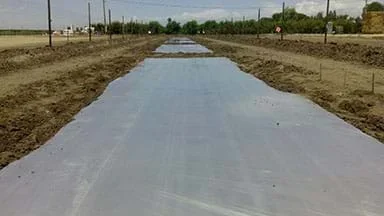 Soil biosolarization.Copyright 2016 Jesús D. Fernandez Bayo, RESOURCE GK-12 Program, College of Engineering, University of California Davis
Over the course of three sessions, students act as agricultural engineers and learn about the sustainable pest control technique known as soil biosolarization in which organic waste is used to help eliminate pests during soil solarization instead of using toxic compounds like pesticides and fumigants. Student teams prepare seed starter pots using a source of microorganisms (soil or compost) and “organic waste” (such as oatmeal, a source of carbon for the microorganisms). They plant seeds (representing weed seeds) in the pots, add water and cover them with plastic wrap. At experiment end, students count the weed seedlings and assess the efficacy of the soil biosolarization technique in inactivating the weed seeds. An experiment-guiding handout and pre/post quizzes are provided.
Engineers apply science and math concepts to create products and processes designed for the betterment of humankind and the environment. Microbial engineers use microorganisms to transform waste into something useful. Waste management engineers are responsible for reducing landfill and incinerator waste as well as transforming the waste into something useful. Agricultural engineers create ways that farmers can make and use compost to help plants grow better, less expensively, and without harming farm workers or the environment. The principles of soil biosolarization span each of these engineering specialties as organic waste is transformed to increase crop production and protect crops from pests. In this activity, students act as agricultural engineers to test a soil biosolarization method of eliminating weeds from soil.
After this activity, students should be able to:
- Describe the importance of organic waste to composting.
- Explain the importance of sustainable pest control techniques.
- Conduct a scientific experiment to test the effectiveness of a soil biosolarization pest control method as a means of reducing human impact on the environment.
- Examine experimental results to assess how well the tested soil biosolarization system worked.
- 5.NBT.5 Fluently multiply multi-digit whole numbers using the standard algorithm.
Grade 5
Do you agree with this alignment? - 6.EE.B Reason about and solve one-variable equations and inequalities.
Grade 6
Do you agree with this alignment? - 6.RP.3.c Find a percent of a quantity as a rate per 100 (e.g., 30% of a quantity means 30/100 times the quantity); solve problems involving finding the whole, given a part and the percent.
Grade 6
Do you agree with this alignment?
- 5-ESS3-1 Obtain and combine information about ways individual communities use science ideas to protect the Earth's resources and environment.
Grade 5
Do you agree with this alignment? - MS-ESS3-3 Apply scientific principles to design a method for monitoring and minimizing a human impact on the environment.
Grades 6-8
Do you agree with this alignment?
- CCSS.Math.Content.5.NBT.B.5 Fluently multiply multi-digit whole numbers using the standard algorithm.
Grade 5
Do you agree with this alignment? - CCSS.Math.Content.6.EE.B Reason about and solve one-variable equations and inequalities.
Grade 6
Do you agree with this alignment? - CCSS.Math.Content.6.RP.A.3c Find a percent of a quantity as a rate per 100 (e.g., 30% of a quantity means 30/100 times the quantity); solve problems involving finding the whole, given a part and the percent.
Grade 6
Do you agree with this alignment?
- Students will develop abilities to assess the impact of products and systems.
Grades K-12
Do you agree with this alignment? - Students will develop an understanding of the relationships among technologies and the connections between technology and other fields of study.
Grades K-12
Do you agree with this alignment?
- 5-ESS3-1 Obtain and combine information about ways individual communities use science ideas to protect the Earth's resources and environment.
Grade 5
This resource focuses on the following Three Dimensional Learning aspects of NGSS:
Science & Engineering Practices- Obtain and combine information from books and/or other reliable media to explain phenomena or solutions to a design problem.Do you agree with this alignment?
Disciplinary Core Ideas- Human activities in agriculture, industry, and everyday life have had major effects on the land, vegetation, streams, ocean, air, and even outer space. But individuals and communities are doing things to help protect Earth's resources and environments.Do you agree with this alignment?
Crosscutting Concepts- A system can be described in terms of its components and their interactions.Do you agree with this alignment?
- Science findings are limited to questions that can be answered with empirical evidence.Do you agree with this alignment?
Do you agree with this alignment? - Obtain and combine information from books and/or other reliable media to explain phenomena or solutions to a design problem.
- MS-ESS3-3 Apply scientific principles to design a method for monitoring and minimizing a human impact on the environment.
Grades 6-8
This resource focuses on the following Three Dimensional Learning aspects of NGSS:
Science & Engineering Practices- Apply scientific principles to design an object, tool, process or system.Do you agree with this alignment?
Disciplinary Core Ideas- Human activities have significantly altered the biosphere, sometimes damaging or destroying natural habitats and causing the extinction of other species. But changes to Earth's environments can have different impacts (negative and positive) for different living things.Do you agree with this alignment?
Crosscutting Concepts- The uses of technologies and any limitations on their use are driven by individual or societal needs, desires, and values; by the findings of scientific research; and by differences in such factors as climate, natural resources, and economic conditions. Thus technology use varies from region to region and over time.Do you agree with this alignment?
- Relationships can be classified as causal or correlational, and correlation does not necessarily imply causation.Do you agree with this alignment?
Do you agree with this alignment? - Apply scientific principles to design an object, tool, process or system.
Each group needs:
- 6 pots or cups with drainage holes, such as seed-starting plastic pots
- container or tray to catch draining water from the seed starting pots
- 60 seeds, such as lettuce or other plant that sprouts within a week
- 1 graduated container, to measure the volume of the seed starting pots
- bucket for mixing soil and “organic waste,” big enough to hold enough soil and organic waste to fill 3 of the seed-starting pots
- thermometer
- Soil Biosolarization Activity Handout (PDF), Pre-Activity Quiz (PDF) and Post-Activity Quiz (PDF), one each per student
To share with the entire class:
- potting soil or compost, enough for each group to fill its 6 seed-starting pots
- “organic waste,” such as a solid food source that is easy to mix with soil, like oatmeal, flour or cornstarch
- transparent plastic wrap
- water
- Pre-Activity Quiz (docx)
- Pre-Activity Quiz (pdf)
- Pre-Activity Quiz Answer Key (docx)
- Pre-Activity Quiz Answer Key (pdf)
- Soil Biosolarization Activity Handout (docx)
- Soil Biosolarization Activity Handout (pdf)
- Post-Activity Quiz (docx)
- Post-Activity Quiz (pdf)
- Post-Activity Quiz Answer Key (docx)
- Post-Activity Quiz Answer Key (pdf)
Students should be:
- Familiar with the concepts covered in the associated lesson, Sun Keeps the Pests Away: How Soil Solarization Works. Familiarity with the greenhouse effect is helpful, but not necessary.
- Familiar with the scientific method and able to explain that experimental controls provide a means of comparing treated samples to non-treated samples in order to assess the effectiveness of a treatment.
- Able to calculate averages and percentages to assess soil biosolarization efficacy.
Now that we have learned all about soil solarization (from conducting the associated lesson), today we are going to learn about soil biosolarization, a version of soil solarization in which the soil has been treated (mixed) with any type of organic material before it is covered with a plastic tarp.
Do you think the banana peel or veggie scraps that you throw away could be useful? They are! They are known as organic waste because they can be broken down by other living beings, and are much more useful than you might think.
In the natural environment, very little critters, called microorganisms, eat leftover food and transform it. Thanks to them, what might be considered useless (such as food waste) can be useful. Thousands of types of microorganisms exist—each with different functions. Microbial engineers use these microorganisms to create different useful products. Many microorganisms are able to transform organic waste into compost. What is compost? (See if any students can describe it.) Compost is a soil-like, brown material that helps plants grow. Farmers use compost to supply vitamins and other nutrients to growing plants.
Who has pulled weeds in a garden? Why did you do that? (Listen to a few student explanations.) Some undesired plants, like weeds, grow in and amidst fields of crops and can be a nuisance by taking the nutrients and water that the desired plants need to grow. Instead of pulling weeds by hand, because it would be too much work, some farmers apply toxic liquids or powders, called pesticides, to eliminate these undesired plants. The problem with this approach is that most pesticides are harmful to the environment—they can kill other plants and animals, too, not just weeds—and dangerous to human health.
Agricultural engineers create ways that farmers can make and use compost to help them grow plants better, less expensively, and without harming farm workers or the environment. In this activity, you will act as if you are agricultural engineers challenged to test a soil biosolarization method of eliminating weeds from a soil based on the concepts you learned about during the associated lesson.
Background
Soil solarization is a sustainable and non-chemical pest control method that eliminates soilborne pests via the high temperatures produced when solar radiation reaches soil covered with a transparent plastic tarp. The process usually takes four to six weeks and is performed during the hottest period of the year (Katan et al., 1976). The plastic sheets trap the sun’s heat in the soil, taking advantage of the greenhouse effect. The process can kill a wide range of soilborne pests, such as weeds, pathogens, nematodes and insects. In some cases, this heating is not enough to kill the soilborne pests. Organic waste soil amendment can boost the soil microbial activity by adding two new effects to the process: 1) the metabolic energy of microbes degrading organic matter slightly increases the temperature during the process, and 2) during the degradation of the organic matter, volatile fatty acids made by the microbes can reach levels that are toxic to soilborne pathogens. This method is known as soil biosolarization (Gamliel & Stapleton, 1997).
Before the Activity
Gather materials and make copies of the Soil Biosolarization Activity Handout (PDF), Pre-Activity Quiz (PDF) and Post-Activity Quiz (PDF), one each per student.
Check the weather and consider conducting the activity outside if weather permits.
Administer the Pre-Activity Quiz (PDF), giving students enough time to answer the seven questions. Review their responses to determine which concepts need to be reinforced during the activity.
With the Students—Session 1: Experiment Setup
- Present the Introduction/Motivation content to the class, highlighting the following main points:
- The importance of organic waste and the role of microorganisms in transforming organic waste into compost
- The terms “pest” and “pesticide”
- The environmental and health problems associated with the use of pesticides
- The importance of developing and using less harmful pest control methods
- The (hypothetical) student role in the activity—acting as an agricultural engineer testing a method designed to eliminate weeds from soil
- Pass out the handout. Explain that the handout contains activity experiment instructions as well as questions and a data table for students to complete as their teams work through the activity. The activity is divided into three stages: experiment setup plus data gathering one day and one week later.
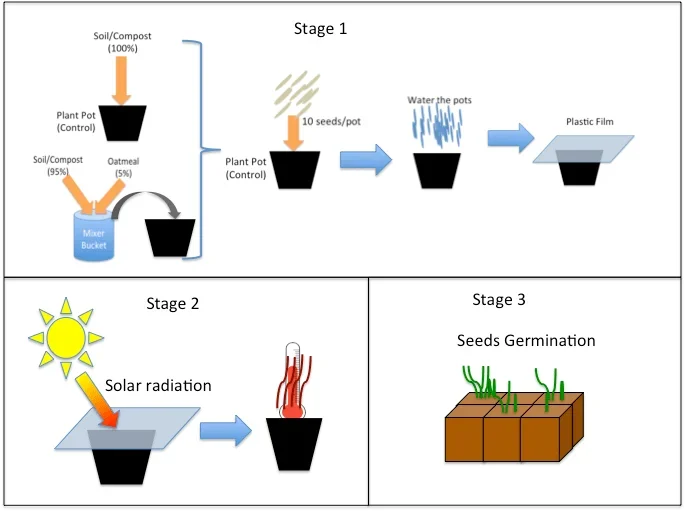 The three activity stages.Copyright 2016 Jesús D. Fernandez Bayo, RESOURCE GK-12 Program, College of Engineering, University of California Davis
- Divide the class into engineering teams of four students each.
- Tell students that each member of the team is an agricultural engineer and that—while all team members are expected to participate in all components of the activity—each team member will be responsible for a specific task. For each engineering team, assign student roles:
- Reader: reads instructions
- Writer: fills out the worksheet
- Speaker: presents and explains results to the class
- Organizer: leads the experimental setup
- Tell students which materials they can use to prepare the “agricultural soil mix” and why they are important:
- Soil and/or compost provide the environment where the pests and microorganisms live.
- Organic waste (the oatmeal, flour, cornstarch or other food ingredient of your choice) is a source of easily degradable organic carbon to feed the microbes.
- Explain that each group will have two treatments: 1) control treatment, which is only soil, and 2) experimental treatment (soil and organic waste).
- Guide students to measure the volume of their seed-starting pots using a graduated container and potting soil. Prompt them to use this information to estimate the amount of organic waste they need to add (5% of the seed-starter pot volume) and record their findings on the handout.
- Have students fill three of their pots with soil only (the controls). Somehow (tape, sticks) identify these pots as the control pots for each team.
- To prepare the three treated soils, direct students to fill their mixer buckets with three times the amount of soil and organic waste estimated in step 7; then, close the mixer bucket and shake it to mix the soil and organic waste.
- After mixing, tell students to divide the mixture evenly and transfer it into the three treatment pots.
- Once each group has its six pots ready, direct them to plant 10 seeds in each pot. Explain that the seeds represent the weeds they are trying to eliminate.
- Have students water each of the six pots until water flows out of the bottom. (It is helpful to place a container or tray under the pots to minimize the mess.) Then cover each pot with plastic wrap.
- Place the pots in a sunny spot in the school and leave them for solarization for at least one day (no more than one week is recommended).
With the Students—Session 2: Data Collection (after at least 1 day)
- Have students remove the plastic film from their pots, smell the control and treatment pots, and describe their smell observations in Table 1 on the handout.
- Hand out thermometers and guide students to measure and record soil temperatures.
- Have students calculate the mean temperature per treatment.
- Direct students to water the pots again. If possible, keep the pots in a humid place and/or cover them with a transparent box.
- Until the next session, have students keep the soil in the pots moist by watering every 2-3 days. This is especially important if the pots are not covered.
With the Students—Session 3: Data Collection and Analysis (final session; 1 week after Session 2)
- One week later, have students count the number of plants in each pot and record their findings.
- Direct students to calculate the mean percentage of seed inactivation per treatment.
- Have each team present its results to the class and post the data on the classroom board for all to see.
- Engage the class in a discussion of the results and in determining conclusions. Expect the results to show more plants in the control pots than in the treated soils. Expect a higher percentage of seed inactivation in the soil amendment to be related to the smells perceived during session 2. This bad smell is attributed to the acids formed during the degradation of the organic matter and their accumulation to a toxic level due to the plastic preventing them from escaping.
- As a class, review the activity learning objectives.
- Administer the Post-Activity Quiz (PDF).
- compost
- Organic matter from organic waste that has decomposed in aerobic conditions. Used to improve and fertilize soil.
- scientific control
- A sample used in an experiment to provide a reference for what would happen in the experimental environment in standard, no-treatment conditions.
- greenhouse effect
- An accumulation of heat when shortwave solar radiation is able to pass through a layer (such as the atmosphere, transparent plastic, glass, etc.) that covers an area, and the reflected longer wavelength heat radiation is less readily transmitted outward, accumulating heat in the covered area (such as the soil, greenhouse, car, etc.).
- organic waste
- Waste that can be decomposed by microorganisms and other living things into carbon dioxide, water, methane or other smaller organic molecules.
- pest (organism)
- An insect, plant, fungi or other animal that damages or destroys desired plants, trees, etc.
- pesticide
- A chemical formulation applied for the purpose of eradicating (destroying, killing) unwanted insect, fungal or animal pests.
- soil solarization
- The process of heating moist soil by covering it with a plastic tarp so the sun’s radiation passes through the tarp, in order to disinfect the soil of pests.
- toxic chemical
- A substance that is harmful to the environment and/or human and animal health at a specific concentration level and is inhaled, ingested or absorbed through the skin.
- volatile fatty acids
- Fatty acids produced from microbes as they decompose organic matter. Example VFAs: acetic acid, propionic acid and butyric acid.
- weed
- A plant considered undesirable in a particular situation, such as growing in cultivated soil and negatively affecting a desired crop.
Pre-Activity Assessment
Pre-Quiz: Before starting the activity, have students complete the seven-question Pre-Activity Quiz (PDF), which includes some short questions related to the learning objectives. Review their answers to determine which concepts need to be reinforced during the activity.
Activity Embedded Assessment
Class Results: During the activity, have students use the Soil Biosolarization Activity Handout (PDF) to record measurements, observations and calculations, examine their results, and compare their findings with other groups. After they have finished comparing results, compile class data in order to more widely compare results and discuss as a class.
Post-Activity Assessment
Post-Quiz: At activity end, have students complete the seven-question Post-Activity Quiz (PDF), which includes some short questions that are similar to the pre-quiz. Review student responses to gauge their depth of comprehension.
- During the activity, students handle soil and compost so advise them to wash their hands after the activity, or use gloves during the activity.
- Verify that no students have allergies to the selected food waste.
- Prior to conducting the activity, plant some seeds in the substrate that the class will be using in order to confirm that the seeds are viable and will grow during the experiment.
- If no plants emerge after one week, wait a bit longer to make sure they are watered sufficiently and in a humid place. If no plants emerge and the final session cannot be delayed any further, give students hypothetical counts for the number of emerged plants per pot; make these values show a higher number of plants (weeds) grown in the control pots than the treated pots.
- For lower grades (3-4), skip or simplify the mathematical calculations. Also consider providing students with specific values of organic waste and soil, or calculate them as a class.
- For higher grades (7-9), remove the equations and designs that clarify the calculations outlined on the student handout and have students independently determine the necessary calculations. Also consider diversifying the types and quantities of organic wastes added to the treatment pots.
- For large classes in which more than four groups can be formed, consider having each group add a different amount of organic waste to the soil in the treatment pots. Then, as a class, compare results and discuss which amount was the most effective at eliminating “weeds.”
Gamliel, A., Stapleton, J.J. 1997. Improvement of Soil Solarization with Volatile Compounds Generated from Organic Amendments. Phytoparasitica, 25, S31-S38.
Katan, J., Greenberger, A., Alon, H., Grinstein, A. 1976. Solar Heating by Polyethylene Mulching for Control of Diseases Caused by Soil-Borne Pathogens. Phytopathology, 66(5), 683-688.
- Sun Keeps the Pests Away: How Soil Solarization Works
- Soil Biosolarization: Using Waste & Sunshine to Get Rid of Weeds
Contributors
Jesús D. Fernández Bayo
Supporting Program
RESOURCE GK-12 Program, College of Engineering, University of California Davis
Acknowledgements
The contents of this digital library curriculum were developed by the Renewable Energy Systems Opportunity for Unified Research Collaboration and Education (RESOURCE) project in the College of Engineering under National Science Foundation GK-12 grant no. DGE 0948021. However, these contents do not necessarily represent the policies of the National Science Foundation, and you should not assume endorsement by the federal government.
This activity was developed with the support and help of all the members of the RESOURCE project: Jean VanderGheynst, Alisa B. Lee, Sara A. Pace, Joshua T. Claypool, Alexander Kon, Kelley V. Hestmark, Destiny R. Garcia and Lauren K. Jabusch.
Copyright
2016 by Regents of the University of Colorado; original © 2016 University of California Davis