
Sun Keeps the Pests Away: How Soil Solarization Works
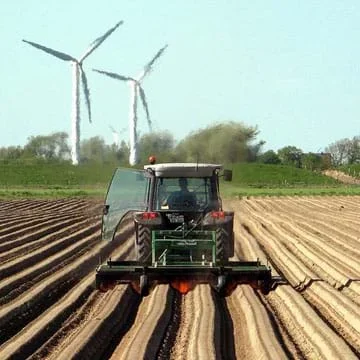 Agricultural fields being prepared for solarization.Copyright 2008 Dirk Ingo Franke, Wikimedia Commons https://commons.wikimedia.org/wiki/File:Speicherkoog_Kartoffelacker_Abflammger%C3%A4t_Envo-Dan.jpg
Students learn how the process of soil solarization is used to pasteurize agricultural fields before planting crops. Soil solarization is a pest control technique in agriculture that uses the sun’s radiation to heat the soil and eliminate unwanted pests that could harm the crops. The approach is compared to other pest control methods such as fumigation and herbicide application, highlighting the respective benefits and drawbacks. In preparation for the associated hands-on activity on soil biosolarization, students learn how changing the variables involved in the solarizing process (such as the tarp material, soil water content and addition of organic matter) impacts the technique’s effectiveness. A PowerPoint® presentation and pre/post-quiz is provided.
Some engineers are responsible for making sure that food crop production processes are sustainable and produce high-quality food. To do this, they must understand biological concepts such as photosynthesis and nutrient webs, as well as potential plant threats so they can design approaches and technologies to address those threats. Soil solarization is a technology that offers an effective and more sustainable way to protect crops without many of the negative impacts of conventional herbicide and pesticide application methods.
After this lesson, students should be able to:
- Define “herbicide” and “pesticide” and describe their detrimental side effects.
- Describe the major processes of soil solarization.
- Explain how changing the variables involved in the solarizing process impacts the effectiveness of the technique.
- 5-ESS3-1 Obtain and combine information about ways individual communities use science ideas to protect the Earth's resources and environment.
Grade 5
Do you agree with this alignment?
- Students will develop an understanding of the effects of technology on the environment.
Grades K-12
Do you agree with this alignment? - Students will develop an understanding of and be able to select and use agricultural and related biotechnologies.
Grades K-12
Do you agree with this alignment?
- 5-ESS3-1 Obtain and combine information about ways individual communities use science ideas to protect the Earth's resources and environment.
Grade 5
This resource focuses on the following Three Dimensional Learning aspects of NGSS:
Science & Engineering Practices- Obtain and combine information from books and/or other reliable media to explain phenomena or solutions to a design problem.Do you agree with this alignment?
Disciplinary Core Ideas- Human activities in agriculture, industry, and everyday life have had major effects on the land, vegetation, streams, ocean, air, and even outer space. But individuals and communities are doing things to help protect Earth's resources and environments.Do you agree with this alignment?
Crosscutting Concepts- A system can be described in terms of its components and their interactions.Do you agree with this alignment?
- Science findings are limited to questions that can be answered with empirical evidence.Do you agree with this alignment?
Do you agree with this alignment? - Obtain and combine information from books and/or other reliable media to explain phenomena or solutions to a design problem.
Students should be familiar with the concepts of solar radiation, heat transfer and the greenhouse effect, in addition to basic biological concepts such as the requirements for life.
Living things ingest food to produce energy and produce waste products (metabolism). These waste products can be altered based on the organism’s environment. When oxygen is limited, bacteria still metabolize, but produce acids instead of CO2 and water. It is these acids that are toxic to agricultural pests.
Living things prefer specific environmental conditions to live in, including temperature and chemical concentrations. For example, humans must keep their body temperatures between 97 °F and 104 °F to live and sufficient oxygen must exist in our surroundings in order to breathe; the same concepts apply to weeds and pests. They die in excessively high temperatures and in the presence of high enough concentrations of certain chemicals, such as acids.
(After administering the Soil Solarization Quiz (PDF), present to the class the following content. [optional] Use the 17-slide Soil Solarization Presentation (PPTX), a PowerPoint® file, to present the lesson concepts. The slides are animated so clicking the keyboard or mouse in the slide show mode advances to the next text, image or slide. Be ready to administer the same Soil Solarization Quiz (PDF) at the end of the lesson.)
(Slide 1) Since the first humans began collecting seeds and cultivating land instead of hunting and gathering, many beneficial changes to farming practices have been made. For example, humans developed ways to water crops more efficiently, rotate the crops they plant every year, and apply fertilizer to improve soil health and increase the amount of fruit and vegetables produced. In the past century, the creation of pesticides and herbicides has severely decreased the competition between humans and the bugs and fungi that eat cultivated crops. In order to meet the growing global food demands, agricultural engineers continue to develop techniques aimed at increasing the yield and quality of crops, such as engineering corn to be drought resistant.
(Slide 2) These techniques might be viewed as human-developed “weapons” for the purpose of protecting food sources and producing more food. Today, almost all vegetables and fruits that we eat have survived what might be called an “agricultural war” on the way to your plate. Humans fight pests like fungus and weeds in order to grow healthy produce for us to eat. (Click to show the moldy strawberry and strawberry snail.) Did you know that in order for a strawberry to make it to your home, it had to survive quite a battle? Many natural predators want to eat crops that humans grow; these predators include animals, insects, fungi and diseases. Humans must fend off these pests so we have ripe and healthy food for our own bellies.
Currently, people use pesticides and herbicides to defend their crops, however, in addition to harming the target enemies, these chemicals also hurt the beneficial microorganisms and insects, and the health of the surrounding environment. It is the job of engineers and researchers to invent equally effective, but more sustainable ways to protect our crops without negatively impacting the ecosystems around farms. Today we are going to learn about one of these techniques called soil solarization.
Solarization is an alternative to the chemical approach—a way to achieve the same end goal without the negative side effects. Soil solarization uses the radiation from the sun to pasteurize the soil. Like boiling water to kill the germs that live in it, heating the soil kills unwanted pests in the ground. This heating is achieved through the use of plastic tarps that create a greenhouse effect in the air just above the soil; this traps the solar radiation and heats the soil with no need for help from other energy sources.
Different combinations of plastic types, soil moisture, and soil contents impact the effectiveness of the solarization technique. Today we are going to learn how each of these variables affects the heating of the soil and discuss how agricultural engineers assess soil heating.
(Slide 3) Current and common means of agricultural pest control are herbicides and pesticides. These are chemicals that are applied to fields to indiscriminately kill living things with which they come in contact. These chemicals can mobilize in the surface water and spread beyond the intended area.
Let’s break the word “herbicide” into its parts: “herb” and “icide.” You have likely heard of herbs in terms of cooking and can guess that this refers to plants of all kinds. The second word is a little harder, but you might be able to guess if you think of how it is part of other words that you know, like genocide and suicide. Together, these two parts mean “plant killer.”
(Slide 4) Now let’s use the same word breakdown method as before to deduce the definition of “pesticide.” (Expect some students to suggest that pest means annoying or obnoxious, which is on the right track; lead them to understand how pests can be “annoying” in agriculture.)
(Slide 5) Can you make an educated guess as to why the man in the photo wears so much protective gear? (Listen to some student hypotheses.) Since pesticides and herbicides kill other living things like plants and animals, they are also toxic to humans! So, people who are exposed to a lot of these chemicals require protective gear or they can get sick. Also, these chemicals are non-specific—that means that they kill or harm most living things that they are in contact with—which means they kill helpful and beneficial insects and plants as wells as the undesirable ones.
(Slide 6) Another disadvantage of using pesticides is that when it rains, the chemicals are washed away from the fields into the surface water, including rivers, streams and lakes, and into the surrounding land where they travel in the soil to wells and aquifers. These chemicals can then disrupt the ecosystems in lakes, rivers and streams, as well as pollute drinking water sources.
(Slide 7) (Review the pros and cons of using pesticides and herbicides. See if students can first remember the points that were already talked about before revealing the answers. Emphasize that the cons outweigh the pros, especially since other less harmful ways exist to protect crops from predators.) Pros: Pesticides and herbicides are very effective at killing animals and plants that want to eat our crops. Cons: They are toxic to humans, kill both harmful and helpful plants and animals, and can run off into surrounding areas, damaging and polluting ecosystems.
(Slide 8) Some alternatives to using chemical means to rid fields of pests include introducing natural predators, such as introducing ladybugs to eat aphids if you have an aphid problem, mulching by covering the ground surrounding the crop with wood chips so weeds cannot photosynthesize, and another approach called soil solarization.
(Slide 9) Soil solarization is a pest control technique in agriculture that uses the sun’s radiation to heat the soil and eliminate unwanted pests that could harm the crops.
(Slide 10) How does soil solarization work? Have you ever been inside a greenhouse? Was it warmer or colder inside the greenhouse than outside? (Answer: Warmer.) Why do you think that temperature difference exists? The glass walls permit solar radiation into the greenhouse, but do not let it out. The radiation is absorbed by the plants and floor so heat builds up inside.
Let’s apply this same concept to pest control. For soil solarization, farmers cover their field rows with transparent plastic tarps that let the sun’s radiation pass through, like the greenhouse glass. Since the soil is dark in color, it absorbs much of the radiation, causing it to heat up. The tarp prevents the radiation and heat from escaping, causing the soil to heat up substantially. Weed seeds and pests cannot live in the high temperatures created by solarization; they either die or migrate to another area where they are comfortable, similar to how humans can only live in a certain temperature range, between 50–100 °F, without discomfort or death.
(Slide 11) Along with weeds and pests, microorganisms live in the soil. Have you ever heard of microorganisms? What are microbes? (Listen to student answers.) Let’s breakdown the word “microorganism.” “Micro” indicates very small, and “organism” means a living thing. So microorganisms are tiny living things—such as bacteria, fungi and viruses.
(Slide 12) Some microorganisms prefer to live in the heated environment that solarization creates. Under these conditions they produce acids that are toxic to weeds and pests. The longer you solarize the soil, the more acids are created and the fewer weeds and pests can survive.
(Slide 13) Three engineering design variables for soil solarization include: the type/color of plastic used, the amount of water in the soil, and the addition of compost to the soil.
(Slide 14) When solarizing a field, agricultural engineers choose from different types of plastics because light rays interact differently with different materials (see Figure 1). Black plastic does not permit radiation to pass through, but instead directly absorbs the sun’s radiation. This method is less effective in heating the soil, but still prevents the photosynthesis of weeds surrounding the plants. Clear plastic lets the sun’s radiation easily pass through to heat the soil. This method does not prevent the photosynthesis of other plants, but it is very effective in heating the soil.
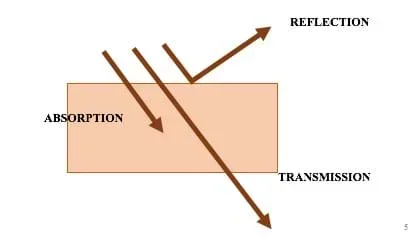 Figure 1. Possible light interactions with materials.Copyright 2016 Kelley Hestmark, RESOURCE GK-12 Program, College of Engineering, University of California Davis
(Slide 15) The more water in the soil, the longer it takes to heat up. Think about making pancakes: It takes longer to cook really soupy batter than it does to cook thick batter. Yet the microorganisms in the soil need water to live. So, for solarization to work, it is best if the soil is in the “sweet spot” between too wet and too dry.
(Slide 16) What is composting? How does composting work? (Listen to student ideas.) Have you ever been near a compost pile and felt heat come off it? Or seen a compost pile being mixed and seen steam rising from it? Compost piles can get really warm, up to 150 °F! (Ask students to brainstorm.) What do you think is making the heat? (Listen to their ideas.) Microorganisms! When the microbes eat food and break it down, a by-product is heat. Think about when you run and start to sweat. The reason you sweat is to cool down your body from the heat it is producing from breaking down your food to make energy. The microorganisms function similarly.
Compost contains microorganisms that thrive in warm conditions. Under solarization conditions, the microorganisms in the soil produce toxic acids. (Explain that students will learn more about this first-hand during the upcoming associated activity Soil Biosolarization: Using Waste & Sunshine to Get Rid of Weeds on soil biosolarization.)
(Slide 17) (As a class, review the concepts by having students suggest words to fill in the <blanks> in the text on the slide.)
A pesticide is a chemical that is applied to a field to eliminate <pests> that can harm crops.
<Pesticides> and <herbicides> are toxic to humans and disrupt ecosystems.
Soil solarization uses the sun’s <radiation> to heat the soil.
The heat and <toxic acids> produced by microbes prevent weeds and pests from living in the soil where crops grow.
Engineers can decide the <type of plastic>, <amount of water> and whether to add <compost> in order to change the effectiveness of soil solarization.
(Conclude by administering the lesson post-quiz.)
After this lesson, I hope you have a better idea of how much work goes into protecting your food from pests and weeds. Farmers and agricultural engineers are constantly inventing and applying different methods to make sure that the crops we grow are eaten by humans, not pests, and are able to grow disease-free to ripeness. The current method of applying chemical herbicides and pesticides is very effective, but it has undeniable bad effects, too. What are those disadvantages? (Listen to student answers.) That’s right, the chemicals are toxic to humans, they kill beneficial animals and microorganisms as well as the harmful ones, and they disrupt surrounding ecosystems by running off the agricultural land into rivers and streams.
The alternative we learned about—soil solarization—uses the sun’s radiation to heat the soil. The super-heated soil environment is not suitable for weeds or pests to live in. Furthermore, the beneficial microbes in the soil prefer the high temperatures and produce toxic acids. The acids make the soil even less livable for the pests. The solarization process, with contributions from the heat and the microbes, sterilizes the soil so that crops can be planted without competition or predators. Engineers are currently researching different combinations of plastic, water content and compost additions to make solarization more effective as an alternative to using herbicides and pesticides.
- greenhouse effect
- An accumulation of heat when shortwave solar radiation is able to pass through a layer (such as the atmosphere, transparent plastic, glass, etc.) that covers an area, and the reflected longer wavelength heat radiation is less readily transmitted outward, accumulating heat in the covered area (such as the soil, greenhouse, car, etc.).
- herbicide
- A chemical substance applied by farmers to destroy/kill unwanted plants in their fields.
- metabolism
- The chemical reactions involved in keeping cells alive.
- microorganism
- A microscopic living organism. A classification of organisms that includes any living thing that is too small to be viewed by the unaided eye. Examples: bacteria, protozoa, fungi and algae. Also called microbe.
- pasteurize
- A process that exposes something to heat long enough to kill microorganisms, with the intent to destroy the microbes that cause disease and/or spoilage.
- pesticide
- A chemical formulation created and applied for the purpose of eradicating (destroying, killing) unwanted insect, fungal or animal pests.
- soil solarization
- An organic pest control technique in agriculture that uses the sun’s radiation and a tarp to heat the soil and eliminate unwanted pests.
- solar radiation
- Energy from the sun in the form of electromagnetic waves of different wavelengths.
Pre-Lesson Assessment
Pre-Quiz: Before revealing any information on the lesson subject, administer the four-question Soil Solarization Pre/Post-Quiz (PDF). Collecting this information is key to gauging how much student knowledge gain can be attributed solely to the lesson and not to prior knowledge from outside material.
Post-Introduction Assessment
Class Discussion: Lead the class in a discussion to explore how much effort and energy goes into ensuring that the food we grow makes it to the dinner table. Ask the students:
- What “dangers” do plant foods face while growing in fields?
- What methods do people use to keep weeds and unwanted animals away from growing crops?
- Have you seen your parents or other family members use particular methods in their gardens to make sure plants (vegetables, fruits, flowers) grow and ripen without being attacked by pests?
- What do you know about how the food you eat gets from the field to your plates?
- What is the path that produce must follow to make it from farm to table?
- What are some of the harvesting, cleaning, sorting and shipping processes?
Lesson Summary Assessment
Class Discussion: Lead a class discussion using the following prompt:
- Other than the three variables that we discussed in class, can you think of other aspects of the soil solarization process that could be altered to change how effective it is? (Possible answers: In addition to color, many aspects of the plastic tarp could be changed, such as its thickness, plastic type and biodegradability. Also, why do we use plastic? Might we use other materials that are better than plastic? Expect students to suggest many other changes and ask them to justify why they think the change would improve the process.)
Post-Quiz: Administer the Soil Solarization Pre/Post-Quiz (PDF) again. Comparing students’ pre- and post-quiz scores reveals both individual and class average changes in comprehension of the soil solarization concept and meeting of the learning objectives.
- Sun Keeps the Pests Away: How Soil Solarization Works
Contributors
Kelley Hestmark
Supporting Program
RESOURCE GK-12 Program, College of Engineering, University of California Davis
Acknowledgements
The contents of this digital library curriculum were developed by the Renewable Energy Systems Opportunity for Unified Research Collaboration and Education (RESOURCE) project in the College of Engineering under National Science Foundation GK-12 grant no. DGE 0948021. However, these contents do not necessarily represent the policies of the National Science Foundation, and you should not assume endorsement by the federal government.
Many thanks to Jean Vandergheynst, Alisa Lee, Lauren Jabusch, and all the University of California Davis RESOURCE Fellows and activity reviewers for providing feedback, support and guidance to make this activity possible.
Copyright
2016 by Regents of the University of Colorado; original © 2016 University of California Davis