
Let the Blood Flow: Biomedical Artery Unclogging Experiment
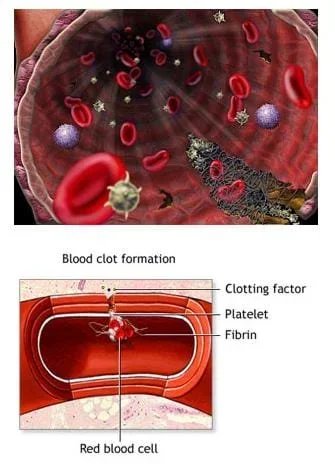 Biomedical engineers develop ways to break down blood clots that could cause strokes.Copyright (bottom) Medline Plus, U.S. National Library of Medicine, National Institutes of Health, (top) Nicole Rager-Fuller, National Science Foundation http://www.nlm.nih.gov/medlineplus/ency/imagepages/19462.htm http://www.nsf.gov/news/news_images.jsp?cntn_id=108100&org=CHE
Students work as biomedical engineers to find liquid solutions that can clear away polyvinyl acetate polymer "blood clots" in model arteries (made of clear, flexible tubing). Teams create samples of the "blood clot" polymer with different concentrations to discover the concentration of the model clot and then test a variety of liquids to determine which most effectively breaks down the model blood clot. Students learn the importance of the testing phase in the engineering design process, because they are only given one chance to present the team's solution and apply it to the model blood clot.
Biomedical engineers apply their understanding of scientific and mathematical principles to create practical solutions to biological problems. The highly interdisciplinary field includes diverse applications of new technologies created to improve patient treatment. With circulatory system diseases a leading cause of death in the U.S., engineers have designed, tested and implemented many devices, such as artificial hearts, artificial valves, stents, as well as medical and surgical procedures, to save lives. In the case of life-threatening blood clots in blood vessels, biomedical engineers research the biochemistry and structure of blood clots and apply this knowledge to develop and test methods for harmlessly breaking them down.
After this activity, students should be able to:
- Explain the importance of the testing stage in the engineering design process before presenting and using a solution to a problem.
- Describe methods and approaches biomedical engineers may use to develop solutions to dangerous and life-threatening blood clots in blood vessels.
- Apply their understanding of the formation and degradation of polymers to develop liquid solutions that break down polyvinyl acetate polymers.
- G.GMD.3 Use volume formulas for cylinders, pyramids, cones, and spheres to solve problems.
Grades 9-12
Do you agree with this alignment? - N.Q.1 Use units as a way to understand problems and to guide the solution of multi-step problems; choose and interpret units consistently in formulas; choose and interpret the scale and the origin in graphs and data displays.
Grades 9-12
Do you agree with this alignment? - HSS.ID.A Summarize, represent, and interpret data on a single count or measurement variable
Grades 9-12
Do you agree with this alignment?
- HS-ETS1-3 Evaluate a solution to a complex real-world problem based on prioritized criteria and trade-offs that account for a range of constraints, including cost, safety, reliability, and aesthetics, as well as possible social, cultural, and environmental impacts.
Grades 9-12
Do you agree with this alignment? - HS-PS2-6 Communicate scientific and technical information about why the molecular-level structure is important in the functioning of designed materials.
Grades 9-12
Do you agree with this alignment?
- CCSS.Math.Content.HSG-GMD.A.3 Use volume formulas for cylinders, pyramids, cones, and spheres to solve problems.
Grades 9-12
Do you agree with this alignment? - CCSS.Math.Content.HSN-Q.A.1 Use units as a way to understand problems and to guide the solution of multi-step problems; choose and interpret units consistently in formulas; choose and interpret the scale and the origin in graphs and data displays.
Grades 9-12
Do you agree with this alignment? - CCSS.Math.Content.HSS-ID.A Summarize, represent, and interpret data on a single count or measurement variable
Grades 9-12
Do you agree with this alignment?
- Students will develop an understanding of the relationships among technologies and the connections between technology and other fields of study.
Grades K-12
Do you agree with this alignment? - Medical technologies include prevention and rehabilitation, vaccines and pharmaceuticals, medical and surgical procedures, genetic engineering, and the systems within which health is protected and maintained.
Grades 9-12
Do you agree with this alignment?
- HS-ETS1-3 Evaluate a solution to a complex real-world problem based on prioritized criteria and trade-offs that account for a range of constraints, including cost, safety, reliability, and aesthetics, as well as possible social, cultural, and environmental impacts.
Grades 9-12
This resource focuses on the following Three Dimensional Learning aspects of NGSS:
Science & Engineering Practices- Evaluate a solution to a complex real-world problem, based on scientific knowledge, student-generated sources of evidence, prioritized criteria, and tradeoff considerations.Do you agree with this alignment?
Disciplinary Core Ideas- When evaluating solutions it is important to take into account a range of constraints including cost, safety, reliability and aesthetics and to consider social, cultural and environmental impacts.Do you agree with this alignment?
Crosscutting Concepts- New technologies can have deep impacts on society and the environment, including some that were not anticipated. Analysis of costs and benefits is a critical aspect of decisions about technology.Do you agree with this alignment?
Do you agree with this alignment? - Evaluate a solution to a complex real-world problem, based on scientific knowledge, student-generated sources of evidence, prioritized criteria, and tradeoff considerations.
- HS-PS2-6 Communicate scientific and technical information about why the molecular-level structure is important in the functioning of designed materials.
Grades 9-12
This resource focuses on the following Three Dimensional Learning aspects of NGSS:
Science & Engineering Practices- New technologies advance scientific knowledge.Do you agree with this alignment?
Disciplinary Core Ideas- Attraction and repulsion between electric charges at the atomic scale explain the structure, properties, and transformations of matter, as well as the contact forces between material objects.Do you agree with this alignment?
Crosscutting Concepts- Investigating or designing new systems or structures requires a detailed examination of the properties of different materials, the structures of different components, and connections of components to reveal its function and/or solve a problem.Do you agree with this alignment?
Do you agree with this alignment? - New technologies advance scientific knowledge.
Each group needs:
- 4 paper cups
- 4 wooden stirrers
- clear, flexible tubing (3/4-inch diameter X 5/8-inch interior diameter X 4-inch length)
- rubber stopper, a size that temporarily fits and blocks the tubing
- white glue, 60 ml
- 1 cup (~237 ml) of 4% borax solution (50 ml)
- graduated cylinder (50 ml)
- water
- marker, for labeling the paper cups
- 1 cup (~237 ml) of 1 M HCl (hydrochloric acid), such as a 1 liter bottle for $9.75 at http://Carolina.com/
- 1 cup (~237 ml) of 1 M NaOH (sodium hydroxide), such as a 1 liter bottle for $12 at http//Carolina.com/; alternatively, see note below
- 1 cup (~237 ml) of enzyme solution, such as item #15666 for $36 at Valley Vet (4-ounce Zymox Otic with 1% hydrocortisone enzymatic solution that contains three active enzymes); alternatively, see note below
- 1 cup (~237 ml) of NaCl solution (make in bulk for the class by adding 1 cup table salt to 1 gallon water and stirring rapidly until the salt is dissolved)
- 1 cup (~237 ml) of glucose solution (make in bulk for the class by adding 1 cup granulated sugar to 1 gallon water and stirring rapidly until the sugar is dissolved)
- 1 cup (~237 ml) liquid dish or laundry detergent
- 6 test tubes
- 6 droppers or pipettes
- safety goggles, one per student
- lab apron, one per student
- gloves, one pair per student
- Let the Blood Flow Student Handout (PDF), one per student
Note: The enzyme solution and the sodium hydroxide solutions could be replaced with less expensive alternatives. Only the hydrochloric acid (HCl) solution is a viable solution in this activity, thus, the other solutions (sodium hydroxide, enzyme solution, NaCl solution, glucose solution, liquid detergent) are provided so students have testing options for experimentation, ultimately discovering that they do not work. For example, for the purposes of this activity, since the enzyme solution is so expensive, replace it with any other inexpensive, readily accessible and unidentifiable liquid, perhaps an unfamiliar juice (cabbage juice?) or even Windex, and call it the enzyme solution.
To share with the entire class:
- hazardous waste bin, to collect polymer waste material
- bucket, to collect any spilled liquid during testing
- dish soap, for cleaning test tubes
Familiarity with laboratory techniques and safety.
(Have ready a model blood clot in an artery, made with polymer-blocked clear tubing, as described in the Procedures section.)
Some biomedical engineers and scientists focus their research and creativity on developing therapeutic methods to unblock human blood vessels that might lead to ischemic stroke. Investigators typically conduct experiments with models before testing their treatments on humans. (Show students the model blood clot in tubing).
In this activity, your goal is to find a method to unclog the tubing without using mechanical force. Just as biomedical engineers first studied the blood clotting process before developing therapies, you will first experiment with the polymerization of the white clog in the tube.
The white clog is made by mixing polyvinyl acetate (C4H6O2)n with borax (sodium borate, Na2B4O710H20), to form a rubbery white polymer. Polyvinyl acetate is a large polymer made of vinyl acetate monomers covalently bound together: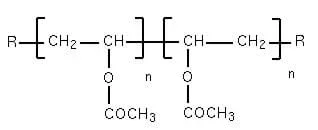 Copyright Azim Laiwalla, UCLA SEE-LA GK-12 Program, University of California, Los Angeles
In the presence of water, borax forms the following borate-boric acid buffer system: Copyright Azim Laiwalla, UCLA SEE-LA GK-12 Program, University of California, Los Angeles
When mixed together, the polyvinyl acetate is cross-linked, trapping water, and produces the white clog: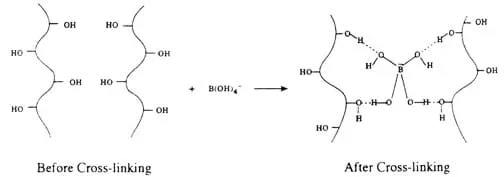 Copyright Azim Laiwalla, UCLA SEE-LA GK-12 Program, University of California, Los Angeles
In this lab, your objective is to explore chemical treatments that are able to degrade the white clog and restore flow in the tube.
Before the Activity—Teacher
- Gather materials and make copies of the Let the Blood Flow Student Handout (PDF).
- Prepare for each group one model blood clot in an artery (clear tubing obstructed with a polymer "clot"), following these steps:
- Place the stopper one inch from the bottom of the four-inch length of clear, flexible tubing.
- Prepare the polyvinyl acetate polymer by mixing together 15 ml white glue, 30 ml water, 10 ml 4% borax solution and stirring well.
- Quickly pour the polymer into the tubing, about one-half inch in height.
- Remove the stopper from the tubing.
Before the Activity—With the Students
- Review with students the content presented in the associated Blood Clot, Polymers and Stroke lesson. Assign students to answer the pre-lab questions provided in the Assessment section (page 1 of the student handout).
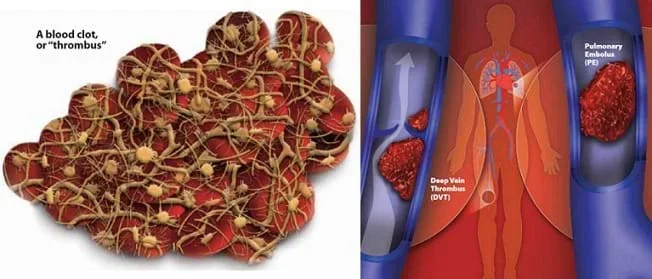 Biomedical engineers help to save lives in the case of potentially deadly blood clots of "thrombus" in the blood vessels.Copyright Agency for Healthcare Research and Quality, U.S. Department of Health & Human Services http://effectivehealthcare.ahrq.gov/index.cfm/search-for-guides-reviews-and-reports/?productid=1144&pageaction=displayproduct
With the Students—Instructions
Divide the class into groups of five students each.
Direct students to follow the instructions on the student handout to make four polyvinyl acetate polymers of varying concentrations. Remind them to record all observations—color, texture, viscosity, smell, etc. Direct them to make polymers in the paper cups only—do not pour white glue in the graduated cylinders. Below is a teacher version of the instructions on the student handout:
- Label the four paper cups as polymers 1, 2, 3, 4.
- Fill the graduated cylinder with 15 ml of water and pour into paper cup 1. Mark the level of the water in the cup. Pour out the water. Mark the same level on the three other cups.
- For each paper cup trial, fill the white glue up to the line on the paper cup. Vary the amounts of borax solution and water based on the table in the student handout.
- Stir well and once polymer is formed, knead for several minutes and continue to observe and record observations in the table. (As necessary, guide students to discover the correct polymer by comparing their samples to the model "blood clot" in the "artery.") Based on your observations, determine which one of the polymers created is the same concentration as the "blood clot" in the artery. (Answer: Polymer 2.)
- Develop a liquid solution to unclog the artery (tube).
- Design an experiment using your knowledge of making polymers and its molecular structure to test how well each of the six liquids (1 M HCl, 1 M NaOH, enzyme solution, 5% NaCl solution, glucose solution, liquid detergent) break down the polyvinyl acetate polymer. Make sure the correct concentration of the polyvinyl acetate polymer is being used for the tests; if necessary, create more of this sample for testing.
- An example experiment: Add a small sample of the polymer to the test tube, and then a sample of one of the liquids. Begin with a few drops of the liquid. If you do not see anything happen, add a few more drops. Record your observations on the handout. Empty the test tube contents into the hazardous waste bin and clean out the test tube.
- Repeat the previous step for the remaining five liquids.
- After testing is done, present and demonstrate your method to the entire class. Describe to the class the steps your group took to discover your best liquid solution. Over a bucket, pour your liquid solution into the model artery to the class how effective it is at breaking down the "blood clot."
- Have students prepare lab reports with the following sections: objective, hypothesis, materials and methods, data, data analysis, discussion and conclusion.
- Assign students to answer the post-lab questions by the day after the activity.
- blood clot
- A meshwork of fibrin and platelets that stops blood loss at the site of damage.
- coagulation
- The process of forming a blood clot.
- degradation
- The process of breaking down a substance.
- embolism
- An object (blood clot, plaque) that travels through a vessel and blocks blood flow.
- hemorrhage
- A discharge of blood from a ruptured blood vessel; bleeding.
- ischemia
- Lack of blood flow.
- polymer
- Large molecule made of repeating units covalently bound to one another.
- stroke
- A loss of brain function due to interruption of the blood supply to the brain.
- thrombosis
- Abnormal blood clot formation within a vessel.
- vessel
- The "pipes" of the circulatory system that transport blood.
Pre-Activity Assessment
Pre-Lab Questions: On the day prior to conducting the activity, have students answer the following questions, as provided on page 1 of the Let the Blood Flow Student Handout (PDF). See answers in the Let the Blood Flow Student Handout Example Answers (PDF). Review answers with students and briefly explain the blood clotting procedure.
- What is a polymer? How does a polymer form? What type of atom most commonly allows the formation of natural polymers?
- Is a blood clot a polymer? Is it a protein?
- What are causes of stroke?
- Flow rate is the amount of fluid that flows per unit time: f= Av, where f is the flow rate, A is the cross-sectional area of the pipe/vessel, and v is the speed of the flow. What is the flow rate of blood through a vessel that is 1 cm in diameter moving at 5 cm/s?
- If the same blood vessel as in question 4 has a blood clot that is 2 cm long and 0.7 cm thick, what is its estimated volume in centimeters? What is the new flow rate? What is the difference from your previous answer?
Activity Embedded Assessment
In-Class Presentation: Have teams present their biomedical methods and solutions to the entire class, explaining why they chose that liquid solution, what concentration they used, and what they think will happen. Conduct the final liquid solution trials in front of the entire class. Ask students to suggest ways to improve their results. In addition, ask students to explain how the molecular structure of the polymer makes it clog the tubing. (Hint: remind students of the reactions discussed in the Introduction/Motivation.) Have them explain the properties of the polymer that might make it useful for other purposes.
Post-Activity Assessment
Lab Report: Have students complete lab write-ups with the following sections: objective, hypothesis, materials and methods, data, data analysis, discussion and conclusion. Review their lab reports to gauge their comprehension.
Post-Lab Questions: As homework, assign students to answer the post-lab questions on the student handout by the day after the activity. Review their answers to gauge their comprehension.
- If a blood vessel was clogged with a polyvinyl acetate polymer, would the solution your group found be applicable? Explain.
- If you were developing a cure or treatment for patients with life-threatening blood clots, what would you need to do before trying it on the actual patients?
- Students must wear protective equipment, including chemical goggles, lab apron and gloves.
- Make sure the classroom or lab used for this activity has lab safety equipment, including a safety shower, first-aid kit, telephone, fire extinguisher, eye wash and fire blanket.
- Do not allow students to put the polymer in their mouths.
- Refer to the following websites for specific information about handling hydrochloric acid (HCl) and sodium hydroxide (NaOH): https://www.carolina.com/teacher-resources/Interactive/chemistry-recipes-for-common-solutions/tr10863.tr
Students may feel that they do not have enough instruction to scientifically find a liquid solution to unclog the tube and rather decide to just test all available solutions—urge students to use their knowledge of how the polymer forms on a molecular level.
Chemistry. Encyclopædia Britannica. 2009. Encyclopædia Britannica Online. Accessed May 3, 2009 http://www.britannica.com/EBchecked/topic/108987/chemistry
Heart Disease and Stroke Statistics. 2009 Update: A Report from the American Heart Association Statistics Committee and Stroke Statistics Subcommittee. 2009. Accessed May 3, 2009 http://circ.ahajournals.org/cgi/reprint/CIRCULATIONAHA.108.191261
- Blood Clots, Polymers and Strokes
- Let the Blood Flow: Biomedical Artery Unclogging Experiment
Contributors
Azim Laiwalla; Ann McCabe; Carleigh Samson
Supporting Program
Science and Engineering of the Environment of Los Angeles (SEE-LA) GK-12 Program, UCLA
Acknowledgements
This digital library content was developed by the University of California's SEE-LA GK-12 program under National Science Foundation grant number DGE 0742410. However, these contents do not necessarily represent the policies of the National Science Foundation, and you should not assume endorsement by the federal government.
Copyright
2013 by Regents of the University of Colorado; original © 2009 University of California, Los Angeles