
Measuring Lava Flow
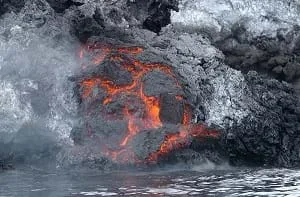 Students measure lava flowCopyright http://upload.wikimedia.org/wikipedia/commons/1/18/Tair_Mountain_-_Lava_flow.jpg
Students learn how volume, viscosity and slope are factors that affect the surface area that lava covers. Using clear transparency grids and liquid soap, students conduct experiments, make measurements and collect data. They also brainstorm possible solutions to lava flow problems as if they were geochemical engineers, and come to understand how the properties of lava are applicable to other liquids.
Many types of engineers must understand the properties of liquids, including how they behave differently depending on their volume, viscosity and slope. This applies directly to geoengineers who devise ways to divert the flow of lava if it becomes a hazard to people and communities. It also applies to engineers who design factory equipment that bottles liquids, everything from motor oil and glue to orange juice and milk, and chemical engineers who create plastics, fuel and ceramics.
After this activity, students should be able to:
- Understand and describe how volume, viscosity and slope (of the substrate) affect the surface area that a fluid covers.
- Understand that lava behaves like other fluids in the liquid state of matter.
- Gather evidence and data to logically support or disprove a hypothesis.
- Calculate the area of irregular shapes by counting squares and partial squares.
- HSG.GMD.B Visualize relationships between two-dimensional and three-dimensional objects
Grades 9-12
Do you agree with this alignment?
- HS-ESS2-1 Develop a model to illustrate how Earth's internal and surface processes operate at different spatial and temporal scales to form continental and ocean-floor features.
Grades 9-12
Do you agree with this alignment? - HS-ESS3-1 Construct an explanation based on evidence for how the availability of natural resources, occurrence of natural hazards, and changes in climate have influenced human activity.
Grades 9-12
Do you agree with this alignment?
- STEL-3G Explain how knowledge gained from other content areas affects the development of technological products and systems.
Grades 6-8
Do you agree with this alignment?
- Properties and Changes of Properties in Matter
Grades 5-8
Do you agree with this alignment?
- DCI.ESS2.A.6-8.4 All Earth processes are the result of energy flowing and matter cycling within and among the planet's systems. This energy is derived from the sun and Earth's hot interior. The energy that flows and matter that cycles produce chemical and physical changes in Earth's materials and living organisms.
Grades 6-8
Do you agree with this alignment? - HS-ESS3-1 Construct an explanation based on evidence for how the availability of natural resources, occurrence of natural hazards, and changes in climate have influenced human activity.
Grades 9-12
This resource focuses on the following Three Dimensional Learning aspects of NGSS:
Science & Engineering Practices- Construct an explanation based on valid and reliable evidence obtained from a variety of sources (including students' own investigations, models, theories, simulations, peer review) and the assumption that theories and laws that describe the natural world operate today as they did in the past and will continue to do so in the future.Do you agree with this alignment?
Disciplinary Core Ideas- Resource availability has guided the development of human society.Do you agree with this alignment?
- Natural hazards and other geologic events have shaped the course of human history; [they] have significantly altered the sizes of human populations and have driven human migrations.Do you agree with this alignment?
Crosscutting Concepts- Empirical evidence is required to differentiate between cause and correlation and make claims about specific causes and effects.Do you agree with this alignment?
- Modern civilization depends on major technological systems.Do you agree with this alignment?
Do you agree with this alignment? - Construct an explanation based on valid and reliable evidence obtained from a variety of sources (including students' own investigations, models, theories, simulations, peer review) and the assumption that theories and laws that describe the natural world operate today as they did in the past and will continue to do so in the future.
- DCI.ESS2.A.6-8.5 The planet's systems interact over scales that range from microscopic to global in size, and they operate over fractions of a second to billions of years. These interactions have shaped Earth's history and will determine its future.
Grades 6-8
Do you agree with this alignment?
Each group needs:
- 3 transparencies with a grid of -cm2 boxes photocopied on it (use Blank Graph Paper (PDF) for the grid)
- 1 graduated cylinder (at least 10 ml)
- materials from one of the following three different experimental groups:
- Viscosity-measuring group materials: 8 ml liquid soap, 1 T salt, 5 ml water, 4 small cups, eyedropper
- Volume-measuring group materials: 18 ml liquid soap, small cup
- Slope-measuring group materials: 9 ml liquid soap, 1 pencil, small cup, and 1 small circular wooden dowel (such as a medical applicator stick, 1/12-inch diameter x 6-inch long [~2.1-mm x 15.2-cm], available from medical products companies, such as Puritan Medical Products)
- paper towels, sponges and water (for clean-up)
- Measuring Lava Flow Worksheet (PDF), one per student
- (optional) cardboard box or plastic tub to organize a group's various materials
- (optional) containers or squeeze bottles for liquid soap (to make measuring easier and tidier)
- (optional) plastic pipettes, instead of pouring soap
For the teacher to demonstrate the procedure:
- 1 grid transparency and few ml of liquid soap
- (optional) overhead projector
A mathematical understanding of surface area and volume. The definitions of viscosity and slope. Background knowledge in lava flows and volcanoes, as presented in the associated How Far Does a Lava Flow Go? lesson.
Do you know anyone who lives near a volcano? Would you want to live near a volcano? What happens to the towns and communities near volcanoes when they erupt? (Take suggestions from students. Possible answers: The area surrounding the volcano would contain fire, explosions, noise, ash, heat, wind and lava in the air, water and land near people's homes and activities, affecting their breathing, comfort, shelter, water and food supplies, and safety.)
Does everyone know what lava is? (Answer: Lava is extremely hot molten rock mixed with dissolved gasses from the Earth's core that reaches the planet's surface.) Some erupting volcanoes spew lava in violent bursts, which results in steep-sloped volcano shapes. Others release great quantities of lava that spew forth in rivers, like streams, producing gently-sloping volcanoes.) What is lava like? What is its state of matter? (Liquid) How fast does it move? How far does it move? How thick does it cover the surface? Let's find out more about the factors that determine how far a lava flow goes.
Today you will be experimenting with how volume, viscosity and slope affect the surface area that a liquid, like lava, covers. (As necessary, make sure students understand the three factors: volume, viscosity, slope.) We will use liquid soap to represent volumes of molten hot lava (but you can touch it, of course!). Some groups will experiment with viscosity by also using salt and water to investigate this property. Other groups will investigate the effect of various sloped surfaces on the lava spread. Volcano shapes are different from each other and different landscape slopes affect how a liquid flows over it. For all groups, your lava (soap) will flow over a transparency with1-cm squares printed on it, which represents your volcano. You will record the surface area that your lava covers by pouring it onto the grid transparency and counting the covered squares. Partial squares should be added up to whole squares using your best guesses.
(Demonstrate the basic experiment and measurement process to students by using an overhead projector with a grid transparency, or gathering students around a table. Pour a small amount of liquid soap, wait for it to stop spreading, and then count the covered squares [adding up partial squares] to determine the surface area covered by the lava.)
By understanding these factors as they apply to liquid soap (representing lava), we can understand how the properties of liquids are used in the real world, just as engineers do.
Background
This activity simulates volcanoes and lava flows. It is suggested that this activity be conducted in conjunction with its associated lesson, How Far Does a Lava Flow Go?
Students teams use liquid soap and plastic grid paper to simulate and measure lava flows. To begin this activity, students are asked to form hypotheses on how the factors of volume, slope and viscosity may affect the surface area that a liquid covers. Then they test their hypotheses through experimentation. They determine surface area by counting the number of grid squares that the liquid soap covers, adding together partial boxes to make wholes.
The equation for the surface area of a square is useful for this lesson: surface area = side length2.
At the end of the activity, students are asked to "become" geochemical engineers to think of ways to slow down, divert or halt lava flows. In a concluding discussion, they see how the properties of liquids that they learned about are applicable to other real-life scenarios.
Before the Activity
- Gather materials and organize them in separate cardboard boxes or plastic tubs for each team. If the class is divided into more than three groups, have more than one team do the same experiment, or add the activity extension idea (using heated liquid soap).
- Put soap into containers or squeeze bottles for students' ease of use.
- Make copies of the Measuring Lava Flow Worksheet. (PDF)
- Make grid transparencies by photocopying the Blank Graph Paper (PDF) onto transparencies.
With the Students
- Demonstrate the general procedure by placing a grid transparency on an overhead projector and pouring a small amount of liquid soap on it. Tell the class that they must figure out on their own how to find the surface area that the liquid covers by using the 1-cm2 squares. Point out that partial squares must be accounted for (not ignored). Remind students that the surface area is the total area that the soap covers and in this case equals the area of the two-dimensional squares it covers. If necessary, remind students that the area of a square is equal to the length of one side squared (surface area = side length2).
- Divide the class into teams of at least three students per group; teams of six are suggested.
- Ask each group which aspect they want to explore: volume, viscosity or slope. Make sure at least one group tests each aspect.
- Hand out the worksheets, which provide detailed experiment instructions. Direct students to follow the written procedures for Part 1 of their assigned experiments. Each group writes a hypothesis about how they expect volume, viscosity or slope to affect the surface area the liquid covers. Direct students to make a table and record their data and observations on their worksheets.
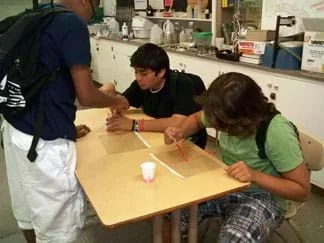 Students conducting the lava flow activity.Copyright 2009 Marschal Fazio, University of California, Los Angeles
 - Give students time to perform the experiments. Help with any problems or questions.
- For Part 2, have students share their group data by writing it in tables on the classroom board. Have students complete their worksheets by determining the relationship between what they tested (volume, viscosity or slope) and surface area of the liquid, and writing down whether their own group's hypothesis was supported or rejected. Have them also write down the relationship between surface area and the other factors that they did not test in their experiment by examining data provided by the other groups.
- Lead a class discussion to review the results of all the groups. Discuss any unexpected results. (See questions provided in the Assessment section.)
- Direct students to move on to Part 3, in which each group acts as a team of geochemical engineers with the goal of finding good ways to stop, slow down or divert lava flows from human settlements. Encourage students to be creative and not restrict themselves by how much a solution might cost or how hard it would be to achieve; this is how teams of engineers initially come up with great ideas. Give students time to brainstorm, write down and sketch their ideas.
- Lead a concluding group discussion to share brainstorming ideas.
- slope
- Steepness, incline, such as the slope of the side of a volcano or mountain.
- surface area
- The extent of a two-dimensional surface enclosed within a boundary.
- viscosity
- A liquid's resistance to flow.
Pre-Activity Assessment
Warm-Up Questions: Ask students the following questions:
- What is volume? (Answer: Volume is the three-dimensional mass of a material.)
- What is viscosity? (Answer: Viscosity is a fluid's resistance to flow. More viscous fluids do not flow as easily as less-viscous ones.)
- What are some highly viscous liquids? (Possible answers: Honey, molasses, glue, motor oil, sour cream, vegetable oil, shampoo.)
- What are some lower-viscous fluids? (Possible answers: Water, juice, milk, coffee, gasoline, alcohol.)
- What is slope? (Answer: Slope is the steepness or incline of a surface.)
- What is surface area? (Answer: The amount of two-dimensional space within a certain perimeter.)
Activity Embedded Assessment
Experimentation and Data Collection: Make sure that groups have written down on their Measuring Lava Flow Worksheets (PDF) their hypotheses on how volume, viscosity or slope will affect the surface area that their lava (soap) covers. Make sure students record their data in their own data tables and write it on the classroom board for other teams to copy down. Have students examine the data to determine the relationships between surface area and volume, viscosity and slope, and describe these on their worksheets. Have them also state whether their group's hypothesis was supported or not.
Post-Activity Assessment
Class-Wide Analysis of Results & Discussion: Ask the students and discuss as a group the following questions. Ask for volunteers from each group to describe their results.
- What did you find from your experiments about the relationships between the surface area that a liquid covers and its volume, viscosity and the slope of the substrate it flowed across? (Answer: Expect students to report that the surface area associates positively with volume and slope, and negatively with viscosity.)
- Any unexpected results? Discuss what could have caused them.
- Are all volcanoes equally dangerous? (Answer: No. The amount of danger or hazard depends on how much lava is released [volume], its viscosity [how fast it moves], and the slope of the volcano it flows down, as well as other magma characteristics and environmental conditions.)
- As "geochemical engineers," what possible solutions did you come up with to halt or divert the flow of lava? (Possible answers: In general, ways to increase viscosity, make the slope less steep, reduce the volume, or more specifically, throw additional rocks into the lava to make it more viscous or divert the flow so that less volume reaches inhabited areas, etc.)
- How are the properties of lava that you have learned about during this activity relevant to understanding the movements of other liquids? (Answer: The properties relating the surface area to the volume, viscosity and slope in lava are the same for any liquid. One can use this knowledge to design new liquids or the facilities and factories that contain or process them.)
- Students should not ingest soap.
- If you have students conduct the activity extension to test the effect of temperature on surface area, monitor them when they are heating the liquid soap, as it should not be overheated; only about 10 seconds in a microwave is necessary.
Test the effect of temperature on surface area by having some groups use heated liquid soap. Carefully heat the soap in a microwave for about 10 seconds before pouring it on a transparency.
- For lower grades, focus on the conceptually simpler topics of how volume and slope affect the surface area a liquid can cover (eliminate the topic of viscosity).
- For lower grades, conduct the three experiments as classroom demonstrations with students being called on to do each step.
- For upper grades, ask students to make bar graphs of their data, or repeat their experiment three times and calculate an average. More time may be required to add these tasks.
- For upper grades, provide less guidance, requiring students to figure out and record their own methods in order to test their hypotheses, and/or figure out how to measure and calculate surface area on their own.
- For upper grades, suggest more options for experimentation, such as the effect of temperature and substrate texture on surface area.
Learn about the active volcano on Montserrat Island in the Caribbean, which has destroyed its cities, airports and harbor on one side of the island. See https://en.wikipedia.org/wiki/Montserrat
Learn about the active volcanoes on Hawaii, where lava flow regularly flows over roads and into residential areas. See Hawaii's lava flow hazard zone maps at USGS's website, https://pubs.usgs.gov/mf/1992/2193/
Smith, Michael; Southard, John B.; Eisenkraft, Arthur; Freebury, Gary; Ritter, Robert; Demery, Ruta. Integrated Coordinated Science for the 21st Century. Armonk, NY: It's About Time, 2004. (Activity is adapted from Part A: Area of Lava Flow, pg. 26.)
See the original website rendering of this curriculum at: http://measure.igpp.ucla.edu/GK12-SEE-LA/Lesson_Files_08/Lessons0809/lesson_BE_lava.html
- How Far Does a Lava Flow Go?
- Measuring Lava Flow
Contributors
Brittany Enzmann; Marschal Fazio (This lesson was classroom-tested in ninth-grade Integrated Coordinated Science classes at University High School in Los Angeles.)
Supporting Program
Science and Engineering of the Environment of Los Angeles (SEE-LA) GK-12 Program, UCLA
Acknowledgements
This digital library content was developed by the University of California's SEE-LA GK-12 program under National Science Foundation grant number DGE 0742410. However, these contents do not necessarily represent the policies of the National Science Foundation, and you should not assume endorsement by the federal government.
Copyright
2013 by Regents of the University of Colorado; original © 2009 University of California, Los Angeles