
How Far Does a Lava Flow Go?
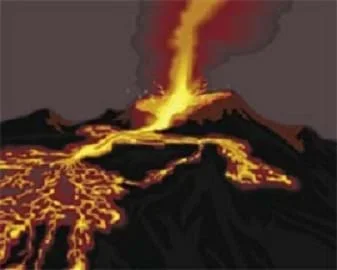 Lava behaves like other fluids in the liquid state of matter.Copyright 2004 Microsoft Corporation, One Microsoft Way, Redmond, WA 98052-6399 USA. All rights reserved.
While learning about volcanoes, magma and lava flows, students learn about the properties of liquid movement, coming to understand viscosity and other factors that increase and decrease liquid flow. They also learn about lava composition and its risk to human settlements.
Many types of engineers must understand the properties of liquids. Understanding viscosity and the factors that change how liquids move can aid in the design of structures that use liquids to do work, as well as structures and devices that control or contain liquids. Geochemical engineers use science to solve environmental and civil engineering problems, some working on ways to halt or divert lava flows to protect human-built structures. For instance, R.D. Schuiling suggests that limestone walls could be built to rapidly cool lava (making it more viscous) and thus slow the flow enough to salvage human settlements.
After this lesson, students should be able to:
- Describe two different kinds of volcanoes, in terms of the nature of their lava flows and resulting slopes.
- Explain how the properties of liquid movement are relevant to the phenomena of lava flows and how this can affect human civilization.
- Describe how fluid properties are important in science and engineering.
- HS-ESS2-1 Develop a model to illustrate how Earth's internal and surface processes operate at different spatial and temporal scales to form continental and ocean-floor features.
Grades 9-12
Do you agree with this alignment? - HS-ESS3-1 Construct an explanation based on evidence for how the availability of natural resources, occurrence of natural hazards, and changes in climate have influenced human activity.
Grades 9-12
Do you agree with this alignment?
- STEL-3G Explain how knowledge gained from other content areas affects the development of technological products and systems.
Grades 6-8
Do you agree with this alignment?
- Properties and Changes of Properties in Matter
Grades 5-8
Do you agree with this alignment?
- HS-ESS2-1 Develop a model to illustrate how Earth's internal and surface processes operate at different spatial and temporal scales to form continental and ocean-floor features.
Grades 9-12
This resource focuses on the following Three Dimensional Learning aspects of NGSS:
Science & Engineering Practices- Develop a model based on evidence to illustrate the relationships between systems or between components of a system.Do you agree with this alignment?
Disciplinary Core Ideas- Earth's systems, being dynamic and interacting, cause feedback effects that can increase or decrease the original changes.Do you agree with this alignment?
- Plate tectonics is the unifying theory that explains the past and current movements of the rocks at Earth's surface and provides a framework for understanding its geologic history. Plate movements are responsible for most continental and ocean-floor features and for the distribution of most rocks and minerals within Earth's crust.Do you agree with this alignment?
Crosscutting Concepts- Change and rates of change can be quantified and modeled over very short or very long periods of time. Some system changes are irreversible.Do you agree with this alignment?
Do you agree with this alignment? - Develop a model based on evidence to illustrate the relationships between systems or between components of a system.
- HS-ESS3-1 Construct an explanation based on evidence for how the availability of natural resources, occurrence of natural hazards, and changes in climate have influenced human activity.
Grades 9-12
This resource focuses on the following Three Dimensional Learning aspects of NGSS:
Science & Engineering Practices- Construct an explanation based on valid and reliable evidence obtained from a variety of sources (including students' own investigations, models, theories, simulations, peer review) and the assumption that theories and laws that describe the natural world operate today as they did in the past and will continue to do so in the future.Do you agree with this alignment?
Disciplinary Core Ideas- Resource availability has guided the development of human society.Do you agree with this alignment?
- Natural hazards and other geologic events have shaped the course of human history; [they] have significantly altered the sizes of human populations and have driven human migrations.Do you agree with this alignment?
Crosscutting Concepts- Empirical evidence is required to differentiate between cause and correlation and make claims about specific causes and effects.Do you agree with this alignment?
- Modern civilization depends on major technological systems.Do you agree with this alignment?
Do you agree with this alignment? - Construct an explanation based on valid and reliable evidence obtained from a variety of sources (including students' own investigations, models, theories, simulations, peer review) and the assumption that theories and laws that describe the natural world operate today as they did in the past and will continue to do so in the future.
A mathematical understanding of surface area, an understanding of the liquid phase, and background earth science knowledge about the Earth's layers, plate tectonics and volcanoes.
Through this lesson and its associated activity, students learn through experimentation the relationships between a flowing liquid's volume, viscosity, slope, and the surface area it covers. While some equations involving flow and viscosity can be complex, the essential relationships between volume, viscosity, slope and the surface area coverage of lava flows are straightforward. The greater the lava volume, the more surface area covered. The more viscous the lava, the less surface area it covers. The steeper the slope, the more surface area the lava covers. As with all liquids, other properties play a role in lava's movement, too, such as its temperature (higher temperature results in lower viscosity), composition (silica-rich lava is cooler, thicker and slower flowing), obstacles (more obstacles slow its flow) and substrate texture (rough texture slows its flow). Hence, volcanoes are not all equally hazardous to human populations, since every volcano is unique in its lava volume, viscosity, slope and other characteristics and conditions.
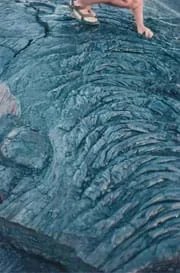 Looking at cooled lava, it is hard to imagine that it once flowed like a river.Copyright 1996 Denise W. Carlson, University of Colorado Boulder. Used with permission.
Many active volcanoes exist today around the world. Some are a lot more dangerous than others. Following are a few examples:
- Mt. Kilauea in Hawaii: The locals must constantly be aware of the changing directions of the very active volcano's lava flows as it crosses roads and invades residential neighborhoods. Luckily, this lava tends to be slow-moving because of its high viscosity and the volcano's gentle mountain slopes.
- Mt. Saint Helens in Washington: The 1980 pyroclastic eruption of this volcano was the deadliest and most destructive in US history. It killed 57 people and destroyed numerous homes, roads, bridges and other structures.
- Mt. Nyiragongo in the Democratic Republic of the Congo: This volcano's unique low-viscosity lava (due to its low silica content) and steep slopes makes its fast-moving lava (up to 60 mph! [97 kph]) flows a huge risk for the nearby city of Goma.
Lava is composed of hot molten rock (magma) mixed with dissolved gases. At extremely high temperatures (2000° F or 700° C, or higher!), it behaves like other fluids in the liquid state of matter. Knowing the properties of liquids, geochemical engineers think of creative ways to protect human settlements and structures from lava flows (as much as is possible). This might include cooling the lava and its surrounding air so it hardens and slows, adding material to the lava to increase its viscosity, erecting structures and swales to block and re-route lava streams, and changing the slope and/or texture of the slope. In a broader sense, engineers of all types must understand the properties of liquid movement for the work they do — designing dams, levees, boat motors, turbines; understanding ocean currents; creating liquid products and manufacturing plants, cleaning up toxic spills, studying the Earth's mantle and how liquids behave in space.
Volcanoes can be hazardous geological features. They contain large amounts of extremely hot molten rock mixed with dissolved gases that are very close to the surface of the Earth (show or sketch on the board a picture showing magma beneath a volcano). Does anyone know what the molten rock mixture is called? (Answer: Magma.) What can happen to magma when it moves close to the surface and the gases start to bubble out? (Answer: It can erupt.) Once magma reaches the surface, it is called lava. Lava can leave volcanoes in violent bursts. We call this an explosive eruption (show a picture of an erupting volcano, or depict it by drawing on the board). It can also leave the volcano through river-like streams. This is called an effusive eruption (show a picture or draw on the board). When lava flows effusively, various factors can make it move faster or slower, and also affect how much area the lava covers.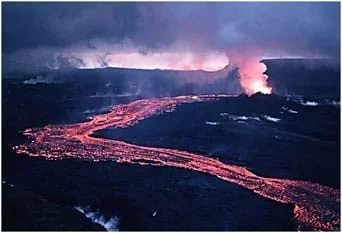 Effusive lava flow during a rift eruption at Krafla volcano in northern Iceland in 1984.Copyright Michael Ryan, US Geological Survey, Wikimedia Commons http://en.wikipedia.org/wiki/File:Lava_flow_at_Krafla,_1984.jpg
For instance, the greater the amount of the compound silica (SiO2) present in the magma, the more sluggishly it moves. The ability of a fluid to move fast or slow is called its viscosity. Described another way, viscosity is a fluid's resistance to flow. This means that more viscous fluids do not flow as easily as less viscous ones. Who can think of some fluids that are viscous? (Example answers: Honey, glue, oil, sour cream, shampoo, motor oil.) How about some fluids that are not very viscous? (Example answers: Water, juice, milk, coffee, gasoline, alcohol.) Viscosity is an important property of fluids; it has many applications in our lives. For instance, suppose you were an engineer that was designing a glue factory. Would it be important to know the viscosity of glue in order to design machines that fill glue bottles?
Now getting back to lava flow, another aspect that can affect the spread of lava is the shape of its volcano. Volcano shapes can be tall and thin or short and wide. That means that they may have different slopes. Some are steep and some are not. These different landscapes were caused by different types of lava eruptions in the first place, and in turn, affect how liquids flow over them.
Properties such as volume, viscosity and the slope of a surface can all affect how a liquid flows and thus how much surface area it can cover. These properties are important to engineers who work with liquids because they must understand how liquids move. For instance, a chemical engineer must know the properties of a liquid product in order to design a container for it. Environmental engineers must know how water moves in order to create barriers such as dams or levees to divert or contain bodies of water.
(Proceed to conduct the associated activity, Measuring Lava Flow.)
(Conclude the lesson after completion of the associated activity, Measuring Lava Flow.)
Now that you have experimented with your lava (liquid soap), who can tell me how volume affects the surface area that a lava flow will cover? (Answer: Greater volume covers more area.) How about how viscosity affects the surface area that a lava flow will cover? (Answer: The more viscous the lava, the less area it covers.) Who can tell me how slope affects the surface area that a lava flow will cover? (Answer: The steeper the slope, the more surface area it covers.) What other properties do you think affect lava flow? (Possible answers: Temperature [higher temperature results in lower viscosity], the chemical components making up the lava, how many obstacles block the path of the lava flow, the texture of the substrate over which the lava flows [smooth vs. rough].)
Let's revisit the question that I asked you earlier: Do all volcanoes have the same risk to human settlements? (Answer: Students should realize that risk to human settlements depends on many factors, including how much lava [its volume], how fast it flows [its viscosity], the slope of the volcano, and other surrounding conditions.) It turns out that some volcanoes are a lot more dangerous than others. One well-known example of a hazardous volcano is Mount Nyiragongo in the Democratic Republic of Congo. Its lava has very low viscosity because of its low silica content. Mount Nyiragogo also has very steep slopes. Together, these factors together enable the lava to travel up to 60 mph! And, the volcano's close proximity to a city also makes it especially dangerous. By contrast, Mt Kilauea in Hawaii is a much less steep volcano with more viscous lava, so even though it is very active, it poses less threat to people.
In the second part of the activity, each group "became" a team of geochemical engineers with the goal of brainstorming ways to save human structures from lava flows. I would like one person from each group to share one possibility you came up with as a way to stop or divert lava flows. (Encourage students to be creative! Possible answers: Spraying lava with cold water so it hardens and slows, building walls to block and divert, digging ditches to divert flow, decreasing the slope of the substrate, cooling the ambient air, adding things to the lava to increase its viscosity.)
Lastly, can anyone tell me why knowing the properties of liquid movement might be important to know in the world today? (Possible answers: Designing dams, boat motors, turbines, understanding water currents in the ocean, in industry [creating liquid products], studying the Earth's mantle and liquids in space.)
- effusive
- Flowing, for example, lava that flows.
- lava
- Magma that has reached the Earth's surface.
- magma
- A substance composed of melted rock and dissolved gasses.
- slope
- Steepness, incline.
- viscosity
- A liquid's resistance to flow.
Pre-Lesson Warm-Up Questions: Ask students the following questions:
- In which phase or state of matter is lava from a volcano? (Answer: Liquid.)
- Do all liquids move in the same way? (Answer: No, some are fast, some are slow.)
- Do you think that towns and cities that are close to volcanoes are all at the same risk during an eruption? (Answer: Expect various answers of why or why not students think some locations / volcanoes may be riskier than others. Indicate that the answer to this question will become clear later in the lesson.)
Post-Lesson Discussion: As a class, ask students the questions provided in the Lesson Closure section, using their answers to evaluate their comprehension.
Lava flow video clips at Volcano Video Productions' website at http://www.volcanovideo.com/p8vidclp.htm
See photos of lava in various states and a list of towns destroyed by lava at Wikipedia's page on lava: https://en.wikipedia.org/wiki/Lava
See a list of the world's 21 most active volcanoes and their years of continuous eruption at the Volcano Live website: http://www.volcanolive.com/active2.html
Allard, P.; Baxter, P.; Halbwachs, M.; Kasareka, M.; Komorowski, J.C.; and Joron J.L. "The most destructive effusive eruption in modern history: Nyiragongo 2003." Geophysical Research Abstracts 5 (2003): 11970.
Lamb, Annette, and Larry Johnson. Volcanic Landforms. May 2002. Naturescapes, eduScapes. Accessed November 12, 2009. http://eduscapes.com/nature/lava/index1.htm
Lava. (Questions and answers with volcanologist Dr. Stanley Williams.) Scholastic, Inc. Accessed November 12, 2009. http://www.scholastic.com/teachers/article/lava
Mount Nyiragongo. Onpedia. Accessed April 15, 2009. http://www.onpedia.com/encyclopedia/Mount-Nyiragongo
Schuiling, R.D. "How to stop or slow down lava flows" International Journal of Global Environmental Issues 2008, Vol. 8, No. 3, pp. 282-285.
Smith, Michael, Southard, John B., Eisenkraft, Arthur, Freebury, Gary, Ritter, Robert, Demery, Ruta. Integrated Coordinated Science for the 21st Century. Armonk, NY: It's About Time, 2004.
See the original website rendering of this curriculum at: http://measure.igpp.ucla.edu/GK12-SEE-LA/Lesson_Files_08/Lessons0809/lesson_BE_lava.html
- How Far Does a Lava Flow Go?
Contributors
Brittany Enzmann; Marschal Fazio
Supporting Program
Science and Engineering of the Environment of Los Angeles (SEE-LA) GK-12 Program, UCLA
Acknowledgements
This digital library content was developed by the University of California's SEE-LA GK-12 program under National Science Foundation grant number DGE 0742410. However, these contents do not necessarily represent the policies of the National Science Foundation, and you should not assume endorsement by the federal government.
Copyright
2013 by Regents of the University of Colorado; original © 2009 University of California, Los Angeles