
Investigating the Properties of Plastic and its Effects on the Environment
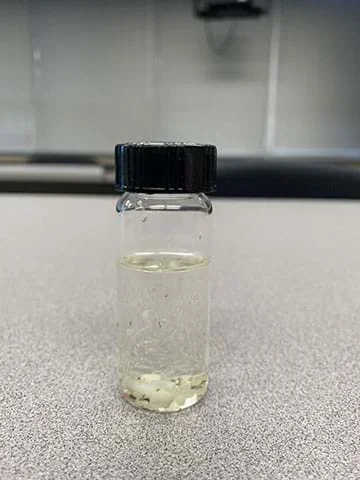 A sample of microplastics collected from the Pacific Ocean.Copyright 2019 Erica Smeader, University of Akron RET
Plastics offer a lot of worth to our world, ranging from medical use to consumer products, but they also adversely affect our environment and ecosystems. Working in teams, students investigate four different plastic properties: density, chemical decomposition, physical decomposition, and the ability to enter the food web. Based on their investigations, students learn how the properties of plastic create pollution that significantly impacts the environment and ecosystems.
Polymer engineering is a field of engineering in which plastics are created. Understanding plastic and its properties may help polymer engineers create more environmentally-friendly plastics and/or develop methods to clean up plastics. Plastic waste and cleanup also impact another branch of engineering: environmental engineering. Environmental engineering is a branch of engineering that utilizes math, science and engineering principles to create solutions that will protect and improve the health of living organisms and improve the condition of the environment. Environmental engineers also work on amelioration of plastic waste and its impacts.
After this activity, students should be able to:
- Identify sources of plastic and microplastic.
- Identify impacts of plastic and microplastic on the environment and ecosystems.
- Create, investigate and analyze potential solutions to the problems associated with plastic and microplastic pollution.
- CCSS.ELA-Literacy.RST.11-12.7 Integrate and evaluate multiple sources of information presented in diverse formats and media (e.g., quantitative data, video, multimedia) in order to address a question or solve a problem.
Grades 11-12
Do you agree with this alignment? - CCSS.ELA-Literacy.RST.11-12.8 Evaluate the hypotheses, data, analysis, and conclusions in a science or technical text, verifying the data when possible and corroborating or challenging conclusions with other sources of information.
Grades 11-12
Do you agree with this alignment? - CCSS.ELA-Literacy.W.9-10.7 Conduct short as well as more sustained research projects to answer a question (including a self-generated question) or solve a problem; narrow or broaden the inquiry when appropriate; synthesize multiple sources on the subject, demonstrating understanding of the subject under investigation.
Grades 9-10
Do you agree with this alignment?
- CCSS.Math.Practice.MP2 Reason abstractly and quantitatively.
Grades K-12
Do you agree with this alignment?
- Students will develop an understanding of the effects of technology on the environment.
Grades K-12
Do you agree with this alignment? - Students will develop an understanding of the role of society in the development and use of technology.
Grades K-12
Do you agree with this alignment?
- HS-LS2-7 Design, evaluate, and refine a solution for reducing the impacts of human activities on the environment and biodiversity.
Grades 9-12
This resource focuses on the following Three Dimensional Learning aspects of NGSS:
Science & Engineering Practices- Design, evaluate, and refine a solution to a complex real-world problem, based on scientific knowledge, student-generated sources of evidence, prioritized criteria, and tradeoff considerations.Do you agree with this alignment?
Disciplinary Core Ideas- When evaluating solutions it is important to take into account a range of constraints including cost, safety, reliability and aesthetics and to consider social, cultural and environmental impacts.Do you agree with this alignment?
- Moreover, anthropogenic changes (induced by human activity) in the environment—including habitat destruction, pollution, introduction of invasive species, overexploitation, and climate change—can disrupt an ecosystem and threaten the survival of some species.Do you agree with this alignment?
- Humans depend on the living world for the resources and other benefits provided by biodiversity. But human activity is also having adverse impacts on biodiversity through overpopulation, overexploitation, habitat destruction, pollution, introduction of invasive species, and climate change. Thus sustaining biodiversity so that ecosystem functioning and productivity are maintained is essential to supporting and enhancing life on Earth. Sustaining biodiversity also aids humanity by preserving landscapes of recreational or inspirational value.Do you agree with this alignment?
- Biodiversity is increased by the formation of new species (speciation) and decreased by the loss of species (extinction).Do you agree with this alignment?
Crosscutting Concepts- Much of science deals with constructing explanations of how things change and how they remain stable.Do you agree with this alignment?
Do you agree with this alignment? - Design, evaluate, and refine a solution to a complex real-world problem, based on scientific knowledge, student-generated sources of evidence, prioritized criteria, and tradeoff considerations.
Each group needs:
- A computer, phone or device with internet
- Student Worksheet (PDF) (1 per student)
For the class to share:
- compost kit available online (Note: this needs to be prepared weeks in advance.)
- 4 samples of water containing macro-invertebrates and plastic. These can be collected from regional sources such as rivers, lakes, and oceans or they can be created by ordering plastic (available online) and adding macroinvertebrates from local sources. For the macroinvertebrates, you can order freeze dried plankton to mix with plastic (available online).
- 6 beakers (400 ml) with tap or distilled water
- 4 magnifying glasses
- 8 pipettes
- 12 oz. face wash with microbeads (for example Clean & Clear Morning Burst Oil-Free Hydrating Facial Cleanser)
- 6 bowls (2 L or larger)
- samples of plastic materials with a variety of resin codes
- plastic for the compost kit (examples include plastic fork or spoon, plastic bag, Styrofoam, PVC pipe, plastic straw)
- 4 synthetic fabric (microfiber) samples (polyester/nylon; preferably in red color for better visibility), available online
- 4 funnels (10 cm diameter)
- 12 coffee filters
- 12 petri dishes
- 4 microscopes (dissecting preferred)
- 4 Background Sheets (PDF)
- slides of algae or other types of fish feeding material (optional)
- access to the internet and ability for teacher to show video for entire class to see
Students should come into the activity having an understanding of:
- ecosystems and the interconnectedness of life on the planet
- food chains and food webs
- plastics
How many of you used a plastic product today? (Have students respond by a show of hands.)
What were some of those items? (Have students give examples. Write a list of the plastic products on the board. Then go through the list and ask students to raise their hands to document how much of each product was used for a day. Optionally: multiply the numbers by week/month/year).
What do you think happens after you use the product? Does it just disappear? (Get responses from students.) If it doesn’t disappear, where does it go? What happens after it is thrown away? (Potential answers: recycled, landfills.) Discuss options such as landfills, burning, poor waste management, plastic entering rivers, lakes and streams, eventually ending up in the ocean.)
What do you think happens to plastic over time if it is constantly being exposed to the elements of nature? Do you think it will break down? What do you think will happen to those smaller pieces? (Get responses from students.)
Let’s talk about this word: microplastic. (Write this word on the board.) Microplastics are very small pieces of plastic. They are not a specific kind of plastic, but are any type of plastic fragment that is less than 5 mm in length. Microplastics are plastics that have broken down over time, have been weathered into smaller and smaller pieces. Microplastics are created by a variety of sources, including: cosmetics, plastic bags, manufacturing, tires, packaging and shipping, and plastic water bottles, among others.
Have you ever heard of a nurdle? (Listen to responses. If you have a sample of nurdles, pass them around and let students see what they look like.) Nurdles are like tiny beads and technically they are microplastics too. They are used to make plastic and because they enter the environment already in microplastic form, they are known as “primary microplastics.”
Nurdles and microplastics cause problems because when they get into the environment, specifically in the oceans, they can be mistaken for food by wildlife. Eating these plastic pieces is bad because it can cause animals to feel full and stop eating real food. This can lead to starvation and potentially death. In addition, plastics have toxic chemicals that can transfer from the microplastics to the animals that eat them, causing further harm. In this way, toxic plastic chemicals enter the food chain; bigger animals eat the smaller animals (which have already eaten the microplastics) and so on.
In this activity, our goal is to further discuss microplastics, and, specifically, their impact on the environment. You’ll see how their size makes it easy for them to enter the ecosystem, how they are entering the ecosystem, and where they are being found.
Background
Plastics are both durable and cheap, and humans produce a lot of them. Plastic is used in everything from packaging to buildings and construction (such as piping, plumbing, vinyl siding) to transportation, electronics, furniture, toys, cosmetics and other beauty products. Plastics are even used in the medical field, including polymer implants and other medical devices.
Plastics, also called polymers, are made from synthetic or semi-synthetic organic compounds. They are produced either by the conversion of natural products or by the synthesis of chemicals that generally come from oil, natural gas, or coal. Plastics tend to have high molecular weight which means each molecule can have thousands of atoms bound together. A high molecular weight increases how far the material can stretch before rupturing, increases the impact resistance of the material, increases the chemical resistance, and increases the viscosity of the material. Based on these properties, plastics are easily shaped when they are soft but hold their shape when hardened.
While the unique characteristics of plastic make it a material that is useful for many applications, these same properties have created (and still create) a global waste problem. Plastic pollution, the accumulation of plastic objects and particles (like plastic bags, bottles, or microbeads found in cleaning products), has significantly impacted the environment and ecosystems. Plastic pollution is difficult to contain, mitigate and remove because plastics decompose mechanically into smaller and smaller plastic pieces, called microplastics, decompose chemically very slowly.
Microplastics enter natural ecosystems from a variety of sources, including cosmetics, clothing, and industrial processes. Plastics can be detrimental to the environment and living organisms. Living organisms, particularly marine animals, can be harmed either by mechanical effects of plastic, like entanglement or ingestion of plastic objects, or through exposure to chemicals within the plastics that interfere with their physiology. Humans also can be affected chemically by plastic waste through the disruption of various hormonal mechanisms.
This activity will look into some of the properties of plastics and how those properties affect the ecosystem. The students will investigate four different properties: density, long decomposition, breaking down into microplastics, and the ability to enter the food web. There will be a set of four stations and the students will move around the room and learn about a different topic at each station.
Before the Activity:
- Weeks in advance, set up the compost kit. Fill one side with organic materials like banana peels and paper. Fill the other with plastic materials and dirt. Let the materials decay for a few weeks before lab.
- Set up the four exploration stations before the students arrive to class. Provide the following items at each station, enough for the maximum number of groups that will be at each station at any given time.
- Station 1: Chemical decomposition of plastic
- compost kit
- Station 2: Physical decomposition of plastic: Microplastics/Microfibers
- Microplastics activity:
- 3 bowls (2 L)
- beauty products containing microplastics
- 6 funnels
- 6 coffee filter
- water
- magnifying glass (optional)
- microscope (optional)
- Microfiber activity:
- samples of microfiber material (red preferably so it is easily seen)
- bowl/cup of water
- 8 pipettes
- either microscope or dissecting microscope and locate fiber strands
- slides of algae or other types of fish feeding material (optional)
- Station 3: Plastics density
- an assortment of plastic items
- 4 Background sheets
- a pitcher or bowl with water
- Station 4: Macroinvertebrates
- sealed container containing microplastics and macroinvertebrates, plankton, zooplankton, or algae
- microscope
- 4 petri dishes
- 4 pipettes
With the Students:
- Show students the video: “The Nurdles’ Quest for Ocean Domination” from TED-Ed: https://www.youtube.com/watch?v=KpVpJsDjWj8
- Briefly describe what each station covers and go over the worksheet.
- Station 1: Prediction and observation of plastic decomposition.
- Station 2: Analyzing how plastics breakdown into smaller plastic pieces called microplastics.
- Station 3: Using density to determine plastic type.
- Station 4: Observation of plastics and macroinvertebrates.
- After watching the video, assign students into teams of three.
- Assign student groups equally among the four stations. They will need their Student Worksheet (PDF).
- Give students about 15-20 minutes per station to complete the work.
- Student procedures for each station:
Station 1. Decomposition of plastic
- Students should observe the compost kit, noting the differences between the side filled with organic material and the side filled with plastic.
- Have students answer the questions on the worksheet about their observations.
- Students research decomposition times and fill in the table on the worksheet.
- Students answer the remaining worksheet questions. Students look at the composition kit with decomposing materials on both sides.
- Based on their observations, students answer the questions on the Student Worksheet (PDF).
Station 2: Mechanical breakdown of plastics into smaller pieces: Microfibers/Microplastics (Adapted from this YouTube video: https://www.youtube.com/watch?v=Hh1cGaVZL2s)
- Students can watch the video and follow along the steps (which requires one more bowl or jar than this version), or they can complete the following steps:
- Students will need the bowl/funnel/coffee filter/face wash/water.
- Line the funnel with coffee filter and place in a beaker.
- Squirt a small amount of face wash onto coffee filter.
- Use water in beaker and flush face wash through filter.
- Pull out filter and examine (use magnifying glass and/or microscope if you want a closer look)
- Read the article, https://www.chemistryworld.com/news/us-bans-microbeads-from-personal-care-products/9309.article?fbclid=IwAR0wfnJ2M0r5gxsmWwQTWBf6yJJBDKrzcGxOIJaI1KkCVxoZrIpoZ7VQdYo
- Answer the questions on the Student Worksheet (PDF).
- Watch the video on The Story of Stuff: https://storyofstuff.org/movies/story-of-microfibers/
- Answer the questions on the Student Worksheet (PDF).
- Complete the microfiber activity:
- Take a sample of the microfiber material.
- Place sample in bowl and cover it with 250 ml of water.
- Simulate washing (e.g., scrub the sample).
- Take water sample out using pipette and place in petri dish.
- Examine under either microscope or dissecting microscope and locate fiber strands.
- If using the slides of algae or other types of fish feeding material, students next examine these and compare the two.
- To extract microbeads from face wash, students first line the funnel with one coffee filter and place the funnel tip into an empty beaker.
- Students squirt a small amount of face wash onto the coffee filter.
- Fill another beaker with water and then gently flush the facewash through the filter. (Note: The microbeads should remain on the filter.)
- Gently pull out the filter and examine the microbeads with a magnifying glass or with a microscope.
- Read this article from Chemistry World and answer the following questions: https://www.chemistryworld.com/news/us-bans-microbeads-from-personal-care-products/9309.article?fbclid=IwAR0wfnJ2M0r5gxsmWwQTWBf6yJJBDKrzcGxOIJaI1KkCVxoZrIpoZ7VQdYo
- Complete the worksheet.
Station 3: Using Density to Determine the Type of Plastic (Adapted from “Plastic in the Water Column” Monterey Bay Aquarium):
- Students will use the Background Sheet (PDF) and density table graph to answer the following in their worksheet.
- Examine the plastics provided.
- Fill out the chart in the student worksheet.
- Test each plastic item for buoyancy by placing it in the water.
- Mark down if it sinks or floats.
- Answer the questions on the worksheet.
- Watch the video on Story of Stuff https://storyofstuff.org/movies/story-of-microfibers/ and answer the questions on the Student Worksheet (PDF).
- Instructions for the microfiber activity, students create a small sample of the microfiber material.
- Place the sample into bowl and pour one cup of water over the sample.
- Simulate washing (e.g., scrub the sample).
- Take a water sample out after “washing” for 1 minute.
- Examine the sample under a microscope and locate fiber strands.
- Draw your observations.
Station 4: Plastic or Macroinvertebrate
- Use pipette to put a sample into the petri dish.
- Place under dissecting microscope and focus.
- Observe.
- Draw observations.
- Watch the video, https://www.youtube.com/watch?v=FAi1okMUdQ8.
- Answer questions on the worksheet.
- buoyancy
- An upward force exerted by a fluid that opposes the weight of a partially or fully immersed object.
- decomposition
- The process of decaying or rotting.
- density
- The mass per unit volume of a substance.
- ecosystem
- Biological community of interacting organisms and their physical environment.
- food chain
- Hierarchical series of organisms each dependent on the next as a source of food.
- food web
- System of interlocking and interdependent food chains.
- gyre
- Any large system of circulating ocean currents.
- macroinvertebrate
- Organisms that lack a spine and are large enough to be seen with the naked eye. Examples of macro- invertebrates include flatworms, crayfish, snails, clams and insects, such as dragonflies.
- microplastic
- Extremely small pieces of plastic debris in the environment resulting from the disposal and breakdown of consumer products and industrial waste.
- nurdle
- Very small pellets of plastic which serve as raw material in the manufacture of plastic products.
- plastic
- A wide range of synthetic or semi-synthetic organic compounds that are malleable and so can be molded into solid objects.
- polymer
- A large molecule, or macromolecule, composed of many repeated subunits. An example is the many synthetic organic materials used as plastics and resins.
Pre-Activity Assessment
Food webs/food chains: Make sure that before the activity students have worked on and understand food chains and food webs. Have students create food webs and food chains so later when plastic is present in food chain they know where it will enter and how it will climb through and include many organisms.
Activity Embedded Assessment
Student Worksheet: Have students complete the Student Worksheet (PDF). It has guided questions that students will answer as they move through activity. It includes questions on activities as well as videos and articles found on-line.
Post-Activity Assessment
Brainstorm: Have students brainstorm ideas on how to keep plastic out of the ecosystem. Write down all ideas on the board and discuss how to apply these ideas in the future.
Gloves and goggles may be utilized as needed.
Activities that would extend on this include the activities Tracing Fluorescent Plastics in an Aquatic Environment and Creating Mini Wastewater Treatment Plants.
“How to discover hidden microplastics” - Sunday Science: https://www.youtube.com/watch?v=Hh1cGaVZL2s
“Plastics in the water column” - Monterey Bay Aquarium. https://www.montereybayaquarium.org/for-educators/educator-professional-development/curriculum/plastic-in-the-water-column
“The nurdles' quest for ocean domination” https://www.youtube.com/watch?v=KpVpJsDjWj8&fbclid=IwAR2ZYMzg4MUPNHl4BUBfVb0WHcokPq7mtIjpCi19ZP3f4SZyOMkIEUideK4
“The Great Pacific Garbage Patch” - National Geographic. https://www.nationalgeographic.org/encyclopedia/great-pacific-garbage-patch/
The story of microfibers. 2018 Story of Stuff Project. https://storyofstuff.org/movies/story-of-microfibers/
“US bans microbeads from personal care products” - Chemistry World. https://www.chemistryworld.com/news/us-bans-microbeads-from-personal-care-products/9309.article?fbclid=IwAR0wfnJ2M0r5gxsmWwQTWBf6yJJBDKrzcGxOIJaI1KkCVxoZrIpoZ7VQdYo.
Contributors
Erika Smeader
Supporting Program
Research Experience for Teachers, the Polymer Engineering Department, University of Akron, Akron, Ohio
Acknowledgements
This curriculum was based upon work at the University of Akron supported by the National Science Foundation under RET grant no. EFC-1542358. Any opinions, findings, and conclusions or recommendations expressed in this material are those of the authors and do not necessarily reflect the views of the National Science Foundation.
Copyright
2020 by Regents of the University of Colorado; original © 2019 University of Akron