
Tracing Fluorescent Plastics in an Aquatic Environment
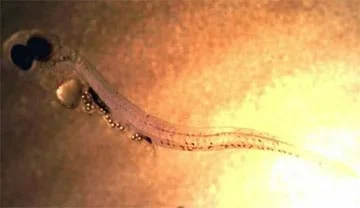 Aquatic species are prone to ingest any available small particles in the environment.Copyright 2016 Oona M. Lonnstedt, Wikimedia Commons CC BY-SA 3.0 https://commons.wikimedia.org/wiki/File:Microplastic_particles_influence_in_Perch_Larval.png
Student teams investigate the migration of small-particle plastic pollution by exposing invertebrates found in water samples from a local lake or river to fluorescent bead fragments in a controlled environment of their own designs. Students begin by reviewing the composition of food webs and considering the ethics of studies on live organisms. In their model microcosms, they set up a food web so as to trace the microbead migration from one invertebrate species to another. Students use blacklights and microscopes to observe and quantify their experimental results. They develop diagrams that explain their investigations—modeling the ecological impacts of microplastics.
Engineers design and implement municipal and industrial water treatment processes. To monitor the success of discharge and filtration efforts, they routinely test samples of both water and the organisms that depend on the integrity of the local ecosystem. Like engineers, students create model microcosm systems on which they conduct experiments to introduce pollution and then measure and observe the effects of human technology on the natural environment.
After this activity, students should be able to:
- Develop a microcosm that represents a freshwater aquatic food chain.
- Monitor the movement of fluorescent microbeads (FMB) within a microcosm environment.
- Use microscope skills to quantify, document and record the movement of FMBs.
- Present findings in a summary report, including a discussion of the significance of the results.
- Present an extrapolation of experimental results, including a food web diagram that illustrates the effects of technology (microbeads) on the environment.
- CCSS.Math.Content.HSS-ID.A Summarize, represent, and interpret data on a single count or measurement variable
Grades 9-12
Do you agree with this alignment?
- Students will develop an understanding of the effects of technology on the environment.
Grades K-12
Do you agree with this alignment? - Students will develop an understanding of the role of troubleshooting, research and development, invention and innovation, and experimentation in problem solving.
Grades K-12
Do you agree with this alignment?
- Summarize, represent, and interpret data on a single count or measurement variable.
Grades 9-12
Do you agree with this alignment?
- HS-ESS3-4 Evaluate or refine a technological solution that reduces impacts of human activities on natural systems.
Grades 9-12
Do you agree with this alignment? - HS-LS2-7 Design, evaluate, and refine a solution for reducing the impacts of human activities on the environment and biodiversity.
Grades 9-12
Do you agree with this alignment?
- HS-ESS3-4 Evaluate or refine a technological solution that reduces impacts of human activities on natural systems.
Grades 9-12
This resource focuses on the following Three Dimensional Learning aspects of NGSS:
Science & Engineering Practices- Design or refine a solution to a complex real-world problem, based on scientific knowledge, student-generated sources of evidence, prioritized criteria, and tradeoff considerations.Do you agree with this alignment?
Disciplinary Core Ideas- Scientists and engineers can make major contributions by developing technologies that produce less pollution and waste and that preclude ecosystem degradation.Do you agree with this alignment?
- When evaluating solutions it is important to take into account a range of constraints including cost, safety, reliability and aesthetics and to consider social, cultural and environmental impacts.Do you agree with this alignment?
Crosscutting Concepts- Engineers continuously modify these technological systems by applying scientific knowledge and engineering design practices to increase benefits while decreasing costs and risks.Do you agree with this alignment?
- Feedback (negative or positive) can stabilize or destabilize a system.Do you agree with this alignment?
Do you agree with this alignment? - Design or refine a solution to a complex real-world problem, based on scientific knowledge, student-generated sources of evidence, prioritized criteria, and tradeoff considerations.
- HS-LS2-7 Design, evaluate, and refine a solution for reducing the impacts of human activities on the environment and biodiversity.
Grades 9-12
This resource focuses on the following Three Dimensional Learning aspects of NGSS:
Science & Engineering Practices- Design, evaluate, and refine a solution to a complex real-world problem, based on scientific knowledge, student-generated sources of evidence, prioritized criteria, and tradeoff considerations.Do you agree with this alignment?
Disciplinary Core Ideas- When evaluating solutions it is important to take into account a range of constraints including cost, safety, reliability and aesthetics and to consider social, cultural and environmental impacts.Do you agree with this alignment?
- Moreover, anthropogenic changes (induced by human activity) in the environment—including habitat destruction, pollution, introduction of invasive species, overexploitation, and climate change—can disrupt an ecosystem and threaten the survival of some species.Do you agree with this alignment?
- Humans depend on the living world for the resources and other benefits provided by biodiversity. But human activity is also having adverse impacts on biodiversity through overpopulation, overexploitation, habitat destruction, pollution, introduction of invasive species, and climate change. Thus sustaining biodiversity so that ecosystem functioning and productivity are maintained is essential to supporting and enhancing life on Earth. Sustaining biodiversity also aids humanity by preserving landscapes of recreational or inspirational value.Do you agree with this alignment?
- Biodiversity is increased by the formation of new species (speciation) and decreased by the loss of species (extinction).Do you agree with this alignment?
Crosscutting Concepts- Much of science deals with constructing explanations of how things change and how they remain stable.Do you agree with this alignment?
Do you agree with this alignment? - Design, evaluate, and refine a solution to a complex real-world problem, based on scientific knowledge, student-generated sources of evidence, prioritized criteria, and tradeoff considerations.
Each group needs:
- paper or notebook, for introductory discussion note-taking, recording the process and observations
- small tank, tub or bucket, in which to create a microcosm
- oxygenating bubbler system, such as a Pawfly kit for $10 from Amazon; the kit includes an air stone, airline tubing and air pump
- fluorescent microplastic beads, 5 μm diameter, 0.1 mg (or .1 ml) per group, such as from a 5-ml vial of fluorescent polystyrene latex beads (PSF-005UM) for $90 from Magsphere (enough for 50 teams); alternative source: 60 ml of Thermo ScientificTM Fluoro-Max dyed green aqueous fluorescent polystyrene particles (G0500B) from Thermo Fisher Scientific
- a supply of lab experiment equipment such as petri dishes, pipettes and forceps
- safety glasses
To share with the entire class:
- technical capability to show the class the Food Web Visual Aid (PPTX) (a PowerPoint® file; same as Figure 1)
- ~8 liters (2 gallons) stream, lake, pond or lagoon water containing a range of organisms: algae, protists, phytoplankton, bloodworms, scuds, copepods, daphnia, mosquito larvae, odonata nymphs, backswimmers and crayfish; ideally, containing a minimum of three steps within a food chain such as algae, daphnia and bloodworms, or freshwater micro invertebrates like Daphnia magna and its predators
- natural elements/micro-habitats (rocks, shells, wood, etc.); avoid using gravel and sand as substrates because it makes micro-organism and fluorescent microbead collection very difficult
- binocular dissecting scopes, such as the S6 Basic Stereo Zoom LED microscope 7x-45x from MicroscopeWorld
- light microscopes
- a way to take microscopic photographs, either with the microscopes or other add-on devices
- UV flashlight, such as a blacklight UV flashlight 12 LED ultraviolet detector for $8 from Amazon
- rubbing alcohol
- filter paper, such as a pack of 100 11-cm circles of alpha cotton cellulose for $5 from Amazon
It is recommended that students complete the associated lesson prior to conducting this activity.
(Be ready with a computer and projector to show students Figure 1, an aquatic and terrestrial food web, which is provided as the Food Web Visual Aid (PPTX), a PowerPoint® file.)
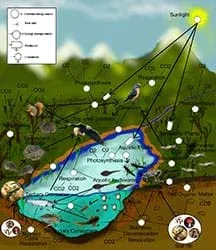 Figure 1. Example freshwater aquatic and terrestrial food-web.Copyright 2010 Thompsma, Wikimedia Commons CC BY SA-1.0 (universal public domain) https://commons.wikimedia.org/wiki/File:FoodWeb.jpg
Take a look at this diagram of an aquatic and terrestrial food web. (Give students some time to observe the diagram. Then lead a class discussion about what the lines and labels represent. Suggested prompts are provided below.)
- What processes are at work? (Possible answers: Photosynthesis, respiration, nutrient cycle, etc.)
- What substances are being transferred from one species to another? (Possible answers: Nutrients, carbon dioxide, etc.)
- Do you think that anthropogenic (human-generated) pollution can impact this food web? If so, how? (Have students discuss in small groups and then share as a class. Possible answers: Pollution harms smaller animals, which then affect the larger animals).
- In the long term, how might those pollution impacts affect human health and economics? (Possible answers: They affect the quality of drinking water sources; lower the soil nutrient levels, which affect farming, which impact human health and farming costs; harm human health when affected animals are eaten, etc.)
(Next, introduce students to the ethics of animal research.) In today’s investigation, we will test the impact of plastic on an ecosystem and the living things that exist within it. In engineering teams, you will create a small ecosystem that you populate with small living things. To model and investigate what happens in the real world, you will expose the organisms to plastics that may interfere with their health.
What might be some of the pros and cons about this research investigation approach? (Give students time to discuss and record their ideas in small groups. Possible pros: Modeling effects of pollution in a controlled environment to isolate pollution effects, get a detailed view of how pollution travels through the food chain, etc. Possible cons: Harming the organisms as part of the experimental testing; model conditions may not accurately depict the real world, etc.)
(Lead students through an ethics discussion. Suggested prompts are provided below.)
- Thinking about all the pros and cons we came up with, why might research like this be beneficial? (Possible answers: To test the pollution effects of emerging pollutants, to test whether emissions from a new or proposed building would impact the balance of the natural environment or human health, etc.)
- In what ways might you minimize the harm (the cons)? (Possible answers: Use only the minimum number of animals; carefully record experimental results so that the experiment does not need to be run again, etc.)
- What alternate activities can you suggest as ways to investigate the same question? (Possible answers Observe an existing real-world ecosystem; create a computer model, etc.)
Before the Activity
- Set out material piles for each group and place class materials in a centralized location. Separate the fluorescent microbeads from the rest of the materials.
- Prepare a control microcosm into which NO fluorescent microbeads will be added.
- Set up a computer and projector to show the Food Web Visual Aid (PPTX) (a PowerPoint® file; same as Figure 1), an aquatic and terrestrial food web.
With the Students
- Divide the class into groups of three students each and conduct the pre-activity assessment as described in the Assessment section.
- Introduce the activity by presenting the content in the Introduction/Motivation section. This includes examining the food web diagram, discussing ethics issues, and introducing the team research project.
- Direct the groups to proceed to create their aquatic microcosms from local aquatic sources (ponds, creeks, lakes, etc.). Permit the teams to collect materials. Make sure each group includes an airstone to provide oxygen and prevent stagnation. Do not provide the fluorescent microbeads yet.
- Remind students to carefully write down their experimental procedures, including the amounts and types of materials used, and the types of organisms in their microcosms.
- Have teams select aquatic organisms and carefully observe them under magnification. Require groups to include species from three or more connected trophic levels. Have students take photos at this time and during all observations as a way to document their findings. After observations are completed, have students place the organisms in the water.
- Give each team no more than one 0.1 mg sample of fluorescent microbeads with which to work in their microcosms. Add the beads to the water surface so they are available to the organisms.
- Maintain microcosms with multiple species for at least one week so that acclimation and feeding occurs. During this time, have teams document their qualitative observations.
- After one or two weeks, take samples at each trophic level and observe them under magnification using a UV flashlight in a dark space so that fluorescent beads may be observed. Collect quantitative and qualitative data.
- After one or two more weeks, collect the remaining organisms and euthanize them in alcohol. Collect data and record observations. Make comparison observations and measurements to the control microcosm.
- If possible, filter the water using paper filters. Observe the filtrate for fluorescent beads and additional microorganisms.
- Conclude by assigning the post-activity assessment report and reflection writings, as described in the Assessment section.
- anthropogenic
- Originating in human activity. For example, having to do with human impact on the environment.
- bioindicator
- Any species (an “indicator species”) or group of species whose function, population or status reveals the qualitative status of the environment.
- biomagnification
- The increasing concentration of toxins in an organism as a result of its ingesting other plants or animals in which the toxic substances are less concentrated. The process whereby certain substances work their way into bodies of water and then move up food chains, manifesting in progressively greater concentrations.
- food web
- A system of interconnected food chains within an ecological community.
- microcosm
- A simplified, artificial ecosystem used to simulate and predict the behavior of a natural ecosystem under controlled conditions. Also called an experimental ecosystem.
- trophic level
- Each of several hierarchical levels in an ecosystem, comprising organisms that share the same function in the food chain and the same nutritional relationship to the primary sources of energy. The trophic level of an organism is the position it occupies in a food chain.
Pre-Activity Assessment
Local Food Chains: Have students describe food chains that they observe in daily life. For example: sunlight > tree > nut > squirrel > hawk OR sunlight > grass > cow > human. Student answers indicate their base understanding of food chains and the interconnectedness of organisms in the natural world.
Activity Embedded Assessment
Observation and Experimentation: As student groups are creating and examining their microcosms, make sure they participate in the following experiment activities:
- Take photographs of all organisms present in the microcosm, pre- and post-microplastics addition.
- Write a detailed microcosm setup procedure that documents how the experiment was carried out.
- Carefully record collected data and results—both quantitative and qualitative, such as: number of organisms ingesting fluorescent microbeads (FMB), percentage FMB uptake per volume of microcosm, average FMB ingestion, etc.
Post-Activity Assessment
Reports and Reflections: Give groups time to reflect on their results through the following assignments:
- Write a conclusion/discussion paper that summarizes the project results AND the significance of the results.
- Include an extrapolation of the results that includes the impacts of microplastic pollution on four trophic levels of an aquatic ecosystem. Provide a diagram to explain the ecological impacts of microplastics.
- Require students to wear safety goggles as eye protection.
- Avoid the use of fish or other vertebrates because research investigations with these organisms requires approval by an official experimental review board.
If unclear about how to find local water with three food chain levels present, get assistance from county extensions or nearby university biology departments who know more about finding aquatic organisms.
Have students assess the water quality of the ecosystem from which the original organisms were taken, based on the types of organisms present. Learn about the categories and common species of these bioindicators at https://environment.arlingtonva.us/streams/macroinvertebrates/.
Have students observe the microcosm systems for longer periods of time in order to ascertain long-term impacts on various species.
Show students a 1:46-minute video, Plankton Munching Microplastics by Bo Eide at https://www.youtube.com/watch?v=2oQeXhURTgY. This video, filmed through a microscope, shows little sea creatures, filter feeders, that are transparent, which enables observation of the accumulation of plastic particles colored with fluorescent dye (little green dots) that have been ingested by the plankton.
- The Plastisphere: Plastic Migration and Its Impacts
- Microplastic Extraction of Exfoliating Beads from Cleansers
- Creating Mini Wastewater Treatment Plants
- Tracing Fluorescent Plastics in an Aquatic Environment
Contributors
David Bennett; Sara Hettenbach; William Welch
Supporting Program
SHIFTED RET Program, University of Kansas Lawrence and Greenbush
Acknowledgements
This curriculum was based upon work supported by the National Science Foundation under RET grant no. EEC 1301051—Shaping Inquiry from Feedstock to Tailpipe with Education Development (SHIFTED) through the Center for Environmentally Beneficial Catalysis, hosted by the University of Kansas Lawrence and the Southeast Kansas Education Service Center (referred to as Greenbush). Any opinions, findings, and conclusions or recommendations expressed in this material are those of the authors and do not necessarily reflect the views of the National Science Foundation.
Special thanks to Belinda Sturm, Samik Bagchi, Robert Everhart and Rachel Bowes.
Copyright
2018 by Regents of the University of Colorado; original © 2017 University of Kansas