
The Plastisphere: Plastic Migration and Its Impacts
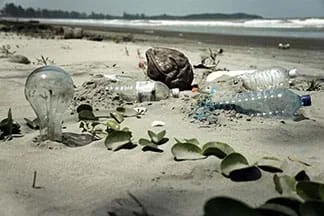 While plastic is a growing source of pollution problems, we have many bright ideas as solutions.Copyright 2011 epSos.de, Wikimedia Commons CC BY 1.0 https://commons.wikimedia.org/wiki/File:Water_Pollution.jpg
Students are introduced to the growing worldwide environmental problems that stem from plastic waste. What they learn about microplastics and the typical components of the U.S. water treatment process prepares them to conduct three engaging associated activities. During the lesson, students become more aware of the pervasiveness and value of plastic as well as the downstream pollution and health dangers. They learn how plastic materials don’t go away, but become microplastic pollution that accumulates in water resources as well as human and other animal bodies. They examine their own plastic use, focusing on what they discard daily, and think about better ways to produce or package those items to eliminate or reduce their likelihood of ending up as microplastic pollution. A concluding writing assignment reveals their depth of comprehension. The lesson is enhanced by arranging for a local water treatment plant representative to visit the class for Qs and As. In three associated activities, students design/test microplastic particle filtering methods for commercial products, create mini wastewater treatment plant working models that remove waste and reclaim resources from simulated wastewater, and design experiments to identify the impact of microplastics on micro-invertebrates.
Plastic pollution is a rising concern that demands new research methods to identify and quantify the amount of plastic in our waterways and to observe and measure the impacts of this plastic. Environmental engineers identify potential hazards in water supplies and evaluate different methods for treating water resources for drinking or releasing back into the environment. They use mechanical and chemical processes to remove toxic and biotic pollutants. By learning about the microplastic pollutants found in local waterways and the processes used to purify or treat water (in this lesson), students are ready to develop their own methods to model and build on these critical processes (in the associated activities).eria, biomagnification, discarded hydrocarbons, ecology, environment, environmental impact, filtration, hydrocarbons, microbead, microplastics, microscopy, microorganisms, plastic, plastisphere, pollution, polyethylene, single use, sustainability, waste, water pollution, water treatment, wastewater treatment, writing assignment
After this lesson, students should be able to:
- Describe ways their lives might be different without the benefits of plastic.
- Explain some ways that microplastics get into our bodies.
- Explain how microplastic pollution can result from both ordinary plastic use and plastic disposal.
- Think of ways that daily disposed-of plastic items could be produced or packaged to eliminate or reduce their likelihood of becoming microplastic pollution.
- (optional; extension activity) Interpret and draw conclusions from scientific journal articles.
- Students will develop an understanding of the effects of technology on the environment.
Grades K-12
Do you agree with this alignment? - Students will develop an understanding of the role of troubleshooting, research and development, invention and innovation, and experimentation in problem solving.
Grades K-12
Do you agree with this alignment?
- DCI.LS4.D.9-12.5 Humans depend on the living world for the resources and other benefits provided by biodiversity. But human activity is also having adverse impacts on biodiversity through overpopulation, overexploitation, habitat destruction, pollution, introduction of invasive species, and climate change. Thus sustaining biodiversity so that ecosystem functioning and productivity are maintained is essential to supporting and enhancing life on Earth. Sustaining biodiversity also aids humanity by preserving landscapes of recreational or inspirational value.
Grades 9-12
Do you agree with this alignment? - DCI.ESS3.C.9-12.5 The sustainability of human societies and the biodiversity that supports them requires responsible management of natural resources.
Grades 9-12
Do you agree with this alignment? - DCI.ESS3.C.9-12.6 Scientists and engineers can make major contributions by developing technologies that produce less pollution and waste and that preclude ecosystem degradation.
Grades 9-12
Do you agree with this alignment?
An understanding about the locations of regional water supplies and the relationships within food webs.
Microplastics
We live in the “plastic age.” In the 1940s, people fantasized about the clean and efficient future world we would be able to create with the help of plastics. Developed in the early 1900s from petroleum refining byproducts, plastic is a human-made hydrocarbon material that is rapidly forming the “plastisphere,” a fragmented layer of our creation around the Earth (Zettler, 2013). About 600 billion pounds of new plastic is produced annually for consumer products and packaging. Its beneficial utility as a versatile, moldable, lightweight and inexpensive material may ultimately be overshadowed by its exceptional and unwanted persistence. Students can act as R&D engineers in the associated activity Microplastic Extraction of Exfoliating Beads from Cleansers to design and test their own methods for filtering microplastic particles from a sample of a commercial personal care cleaning product. Students can further investigate the impacts of microplastics with the associated activity Tracing Fluorescent Plastics in an Aquatic Environment to design experiments to identify the impacts of microplastics in food webs found in a local natural water supply.
Whether formed into a pair of socks, a heart stent, a Corvette bumper or a candy wrapper, a typical piece of plastic remains wholly intact hundreds of years beyond its original intended use. Some plastic types, like the bioplastics made from polylactide acid (PLA), can biodegrade in a few weeks into less harmful monomers as bacteria digest them (Woodford, 2017). Other more widely used plastics, like the PVC used in plumbing and cling wrap, gradually release hormone-disrupting bisphenols into our bodies over a lifetime of repeated exposure (Inadera, 2015).
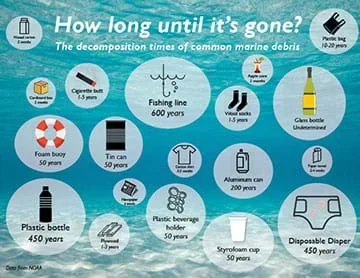 The decomposition times of common marine debris—from two weeks to 450 years!Copyright 2018 Zephyrschord, Wikimedia Commons CC BY-SA 4.0 https://commons.wikimedia.org/wiki/File:How_long_until_it%27s_gone.jpg
The ubiquitous presence of plastic in and around our planet’s biosphere results in many health and environmental hazards. The production of plastic from petroleum produces airborne toxins and water pollutants. This includes recovered plastics that undergo a recycling process. The end-products commonly find their way into the environment as litter or landfill, and though it may take the forces of sunlight (photodegradation), friction and millions of microbes, microplastic pieces eventually drift through ecosystems causing harm to organisms.
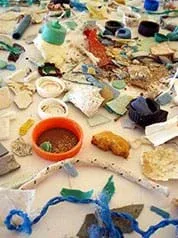 Small bits of plastic, known as microplastics, make up a big portion of the marine debris that float suspended in the water column of gyres.Copyright 2012 NOAA Marine Debris Program via Wikimedia Commons CC BY-SA 2.0 https://commons.wikimedia.org/wiki/File:Microplastics_(7656713582).jpg
In aquatic systems, bottles and bags form well-documented “gyres” or swirling refuse masses, and while these eyesores can entangle and choke wildlife (Browne, 2011), they mask the more serious issue of microplastic and byproduct particles that find their way into living tissue. Microplastics leaching from products to animals (including humans) results in developmental, neurologic and reproductive disorders and have been implicated in some types of cancer (Teuten, 2009).
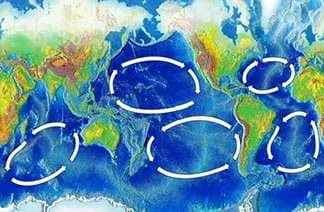 The locations of five major ocean-wide gyres.Copyright 2008 NOAA via Wikimedia Commons (public domain) https://commons.wikimedia.org/wiki/File:Oceanic_gyres.png
Efforts to quantify plastic pollutants in our water are complicated by the fact that plastic is found in various forms, each posing a unique set of challenges for identification. Plastics are not magnetic, predictable in their decomposition, or easy to attach to molecular markers that would simplify tracing. Researchers have only recently begun to recognize the existence and issues associated with microplastic pollution and initiatives are now underway to eliminate the intentional introduction of plastic microbeads in cosmetic and cleanser products. Starting in 2017, the U.S. Microbead-Free Waters Act 2015 banned plastic microbeads in the manufacturing of certain cosmetics and personal care products (USDOC/NOAA, 2016). More research is needed in this field to accurately assess the amount and impact of plastic particles in the environment, and how to best clean up the debris and pollutants. As the future researchers and engineers, we could really use your good ideas!
WWTPs and WRRRFs
Since the development and implementation of the 1972 Clean Water Act, engineers and scientists have been developing methods for wastewater treatment plants (WWTPs) to rid wastewater of pollutants. The Clean Water Act aims to restore and maintain the chemical, physical and biological integrity of the nation’s natural waters. To do this, treatment plants remove solids and lower biological oxygen demand (BOD). Most facilities lower the BOD by removing ammonia from the wastewater. Depending on the permit, some facilities also remove phosphorus and nitrogen.
While no two WWTPs are exactly the same, the general process is composed of three main steps: Pre-treatment, primary treatment, and secondary treatment. Pre-treatment steps involve filtering out large solids and debris from incoming sewage using bar racks, removing heavy “grit,” and equalizing the water flow into the primary treatment steps. Equalization must be done because the water does not come into the plant at a constant flow throughout the day. Morning and evening are busiest—when people are showering, cooking and doing laundry. After these pre-treatment steps, water is sent at a steady flow into treatment plants for cleaning.
During primary treatment, the influent water fills large basins called settlers or clarifiers where heavier debris settles and is removed from the tank bottom. In these basins, a slow-rotating bar usually moves across the top of the water to remove any floating material as well. Refer to the associated activity Creating Mini Wastewater Treatment Plants for students to create working wastewater treatment plant models in 2-liter plastic bottles to remove contaminants and reclaim resources from simulated wastewater.
Before the Clean Water Act, water was permitted to be returned to the environment after primary treatment. Since then, water must undergo secondary treatment to lower BOD levels. Usually, this is done using biological microorganisms to break down the ammonia and other organics still in the water. The community of microorganisms is often referred to as “sludge.” After a set amount of time in the biological treatment basins, wastewater is moved to yet another clarifying or settlement basin. In this basin, the sludge settles out and is dried, often at a different plant location. Because sludge is highly nutrient-rich, it is often used as fertilizer in commercial and residential farming.
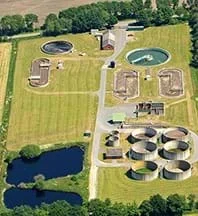 A wastewater treatment plant in Germany.Copyright 2012 Martina Nolte, Wikimedia Commons CC BY-SA 3.0 https://commons.wikimedia.org/wiki/File:2012-05-28_Fotoflug_Cuxhaven_Wilhelmshaven_DSCF9867_(crop).jpg
Wastewater treatment plants are only required to treat water through the secondary steps described above. But often, plants sterilize the water using chlorine or UV light to ensure that it is safe to return to the ecosystem.
As our understanding of anthropogenic (human-generated) pollution increases, the wastewater treatment process may evolve to be more complex. For instance, plastics that are smaller in size than the initial pre-treatment bar grates that sewage runs through do not get removed during the remaining treatment process and end up in rivers.
Along with pollutant control, a new emphasis in the wastewater treatment industry is reclamation of the resources used during the treatment process. When this aspect is added to the water treatment process, the WWTPs are rebranded as water recycling and resource recovery facilities—WRRRFs—because they include operations such as recycling and treating the activated sludge into fertilizer and reclaiming methane gas produced by anaerobic organisms.
What do you think happens to a plastic cup or bottle after it is thrown away into the trash? (Listen to student responses.) That’s right, when it comes to disposing the materials we use, there is no “away.”
When we put something into the trash, it goes to the landfill. When we burn fuel, toxic gases and particles are released into the air. Whatever we flush down our drains is carried to streams and seas. In particular, all the plastic we use and dispose of daily is added to our growing “plastisphere”—the fragmented layer of discarded hydrocarbons that humans are rapidly creating in the land and water around the Earth (Zettler, 2013).
Microplastics originate from cosmetic products, washed clothing and the breakdown of larger plastic pieces. The National Oceanic and Atmospheric Administration defines microplastics as hydrocarbon particles that are 5 mm or smaller in diameter—or about the size of a sesame seed (USDOC/NOAA, 2016). More and more people are becoming aware of this form of pollution. These pieces may be small, but the ripple effects of problems are huge. Ingestion of particles and byproducts by wildlife and humans are linked to disorders and diseases.
(Move on to conduct the post-introduction assessment to make the issue more personal. Then continue to present the background information and concepts, concluding with a visit by a representative from a local wastewater treatment if possible.)
A powerful lesson closure is a class visit by a representative of your local municipal wastewater treatment facility. Since students have just learned about water pollution, its impacts and the ways we might minimize these impacts, it is a great time for them to consider what can be done locally to benefit valuable water resources. Invite a water treatment and wastewater treatment operator, manager, civil/sanitary/environmental engineer or lab technician to come to your class to put this information in a real-world local context. Suggest that students write questions in advance of the visit to demonstrate their knowledge about water resources and dig deeper.
- anthropogenic
- Originating in human activity.
- bioindicator
- Any species (an "indicator species") or group of species whose function, population or status reveals the qualitative status of the environment.
- biomagnification
- The concentration of toxins in an organism as a result of its ingesting other plants or animals in which the toxins are more widely disbursed.
- dissolved oxygen
- The amount of free oxygen in solution in water or wastewater effluent. Adequate concentrations of dissolved oxygen are necessary for fish and other aquatic organisms to live and to prevent offensive odors. Abbreviated as DO.
- effluent
- The outflowing liquid from a treatment plant to a natural body of water after completion of the treatment process.
- eutrophication
- The process by which a reservoir, pond or lake becomes enriched with nutrients, especially nitrogen and phosphorus, that support the excess production of algae and other aquatic plant life.
- flocculation
- The process by which clumps of solids in sewage are made to increase in size by chemical action.
- food web
- A system of interlocking and interconnected food chains.
- gyre
- A system of circular ocean currents formed by global wind patterns and forces created by the Earth’s rotation
- influent
- The water, wastewater or other liquid that flows into a reservoir, basin or treatment plant.
- microplastics
- Small particles of various types of plastic that measure less than 5 mm in diameter.
- organic chemicals
- A broad class of compounds that contain carbon. Smaller molecules of this class are primary components of ecological systems. Larger compounds are commonly used to create fuels, solvents, pesticides, plastics and many industrial processes.
- pathogen
- A disease-causing microorganism, including pathogenic bacteria, viruses, helminths and protozoans.
- sedimentation
- A water-treatment process during which floating wastes are skimmed off and settled solids are removed for disposal or recycling.
- sludge
- A thick, soft, wet mud or a similar viscous mixture of liquid and solid components, such as the product of a wastewater treatment, industrial or refining process.
- trophic level
- Each of several hierarchical levels in an ecosystem, comprising organisms that share the same function in the food chain and the same nutritional relationship to the primary sources of energy.
- valorization
- To give a value to, especially a higher value.
- wastewater treatment
- When water used by cities or industry is sent through a series of tanks, screens, filters and other treatment actions during which pollutants are removed.
- wrrrf
- Acronym for water recycling and resource recovery facility. A centralized plant where water used by the people in cities or industrial processes is sent through a series of tanks, screens, filters and other treatment actions for the purpose of removing, valorizing and reusing materials.
Post-Introduction Assessment
Make It Personal: After presenting the Introduction/Motivation content to the class, have students individually list plastic items that they dispose of daily. Then have them share their lists in small groups and discuss ways that their particular items are disposed of after use, followed by ideas for reuse and/or elimination, perhaps by coming up with ideas for alternatives to the plastic items. Especially think of single use items that will not decompose for hundreds of years (if ever). Example items might include ziplock bags, food wrappings, candy wrappers, straws, pull-tabs, plastic bottles, screw plastic bottle caps, wrappings from purchased products, shopping bags, jar lids, dental floss, toothbrushes, pens, packing materials, strapping tape, plastic-coated materials.
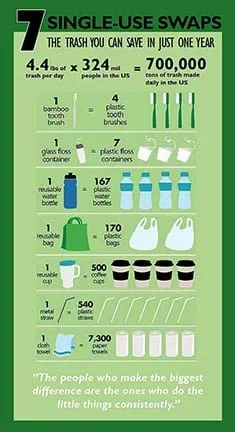 Example ideas to replace single-use plastic products.Copyright 2018 Zephyrschord, Wikimedia Commons CC BY-SA 4.0 https://commons.wikimedia.org/wiki/File:7_Swaps.jpg
Lesson Summary Assessment or Homework
Writing Recap: Have students respond individually in writing to the following prompts. Review their answers to gauge their comprehension of the subject matter.
- Describe three ways that your life may be different without the benefits of plastic.
- What are some ways that microplastics may get into our bodies? (Example answer: Direct ingestion of microplastics—such as those in personal care products—and other byproducts that result from plastic exposure and degradation. Indirect ingestion of microplastics by eating seafood that bioaccumulated the plastics. Plastics like PVC used in plumbing and cling wrap gradually release hormone-disrupting bisphenols into our bodies over a lifetime of repeated exposure.)
- How can microplastic pollution result from both ordinary plastic use and plastic disposal? (Example answer: Microplastics originate from cosmetic and cleanser products, washed clothing and eroding sponges—and you wash the microplastics down the drain into the urban water cycle. In addition, discarded larger plastic pieces become litter or landfill and eventually become microplastic pollution when they break down due to photodegradation, friction and microbes. In addition to air and water pollution from manufacturing plastic items, additional pollution is often generated from recycling them.)
- Choose one plastic item that you typically use in a day and write about an alternate way that the item could be produced or packaged to eliminate or reduce its likelihood of becoming microplastic pollution.
Assign groups to follow the resource links in the Additional Multimedia Support section and write summaries about the information sources, including the purpose of the online publication and possible biases.
A quick introduction to the planetary problem of plastics (2:17 minutes): Science Today: Plastic Pollution | California Academy of Sciences (2:17 seconds) at https://www.youtube.com/watch?time_continue=128&v=h-hn6w9t7ZM
A guest column about microbeads/plastics written by a high school student: “Beauty and the Beads” by Marcella Capuco, June 3, 2015, Water Online, at http://www.wateronline.com/doc/beauty-and-the-beads-0001
A high school-level scientific paper about microplastics in facial cleansers, “Contributing to Marine Pollution by Washing Your Face: Microplastics in Facial Cleansers” by Lisa S. Fenall and Mary A. Sewell, August 2009, Marine Pollution Bulletin, at http://www.sciencedirect.com/science/article/pii/S0025326X09001799
International campaign against microplastic ingredients in cosmetics, supported by 38 countries: Beat the Micro Bead, at http://www.beatthemicrobead.org/en/science
Product lists by country of products that do and do not contain microplastic ingredients, Beat the Micro Bead, at http://www.beatthemicrobead.org/product-lists/
Reducing plastics in the ocean information, 5 Gyres Institute: Science to Solutions (nonprofit), at http://www.5gyres.org
“Crest Toothpaste Embeds Plastic in Our Gums,” (a dental hygienist/mom’s home experiment to find and try to dissolve the inert polyethylene particles in toothpaste that she finds when cleaning teeth) by Trish Walraven, Dental Buzz, March 4, 2014, at http://www.dentalbuzz.com/2014/03/04/crest-imbeds-plastic-in-our-gums/
Early microplastic in marine ecosystem research in “Lost at Sea: Where Is All the Plastic?” by Richard C. Thompson et al., in Science, May 7, 2004, at http://www.sciencemag.org/content/304/5672/838
Plastic in the environment in “Plastics, the Environment and Human Health: Current Consensus and Future Trends,” by Richard C. Thompson et al., in Philosophical Transactions of the Royal Society, June 14, 2009, at http://rstb.royalsocietypublishing.org/content/364/1526/2153
Browne, Mark A., Crump, Phillip, Niven, Stewart J., Teuten, Emma, Tonkin, Andrew, Galloway, Tamara, and Thompson, Richard. “Accumulation of Microplastic on Shorelines Worldwide: Sources and Sinks,” Environmental Science & Technology, 2011, 45(21), 9175–9179. https://pubs.acs.org/doi/abs/10.1021/es201811s
Davis, Mackenzie L., and David A. Cornwell. Introduction to Environmental Engineering. 4th edition. New York, NY: McGraw Hill, 2008.
Inadera, Hidekuni. “Neurological Effects of Bisphenol A and Its Analogues.” International Journal of Medical Sciences. 2015. 12(12), 926–936. http://doi.org/10.7150/ijms.13267
Teuten, Emma L., et al. “Transport and Release of Chemicals from Plastics to the Environment and to Wildlife.” Philosophical Transactions of the Royal Society of London. Series B, Biological Sciences. June 14, 2009. 364(1526), 2027–2045. http://doi.org/10.1098/rstb.2008.0284
Thompson, Richard C., Moore, Charles J., vom Saal, Frederick S., and Swan, Shanna H. “Plastics, the Environment and Human Health: Current Consensus and Future Trends.” Philosophical Transactions of the Royal Society of London. Series B, Biological Sciences. June 14, 2009. 364(1526). http://doi.org/10.1098/rstb.2009.0053
U.S. Department of Commerce, National Oceanic and Atmospheric Administration. “What are microplastics?” NOAA's National Ocean Service. April 13, 2016. http://oceanservice.noaa.gov/facts/microplastics.html
Woodford, Chris. “Bioplastics and biodegradable plastics.” Last updated June 11, 2017. Explain That Stuff. http://www.explainthatstuff.com/bioplastics.html
Zettler, Erik R., Mincer, Tracy J., and Amaral-Zettler, Linda A. “Life in the ‘Plastisphere’: Microbial Communities on Plastic Marine Debris.” Environmental Science & Technology. 2013. 47(13), 7137−7146. https://pubs.acs.org/doi/abs/10.1021/es401288x
- The Plastisphere: Plastic Migration and Its Impacts
Contributors
David Bennett; Sara Hettenbach; William Welch
Supporting Program
SHIFTED RET Program, University of Kansas Lawrence and Greenbush
Acknowledgements
This curriculum was based upon work supported by the National Science Foundation under RET grant no. EEC 1301051—Shaping Inquiry from Feedstock to Tailpipe with Education Development (SHIFTED) through the Center for Environmentally Beneficial Catalysis, hosted by the University of Kansas Lawrence and the Southeast Kansas Education Service Center (referred to as Greenbush). Any opinions, findings, and conclusions or recommendations expressed in this material are those of the authors and do not necessarily reflect the views of the National Science Foundation.
Special thanks to Belinda Sturm, Samik Bagchi, Robert Everhart and Rachel Bowes.
Copyright
2018 by Regents of the University of Colorado; original © 2017 University of Kansas