
Microplastic Extraction of Exfoliating Beads from Cleansers
After watching a short online video that recaps the enormous scale of accumulating plastic waste in our oceans, student teams are challenged to devise a method to remove the most plastic microbeads from a provided commercial personal care product—such as a facial cleanser or body wash. They brainstorm filtering methods ideas and design their own specific procedures that use teacher-provided supplies (coffee filters, funnels, plastic syringes, vinyl tubing, water, plastic bags) to extract the microplastics as efficiently as possible. The research and development student teams compare the final masses of their extracted microbeads to see which filter solutions worked best. Students suggest possible future improvements to their filter designs. A student worksheet is provided.
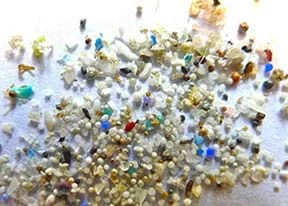 The tiny plastic microbeads found in exfoliating cleansers and gels end up as water pollution. How can we filter them out of the water?Copyright 2012 image by 5Gyres, courtesy of Oregon State University, Flickr CC BY-SA 2.0 https://www.flickr.com/photos/oregonstateuniversity/21282786668
Keeping water resources free of plastic is a challenge since microplastics are not soluble nor magnetic, and vary in size, material composition, and decomposition stage. Because plastic pollution is a growing issue, engineers are designing new technologies to remove microplastics from drinking water and the natural environment. In this activity, students get a taste of this clean-up challenge by developing their own methods to extract microplastics from samples of commercially available facial cleansers.
After this activity, students should be able to:
- Evaluate environmental impacts of personal care products.
- Develop and test a model for an innovative and efficient water filtration system and recover contaminants/resources.
- CCSS.Math.Content.HSS-ID.A Summarize, represent, and interpret data on a single count or measurement variable
Grades 9-12
Do you agree with this alignment?
- Students will develop an understanding of the effects of technology on the environment.
Grades K-12
Do you agree with this alignment? - Students will develop an understanding of the role of troubleshooting, research and development, invention and innovation, and experimentation in problem solving.
Grades K-12
Do you agree with this alignment?
- Summarize, represent, and interpret data on a single count or measurement variable.
Grades 9-12
Do you agree with this alignment?
- HS-ESS3-4 Evaluate or refine a technological solution that reduces impacts of human activities on natural systems.
Grades 9-12
Do you agree with this alignment? - HS-LS2-7 Design, evaluate, and refine a solution for reducing the impacts of human activities on the environment and biodiversity.
Grades 9-12
Do you agree with this alignment?
- HS-ESS3-4 Evaluate or refine a technological solution that reduces impacts of human activities on natural systems.
Grades 9-12
This resource focuses on the following Three Dimensional Learning aspects of NGSS:
Science & Engineering Practices- Design or refine a solution to a complex real-world problem, based on scientific knowledge, student-generated sources of evidence, prioritized criteria, and tradeoff considerations.Do you agree with this alignment?
Disciplinary Core Ideas- Scientists and engineers can make major contributions by developing technologies that produce less pollution and waste and that preclude ecosystem degradation.Do you agree with this alignment?
- When evaluating solutions it is important to take into account a range of constraints including cost, safety, reliability and aesthetics and to consider social, cultural and environmental impacts.Do you agree with this alignment?
Crosscutting Concepts- Engineers continuously modify these technological systems by applying scientific knowledge and engineering design practices to increase benefits while decreasing costs and risks.Do you agree with this alignment?
- Feedback (negative or positive) can stabilize or destabilize a system.Do you agree with this alignment?
Do you agree with this alignment? - Design or refine a solution to a complex real-world problem, based on scientific knowledge, student-generated sources of evidence, prioritized criteria, and tradeoff considerations.
- HS-LS2-7 Design, evaluate, and refine a solution for reducing the impacts of human activities on the environment and biodiversity.
Grades 9-12
This resource focuses on the following Three Dimensional Learning aspects of NGSS:
Science & Engineering Practices- Design, evaluate, and refine a solution to a complex real-world problem, based on scientific knowledge, student-generated sources of evidence, prioritized criteria, and tradeoff considerations.Do you agree with this alignment?
Disciplinary Core Ideas- When evaluating solutions it is important to take into account a range of constraints including cost, safety, reliability and aesthetics and to consider social, cultural and environmental impacts.Do you agree with this alignment?
- Moreover, anthropogenic changes (induced by human activity) in the environment—including habitat destruction, pollution, introduction of invasive species, overexploitation, and climate change—can disrupt an ecosystem and threaten the survival of some species.Do you agree with this alignment?
- Humans depend on the living world for the resources and other benefits provided by biodiversity. But human activity is also having adverse impacts on biodiversity through overpopulation, overexploitation, habitat destruction, pollution, introduction of invasive species, and climate change. Thus sustaining biodiversity so that ecosystem functioning and productivity are maintained is essential to supporting and enhancing life on Earth. Sustaining biodiversity also aids humanity by preserving landscapes of recreational or inspirational value.Do you agree with this alignment?
- Biodiversity is increased by the formation of new species (speciation) and decreased by the loss of species (extinction).Do you agree with this alignment?
Crosscutting Concepts- Much of science deals with constructing explanations of how things change and how they remain stable.Do you agree with this alignment?
Do you agree with this alignment? - Design, evaluate, and refine a solution to a complex real-world problem, based on scientific knowledge, student-generated sources of evidence, prioritized criteria, and tradeoff considerations.
Each group needs:
- small whiteboard (or poster board) with markers
- 3 coffee filters, such as from a pack 100 unbleached #4 size and up on Amazon
- 1 funnel, such as a 4.25 inch-diameter plastic funnel from Amazon
- 1 syringe, such as the 100-ml plastic syringe from Amazon
- 30 cm tubing; the funnel should fit inside the tube, so the .5-inch outer diameter x 3/8-inch inner diameter x 10 feet clear vinyl tubing for $8 from Amazon should fit around the lip of funnel tube
- 1 beaker with 30 ml of water; students may need all this water!
- 1 wastewater container, a small plastic bag or Tupperware container works well
- 1 tablespoon (about 1 oz) of cleanser with microplastic beads, such as Clean & Clear Morning Burst Oil-Free Hydrating Facial Cleanser, Olay Fresh Effects Deep Pore Clean Plus Exfoliating Scrub and others; often “exfoliating” or “microbeads” are mentioned on the packaging; usually ~$5-8 per tube of 5-7 ounces each; plan on about 10-12 oz per class of 30, and only one product is required for student extraction.
- safety goggles, one pair per person
- Microplastic Masses Worksheet (PDF), one per student
To share with the entire class:
- technical capability to show a 3-minute online video from 5Gyres
- tablespoons, 1 per team, for giving each team a cleanser sample for microbead extraction; same for all teams; measure empty tablespoon and provide weight to students
- scale, to measure in milligrams or even more precisely
- water
It is recommended that students complete the associated lesson prior to conducting this activity.
Plastic pollution has been around since the plastic age began in the mid-twentieth century. Today, more and more researchers are investigating the impacts of plastics on the health of humans and other species. In addition, awareness is growing about the existence of plastic “sinks” in the ocean where large amounts of buoyant, lightweight waste accumulate. Let’s watch this video to learn more. (Play the video.)
Many commercial products contain plastic microbeads. For example, they are specifically added into some facial cleansers for the advertised purpose of the “deep exfoliating” of skin. Although they are small, the plastic microbeads that are present in facial cleansers and shower gels and even toothpaste can also contribute to these plastic ocean “gyres.” We are now realizing that these and other personal care products (PCPs) are pollution! Microplastics usually slip right through our municipal water treatment plants and find their way into rivers, lakes and oceans, so environmental engineers are developing technologies to filter microbeads from water.
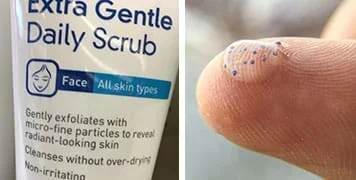 Many commercial products such as facial cleansers contain tiny plastic microbeads that end up contaminating the water in lakes and oceans.Copyright (left) 2018 Denise W. Carlson, ITL Program, College of Engineering and Applied Science, University of Colorado Boulder; 2015 Minnesota Pollution Control Agency, Flickr CC BY-SA 2.0 https://www.flickr.com/photos/mpcaphotos/22208966814/
Your challenge today is to work as environmental engineers to develop a method to remove as many plastic microbeads as possible from one tablespoon of cleanser. After extraction, you will weigh the beads. This is similar to how scientists, engineers and inventors conduct “research and development” (R&D) work in order to come up with new solutions to problems. Remember, your team’s goal is to design a filter system to remove the most beads from a sample of a commercial cleanser, which is the first step to creating a good way to clean the environment of microplastics pollution.
Background
Microplastics are particles of various types of plastic classified by the U.S. National Oceanic and Atmospheric Administration as being less than 5 mm in diameter. These might be broken-down pieces of larger plastic items or they manufactured microbeads originating from beauty products intended to clean skin. Because they are found in various shapes and sizes, are not predictably biodegraded, and are non-magnetic, microplastic are difficult to filter out and can easily pass through wastewater treatment plants and into waterways. Microplastics are increasingly found in aquatic food webs, prompting attempts around the world to eliminate plastic microbeads from consumer products and research better ways to remove these pollutants from the environment.
Before the Activity
- Gather materials and make copies of the Microplastic Masses Worksheet (PDF).
- Using the scale, measure and record the empty weight of one tablespoon. You will provide this weight to students so they can determine the initial masses of their samples.
- Prepare tablespoon samples of the commercial cleanser, one per group. Set aside.
- Organize the rest of the materials, one pile per group.
- Be ready to show the class a three-minute video from 5Gyres, Plastic Pollution in the World’s Oceans from Chris Jones at https://player.vimeo.com/video/113359330.
- Have the commercial cleanser product handy for informal and general examination during team brainstorming.
With the Students: Designing a Filter for Microplastics
- Present the Introduction/Motivation content to the class, including showing the online video and explaining the engineering challenge.
- Organize the class into groups of two to four students each.
- Have teams each observe and touch a sample of a cleanser that contain small beads.
- Conduct the pre-activity assessment as described in the Assessment section. As an outcome of this team brainstorming, each team generates a general plan—in the form of a diagram or sketch—of a possible way they could extract microbeads from a personal care product.
With the Students: Developing a Successful Filter for Microplastics
- Give each group 1 tablespoon of cleanser. Inform the groups that they will each only receive one tablespoon, so they need to take care to avoid spilling it or using it without planning ahead.
- Distribute the worksheet and tell students the empty tablespoon weight. Have students place the tablespoon with cleanser sample on the scale, and then calculate the initial mass of the sample.
- Direct students to collect their teams’ materials and set them on their tables. Then have students talk within their groups about what they could do with the provided materials to accomplish the challenge. Encourage all group members to contribute to the discussions.
- Then have students alter their earlier pre-activity brainstorming filter diagrams/plans to figure out how they could set up the given materials to extract the plastic beads from the cleanser sample. Make a final design plan on the worksheet in the form of a diagram or sketch with materials indicated.
- Require each group to show its final filter diagram to the teacher before constructing it. Alert them to be prepared to answer clarifying questions to explain the filter logic. The teacher does not provide advice but just asks students to explain the reasoning behind the design with prompts such as: Explain why you have set up the filter this way.
- After approval, have teams set up their filter systems and begin extracting microbeads. Remind them of the goal: To extract as many clean beads as possible.
- Direct the groups to set aside all their extracted beads on coffee filters to dry undisturbed. Make sure students identify the coffee filters with team/student names.
- The following class period, after the beads and filter are completely dry, determine which group executed the most effective filtration system by weighing the dry extracted beads for each team.
- Lead a short discussion to share, compare and evaluate results across all teams.
- Give students time to add to their worksheets their redesign/improvement ideas in the form of notes and revisions to the original team diagram/sketch to show any changes they would make after observing other groups systems and microplastics extraction results.
- As a post-activity assessment, have students answer the worksheet reflection questions, as described in the Assessment section.
- gyre
- A system of circular ocean currents formed by global wind patterns and forces created by Earth's rotation.
- microplastics
- Small plastic particles in the environment. NOAA defines microplastics as less than 5 mm in diameter. May be composed of various plastic types. May be originally small microbeads or result from the breakdown of bigger plastic pieces. May be from sources such as personal care products, clothing and industrial processes.
Pre-Activity Assessment
Idea Generation: Have students brainstorm and talk in their teams to hypothesize ways to remove (extract) the microplastics in the commercial cleanser product for further observation. Suggest that students carefully observe and touch the cleanser. Direct them to write down their ideas and plans in the form of diagrams and sketches on a group whiteboard or poster board. Expect them to end up with a general agreed-upon plan/procedure/method for extracting microbeads from the cleanser.
Activity Embedded Assessment
Design, Build and Test: As teams are working to develop successful microplastic filters, watch that students work together in groups to design, construct and use the filters, aiming for every student to have the opportunity to contribute to the design-build-test process.
Post-Activity Assessment
Group/Self Evaluations: Conclude the activity by having students individually provide written answers to the reflection questions on the Microplastic Masses Worksheet (PDF).
- How did your team do?
- Why did you take the steps you did with your team?
- What proportion of your initial cleanser sample was extracted as beads?
- Provide details about why your method was or was not effective.
- What steps would you take next time to improve the method/procedure?
- How effective were you as a productive group member?
Safety goggles are required due to the hazards of soap being used in syringes.
Using samples from local water sources, develop and implement ways to extract and quantify the presence of microplastics.
- For lower grades, provide less emphasis on real-world applications. Shift the focus from cleaning up plastics in the ocean to designing a small filter for their bathroom sinks to capture microbeads at that location.
- For higher grades, provide more connection to real-world ecological and environmental engineering applications. Challenge students to brainstorm large-scale microplastics filters that could be effective at cleaning plastics from ocean gyres.
During the Introduction/Motivation section, show students a three-minute video from 5Gyres, Plastic Pollution in the World’s Oceans from Chris Jones at https://player.vimeo.com/video/113359330.
- The Plastisphere: Plastic Migration and Its Impacts
- Microplastic Extraction of Exfoliating Beads from Cleansers
- Creating Mini Wastewater Treatment Plants
- Tracing Fluorescent Plastics in an Aquatic Environment
Contributors
David Bennett; Sara Hettenbach; William Welch
Supporting Program
SHIFTED RET Program, University of Kansas Lawrence and Greenbush
Acknowledgements
This curriculum was based upon work supported by the National Science Foundation under RET grant no. EEC 1301051—Shaping Inquiry from Feedstock to Tailpipe with Education Development (SHIFTED) through the Center for Environmentally Beneficial Catalysis, hosted by the University of Kansas Lawrence and the Southeast Kansas Education Service Center (referred to as Greenbush). Any opinions, findings, and conclusions or recommendations expressed in this material are those of the authors and do not necessarily reflect the views of the National Science Foundation.
Special thanks to Belinda Sturm, Samik Bagchi, Robert Everhart and Rachel Bowes.
Copyright
2018 by Regents of the University of Colorado; original © 2017 University of Kansas