
Engineering a Water Bottle Holder for Student Desks
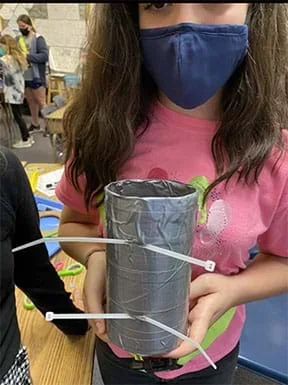 A final design is shown of a water bottle holder that was created from an oatmeal canister wrapped in duct tape before it is attached to a desk leg using two zip ties.Copyright 2022 Jan Elisabeth Merritt, University of Florida MRET
Students solve a real-world problem: How to design a water bottle holder to keep desktops clean and dry? Condensation is a phenomenon encountered in everyday life. In school, we frequently experience this phenomenon as a messy wet area under our water bottles that makes our papers soggy! Students use the engineering design process to work together to brainstorm, sketch, and build a prototype water bottle holder that can attach to the leg of the desk or chair. Students test their designs for usability, durability, and cost-effectiveness, then redesign to make improvements to their product.
Engineers follow a process when developing solutions to real-world problems. Engineers brainstorm possible solutions, creating schematics that allow them to build a prototype. Once a prototype is built, engineers test their design and evaluate how well it solved the problem. The engineering design process may include much iteration of prototypes to make adjustments that improve the final product. Mechanical engineers are responsible for designing and manufacturing products and machines. As with all engineering fields, mechanical engineering requires problem-solving abilities to create items used in everyday life. Mechanical engineers rely on their creativity and analytical skills to bring a product from just an idea to reality.
After this activity, students should be able to:
- Explain the phenomenon of condensation.
- Understand and apply the steps of the engineering design process.
- Design a schematic and build a prototype to solve the problem.
- Test prototype and iterate designs to improve design, taking constraints into account.
- Communicate effectively with peers to improve design and share results.
- CCSS.Math.Practice.MP1 Make sense of problems and persevere in solving them.
Grades K-12
Do you agree with this alignment? - CCSS.Math.Practice.MP5 Use appropriate tools strategically.
Grades K-12
Do you agree with this alignment?
- SC.3.N.1.1 Raise questions about the natural world, investigate them individually and in teams through free exploration and systematic investigations, and generate appropriate explanations based on those explorations.
Grade 3
Do you agree with this alignment? - SC.4.N.1.1 Raise questions about the natural world, use appropriate reference materials that support understanding to obtain information (identifying the source), conduct both individual and team investigations through free exploration and systematic investigations, and generate appropriate explanations based on those explorations.
Grade 4
Do you agree with this alignment? - SC.5.N.1.1 Define a problem, use appropriate reference materials to support scientific understanding, plan and carry out scientific investigations of various types such as: systematic observations, experiments requiring the identification of variables, collecting and organizing data, interpreting data in charts, tables, and graphics, analyze information, make predictions, and defend conclusions.
Grade 5
Do you agree with this alignment?
- 3-5-ETS1-1 Define a simple design problem reflecting a need or a want that includes specified criteria for success and constraints on materials, time, or cost.
Grades 3-5
This resource focuses on the following Three Dimensional Learning aspects of NGSS:
Science & Engineering Practices- Define a simple design problem that can be solved through the development of an object, tool, process, or system and includes several criteria for success and constraints on materials, time, or cost.Do you agree with this alignment?
Disciplinary Core Ideas- Possible solutions to a problem are limited by available materials and resources (constraints). The success of a designed solution is determined by considering the desired features of a solution (criteria). Different proposals for solutions can be compared on the basis of how well each one meets the specified criteria for success or how well each takes the constraints into account.Do you agree with this alignment?
Crosscutting Concepts- People's needs and wants change over time, as do their demands for new and improved technologies.Do you agree with this alignment?
Do you agree with this alignment? - Define a simple design problem that can be solved through the development of an object, tool, process, or system and includes several criteria for success and constraints on materials, time, or cost.
- 3-5-ETS1-2 Generate and compare multiple possible solutions to a problem based on how well each is likely to meet the criteria and constraints of the problem.
Grades 3-5
This resource focuses on the following Three Dimensional Learning aspects of NGSS:
Science & Engineering Practices- Generate and compare multiple solutions to a problem based on how well they meet the criteria and constraints of the design problem.Do you agree with this alignment?
Disciplinary Core Ideas- Research on a problem should be carried out before beginning to design a solution. Testing a solution involves investigating how well it performs under a range of likely conditions.Do you agree with this alignment?
- At whatever stage, communicating with peers about proposed solutions is an important part of the design process, and shared ideas can lead to improved designs.Do you agree with this alignment?
Crosscutting Concepts- Engineers improve existing technologies or develop new ones to increase their benefits, to decrease known risks, and to meet societal demands.Do you agree with this alignment?
Do you agree with this alignment? - Generate and compare multiple solutions to a problem based on how well they meet the criteria and constraints of the design problem.
Each group needs:
- ruler
- pair of scissors
- meter of twine or yarn
- recycled oatmeal canister
- recycled panko canister
- recycled 2-liter soda bottle
- recycled 1.89 liter (1/2 gallon) plastic milk/juice container
- Engineering Design Lab Packet (PDF), Engineering Design Process Steps (PDF), Cost Sheet (PDF), Design a Water Bottle Holder Pre/Post-Quiz (PDF), and Self-Reflection Rubric (PDF)
For the entire class to share:
- (optional) mini bungee cords, available at Amazon
- zip ties 8 inch, available at Amazon
- duct tape (48mm x 54m) roll
- 3 sizes/styles of water bottles for testing prototypes (Example: plastic water bottle such as Dasani, reusable non-insulated water bottle, and an insulated water bottle such as Yeti or Contigo)
- other recyclable materials such as pieces of Styrofoam, a pool noodle sliced into pieces, sponges, squares of cork, scraps of cardboard, etc.
- Engineering Design Lab Packet (docx)
- Engineering Design Lab Packet (pdf)
- Design a Water Bottle Holder Pre/Post-Quiz (docx)
- Design a Water Bottle Holder Pre/Post-Quiz (pdf)
- Design a Water Bottle Holder Pre/Post-Quiz Answer Key (docx)
- Design a Water Bottle Holder Pre/Post-Quiz Answer Key (pdf)
- Self-Reflection Rubric (docx)
- Self-Reflection Rubric (pdf)
- Engineering Design Process Steps (docx)
- Engineering Design Process Steps (pdf)
- Engineering Design Process Steps Answer Key (pdf)
- Cost Sheet (docx)
- Cost Sheet (pdf)
Students may need a familiarity with using a ruler to measure a linear distance to millimeters. Students may require a basic understanding of circumference and diameter of circles.
Have you ever woken up on a warm summer morning and gone to look outside only to find the outside of your window covered in droplets of water? Have you ever noticed the grass and leaves in the morning are wet even though you know it has not rained? Has anyone ever noticed droplets of water forming on a glass of iced tea or a very cold water bottle? (Elicit additional student comments/observations/experiences.) Today you are going to learn what causes these droplets of water on our windows, grass, leaves, drinking glasses and water bottles, but even more exciting is that you are going to become engineers to solve a HUGE classroom problem related to these magic water droplets!
You are going to work in small groups to design, build and test a prototype water bottle holder for your desks that will keep the surface of your desk clean and dry. (Teacher can define prototype as an early sample, model, or release of a product built to test a concept or process.) Where could we put a water bottle holder so that your desk stays clean and dry? (Possible answers: attach to chair leg or attach to desk leg.) What else might we need to consider for our design? (Possible answers: the size of different water bottles in the classroom, whether the water bottles are insulated or not, how heavy the water bottles are. If students do no come up with these considerations, the teacher can present the 3 water bottles that will be used for testing the prototype and help lead the students to realize that each one is different in size- circumference, height, and mass as well as insulation vs. no insulation).
After your team has designed and built the first prototype, you will test it to see how your prototype holds up using our 3 sample water bottles and record your results. Based on these results, your team may decide to iterate, or redesign and repeat the process by building a new prototype. When finished, you will test this iteration and evaluate the results.
Like real scientists and engineers, we will communicate our findings by sharing our designs, our prototypes, and our results.
Background
Condensation is a science phenomenon that we experience in our daily lives. Simple examples are the droplets of water on our windows when it is hot and humid outside but air conditioned on the inside. The warm air outside encounters the cold surface of the window causing the particles of water in the warm air to slow down and release energy. As these particles release energy, they cool down and turn from a vapor (gas) back to a liquid. This process, known as condensation, creates the liquid water droplets on the glass. The same phenomenon can be seen on glasses of iced water. The surface of the glass is cold from the icy water and that causes the particles of water in the air near the glass to cool down, releasing energy and changing from a gas back into a liquid. Your glass now appears to be “sweating.”
Before the Activity
- Gather materials for the design project.
- Assign students to small groups of 3 or 4.
- Make copies of the Engineering Design Lab Packet (PDF), Engineering Design Process Steps (PDF), Cost Sheet (PDF), Design a Water Bottle Holder Pre/Post-Quiz (PDF), and Self-Reflection Rubric (PDF).
- (Optional) Locate a copy of Rosie Revere, Engineer and Your Fantastic Elastic Brain: A Growth Mindset Book for Kids to Stretch and Shape Their Brains in your school library.
Day 1
- Prior to beginning today’s activity, administer the Design a Water Bottle Holder Pre/Post-Quiz (PDF) to students.
- Hook student’s interest by asking questions related to the phenomenon of condensation: “Have you ever looked out of your window in the morning, and you can’t see out because of all the droplets of water on the glass? Where do you think that water came from?” or “Have you ever been riding in the front seat of the car on your way to school and you can hardly see out the window for all the water droplets? Did it rain? If not, how did that water get there? Is it magic?” Teacher may show pictures of condensation on windows, leaves, or water glasses.
- ]\Brainstorm with the class why and/or how these droplets of water appear.
- After discussing the class’s brainstormed ideas, explain the scientific reason for condensation and/or show a short video on condensation, if desired, to make sure that background knowledge is established.
- Ask students if they have ever experienced condensation on a drinking glass or water bottle. Discuss why this might not always happen (Potential answers: the temperature of the liquid in the glass is similar to the temperature in the room so there is no condensation or the water bottle is insulated so the water vapor in the room does not come into contact with the cold surface of the bottle and therefore there is no condensation).
- After explaining condensation, ask students what problem they think this would cause in terms of having their bottle on their desks and what solutions exist to help with the problem. Note: Try to gear discussion so that students identify what problem this phenomenon causes before telling them what their task (solution) is.
- Tell students that today they are going to become engineers and design a water bottle holder for student desks that will keep their bottle from leaving water all over the desk and keep it from tipping over or falling onto the floor and spilling.
- Ask students to turn and talk with a partner (or team) about what they think an engineer is and what they do. Elicit responses from students to share what they think engineers are and what they do. You may choose to record responses on a chart titled “What are Engineers?.”
- Watch a short video about engineering, such as the What is Engineering? video (3:43). Have students add to the “What are Engineers?” chart after watching the video to share what they learned.
- Explain that engineers use a process called the “Engineering Design Process” to solve real world problems.
- Elicit student responses as to what they think the steps might be in this process.
- Show students the follow up YouTube video (1:46) to demonstrate the correct steps in the process. Students can record steps in their science journals and/or teacher can list them on chart paper to post on the board.
- Read aloud Rosie Revere, Engineer and use the storyline to elicit discussion about perseverance and growth mindset that is essential in engineering.
Day 2
- To review the steps in the engineer design process, pass out copies of the Engineering Design Process Steps (PDF) and have students work with partners or small groups to cut apart the steps into strips of paper and work to order the steps correctly.
- Ask students to share the steps to assess understanding. Emphasize that the first step after identifying a problem and before beginning the design process is to do research.
- Allow student groups about ten minutes to research any designs that already exist for water bottle holders to get some ideas of what is already available and how they might adapt these ideas to their student desk water bottle holder.
- Distribute the Engineering Design Lab Packet (PDF) to each student/team. Explain that today they will begin the design process as they look over the available materials and draw a blueprint for a prototype that they will build and test.
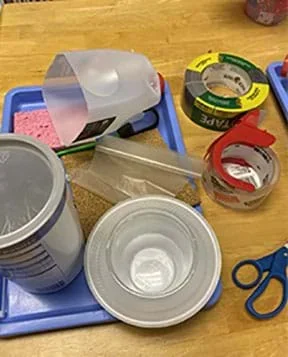 Students can select from a variety of supplies as they work together to brainstorm possible designs.Copyright 2022 Jan Elisabeth Merritt, University of Florida MRET
- Explain that there are some constraints to this project. First, their prototype must cost under $10 using the Cost Sheet (PDF). Second, their prototype must be attached to the leg of the desk or the leg of the chair. It cannot be on the top of the desk. Third, the prototype must withstand the mass of three sample water bottles full of water. Fourth, the prototype must repel or withstand any moisture due to condensation so that it is durable over time.
- Have students work in their small groups to brainstorm which materials they will use, sketching out ideas and decide upon a prototype.
- Have students draw a final blueprint of their prototype and label it clearly.
- The teacher should check that each team’ prototype must fit the constraint of under $10 before they proceed.
Day 3
- Lead a discussion about growth mindset and how it applies to engineering. Note: Some students may get frustrated today and tomorrow as they are building, especially if things do not seem to go as planned. It might be helpful to share some constructive phrases that could replace negative ones, so that students can practice growth mindset and encourage their teammates as well. These could be displayed on a chart or you could have student input to come up with more positive phrases for the “Try” side.
For example:
Instead of: | Try: |
It is not working! | It’s not working yet. |
We failed! | We found something we might need to change to make it better! |
This is too hard! | This is hard, but we can do it if we stick with it! |
I can’t do it! | This is challenging! |
- If available, read aloud Your Fantastic Elastic Brain: A Growth Mindset Book for Kids to Stretch and Shape Their Brains to reiterate the importance of growth mindset to the engineering design process.
- Have students use their blueprints from Day 2 and begin constructing their prototype.
- Walk around the room and facilitate group work by checking on each team and asking questions such as “Tell me about your design.” If students are having difficulty, encourage them to problem solve as a group rather than providing a solution for them. Use statements such as “That sounds challenging, I wonder what you might try next?” or “I can’t wait to see how you solve that!” so that the teams must rely on each other to work through any problems they encounter.
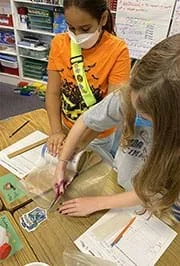 Students begin to follow their labeled sketches and create their first prototype.Copyright 2022 Jan Elisabeth Merritt, University of Florida MRET
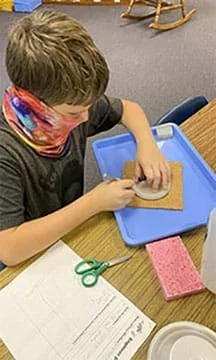 This team decided to cut a circle of cork to use inside the bottom of their water holder to absorb any moisture.Copyright 2022 Jan Elisabeth Merritt, University of Florida MRET
- When prototypes are completed, teams may begin testing them by using the three sample water bottles. They should answer the following: Do the bottles comfortably fit in the water bottle holder? Does the prototype hold the mass of the heaviest bottle? Will it absorb or withstand condensation from non-insulated bottles? Students record data from testing on their Engineering Design Lab Packet (PDF).
- Ask teams to share preliminary results from their first prototype testing. Have them discuss what worked well and what might be improved with iteration.
- In their groups, students can work together to make improvements to their original prototype and sketch/label a new prototype that reflects these changes. Students must calculate the cost of the new design and make sure it remains under $10.
- Have students individually complete a Self-Reflection Rubric (PDF) to assess their own attitude, collaboration, and effort as a team member.
Day 4
- Students use their new blueprints from Day 3 and begin constructing their second prototype.
- The teacher should continue to facilitate group work by checking on each team and asking questions about their iterations and why they made certain changes. Teacher encourages them to work together and think about their self-reflection rubrics from yesterday and how they might work on any improving any personal attitude/collaboration/effort as they work with their team today.
A final design is shown of a water bottle holder that was created from an oatmeal canister wrapped in duct tape before it is attached to a desk leg using two zip ties.Copyright 2022 Jan Elisabeth Merritt, University of Florida MRET
- When prototypes are completed, teams may begin testing them by using the three sample water bottles.
- Have students record data from testing on their Engineering Design Lab Packet (PDF). Teacher circulates during evaluations, asking questions such as “What about your design works really well?” “Is there something else you would change if you could make a third design?”
- When teams have finished their evaluations, have students individually complete a Self-Reflection Rubric (PDF) to assess their own attitude, collaboration, and effort as a team member for today.
- Ask teams to share results from their second prototype. Discuss what about the second design worked well and what may not have worked as well as expected. Ask questions related to growth mindset such as, “What mistakes did you notice from your first design that you were able to find a solution for in your second design?” Lead a discussion about what changes they would make if they were to create a third design.
- Help students connect their experience with this design project to actual engineers who also solve real-world problems, research prototypes what has already been tried, design prototypes, test prototypes, iterate to improve designs, and communicate their results.
- At the end of today’s activity, re-administer the Design a Water Bottle Holder Pre/Post-Quiz (PDF) to assess students’ understanding of the phenomenon of condensation as well as the engineering design process.
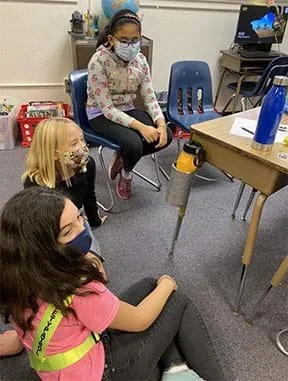 A team of students admire their successful prototype at work!Copyright 2022 Jan Elisabeth Merritt, University of Florida MRET
- condensation
- Condensation is the change of the physical state of matter from the gas phase into the liquid phase.
- iteration
- Iteration is the repetition of a process to generate an outcome.
- prototype
- A prototype is an early sample, model, or release of a product built to test a concept or process.
Pre-Activity Assessment
Pre-Quiz: Provide each student with the Design a Water Bottle Holder Pre/Post-Quiz (PDF) and allow them time to complete it to show what they already know/understand about the phenomenon of condensation and the steps of the engineering design process. Collect the pre-quiz and save to compare to the post-quiz after completion of the entire activity.
Brainstorming: Next, brainstorm as a whole group what students already know or think they know about condensation and how it forms. List all ideas on chart paper or a Google doc to save and review/add to later in the activity. In small groups, ask students to work together to make a list of what they think are the steps to the engineering design process.
Activity Embedded (Formative) Assessment
Lab Packet: During the activity, students will work in small groups to research/design/build a prototype of a water bottle holder that will keep their student desks clean and dry. Teacher will provide an Engineering Design Lab Packet (PDF) which will be used to record findings of research, prototype sketches, itemized costs, and notes on performance of design when tested. The packet will also contain space for a redesign based on testing with space for notes on the rational for each change.
Post-Activity (Summative) Assessment
Post-Quiz: Student groups will communicate their results by sharing their prototypes and explain any redesigns based on test results and constraints. Students will individually retake the Design a Water Bottle Holder Pre/Post-Quiz (PDF) to show growth in understanding both with the phenomenon of condensation and the engineering design process itself.
- Students should ask adult/teacher for assistance if trying to poke holes in a container.
- Students should not use zip ties without teacher assistance as they can constrict on fingers/wrists and pose a hazard.
If no student prototypes hold up to the testing, allow groups to work together to see if they can combine some of their ideas into one new idea that could be designed and tested.
Groups that self-report problems on the Self-Reflection Rubric (PDF) may need some time with the teacher to discuss issues. These groups may also perhaps benefit from assigned roles while working if they are unable to brainstorm solutions for their team on their own.
Students could conduct additional investigations of condensation to observe what happens to a clear glass of water at room temperature and one with ice. Do both begin to condensate? Why or why not? Elicit discussion and have the students record observations and ideas in their science journals.
For younger students, remove the constraint of budget and remove iteration of the design process.
For older students, merge final designs and come up with one design that could actually be used in the classroom and potentially “pitched” to other teachers/classes at your school.
Solve Problems: Be an Engineer!:
https://www.youtube.com/watch?v=D9I35Rqo04E&ab_channel=SciShowKids
Jessi and Squeaks Build a Better Back-Scratcher!
https://www.youtube.com/watch?v=zrAl6JQ3sb4&ab_channel=SciShowKids
Image of Condensation on Water Bottle:
https://commons.wikimedia.org/wiki/File:Condensation_on_bottle.JPG

Image of Melting Condensation on Window:
https://commons.wikimedia.org/wiki/File:MeltingCondensationWindow.jpg

Beaty, Andrea. Rosie Revere, Engineer, New York, NW: Abrams Books for Young Readers, 2013.
Deak, JoAnn. Your Fantastic Elastic Brain Stretch It, Shape It, Naperville, IL: Little Pickle Press, 2010.
Moon, Emily. DROP: An Adventure through the Water Cycle, New York City, NY: Dial Books for Young Readers, 2021.
Rice, William. Condensation, Huntington Beach, CA: Teacher Created Materials, 2011.
Contributors
Jan Elisabeth Merritt
Supporting Program
Engineering for Biology: Multidisciplinary Research Experiences for Teachers in Elementary Grades (MRET), College of Engineering, University of Florida
Acknowledgements
This curriculum was based upon work supported by the National Science Foundation under RET grant no. EEC 1711543— Engineering for Biology: Multidisciplinary Research Experiences for Teachers in Elementary Grades (MRET) through the College of Engineering at the University of Florida. Any opinions, findings, and conclusions, or recommendations expressed in this material are those of the authors and do not necessarily reflect the views of the National Science Foundation.
Special thanks to Sarah Furtney, Kevin Li, Marlina Romano, Andres Rubiano, Chelsey Simmons, Renee Simmons, Kayla Sutcliffe, and Peyton Turinetti.
Copyright
2022 by Regents of the University of Colorado; original © 2022 University of Florida