
DNA Forensics and Color Pigments
Students perform DNA forensics using food coloring to enhance their understanding of DNA fingerprinting, restriction enzymes, genotyping and DNA gel electrophoresis. They place small drops of different food coloring ("water-based paint") on strips of filter paper and then place one paper strip end in water. As water travels along the paper strips, students observe the pigments that compose the paint decompose into their color components. This is an example of the chromatography concept applied to DNA forensics, with the pigments in the paint that define the color being analogous to DNA fragments of different lengths.
 DNA analysis as an alternate "fingerprint."Copyright Cold Spring Harbor Laboratory http://summercamps.dnalc.org/info/forensics.html
Microfluidics concepts and devices used to study colloidal particle flow are also employed by biologist to study and filter biomolecules. Gel electrophoresis is one example of the many and creative engineering applications that are used by biologists to compare fragments of DNA samples.
After this activity, students should be able to:
- Describe the basic steps involved in DNA fingerprinting.
- Explain the function of restriction enzymes and the role of restriction sites along the DNA.
- Explain how DNA fragments are charged molecules.
- Explain that the distance traveled by DNA fragments inside a gel tray depends on fragment.
- Explain that the DNA (genetic code) from related organisms contain similar restriction sites and related DNA are cut into similar fragments by the same restrictions enzymes.
- The sciences of biochemistry and molecular biology have made it possible to manipulate the genetic information found in living creatures.
Grades 9-12
Do you agree with this alignment? - STEL-3J Connect technological progress to the advancement of other areas of knowledge and vice versa.
Grades 9-12
Do you agree with this alignment?
- know that hypotheses are tentative and testable statements that must be capable of being supported or not supported by observational evidence. Hypotheses of durable explanatory power which have been tested over a wide variety of conditions are incorporated into theories;
Grades 9-11
Do you agree with this alignment? - know scientific theories are based on natural and physical phenomena and are capable of being tested by multiple independent researchers. Unlike hypotheses, scientific theories are well-established and highly-reliable explanations, but they may be subject to change as new areas of science and new technologies are developed;
Grades 9-11
Do you agree with this alignment? - distinguish between scientific hypotheses and scientific theories;
Grades 9-11
Do you agree with this alignment? - plan and implement descriptive, comparative, and experimental investigations, including asking questions, formulating testable hypotheses, and selecting equipment and technology;
Grades 9-11
Do you agree with this alignment? - analyze the levels of organization in biological systems and relate the levels to each other and to the whole system.
Grades 9-11
Do you agree with this alignment?
Each group needs:
- access to a box of liquid food coloring dye that contains five or six different colors, for use as mock DNA solutions (the box can be shared among the class or several teams because each team only needs a drop of each color)
- coffee filters or paper towels
- scissors
- toothpicks
- water containers, such as beakers or cups
- water
- (optional) paper clips, may be helpful to secure the paper strips while they dry and while positioned in the beaker
- DNA Forensics and Color Pigments Worksheet (PDF), one per student
Basic knowledge about genetics: DNA, the four nucleotide bases and the base pairing rules, DNA double helix structure, restriction enzymes, gel electrophoresis.
Have you ever watched a TV crime show that has a laboratory conducting DNA analysis? The typical DNA analysis used in genetic studies or for forensics purposes, like in those TV shows, is based on a technology called gel electrophoresis that was created by engineers.
(As was presented during the associated lesson, Restriction Enzymes and DNA Fingerprinting...) A DNA molecule is composed of nucleotide bases that are arranged in a particular order called the DNA sequence. One relatively easy method to find the sequence of a DNA fragment is to compare it with DNA fragments of known sequences and identify which parts or sequences they have in common. During the gel electrophoresis process, DNA fragments move at different rates based on the total molecular weight of the nucleotide bases that make up the DNA fragment. That means that DNA fragments containing the same sequence are expected to travel at the same rates. This enables the comparison of longer DNA fragments to identify the common nucleotide base sequences.
Nucleotide bases are the basic ingredients of DNA, somewhat similar to how pigments are the basic ingredients for colors. Based on this statement, is it possible for different color paints to have common pigments? For example, do red and blue paint both contain green pigments? You'll be able to answer that question after conducting today's activity, which consists of comparing different food coloring solutions and breaking down the solutions to their basic components.
Background
Chromatography can be used to decompose mixtures into their respective components. In a similar manner, water-based paint, or food coloring, can be segregated into the pigments that were added together to obtain a particular color shade.
During this activity, students analyze the components of liquid food coloring by performing chromatography using strips of filter paper. This procedure is analogous to the gel electrophoresis used in comparing DNA fragments (see Figure 1).
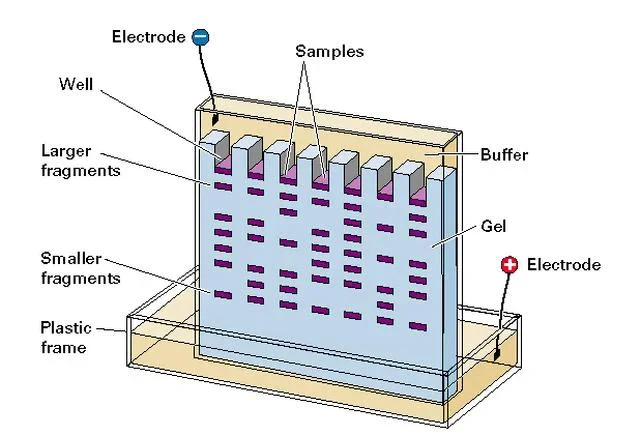 Figure 1: A typical gel electrophoresis analysis set-up.Copyright LabNet
With the Students
- Divide the class into teams of two students each. Hand out the materials and worksheets.
- Cut coffee filters into five strips, each about 1cm wide and 8cm long.
- Using a toothpick, transfer a drop of one food coloring solution to one of the strips. Place the drop in the middle of the paper strip, about 2 cm above the lower edge. Let the solution dry.
- Repeat Step 3, using a different strip of filter paper for each of the coloring solutions (DNA mimicking solution).
- Pour water into a beaker—1 cm height from the bottom.
- Place the paper strips in the beaker with the lower edge touching the bottom of the beaker. Make sure the wall of the beaker is dry.
- After 15 minutes, examine the strips. Compare your strips with other samples.
- Have students clean up the lab materials and complete the worksheet.
- crystalline structure
- A unique arrangement of atoms or molecules in a crystalline liquid or solid.
- electrophoresis
- A method used in biochemistry to separate macromolecules by their charge and/or size.
- dna
- Acronym for deoxyribonucleic acid. A self-replicating material present in nearly all living organisms as the main constituent of chromosomes.
- protein
- Any of a group of complex organic macromolecules that contain carbon, hydrogen, oxygen, nitrogen and usually sulfur, and are composed of one or more chains of amino acids.
- restriction enzyme
- An enzyme that cuts DNA at specific recognition nucleotide sequences called restriction sites.
Worksheet: At activity end, have students complete the DNA Forensics and Color Pigments Worksheet (PDF). Review their answers to assess their understanding of the associated lesson and hands-on activity subject matter and how it relates to restriction enzymes and the analysis of DNA fragments.
Contributors
Mircea Ionescu; Myla Van Duyn
Supporting Program
National Science Foundation GK-12 and Research Experience for Teachers (RET) Programs, University of Houston
Acknowledgements
This digital library content was developed by the University of Houston's College of Engineering under National Science Foundation GK-12 grant number DGE 0840889. However, these contents do not necessarily represent the policies of the NSF and you should not assume endorsement by the federal government.
Copyright
2013 by Regents of the University of Colorado; original © 2012 University of Houston