
Bone Crusher
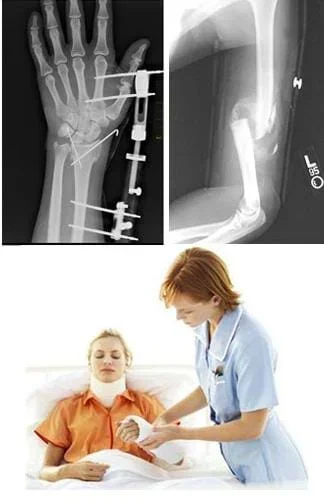 The variety in bones and fractures requires creativity to determine the best repair treatment for every situation.Copyright (top right) 2004 Bill Rhodes, Wikimedia Commons; (bottom) 2004 Microsoft Corporation, One Microsoft Way, Redmond, WA 98052-6399 USA. All rights reserved; (top left) 2011 Nevit Dilmen, Wikimedia Commons http://commons.wikimedia.org/wiki/File:Communitive_midshaft_humeral_fracture_callus.jpg http://office.microsoft.com/en-us/images/results.aspx?qu=broken+arm&ex=1#ai:MP900426551|mt:2| http://commons.wikimedia.org/wiki/File:Medical_X-Ray_imaging_OEN06_nevit.jpg
Students use a tension-compression machine (or an alternative bone-breaking setup) to see how different bones fracture differently and with different amounts of force, depending on their body locations. Teams determine bone mass and volume, calculate bone density, and predict fracture force. Then they each test a small animal bone (chicken, turkey, cat) to failure, examining the break to analyze the fracture type. Groups conduct research about biomedical challenges, materials and repair methods, and design repair treatment plans specific to their bones and fracture types, presenting their design recommendations to the class.
Methods to repair severe bone fractures have evolved over the centuries. Today, biomedical engineers work with physicians and surgeons to understand how different bones in the body are accustomed to withstanding different types and amounts of forces, and thus respond differently to damage and repair treatments. For the most severe cases, they are challenged to create surgical tools and strategies to align bone fragments so they heal correctly. Material science engineers are challenged to design biocompatible materials that can be used inside living and moving bodies without side effects. Thus, repair treatments have become more customized and specific to the unique bone types and fracture patterns.
After this activity, students should be able to:
- Identify factors that must be considered when designing treatment methods.
- Explain the thought process when designing treatment methods.
- Explain how the forces certain bones are able to withstand before fracture affect the specific type of treatment best suited for their repair.
- AP.4.5 Analyze and describe the effects of pressure, movement, torque, tension and elasticity on the human body.
Grades 9-12
Do you agree with this alignment?
- Students will develop an understanding of engineering design.
Grades K-12
Do you agree with this alignment? - Students will develop an understanding of the role of troubleshooting, research and development, invention and innovation, and experimentation in problem solving.
Grades K-12
Do you agree with this alignment? - Students will develop abilities to apply the design process.
Grades K-12
Do you agree with this alignment? - Students will develop an understanding of and be able to select and use medical technologies.
Grades K-12
Do you agree with this alignment?
- HS-ETS1-2 Design a solution to a complex real-world problem by breaking it down into smaller, more manageable problems that can be solved through engineering.
Grades 9-12
This resource focuses on the following Three Dimensional Learning aspects of NGSS:
Science & Engineering Practices- Design a solution to a complex real-world problem, based on scientific knowledge, student-generated sources of evidence, prioritized criteria, and tradeoff considerations.Do you agree with this alignment?
Disciplinary Core Ideas- Criteria may need to be broken down into simpler ones that can be approached systematically, and decisions about the priority of certain criteria over others (trade-offs) may be needed.Do you agree with this alignment?
Do you agree with this alignment? - Design a solution to a complex real-world problem, based on scientific knowledge, student-generated sources of evidence, prioritized criteria, and tradeoff considerations.
- HS-ETS1-3 Evaluate a solution to a complex real-world problem based on prioritized criteria and trade-offs that account for a range of constraints, including cost, safety, reliability, and aesthetics, as well as possible social, cultural, and environmental impacts.
Grades 9-12
This resource focuses on the following Three Dimensional Learning aspects of NGSS:
Science & Engineering Practices- Evaluate a solution to a complex real-world problem, based on scientific knowledge, student-generated sources of evidence, prioritized criteria, and tradeoff considerations.Do you agree with this alignment?
- Analyze data using tools, technologies, and/or models (e.g., computational, mathematical) in order to make valid and reliable scientific claims or determine an optimal design solution.Do you agree with this alignment?
Disciplinary Core Ideas- When evaluating solutions it is important to take into account a range of constraints including cost, safety, reliability and aesthetics and to consider social, cultural and environmental impacts.Do you agree with this alignment?
Crosscutting Concepts- New technologies can have deep impacts on society and the environment, including some that were not anticipated. Analysis of costs and benefits is a critical aspect of decisions about technology.Do you agree with this alignment?
Do you agree with this alignment? - Evaluate a solution to a complex real-world problem, based on scientific knowledge, student-generated sources of evidence, prioritized criteria, and tradeoff considerations.
- in all fields of science, analyze, evaluate, and critique scientific explanations by using empirical evidence, logical reasoning, and experimental and observational testing, including examining all sides of scientific evidence of those scientific explanations, so as to encourage critical thinking by the student;
Grades 9-12
Do you agree with this alignment? - evaluate models according to their limitations in representing biological objects or events; and
Grades 9-11
Do you agree with this alignment?
Each group needs:
- 1 small animal bone, such as from a cat, turkey or chicken; purchase a turkey or chicken from a grocery store or butcher and remove the bones, or purchase a cat for anatomy dissection and remove the bones, or purchase a cat skeleton from https://www.skullsunlimited.com/products/real-cat-skeleton-sk-318
- access to a scale, to measure bone mass
- access to water, graduated containers and a sink, to measure bone volume by water displacement
- (optional) calculators
- computers or iPads with Internet access for student research, ideally one per group
- poster-making supplies or PowerPoint® software, to create a class presentation
- Bone Crusher Fracture Worksheet (PDF), one per group
- Bone Crusher Design Worksheet (PDF), one per student
To share with the entire class:
- tension-compression machine and a video camera to record bone fracture testing; see the note below for options
- safety glasses
Options for tension-compression machines:
- Arrange to use a tension-compression machine, such as a Tinius Olsen universal testing machine, at a local university. Contact the mechanical engineering department first, then the civil engineering department, requesting access to a tension-compression machine. Depending on the machine size, it can be transported to your classroom, or take the class to the university. If a machine is not available for classroom use, arrange for someone at the university to fracture the bones while students watch live via Skype or FaceTime.
- Use the method described in the Sticks and Stones Will Break That Bone! activity. To do this, duct tape a bone so it spans the gap between two tabletops; from the middle of the bone, hang an S-hook connected to a length of chain or rope holding a bucket by its handle. Add weights or sand into the bucket until the bone breaks. After a fracture occurs, measure the weighted bucket. Most chicken bones are capable of holding 40-50 pounds (18-23 kg). Some bones require a large amount of weight to fracture, close to 200 pounds (90 kg).
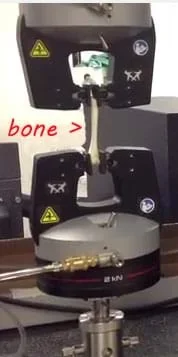 A tension-compression machine applies force to break a cat femur.Copyright 2013 College of Engineering, University of Houston
- Bone Crusher Fracture Worksheet (docx)
- Bone Crusher Fracture Worksheet (pdf)
- Bone Crusher Fracture Worksheet Answer Key (docx)
- Bone Crusher Fracture Worksheet Answer Key (pdf)
- Bone Crusher Design Worksheet (docx)
- Bone Crusher Design Worksheet (pdf)
- Bone Crusher Design Worksheet Answer Key (docx)
- Bone Crusher Design Worksheet Answer Key (pdf)
Basic knowledge about bones, fracture types and forces, as provided in the Forced to Fracture Presentation (PowerPoint® file) in the Forced to Fracture associated lesson.
Put yourself into the minds of biomedical engineers who design repair methods for bone fractures. What do they consider when approaching these problems? What kinds of materials do they choose? Or do they design new materials? (Listen to student ideas.) Every time a person fractures a bone, the situation is different and must be assessed to determine the best treatment method. By examining how different bones fracture and the amount of force necessary to break them, engineers start to visualize treatment option possibilities.
In this activity, you fracture various animal bones so that you can determine which require more force to break. Then you act as biomedical engineers to assess the situation by determining what type of fracture occurred and then design the best repair treatment method for a specific broken bone. What are the pros and cons of your design? If you had unlimited supplies and money, how would you improve the design? What could you invent to make it work better? Through all of this, you perform many of the same steps of the engineering design process as real-life biomedical engineers who solve medical problems to help people.
Background
To provide adequate background information, conduct the Forced to Fracture lesson the day before the activity, which includes presenting the Forced to Fracture Presentation and discussing its contents.
Before the Activity
- Watch a 55-second Femur Breaking video clip to see a university's tension-compression machine break a bone. This is essentially an example of the Day 1 activity setup. See https://www.youtube.com/watch?v=MoOH8LY2ZNw&feature=youtu.be.
- Either arrange for access to a university tension-compression machine or set up the lab with tables, duct tape, hook, rope and some form of weights for breaking the bones.
- Obtain small animal bones, enough for one per group. It is best to provide a variety of different bones from different animals, so even if teams test the same bones they are from different animals. See the Troubleshooting Tips section for a recommendation on bones NOT to make available. If not already clean, boil the bones and remove any remaining meat and tissue (this may smell).
- Gather materials and make copies of the Bone Crusher Fracture Worksheet (PDF) (one per group) and the Bone Crusher Design Worksheet (PDF), (one per student).
Day 1: Breaking Bones
- Divide the class into groups of three students each. Have each group choose a bone. Hand out the fracture worksheets. Have teams work together to answer the questions on page 1 of the worksheet.
- Have teams determine the bone density by finding the mass of the bone using a scale and the volume using a water displacement method. For a quick water displacement method, add a bone to a known volume of water; the change in volume from before to after the addition of the bone is the bone volume. Record bone mass, volume and density in the table on page 2 of the fracture worksheet.
- Have groups predict how much force, in Newtons or pounds, will be required to fracture their bones and record their predictions in the table on page 2 of the fracture worksheet. If desired, have students make predictions for other teams' bones, too.
- As a class, break each groups' bones using a tension-compression machine or alternate setup. Have students document on their worksheets the measured fracture force for their teams' bones (and for other teams' bones, if desired). If using a tension-compression machine, point out to students that the bone is gripped on its ends and either pulled apart by moving the grips apart (tension) or crushed by moving the grips together (compression). The amount of force required for a bone to give way to the grips moving together or apart is the amount of force required to fracture the bone. Note: It is recommended to use only the tension setting because the compression setting requires a much higher load in order to fracture bones.
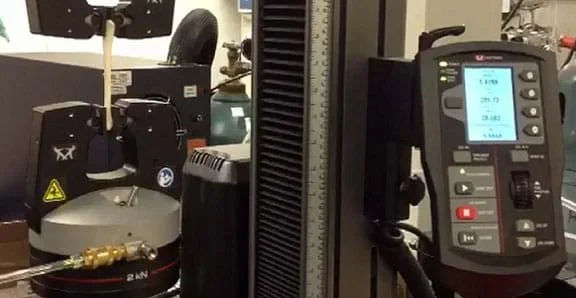 Example activity setup with a cat femur placed in a tension-compression machine to determine the amount of force required to fracture it.Copyright 2013 College of Engineering, University of Houston
 - Have students examine the broken bones and fill out the fracture worksheet with a description of how their bones fractured. For example, did the bone break into multiple pieces; break at the end or the middle; break straight across, at an angle or in a spiral; or not break all the way across? These observations provide clues to help students determine the fracture type(s) of their broken bones. Knowing the fracture pattern is necessary for figuring out how to go about fixing the fracture(s).
Day 2: Repair Design
- Hand out the design worksheets.
- Introduce (or review) the concept of the engineering design process. Share with students the definition in the Vocabulary/Definition section, which lists the steps of this cyclical process. Ask students to predict which steps of the process they anticipate completing in the activity as they design treatment plans for their fractured bones.
- Direct students to work together to research and answer the worksheet questions. With an understanding of their specific bone types and fracture types, have students research the possible and appropriate methods of bone repair. Knowing the bone type and fracture pattern helps to direct their research, brainstorming and plans for repair treatment.
- Have groups agree upon and then draw or sketch on their design worksheets the treatment plans they believe will be best to repair and aid the healing of their particular bones' particular type of fracture(s). Have each group also list reasons why its approach is best for its situation and what faults, limitations or disadvantages might be present.
- Direct teams to create posters or PowerPoint® presentations to describe to the class their recommended bone repair treatment methods, explaining why they think their designs will work and be effective; include background research, sketches, photos, similar examples found, etc.
- Conclude with the class presentations to share and compare what groups have learned about various bone types, fracture types and treatment methods. What are the pros and cons of each design? What improvements might you invent?
- Ask students to think back about the activity and describe in their own words what they did that falls into the steps of the engineering design process.
- avulsion fracture
- A fracture in which part of the bone is separated from its main part.
- biocompatibility
- The ability of a material to interact with the human body without causing adverse effects, such as infections or material degradation.
- calcification
- The accumulation of calcium salts in body tissue, normally occurring in bone formation.
- comminuted fracture
- A fracture in which the bone is broken into several pieces.
- compressive strength
- The capacity of a material to withstand forces pushing upon itself to reduce size.
- engineering design process
- A series of steps used by engineering teams to guide them as they develop new solutions, products or systems. Typically, the steps include: defining a problem, brainstorming, researching and generating ideas, identifying criteria and specifying constraints, exploring possibilities, selecting an approach, developing a design proposal, making a model or prototype, testing and evaluating the design using specifications, refining the design, creating or making it, and communicating processes and results.
- fissure fracture
- An incomplete fracture in which the crack is only in the outer bone layer. Also called a hairline fracture.
- fracture
- A break in a bone.
- greenstick fracture
- A fracture in which only one side of the bone is broken. The bone usually has a bend to it and the fracture is located at the outside of the bend. Common in young children.
- impacted fracture
- A fracture in which bone fragments have been driven into each other.
- oblique fracture
- A fracture that is diagonal to the bone's long axis.
- orthopedic surgeon
- A surgeon whose specialty is treating injuries to the musculoskeletal system using surgical and nonsurgical means.
- osteoblast
- A type of cell that organizes together to synthesize bone.
- osteoclast
- A type of bone cell that dissolves and resorbs bone tissue to enable new bone to be formed by osteoblasts.
- spiral fracture
- A bone fracture caused by a twisting force. Also called a torsion fracture.
- tensile strength
- The capacity of a material to withstand forces pulling it apart or stretching it.
- transverse fracture
- A fracture straight across the bone, usually the result of sharp, direct blows or stress fractures caused by prolonged running; the break occurs at a right angle to the bone's long axis.
Pre-Activity Assessment
Fracture Worksheet: Before beginning to break any bones, have students answer the questions on the first page of the Bone Crusher Fracture Worksheet (PDF) about bones, forces and fracture repair.
Activity Embedded Assessment
Fracture Worksheet: During the activity, have students enter values into the tables on the second page of the Bone Crusher Fracture Worksheet (PDF) as they collect data (bone mass, bone volume), calculate bone density, predict fracture force, document fracture force, compare predicted vs. measured force fracture values, describe the fractures and determine the fracture types.
Post-Activity Assessment
Design Worksheet: Have groups work together to conduct research to answer the questions on the Bone Crusher Design Worksheet (PDF). Then have them draw their test bones before and after the force test, and brainstorm as a group to design the best treatment plans for their broken bones. Review their answers to gauge their individual mastery of the concepts.
Presentation: After groups have collaborated to design treatment plans for their broken bones, have them create posters or PowerPoint® presentations to communicate to the class their recommended bone treatment methods, explaining why they think they will work and be effective; include background research, sketches, photos, similar examples found, etc. What are the pros and cons of your design? If you had unlimited supplies and money, how would you improve the design?
When testing the bones to failure, bone fragments may fly out when the bone is fracturing, so make sure everyone in the room wears safety goggles.
Do not permit students to choose certain bones to test, specifically, the skull and jaw bones are hard to fit into the grips of the tension-compression machine, and most of the small square bones are unable to be gripped on two sides.
Gripping the bones in the machine can be the biggest challenge, so make sure the grips are easily adaptable.
Be aware that in a tension-compression machine, the compression setting requires a much higher load to fracture bones than the tension setting.
As an exploration of how material properties affect material capabilities, have students use ordinary household materials to implement their treatment/repair designs on their fractured bones or make homemade splints for their legs or arms.
For lower grades, instead of having students research treatments/repair strategies based on fracture type, have students use everyday materials (tape, cardboard, paper) to make homemade splints for their arms. Focus more on why different animals and different bones are more fragile than others.
Show students some videos of bones fracturing; note that these are graphic and some images may be disturbing. Example 1:30-minute video, Louisville Kevin Ware Leg Break in March Madness, shows a basketball player breaking his leg: http://www.youtube.com/watch?v=YZW58xPz8kI
As examples of nonsurgical means of repair for broken arms, show students a photograph of a long arm cast, long arm splint and long arm hinged fracture brace at the Houston Methodist Orthopedics & Sports Medicine website: http://www.methodistorthopedics.com/bodyortho.cfm?xyzpdqabc=0&id=41744&action=detail&topicID=34857ee6e5e248055b714e7077a732b6
Harasen, Greg. Biologic Repair of Fractures. April 2002. Canadian Veterinary Journal. Vol. 43, No. 4, pp. 299-301. Accessed July 15, 2014. http://www.ncbi.nlm.nih.gov/pmc/articles/PMC339242/
Muminagic, Sahib N. History of Bone Fracture: Treatment and Immobilization. 2011. Materia Socio Medica. Vol. 23, No. 2, pp. 111-116. Accessed July 15, 2014. http://tinyurl.com/muminagic
Taylor, Tim. Types of Bone Fractures. 2013. Inner Body, HowToMedia, Inc. Accessed July 15, 2014. http://www.innerbody.com/image/skel06.html
- Forced to Fracture
- Bone Crusher
Contributors
Andrea Lee; Megan Ketchum
Supporting Program
National Science Foundation GK-12 and Research Experience for Teachers (RET) Programs, University of Houston
Acknowledgements
This digital library content was developed by the University of Houston's College of Engineering under National Science Foundation GK-12 grant number DGE 0840889. However, these contents do not necessarily represent the policies of the NSF and you should not assume endorsement by the federal government.
Copyright
2014 by Regents of the University of Colorado; original © 2013 University of Houston