
Forced to Fracture
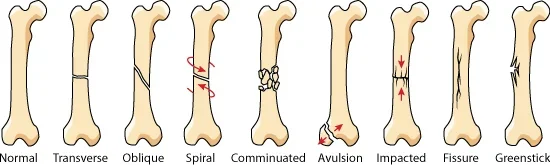 Common bone fracture types can be identified in every unique bone fracture. Biomedical engineers design ways to repair bones depending on the fracture locations and degree of severity.Copyright ASU Ask a Biologist http://askabiologist.asu.edu/how-bone-breaks
Students learn how forces affect the human skeletal system through fractures and why certain bones are more likely to break than others depending on their design and use in the body. They learn how engineers and doctors collaborate to design effective treatments with consideration for the location, fracture severity and patient age, as well as the use of biocompatible materials. Learning the lesson content prepares students for the associated activity in which they test small animal bones to failure and then design treatment repair plans.
Animal bones are strong and they usually only fracture when large forces are applied to the body. Biomechanical engineers examine how different bones in the human body break depending upon the forces and directions in which the forces are applied. Then they design treatment and repair strategies to ensure the body continues to be able to withstand the impact of forces normally applied. Materials science engineers design materials that are biocompatible and maintain the desired mechanical properties of the bone to prevent infection, while aiding in the healing of fractures.
After this lesson, students should be able to:
- Describe the various types of bone fractures and problems that medical doctors face with each type.
- Explain methods to repair the many types of bone fractures.
- Describe the factors to take into consideration when designing materials for use in the human body.
- AP.4.5 Analyze and describe the effects of pressure, movement, torque, tension and elasticity on the human body.
Grades 9-12
Do you agree with this alignment?
- Students will develop an understanding of the role of troubleshooting, research and development, invention and innovation, and experimentation in problem solving.
Grades K-12
Do you agree with this alignment? - Students will develop an understanding of and be able to select and use medical technologies.
Grades K-12
Do you agree with this alignment?
- HS-ETS1-3 Evaluate a solution to a complex real-world problem based on prioritized criteria and trade-offs that account for a range of constraints, including cost, safety, reliability, and aesthetics, as well as possible social, cultural, and environmental impacts.
Grades 9-12
This resource focuses on the following Three Dimensional Learning aspects of NGSS:
Science & Engineering Practices- Evaluate a solution to a complex real-world problem, based on scientific knowledge, student-generated sources of evidence, prioritized criteria, and tradeoff considerations.Do you agree with this alignment?
Disciplinary Core Ideas- When evaluating solutions it is important to take into account a range of constraints including cost, safety, reliability and aesthetics and to consider social, cultural and environmental impacts.Do you agree with this alignment?
Crosscutting Concepts- New technologies can have deep impacts on society and the environment, including some that were not anticipated. Analysis of costs and benefits is a critical aspect of decisions about technology.Do you agree with this alignment?
Do you agree with this alignment? - Evaluate a solution to a complex real-world problem, based on scientific knowledge, student-generated sources of evidence, prioritized criteria, and tradeoff considerations.
- in all fields of science, analyze, evaluate, and critique scientific explanations by using empirical evidence, logical reasoning, and experimental and observational testing, including examining all sides of scientific evidence of those scientific explanations, so as to encourage critical thinking by the student;
Grades 9-12
Do you agree with this alignment? - evaluate models according to their limitations in representing biological objects or events; and
Grades 9-11
Do you agree with this alignment?
A basic understanding of bones, forces and types of mechanical properties.
Fracture Types
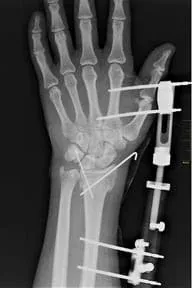 Figure 1. Depending on the fracture type, the best treatment option might be external fixation if the bone needs to be stabilized above and below the fracture. This x-ray shows an external fixation device surrounding the fracture.Copyright 2011 Nevit Dilmen, Wikimedia Commons http://commons.wikimedia.org/wiki/File:Medical_X-Ray_imaging_OEN06_nevit.jpg
When looking at broken bones, eight major types of fractures are commonly identified, with some variations of each type. Transverse fractures are breaks straight across the bone, usually the result of sharp, direct blows or stress fractures caused by prolonged running; they occur at right angles to the bone's long axis. An oblique fracture occurs at diagonals to the bone's long axis. A spiral fracture is one in which part of the bone has twisted. This fracture type is often caused by a twisting motion or force, such as planting your foot while the rest of your leg keeps twisting. A comminuted fracture is when the bone has fractured into several pieces. An avulsion fracture is one in which a part of the bone has entirely separated from the main part of the bone. An impacted fracture results when bone fragments are driven into each other. A fissure fracture is an incomplete fracture in which the crack is only in the outer bone layer; it is also called a hairline fracture. A greenstick fracture is when only one side of a bone is broken. In this case, the bone usually has a bend to it and the fracture is located at the outside of the bend; this type is common in young children because their bones are not as hard as adult bones. Fractures are further described as open or closed, which indicates whether or not the bone broke the skin. Open is when the skin is broken and the bone is protruding. Fractures can also be labeled as complete or incomplete; if a bone is broken across its entire width, it is called a complete fracture.
Healing Process
When a bone is fractured, it goes through four phases of healing to repair itself. A fracture not only breaks the bone, but also severs nerves and blood vessels, which causes blood to accumulate around the injury site, resulting in a hematoma (blood clot). The blood in the hematoma is gradually replaced by fibrocartilage tissue (called a callus) that holds the ends of the broken bone together to keep them in place while internal pathways of new blood vessels reform. The soft fibrocartilage tissues are gradually replaced by new bone matrix as osteoblasts have time to secrete new minerals that harden into bone. The excess bone of the callus is gradually dissolved in a process called remodeling until the bone more closely resembles its original form.
Fracture Treatment
For bones to heal properly using the natural healing process, they must be in the correct position. For example, in an open fracture, the bone is no longer inside the body. However in order to heal well, it must be inside the body and lined up with the other broken portion(s). The degree of surgical and nonsurgical repair varies in every case; it depends upon the fracture. For minor fractures in which the bone does not need to be reset in place, it only requires support and/or immobilization with a sling, splint, cast or brace. All of these repairs are nonsurgical and stabilize the bone during the natural healing process. Additional factors are also considered when determining treatment: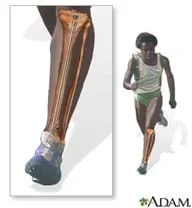 Figure 2. This tibial intramedullary rod is an example of an internal fixation treatment. Advantages of internal fixation are that it often allows early mobility and faster healing. Usually the implants are not removed.Copyright ADAM, Medline Plus, U.S. National Library of Medicine http://www.nlm.nih.gov/medlineplus/ency/presentations/100077_4.htm
- Location and type of fracture: Is the fracture at a joint? Is the bone in multiple pieces or fragments? Is it dislocated or an open fracture?
- Patient age: Elderly patients take longer to heal. Children typically heal more quickly.
- Activity level: For example, bedridden patients heal more slowly and may experience more complications.
- Bone quality: Osteoporotic bones heal more slowly. Other vitamin/mineral deficiencies also have negative effects on healing. These deficiencies might include osteomalacia/rickets due to vitamin D deficiency, calcium deficiency and scurvy (vitamin C deficiency).
Surgical methods are also employed to repair some bone fractures. In some cases, often for open fractures, bolts and screws are inserted into uninjured bone surrounding the fracture to provide stabilization around the fracture. For external fixation, the stabilizing device, such as a curved plate, remains outside of the body with pins inserted through the skin into the bone (see Figure 1). Holes in the skin require diligent wound care to avoid infection. Internal fixation involves the placement of plates and/or screws on the bone itself, with no external stabilizing device (see Figure 2). For internal fixation, often metal plates with screws are used to help keep the bone in the optimal position.
Complications
Fractures at joints such as elbows require special treatment to maintain joint mobility. A cast can only be left on for so long before calcification causes the bone to remain in the same position. The calcium deposits from calcification cause joints to not be able to function as they did before the injury—or worse—to become permanently immobilized. Thus, it is essential that joints stay mobile during the healing process. Another consideration in designing repair treatments, especially if using plates and screws, is that bone atrophy can occur (wasting away, becoming weaker) if the implants bear too much of the bone's load.
Who in this class has broken a bone in his or her body? Raise your hand if you have. I wonder, did each of you have the same type of fracture? How did the bone repair? What was the treatment? (Listen to student examples of fraction locations and how they were fixed.)
What is a splint? That's right, it's a piece of wood or some other rigid material that we use to immobilize a broken or dislocated bone. What is a sling? It's a device that supports an injured body part, like a bandage or cloth looping the neck and arranged to cradle and support an arm. For many years, a splints and slings were the only methods used to treat fractures. More recently, biomedical engineers have designed new materials for casts as well as plates, rods, pins, screws and implants. These new materials and tools enable more severe injuries to be treated, which reduces the number of limb amputations.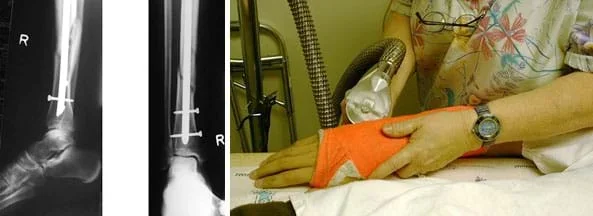 Example bone fracture treatments. (left) An internal fixation using an intramedullary rod, which shares the load with the bone rather than entirely supporting it. (right) A short arm cast with a fiberglass top layer being cut and removed with a special cast saw.Copyright (left) 2006 Kolossos, Wikimedia Commons; (right) 2007 Merzperson, Wikimedia Commons http://commons.wikimedia.org/wiki/File:K-Fuss-z2.jpg http://commons.wikimedia.org/wiki/File:Cast_off.JPG
When designing new materials and methods to help heal the body, what sorts of issues and possible problems do you think biomedical engineers must consider? (Listen to student ideas.) Some issues are biocompatibility with the human body, chances of infection, material degradation, patient stress and cost. These factors contribute to the development of a treatment plan implemented by doctors.
Bones are extremely strong, yet every bone in the body can be fractured, and each bone is shaped differently and has different functions. Since all bones are not the same, engineers must consider the location of broken bones to determine what the body needs to repair it. For example, a leg bone such as the femur holds more weight than a wrist. Thus, each of these repairs requires a different technique and material to fix it. What about a joint fracture or a rib? Both of these also have special needs to be considered. (Continue this discussion to the level of detail desired.)
(Move on to present to the class the 16-slide Forced to Fracture Presentation (PPTX), a PowerPoint® file. Either before or after the presentation, assign students to complete the Forced to Fracture Worksheet (PDF); answers to the worksheet questions are given during the presentation.)
(With slide 1 showing.) Forces are exerted on the body at all times, but why do some bones break? What forces cause them to lose their structure? After a bone break occurs, the body must attempt to repair the fractured bone. How does the body create new bone matrix to be used in repair? When the injury is beyond the body's ability to heal, what are some surgical methods of restoring the bone to its original structure and function? This is part of what biomedical engineers do: creating devices and approaches that can be used to repair fractures too severe for the body to heal on its own. (Continue on with the slides; refer to the slide notes for content to present at each slide). Following the presentation, challenge students to complete the hands-on investigation activity, Bone Crusher to test their understanding and critical solving skills to help remedy different fracture types!
Historical records show that splints and casts were first used in the 1600s by doctors, while the fossil record shows signs of their implementation by ancient Egyptians. The first use of screws and rods occurred in the 1800s, but success was not achieved until the 1900s. In a short amount of time, our ability to repair fractures has increased enormously due to the ongoing creative contributions of biomedical and materials science engineers.
- avulsion fracture
- A fracture in which part of the bone is separated from its main part.
- biocompatibility
- The ability of a material to interact with the human body without causing adverse effects, such as infections or material degradation.
- calcification
- The accumulation of calcium salts in body tissue, normally occurring in bone formation.
- comminuted fracture
- A fracture in which the bone is broken into several pieces.
- compressive strength
- The capacity of a material to withstand forces pushing upon itself to reduce size.
- fissure fracture
- An incomplete fracture in which the crack is only in the outer bone layer. Also called a hairline fracture.
- fracture
- A break in a bone.
- greenstick fracture
- A fracture in which only one side of the bone is broken. The bone usually has a bend to it and the fracture is located at the outside of the bend. Common in young children.
- impacted fracture
- A fracture in which bone fragments have been driven into each other.
- oblique fracture
- A fracture that is diagonal to the bone's long axis.
- orthopedic surgeon
- A surgeon whose specialty is treating injuries to the musculoskeletal system using surgical and nonsurgical means.
- osteoblast
- A type of cell that organizes together to synthesize bone.
- osteoclast
- A type of bone cell that dissolves and resorbs bone tissue to enable new bone to be formed by osteoblasts.
- spiral fracture
- A bone fracture caused by a twisting force. Also called a torsion fracture.
- tensile strength
- The capacity of a material to withstand forces pulling it apart or stretching it.
- transverse fracture
- A fracture straight across the bone, usually the result of sharp, direct blows or stress fractures caused by prolonged running; the break occurs at a right angle to the bone's long axis.
Pre-Lesson Assessment
Discussion Questions: Lead a group discussion by asking the following questions. On the classroom board, make a table of student responses about the types of bones, fractures and treatments experienced.
- Who has broken a bone or knows someone who has broken a bone?
- What was used to fix the fracture?
- Why was that approach or method chosen to fix it?
- Who made the materials that were used to repair the fracture? (For example, biomedical engineers, materials science engineers, etc.)
Lesson Summary Assessment
Worksheet: Either before or after the Forced to Fracture Presentation (PPTX), have students answer the six-question Forced to Fracture Worksheet (PDF) about fractures, repair methods and factors involved in treatment options. Answers to the questions are covered in the presentation. Review students' answers to gauge their comprehension of the lesson content.
Show students a 1:12 minute video called How the Body Works: Repair of Bone at https://www.youtube.com/watch?v=qVougiCEgH8
Three images related to bone fracture repair at the U.S. National Library of Medicine's Medline Plus website at http://www.nlm.nih.gov/medlineplus/ency/presentations/100077_2.htm
What does a future cast look like? Show students this inspiring and stylish 3D-printed cast that uses an ultrasonic pulse generator to speed bone healing (great image): http://www.cnet.com/news/3d-printed-cast-uses-ultrasound-to-speed-healing/
Harasen, Greg. Biologic Repair of Fractures. April 2002. Canadian Veterinary Journal. Vol. 43, No. 4, pp. 299-301. Accessed July 15, 2014. http://www.ncbi.nlm.nih.gov/pmc/articles/PMC339242/
Muminagic, Sahib N. History of Bone Fracture: Treatment and Immobilization. 2011. Materia Socio Medica. Vol. 23, No. 2, pp. 111-116. Accessed July 15, 2014. http://tinyurl.com/muminagic
Taylor, Tim. Types of Bone Fractures. 2013. Inner Body, HowToMedia, Inc. Accessed July 15, 2014. http://www.innerbody.com/image/skel06.html
- Forced to Fracture
Contributors
Andrea Lee; Megan Ketchum
Supporting Program
National Science Foundation GK-12 and Research Experience for Teachers (RET) Programs, University of Houston
Acknowledgements
This digital library content was developed by the University of Houston's College of Engineering under National Science Foundation GK-12 grant number DGE 0840889. However, these contents do not necessarily represent the policies of the NSF and you should not assume endorsement by the federal government.
Copyright
2014 by Regents of the University of Colorado; original © 2013 University of Houston