
Building a Piezoelectric Generator
Students learn how to build simple piezoelectric generators to power LEDs. To do this, they incorporate into a circuit a piezoelectric element that converts movements they make (mechanical energy) into electrical energy, which is stored in a capacitor (short-term battery). Once enough energy is stored, they flip a switch to light up an LED. Students also learn how much (surprisingly little) energy can be converted using the current state of technology for piezoelectric materials.
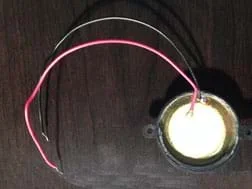 The ceramic piezoelectric element used in the activity.Copyright 2014 Matthew Zelisko, GK-12 Program, University of Houston.
Piezoelectric materials have the unique and useful property of being able to transform mechanical energy into electrical energy, and vice versa. This gives piezoelectric materials a wide range of potential applications from sensors and actuators to artificial muscles. One of the most interesting applications is in the field of energy harvesting, where piezoelectric materials are used to convert mechanical energy that is typically wasted into a source of electrical energy. However, the technology of currently available piezoelectric materials and methods is unable to produce a sufficient amount of energy, so engineers are researching how to improve piezoelectric energy harvesting devices.
After this activity, students should be able to:
- Explain how the piezoelectric generator works and from where it gets its energy.
- List multiple energy-harvesting applications for piezoelectric materials.
- Calculate how much energy is stored in a capacitor and how much is converted by the piezo element.
- CCSS.Math.Content.HSA-CED.A.4 Rearrange formulas to highlight a quantity of interest, using the same reasoning as in solving equations.
Grades 9-12
Do you agree with this alignment? - CCSS.Math.Content.HSA-REI.B Solve equations and inequalities in one variable
Grades 9-12
Do you agree with this alignment? - CCSS.Math.Content.HSA-REI.B.3 Solve linear equations and inequalities in one variable, including equations with coefficients represented by letters.
Grades 9-12
Do you agree with this alignment? - CCSS.Math.Content.HSN-Q.A Reason quantitatively and use units to solve problems.
Grades 9-12
Do you agree with this alignment?
- Students will develop an understanding of the characteristics and scope of technology.
Grades K-12
Do you agree with this alignment? - Students will develop an understanding of the relationships among technologies and the connections between technology and other fields of study.
Grades K-12
Do you agree with this alignment? - Energy cannot be created nor destroyed; however, it can be converted from one form to another.
Grades 9-12
Do you agree with this alignment?
- HS-PS3-1 Create a computational model to calculate the change in the energy of one component in a system when the change in energy of the other component(s) and energy flows in and out of the system are known.
Grades 9-12
This resource focuses on the following Three Dimensional Learning aspects of NGSS:
Science & Engineering Practices- Create a computational model or simulation of a phenomenon, designed device, process, or system.Do you agree with this alignment?
Disciplinary Core Ideas- Energy is a quantitative property of a system that depends on the motion and interactions of matter and radiation within that system. That there is a single quantity called energy is due to the fact that a system's total energy is conserved, even as, within the system, energy is continually transferred from one object to another and between its various possible forms.Do you agree with this alignment?
- Conservation of energy means that the total change of energy in any system is always equal to the total energy transferred into or out of the system.Do you agree with this alignment?
- Energy cannot be created or destroyed, but it can be transported from one place to another and transferred between systems.Do you agree with this alignment?
- Mathematical expressions, which quantify how the stored energy in a system depends on its configuration (e.g. relative positions of charged particles, compression of a spring) and how kinetic energy depends on mass and speed, allow the concept of conservation of energy to be used to predict and describe system behavior.Do you agree with this alignment?
- The availability of energy limits what can occur in any system.Do you agree with this alignment?
Crosscutting Concepts- Science assumes the universe is a vast single system in which basic laws are consistent.Do you agree with this alignment?
- Models can be used to predict the behavior of a system, but these predictions have limited precision and reliability due to the assumptions and approximations inherent in models.Do you agree with this alignment?
Do you agree with this alignment? - Create a computational model or simulation of a phenomenon, designed device, process, or system.
- HS-PS3-2 Develop and use models to illustrate that energy at the macroscopic scale can be accounted for as either motions of particles or energy stored in fields.
Grades 9-12
This resource focuses on the following Three Dimensional Learning aspects of NGSS:
Science & Engineering Practices- Develop and use a model based on evidence to illustrate the relationships between systems or between components of a system.Do you agree with this alignment?
Disciplinary Core Ideas- Energy is a quantitative property of a system that depends on the motion and interactions of matter and radiation within that system. That there is a single quantity called energy is due to the fact that a system's total energy is conserved, even as, within the system, energy is continually transferred from one object to another and between its various possible forms.Do you agree with this alignment?
- At the macroscopic scale, energy manifests itself in multiple ways, such as in motion, sound, light, and thermal energy.Do you agree with this alignment?
- These relationships are better understood at the microscopic scale, at which all of the different manifestations of energy can be modeled as a combination of energy associated with the motion of particles and energy associated with the configuration (relative position of the particles). In some cases the relative position energy can be thought of as stored in fields (which mediate interactions between particles). This last concept includes radiation, a phenomenon in which energy stored in fields moves across space.Do you agree with this alignment?
Crosscutting Concepts- Energy cannot be created or destroyed—it only moves between one place and another place, between objects and/or fields, or between systems.Do you agree with this alignment?
Do you agree with this alignment? - Develop and use a model based on evidence to illustrate the relationships between systems or between components of a system.
- AI.9.12.E solve mathematic and scientific formulas, and other literal equations, for a specified variable.
Grade 9
Do you agree with this alignment? - AI.9.5.B solve linear inequalities in one variable, including those for which the application of the distributive property is necessary and for which variables are included on both sides; and
Grade 9
Do you agree with this alignment?
- Science concepts. The student recognizes multiple forms of energy and knows the impact of energy transfer and energy conservation in everyday life. The student is expected to:
Grades 9-10
Do you agree with this alignment? - evaluate the transfer of electrical energy in series and parallel circuits and conductive materials;
Grades 9-10
Do you agree with this alignment?
Each group needs:
- 1 piezo transducer/piezo element, such as: SparkFun https://www.sparkfun.com/products/10293
- 4 diodes, type PH4148, 1N4148 or 1N914, such as: SparkFun https://www.sparkfun.com/products/8588
- 1 electrolytic capacitor 220 μF or greater (25 to 50 V), such as: SparkFun https://www.sparkfun.com/products/8982
- 1 switch (switch choice may alter wiring diagram), such as: rocker switch from SparkFun https://www.sparkfun.com/rocker-switch-on-off-on-round.html?gad_source=1&gad_campaignid=17479024030&gbraid=0AAAAADsj4ESTGL1d_w0hzLvGcKiY1yWOG&gclid=CjwKCAjwsZPDBhBWEiwADuO6yz9x7ymqB_9hJX0t-cPcly4q4UaREH9si6pNTzF5EVsorfOqf_XLnRoC884QAvD_BwE
- 1 LED, such as: LED light bar from adafruit
- 1 breadboard, such as: from SparkFun https://www.sparkfun.com/products/9567
- 2 alligator clips, such as: a 10-pack of alligator test leads from SparkFun https://www.sparkfun.com/products/12978
- 1-3 breadboard jumper wires, such as: a 10-pack at Sparkfun https://www.sparkfun.com/products/8431
To share with the entire class:
- multimeter, such as: 15-range digital multimeter at https://www.amazon.com/RadioShack-22-182-15-Range-Digital-Multimeter/dp/B00CSMDGS6
- 22 AWG wire, 1 ft per group, such as: 25-ft spool at SparkFun https://www.sparkfun.com/products/8022; note: a higher AWG, such as 24-30, if available, works better in the breadboard sockets
- soldering gun, to prepare materials for the activity
- tiny screwdriver
- ability to show students a few short online help videos
- projector to show students the How to Build a Piezoelectric Generator Presentation (PPTX), a PowerPoint® file
Cost note: Everything in this activity can be reused. The initial ~$20 cost per group can be continually reused for other classes. Ordering from SparkFun Electronics is the least expensive option (better than RadioShack); the company gives a 10% discount when purchasing 10 or more of any item. One exception is the switch; the RadioShack switch has been tested and shown to work, while the SparkFun one has not.
Students should know the basics about electromechanical coupling, especially piezoelectricity and the use of piezoelectric materials for energy harvesting, as presented in the associated lesson, Piezoelectricity. No electrical or wiring background is necessary, but is helpful.
When you were little, did you ever wear shoes that would light up as you walk? (Answer: Expect some students to answer yes.) Does anyone know how those shoes work? (If students paid attention during the associated lesson, hopefully they answer yes.) This type of shoe has no batteries, so what is the power source? (Listen to student responses.) Piezoelectric materials are placed in the bottoms of the shoes, but they do not store any energy. So from where does the energy come? (Listen to student explanations.) The energy comes from you! Whenever you walk, your movements are mechanical energy and some of that mechanical energy can be converted into electrical energy by piezoelectric materials. In the case of the light-up shoes, that energy is used immediately to light-up some LEDs, which brings up an idea: What are the possibilities for storing that energy to use whenever we please?
(Start the seven-slide PowerPoint® presentation, showing students the circuit design on slide 2; this is a simplified circuit that you may wish to replace with the full circuit [Figure 1], which is provided as slide 8 for easy swapping.)
Background
How much energy are we converting? We measure the voltage across the capacitor in our piezoelectric generators for two reasons. The first is simply to make sure it is working. The second, more important reason, is because we can use this voltage to calculate the amount of energy stored in our capacitors using the equation:
Where E is the energy stored in the capacitor, C is the capacitance and V is the voltage measured across the capacitor. When using this equation, make sure the units are correct. We want the capacitance to be in farads; if it is given in μF, simply divide by 1,000,000 to convert. We want the voltage to be in volts (V). Then, the units of energy will be joules (J) or equivalently, in watt-seconds (W-s).
To calculate how much energy is stored for each tap or press on the piezo element, measure the voltage before (V0) and the voltage after the tap (V1), and then use the following equation:
When performing these calculations, we find that very little energy is stored, generally around 0.00001 joules. As a comparison, a cell phone battery stores around 18,000 joules. Since this piezoelectric generator is so inefficient, engineers are working on two main approaches to improve its energy harvesting capabilities:
- Improve the piezoelectric material itself. Essentially create a material that is more efficient at converting mechanical energy into electrical energy.
- Place the material where it will be deformed (or tapped) very rapidly.
The second idea is the driving motivation for most piezoelectric energy-harvesting research work today. Some ideas include placing the materials under sidewalks and roads, or in clothing. Figure 1. Wiring diagram for a piezoelectric generator.Copyright 2014 Matthew Zelisko, GK-12 Program, University of Houston
Before the Activity
- Gather materials and make copies of the Harvesting Energy Worksheet (PDF).
- Make sure the switches are ready to use; they work best if the wire is soldered onto the switch inputs. You may also just strip enough wire and thread it through the holes, but this does not guarantee a good connection. (If interested, RadioShack sells a "learn to solder" kit that is very easy to use.)
- If you use RadioShack alligator clips, you must solder some wire (~12 inches) to each. In this case, it is recommended to only attach one alligator clip to each wire and leave the other end stripped about ¼-inch so it can be inserted into the breadboard. Note that the alligator clips and multimeter are not strictly necessary, but enable students to verify that their capacitors are storing energy.
- If you use RadioShack piezo elements, take them apart to expose the piezo element. To do this without damaging the piezo element, use a tiny screwdriver to carefully pop off the back and expose the element, leaving the remaining casing around it. Figure 3 shows what the RadioShack element looks like with the back removed.
- Review the instructions below, which are based on the Figure 1 circuit diagram and using the RadioShack switch. If using the SparkFun switch, make a slight change to the circuit diagram. Refer to one of the YouTube videos listed in the Additional Multimedia Support section that uses a rocker switch similar to the SparkFun switch.
- Be ready to show the class the seven-slide How to Build a Piezoelectric Generator Presentation (PPTX), a PowerPoint® file.
With the Students
- Start by presenting the Introduction/Motivation content and then slide 2, the circuit diagram.
- Depending on the availability of materials, organize the class into groups of two to four students each. Hand out the materials to each group and have students follow the instructions below.
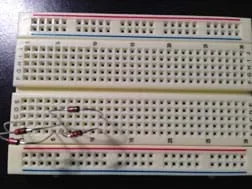 Figure 2. The diode rectifier bridge.Copyright 2014 Matthew Zelisko, GK-12 Program, University of Houston
 - Make a diode rectifier bridge on the breadboard (see Figure 2). Diodes permit current to flow in only one direction. Doing this converts the AC voltage generated by the piezo element into a DC voltage, which can be used by the capacitor and the LED. The diodes are marked to show which way the current will flow. The RadioShack diodes have a black stripe that marks the back end of the diode, which is the convention for any 1N4148 type diode.
- On the breadboard, insert diodes into sockets 1A, 1B, 5C and 6A, facing the same direction with the black stripes up.
- Take the diode from 1A and insert the other end into socket 5A, the diode from 1B to 6B, the diode from 5C to 11C, and 6A to 11A.
- Make sure no diode leads are touching, which would cause a short circuit.
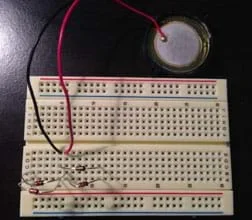 Figure 3. The piezo element connection to the diode rectifier.Copyright 2014 Matthew Zelisko, GK-12 Program, University of Houston
- Connect the piezo element to the breadboard (see Figure 3). To do this, insert the black lead into socket 5E and the red lead into socket 6E.
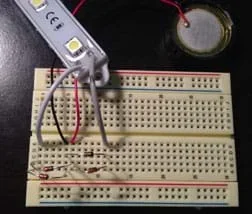 Figure 4. For testing, the piezo element is connected to the diode bridge input and the LED bar to the output.Copyright 2014 Matthew Zelisko, GK-12 Program, University of Houston
 - Test the circuit by hooking up the LED. (Refer to Figure 4 and the Diode Test video listed in the Additional Multimedia Support section.) At this point, we can test the circuit by inserting the LED leads into sockets. If using the SparkFun LED light bar, it is easily visible and the positive and negative leads are clearly marked. If using simple LEDs, the positive side is the longer lead, and negative side is the shorter lead; for these LEDs, dimming or turning off the classroom lights helps to make them more visible.
- Put the positive lead into socket 11E and the negative lead into 1E.
- Once the LED is hooked up to the breadboard, tap the piezo element; expect the LED to light up briefly, confirming that the circuit works.
- If the LED does not light up check, the direction of the diodes and the LED to make sure they are not backwards.
- For the simple LEDs, it is best to look at the very top of the bulb to see if it is lighting up or not.
- Once the circuit has been tested to make sure it works, remove the LED from the breadboard.
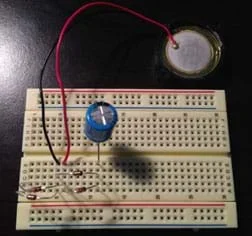 Figure 5. Placement of a capacitor on the breadboard.Copyright 2014 Matthew Zelisko, GK-12 Program, University of Houston
- Hook up the capacitor (see Figure 5). Electrolytic capacitors also have positive and negative leads, so direction matters. Again, the longer lead is positive, and the shorter lead is negative. Insert the positive (longer) lead into socket 11E and the negative (shorter) lead into socket 11H.
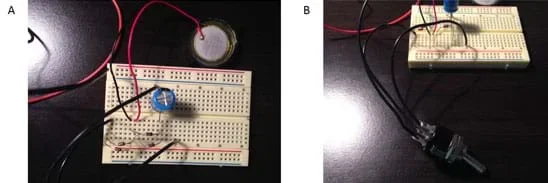 Figure 6. Wire a switch to the breadboard.Copyright 2014 Matthew Zelisko, GK-12 Program, University of Houston
 - Hook up the switch (see Figure 6). This is typically the most confusing step. If using the RadioShack switch, a toggle switch, notice that it has three wires coming from it. Hook up this switch by following these steps:
- Insert the middle wire into socket 11J.
- Insert the two remaining wires into sockets 1E and 15E; it does not matter which wire goes to which socket, since it only affects the switch direction.
- Insert a breadboard jumper wire from socket 11B to socket 20E.
If using the SparkFun switch, a simple rocker switch, notice that it has two wires coming from it. Hook up this switch by following these steps:
- Insert a breadboard jumper wire from socket 11J to socket 5J.
- Insert another breadboard jumper from socket 5I to 1E.
- Insert one switch wire into socket 5H and the other switch wire into socket 15E.
- Insert a breadboard jumper from socket 11B to socket 20E.
- This should be correct, but may need some adjustment as the circuit has not been tested with this switch.
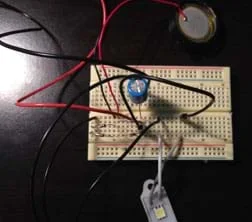 Figure 7. The final wired circuit.Copyright 2014 Matthew Zelisko, GK-12 Program, University of Houston
- Connect the LED (see Figure 7). Connect the positive (longer) lead from the LED (or LED bar) to socket 20A and the negative (shorter) lead to 15A. This completes the circuit!
- Hook up alligator clips to measure energy in the capacitor. Follow these steps if using the SparkFun alligator clips:
- Clip one on the capacitor lead going into socket 11E and the other end to the positive (red) lead on the multimeter.
- Clip the other alligator clip on the capacitor lead going into socket 11H and the other end to the negative (black) lead on the multimeter.
Follow these steps if using the alligator clips with one clip and one exposed wire end:
- Insert one exposed wire into socket 11D and clip to the positive (red) lead on the multimeter.
- Insert the other exposed end into socket 11I and clip to the negative (black) lead on the multimeter.
- Test the circuit. (Refer to the Circuit Test video listed in the Additional Multimedia Support section.) Turn the multimeter to the 20V DC setting and start tapping on the piezo element. Expect to see the voltage across the capacitor increasing, which indicates that it is storing energy. If not, try flipping the switch to the opposite position. Once the capacitor has stored sufficient voltage, flip the switch and the LED should come on briefly. Note: The required voltage across the capacitor will vary, depending on the exact capacitor and LED used. As an example, using a 220 μF 35V capacitor and the LED light bar, required about 8.5V across the capacitor, while the standard single LED only required about 3V.
- Finish the presentation, including energy calculation practice. Go through the energy calculations and have students try them on their own before giving the answers.
- Assign the worksheet. Now that students have working piezoelectric generators and have learned how to make energy calculations, have them complete the worksheet. Questions 1 and 2a require access to their generators. If only one multimeter is available, work through questions 1 and 2a as a class.
- alternating current power
- (AC power) The type of power supplied by electrical outlets in homes as well as the piezoelectric element. In the piezoelectric element, a positive voltage is produced when pressed and an opposite, negative voltage when released.
- capacitor
- A device that stores energy, similar to a battery, but can be recharged and discharged much faster.
- direct current power
- (DC power) Power supplied by a current that only runs in one direction. This type of power is needed for the capacitor and LED.
- diode
- An electrical component that only permits current to flow in one direction.
- light emitting diode
- (LED) An LED does the same thing as a diode, but lights up when the current is sufficiently high.
- multimeter
- A device for making a variety of electrical measurements. In this activity it is used to measure DC voltage.
- piezo element
- The piezoelectric material that converts mechanical energy into electrical energy.
Pre-Activity Assessment
Piezoelectricity Lesson Review: Quickly review with students the material covered in the associated lesson. Ask: What is the piezoelectric effect? What causes piezoelectricity on the atomic level? What are some tested and conceptual applications? If you did not assign the lesson's Piezoelectricity Quiz (PDF), this is also a suitable place for it, or review the quiz answers (PDF) with the class.
Activity Embedded Assessment
Energy Calculations Example: Cell Phone: Once you have given students the equation to calculate the amount of energy stored in a capacitor, see if they can figure out how long it will take to charge a cell phone that requires 18,000 joules of energy. These calculations are already done in the How to Build a Piezoelectric Generator Presentation (PPTX), but have students give it a try before giving the answers.
Post-Activity Assessment
Worksheet: Assign students to complete the Energy Harvesting Worksheet (PDF). Questions 1 and 2a require access to their generators. If only one multimeter is available, work through questions 1 and 2a as a class. For question 4, students brainstorm ways that they could use their piezoelectric generators that would be more efficient than just tapping it. Some examples include putting it under your shoe or under sidewalks. Review their answers to gauge their depth of comprehension.
- Do not overcharge the capacitor. Luckily, this is unlikely to happen since piezo elements are generally unable to convert enough energy to overcome the capacitor energy leakage at high charges.
- While a capacitor is charging, do not touch bare wires so as to avoid receiving a shock. The author was able to complete the entire build and charging/discharging cycles multiple times without even a slight shock using no protective gear.
The most common problem encountered in this activity is making sure that all components have current flowing in the correct direction. Often, if the circuit is not working, something just needs to be turned around.
If the capacitor does not appear to be storing any energy when tapping the piezo element, check that the switch is in the correct starting position. If the capacitor is charging, but flipping the switch does not drop the charge or light the LED, then not enough energy has been stored yet.
Diode Test video (shows how to test the diodes and the piezo element; no switch or capacitors in this setup; 22 seconds): https://www.youtube.com/watch?v=FOIs97xva6U
Circuit Test video (uses a RadioShack-type toggle switch; 71 seconds): https://www.youtube.com/watch?v=1Xyiz67jVSM
Additional YouTube videos of other piezoelectric generators:
- Piezo element powers a green LED (uses a simple rocker switch that is similar to the SparkFun switch; 1:28 minutes) http://www.youtube.com/watch?v=HmyTSS4BHD4
- Piezoelectric Energy Harvesting Demo (uses a RadioShack-type toggle switch; 2:10 minutes) http://www.youtube.com/watch?v=AoscEG9Q_t4
- Testing the Piezoelectric Generator (a setup in a shoe; 57 seconds) https://www.youtube.com/watch?v=lDBhMCFZfv0
Divya. Piezoelectricity: walk, jump, dance, and generate electricity! Posted August 1, 2012. Social Media/Technology, Consumer Instinct. Accessed April 29, 2014. http://www.consumerinstinct.com/piezoelectricity-walk-jump-dance-and-generate-electricity/
- Piezoelectricity
- Building a Piezoelectric Generator
Browse the NGSS Engineering-aligned Physics Curriculum hub for additional Physics and Physical Science curriculum featuring Engineering.
Contributors
Matthew Zelisko; Kimberly Anderson
Supporting Program
National Science Foundation GK-12 and Research Experience for Teachers (RET) Programs, University of Houston
Acknowledgements
This digital library content was developed by the University of Houston's College of Engineering, based upon work supported by the National Science Foundation under GK-12 grant no. DGE 0840889. Any opinions, findings and conclusions or recommendations expressed in this material are those of the authors and do not necessarily reflect the views of the National Science Foundation.
Copyright
2014 by Regents of the University of Colorado; original © 2014 University of Houston