
Piezoelectricity
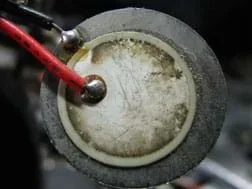 A piezoelectric buzzer.Copyright 2007 I, Gophi, Wikimedia Commons http://commons.wikimedia.org/wiki/File:2007-07-24_Piezoelectric_buzzer.jpg
Students learn about a fascinating electromechanical coupling called piezoelectricity that is being employed and researched around the world for varied purposes, often for creative energy harvesting methods. A PowerPoint® presentation provides an explanation of piezoelectric materials at the atomic scale, and how this phenomenon converts mechanical energy to electrical energy. A range of applications, both tested and conceptual, are presented to engage students in the topic. Gaining this background understanding prepares students to conduct the associated hands-on activity in which they create their own small piezoelectric "generators."
Engineers find electromechanical couplings intriguing and useful because of their ability to convert energy from mechanical to electrical, or vice versa. One example is piezoelectricity, a well-known electromechanical coupling since the early 20th century. The cause of this unique material property is explained by the arrangement of atoms in the material. Once engineers understand this, they are able to predict which materials have the potential for piezoelectric responses and how strong those responses might be, so as to incorporate the materials into creative, useful design solutions, from light-up shoes to sensors and actuators to energy harvesting systems.
After this lesson, students should be able to:
- Explain the piezoelectric effect and the converse piezoelectric effect.
- Describe how the atomic structure of a material determines if it is piezoelectric.
- List numerous applications for piezoelectric materials.
- Energy cannot be created nor destroyed; however, it can be converted from one form to another.
Grades 9-12
Do you agree with this alignment? - STEL-4P Evaluate ways that technology can impact individuals, society, and the environment.
Grades 9-12
Do you agree with this alignment?
- MS-PS3-5 Construct, use, and present arguments to support the claim that when the kinetic energy of an object changes, energy is transferred to or from the object.
Grades 6-8
This resource focuses on the following Three Dimensional Learning aspects of NGSS:
Science & Engineering Practices- Construct, use, and present oral and written arguments supported by empirical evidence and scientific reasoning to support or refute an explanation or a model for a phenomenon.Do you agree with this alignment?
- Science knowledge is based upon logical and conceptual connections between evidence and explanations.Do you agree with this alignment?
Disciplinary Core Ideas- When the motion energy of an object changes, there is inevitably some other change in energy at the same time.Do you agree with this alignment?
Crosscutting Concepts- Energy may take different forms (e.g. energy in fields, thermal energy, energy of motion).Do you agree with this alignment?
Do you agree with this alignment? - Construct, use, and present oral and written arguments supported by empirical evidence and scientific reasoning to support or refute an explanation or a model for a phenomenon.
- analyze energy conversions such as those from radiant, nuclear, and geothermal sources; fossil fuels such as coal, gas, oil; and the movement of water or wind; and
Grades 9-10
Do you agree with this alignment? - examine differences in physical properties of solids, liquids, and gases as explained by the arrangement and motion of atoms, ions, or molecules of the substances and the strength of the forces of attraction between those particles;
Grades 9-10
Do you agree with this alignment?
- Energy Research Worksheet (docx)
- Energy Research Worksheet (pdf)
- Energy Research Worksheet Answer Key (docx)
- Energy Research Worksheet Answer Key (pdf)
- Piezoelectricity Presentation (pptx)
- Piezoelectricity Presentation (pdf)
- Piezoelectric Quiz (docx)
- Piezoelectric Quiz (pdf)
- Piezoelectric Quiz Answer Key (docx)
- Piezoelectric Quiz Answer Key (pdf)
Students should have a basic understanding of the different forms of energy, specifically mechanical and electrical. They also need some prior background on electrons and protons and how they affect the charge of an atom.
What Is Piezoelectricity?
The word piezoelectricity is derived from the ancient Greek words piezo, "to squeeze or press," and electric. So, piezoelectricity literally means electricity from pressure. The piezoelectric effect was discovered by brothers Pierre and Jacques Curie in 1880 when experiments demonstrated that electrical charge was produced when natural crystals were subjected to mechanical stress. (Wikipedia, 2014)
The piezoelectric effect is a type of electromechanical coupling. This means that any mechanical load on the material results in an electrical response. In piezoelectric materials, when a mechanical stress (pressure) or strain (deformation) is applied to the material, the response is the generation of an internal charge. This charge can be described as electrical potential energy (voltage) that can be used like any other energy source. The conversion of mechanical forces into electrical potential is called the direct piezoelectric effect. On the other hand, if a piezoelectric material is subjected to an external electric field, the response is mechanical deformation of the material—called the converse piezoelectric effect.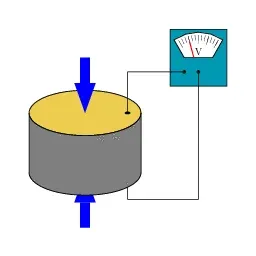 Figure 1. An exaggerated animation of the piezoelectric effect.Copyright 2007 Mael Guennou-Titzeff, Wikimedia Commons http://commons.wikimedia.org/wiki/File:SchemaPiezo.gif
Some common piezoelectric materials:
- crystalline: quartz, sucrose (table sugar), topaz
- biological: bone, wood, silk, viruses, DNA
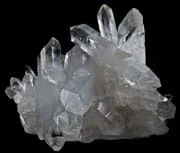 Figure 2. Quartz is a common piezoelectric material and the first to be used in a practical application.Copyright 2010 Didier Descouens, Wikimedia Commons http://commons.wikimedia.org/wiki/File:Quartz_Br%C3%A9sil.jpg
The first application of piezoelectric materials was the use of thin sheets of quartz crystal as part of a submarine sonar detector during World War I (1910s). This application sparked an interest in piezoelectric materials, and today they are used in numerous applications such as sensors, actuators, watches, cell phones, speakers and more. (Several applications are described in the Wikipedia reference.)
What Causes Piezoelectricity?
First, let's clearly define electric potential. In simple terms, electric potential energy exists anytime two opposite signed (positive and negative) charges exist, separated by some distance. When multiple charges are present, the problem may be simplified by taking the average position of the positive charges and the average position of the negative charges and then considering a system with only two charges at these locations. Electric potential can also be called voltage, which makes the concept more relatable.
The mechanism responsible for the piezoelectric response of certain materials can be clarified by looking at the atomic structure. Piezoelectric materials are not completely symmetric. That means that they are symmetric in some directions, but not in all directions.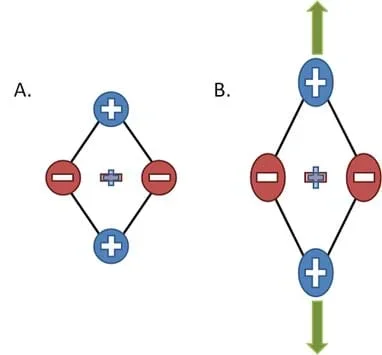 Figure 3. A crystal material in undeformed state (A), and the same material, now deformed (B), showing that the average location of the positive and negative charges do not change.Copyright 2014 Matthew Zelisko, GK-12 Program, University of Houston
Consider Figure 3A. We see a crystal containing four total atoms, two positively charged and two negatively charged, arranged in a diamond pattern. When we look at the average location of the negative charges and the average location of the positive charges, we notice that they are the same. Thus, no electric potential exists. Similarly, when the crystal is mechanically deformed, as in Figure 3B, no change results in the average locations of the charges. This material shows no electrical response to a mechanical force and thus is not piezoelectric. The symmetry can be demonstrated by drawing an arrow to any of the four atoms with a starting point in the center of the crystal, and then drawing the same arrow in the opposite direction. If they point to the same type of atom, it is symmetrical.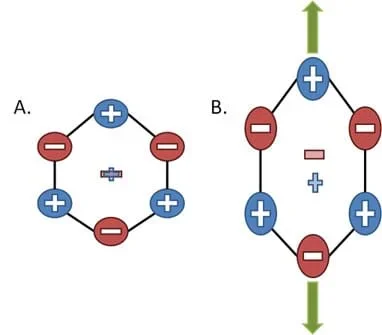 Figure 4. A crystal material in undeformed state (A) and the same material, now deformed (B), showing that the average location of the positive and negative charges are no longer the same, resulting in a piezoelectric response.Copyright 2014 Matthew Zelisko, GK-12 Program, University of Houston
Now consider the crystal shown in Figure 4A. If we calculate the average location of the positive and negative charges, we find that they are the same. However, when the material is deformed, as shown in Figure 4B, we see that the average positions of the charges are different. Performing the same arrow-drawing exercise as before, we find that while this material may look symmetric, drawing the opposite arrow does not point to the same type of atom. Thus, this material has an electrical response to a mechanical force (and vice versa) and is piezoelectric.
Applications for Energy Harvesting
Because the Earth's accessible energy resources will not last forever, new technology is needed to ensure that we have ways to generate enough energy in the future. One creative resource is the energy wasted in various forms every day. Examples range from excess heat generated by internal combustion engines to doing work against natural forces, such as friction. Since energy cannot be created or destroyed, only converted into different forms, piezoelectric materials can help us harvest some of this wasted energy for reuse.
When we walk, we exert mechanical forces on the ground below us. With every step we take, we lose some energy that is transferred to the ground. In Toulouse, France, piezoelectric materials have been positioned under the sidewalks. As pedestrians walk over them, the mechanical energy spent is converted into electrical energy and used to power the street lights. Similar technology has been used in Israel where, piezoelectrics are placed under a small stretch of highway. The weight of the cars passing over, deforms the piezoelectric material underneath, which converts enough extra energy to power about 200 homes with the harvested electricity. (Consumer Instinct, 2012)
Piezoelectric materials have been used for years to make light-up shoes for children, but new advances in materials now have more practical use. At Georgia Tech, small piezoelectric nanogenerators have been embedded in flexible polymers. Theoretically, this might be used as clothing material to convert our mechanical movements throughout the day into electrical energy, which could in turn be used to power small electronic devices, such as tablets, media players or cell phones.
Another interesting idea is to use piezoelectric materials to recharge electric car batteries—and a concept car has been designed to do that. The premise is to cover the outside of the car in a thin layer of piezoelectric material. Then, as you drive, the friction between the air and the car deforms the material to generate energy to charge the car's battery. (Ecofriend, 2012) Imagine an electric car that would essentially never run out of energy! (More information and pictures for these examples are available in the Consumer Instinct and Ecofriend references.)
These are just a few of the possible applications for piezoelectrics in the growing field of energy harvesting. What other applications can you think of? (Encourage the students to think critically about other ways we could use piezoelectrics to harvest energy from every day mechanical movements, such as walking, climbing stairs, opening and closing doors—any sort of plentiful movements.)
(Have ready the nine-slide Piezoelectricity Presentation (PPTX), a Microsoft PowerPoint® file, to show the class; the presentation contains the piezoelectricity content material in the Lesson Background section.)
Take a look around. What can you see in our classroom that requires energy to operate? (Expect students to name most of the electrical devices in the room.) Those are all good answers, but what about the person sitting next to you, does he or she use energy? (Answer: Yes.) So what is the source of that energy? (Answer: Food.) A minute ago we listed a lot of other things in the room that use energy, such as the lights, projector and cell phones. Are these items able to eat food to get energy? (Answer: No.) Then from where do they get their energy? (Answer: Electricity.) That's right; they use electrical energy, which is a different form of energy than what our bodies use, which comes from biomass (food). But from where does this electricity come? Can you think of anything in nature that produces electricity? (Answer: Lightning.) Lighting is a good example of a natural discharge of electrical energy. However, if we want to use lightning to power our homes, how would we do that on a sunny day? How do we create electricity to use whenever we need it? (Listen to student answers. Example answers: Burning fossil fuels, collecting solar power, generating nuclear power, tapping the wind, etc.) All of these methods to produce electricity are examples of energy conversions. That means that we take the energy in one form and convert it to another form that is more useful to us.
In 2019, 63% of the electricity generated in the U.S. was from fossil fuels such as coal and natural gas. Fossil fuels store chemical energy, and when burned, create thermal energy (or heat), which can be converted to electrical energy in power plants, or mechanical energy in car engines. If we, the people on our planet, continue to use these resources as our primary energy source, might we run into any long-term problems? (Answers: Pollution, using up the resources.) Fossil fuels take millions of years to form naturally, so at our current rate of use, we will run out at some point in the future. Do any alternatives to fossil fuels exist? Any other ways to produce energy? (Answer: Nuclear power, numerous renewable energy sources such as hydropower, biomass, geothermal, solar, wind.). Renewable sources of energy are some alternatives, but only 18% of the U.S. energy came from these sources in 2019. Of the renewable energy sources, most come from dams (hydropower, 6.6%) and wind farms (7.3%), both of which convert mechanical energy into electrical energy. Unfortunately, these forms of energy production suffer from their own limitations. About 19.7% of the electricity in the U.S. comes from nuclear power, which is by some measures a much better source than fossil fuels, but is not renewable—although it will not run out for a very long time. (Source: U.S. Department of Energy, 2020)
Now that we have considered all of the methods used to produce energy, let's turn our attention to how we use energy. Tell me some of the ways that we use energy. (Listen to student answers.) Yes, that's right. Cars use mechanical energy to propel down roads. We use mechanical energy to walk between classes or make other movements. What if engineers could create a way for us to collect or harvest some of this energy for reuse? (See if students seem to follow the idea.) Well, doing that very thing is now possible by the use of piezoelectric materials, which are able to convert mechanical energy into electrical energy. Let's find out more about piezoelectricity and piezoelectric materials.
(Proceed to show the class the Piezoelectricity Presentation (PPTX).) Then following the lesson, refer to the hands-on associated activity Building a Piezoelectric Generator where students use common electrical components to create small piezoelectric generators in the classroom.
- converse piezoelectric effect
- A process in which a material converts an electrical input into a mechanical response. In this case, external voltage leads to material deformation.
- electromechanical coupling
- A relationship between mechanical input and electrical output, or vice versa
- piezoelectric effect
- A process in which a material converts a mechanical force to an electrical response. In this case, material deformation leads to electric potential or voltage.
Pre-Lesson Assessment
Homework: A day before the lesson, have students conduct online research about U.S. energy production and usage, as prompted by the Energy Research Worksheet (PDF). Grade the worksheets with the Energy Research Worksheet Answer Key (PDF) that pulls data from the U.S. Energy Information Administration's 2011 Annual Energy Review report at https://www.eia.gov/totalenergy/data/annual/pdf/aer.pdf. Review students' answers to assess their research abilities and ensure their review of energy information and statistics to prime them for the lesson.
Lesson Summary Assessment
Quiz: After the presentation, administer the three-question Piezoelectric Quiz. (PDF). The questions and answers are provided below. Review students' answers to assess their comprehension of the subject matter before conducting the associated activity. Alternatively, use the quiz as a quick review before beginning the associated activity.
- Provide a brief explanation of the piezoelectric effect and the converse piezoelectric effect. (Answer: The piezoelectric effect converts mechanical energy into electrical energy. The converse piezoelectric effect converts electrical energy into mechanical energy.)
- Make a drawing to illustrate what causes the piezoelectric effect at the atomic level. (Hint: Think about the placement of charges in the atoms of the material.) (Answer: Figure 4.)
- List three possible (conceptual or real) applications of piezoelectric materials. (Example answers: Sensors, actuators, speakers, artificial muscles, energy harvesting [walkways, roadways, dance floor, clothes, vehicles, etc.], light-up shoes, and many other possible applications.)
- Bonus Question: Explain your own, unique idea(s) for using piezoelectric materials. (Answers will vary.)
So much exciting research and creative applications are happening in the field of piezoelectricity. Assign students to each research a piezoelectric invention and report back to the class with a summary description and explanation of how it works and how it would be useful to people. For bonus points, have students suggest their own creative applications for piezoelectric materials.
Energy Harvesting Dance Floor video (2 minutes) at http://www.consumerinstinct.com/piezoelectricity-walk-jump-dance-and-generate-electricity/
Designers Conceptualize Next Generation Piezoelectric Based Jaguar E-Type. Published May 16, 2012. Ecofriend. Accessed April 28, 2014. http://www.ecofriend.com/designers-conceptualize-next-generation-piezoelectric-based-jaguar-type.html
Divya. Piezoelectricity: walk, jump, dance, and generate electricity! Posted August 1, 2012. Social Media/Technology, Consumer Instinct. Accessed April 29, 2014. http://www.consumerinstinct.com/piezoelectricity-walk-jump-dance-and-generate-electricity/
Krotz, Dan. Berkeley Lab Scientists Generate Electricity from Viruses. Published May 13, 2012. Berkeley Lab. Accessed October 30, 2014. (harmless viruses convert mechanical energy into electricity; harnessing the piezoelectric properties of biological materials) http://newscenter.lbl.gov/2012/05/13/electricity-from-viruses/
Piezoelectricity. Updated April 26, 2014. Wikipedia, the free encyclopedia. Accessed April 27, 2014. http://en.wikipedia.org/wiki/Piezoelectricity
What is U.S. electricity generation by energy source? Frequently Asked Questions, Independent Statistics & Analysis, U.S. Energy Information Administration (EIA), 27 Feb. 2020, www.eia.gov/tools/faqs/faq.php?id=427.
- Piezoelectricity
Contributors
Matthew Zelisko; Kimberly Anderson
Supporting Program
National Science Foundation GK-12 and Research Experience for Teachers (RET) Programs, University of Houston
Acknowledgements
This digital library content was developed by the University of Houston's College of Engineering, based upon work supported by the National Science Foundation under GK-12 grant no. DGE 0840889. Any opinions, findings and conclusions or recommendations expressed in this material are those of the authors and do not necessarily reflect the views of the National Science Foundation.
Copyright
2014 by Regents of the University of Colorado; original © 2014 University of Houston