
Shielding from Cosmic Radiation: Part 1 - Building the Payload
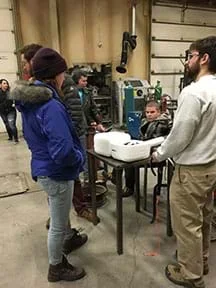 Students collaborate to design and build the payload.Copyright 2020 Wyoming NASA Space Grant Consortium, University of Wyoming, Trina Kelty
This activity has students embarking on an ambitious design project: to build a payload that measures the effect of shielding from cosmic radiation via a high-altitude balloon launch test. Each payload includes a Geiger counter, data collection device (Arduino and microSD memory card), and uses materials that will shield their Geiger counter from cosmic radiation. (Each payload also has a second, unshielded Geiger counter to act as a control.) By the end of the activity, each group has a completed payload ready to launch into near space and collect data.
Engineers often work as a member of an interdisciplinary team, each with separate but complementary roles that promote the mission. Within that interdisciplinary team, engineers must solve problems, then must communicate to other members how the problem was solved or how the goal was met. Although not every student will assume the role of Engineer, all students will need to communicate their activities to the Director, who will synthesize and present a report. Therefore, all students will gain awareness of what engineers do and how they contribute to the overall mission.
After this activity, students should be able to:
- Describe how radiation is measured.
- Describe the types of materials can be used to block cosmic rays.
- Understand high-altitude ballooning and the conditions that the balloon will be exposed to (temperature, pressure, humidity changes, etc.).
- Explain how to design an experiment using both a control and an experimental element, and limitations of designing payloads or spacecraft for space travel (weight considerations, budget considerations, etc.).
- Build a payload/prototype of a device that attempts to shield radiation at high altitudes.
- Students will develop an understanding of the relationships among technologies and the connections between technology and other fields of study.
Grades K-12
Do you agree with this alignment? - STEL-2T Demonstrate the use of conceptual, graphical, virtual, mathematical, and physical modeling to identify conflicting considerations before the entire system is developed and to aid in design decision making.
Grades 9-12
Do you agree with this alignment? - STEL-2W Select resources that involve tradeoffs between competing values, such as availability, cost, desirability, and waste, while solving problems.
Grades 9-12
Do you agree with this alignment? - STEL-7Y Optimize a design by addressing desired qualities within criteria and constraints.
Grades 9-12
Do you agree with this alignment?
- HS-ETS1-1 Analyze a major global challenge to specify qualitative and quantitative criteria and constraints for solutions that account for societal needs and wants.
Grades 9-12
This resource focuses on the following Three Dimensional Learning aspects of NGSS:
Science & Engineering Practices- Analyze complex real-world problems by specifying criteria and constraints for successful solutions.Do you agree with this alignment?
Disciplinary Core Ideas- Criteria and constraints also include satisfying any requirements set by society, such as taking issues of risk mitigation into account, and they should be quantified to the extent possible and stated in such a way that one can tell if a given design meets them.Do you agree with this alignment?
- Humanity faces major global challenges today, such as the need for supplies of clean water and food or for energy sources that minimize pollution, which can be addressed through engineering. These global challenges also may have manifestations in local communities.Do you agree with this alignment?
Crosscutting Concepts- New technologies can have deep impacts on society and the environment, including some that were not anticipated. Analysis of costs and benefits is a critical aspect of decisions about technology.Do you agree with this alignment?
Do you agree with this alignment? - Analyze complex real-world problems by specifying criteria and constraints for successful solutions.
- HS-ETS1-2 Design a solution to a complex real-world problem by breaking it down into smaller, more manageable problems that can be solved through engineering.
Grades 9-12
This resource focuses on the following Three Dimensional Learning aspects of NGSS:
Science & Engineering Practices- Design a solution to a complex real-world problem, based on scientific knowledge, student-generated sources of evidence, prioritized criteria, and tradeoff considerations.Do you agree with this alignment?
- Develop a model based on evidence to illustrate the relationships between systems or between components of a system.Do you agree with this alignment?
Disciplinary Core Ideas- Criteria may need to be broken down into simpler ones that can be approached systematically, and decisions about the priority of certain criteria over others (trade-offs) may be needed.Do you agree with this alignment?
Crosscutting Concepts- Models (e.g., physical, mathematical, computer models) can be used to simulate systems and interactions—including energy, matter, and information flows—within and between systems at different scales.Do you agree with this alignment?
Do you agree with this alignment? - Design a solution to a complex real-world problem, based on scientific knowledge, student-generated sources of evidence, prioritized criteria, and tradeoff considerations.
- HS-ETS1-1 Analyze a major global challenge to specify qualitative and quantitative criteria and constraints for solutions that account for societal needs and wants.
Grades 9-12
Do you agree with this alignment? - HS-ETS1-2 Design a solution to a complex real-world problem by breaking it down into smaller, more manageable problems that can be solved through engineering.
Grades 9-12
Do you agree with this alignment?
Each group needs:
- Payload materials and Arduino parts (see page 2 of the Payload Manual Guide (PDF) for description of hardware)
- Arduino microcontroller (note the Arduino 101 has been discontinued, we recommend using something like an Arduino Mega)
- Pocket Geiger counter
- Data logger
- MicroSD card
- LiPo battery pack
- (Optional) GPS breakout board for obtaining altitude & latitude/longitude (may not work well above 60,000 ft)*
- Miscellaneous items: wiring, soldering materials, hot glue, zip ties, steel sheet, galvanized steel sheet, aluminum sheet, balsa wood, space blanket; see page 5 of the Payload Manual Guide (PDF)
- Small Styrofoam cooler or another lightweight box to house Arduino payload
- Poster board
- Laptop for programming Arduinos
To share with the entire class:
- Weight and “cost” guidelines (weight is an actual constraint; cost may vary depending on how detailed the economic portion is)
- Refer to the Space Agency Roles and Responsibilities Sheet (PDF) and teacher background to guide the Economic Advisor(s) to determine “cost” for materials.
- At least one copy of the Payload Manual Guide (PDF) for Engineer(s) and Computer Scientist(s) to refer to for directions and guidance building and programming, as well as for other roles to gain an overall idea of the goal for the project.
- Markers
- Pencils
- Paper
See information in the Procedure on sourcing and budgeting for some of these materials.
- Knowledge of radiation and types of radiation (learned in the associated lesson, Shielding from Cosmic Radiation: Space Agency Scenario).
- Familiarity with their assigned role in their space agency.
- At least one student per group who is able to perform basic coding in C or C+.
- At least one student per group who has a basic understanding of Arduinos.
- At least one student per group has basic building and soldering capabilities.
[Place all of the materials out for the students to look at.] (Optional) Today we are going to start designing and building your payload to shield your astronauts from radiation is important for space travel.] Once you are in your groups and everyone is up to speed on the project, you need to purchase components for your payload and for your radiation shield.
Remember, you need to stay within budget, within weight limitations, but also place a priority on the safety of your astronauts. You will be engaging in a friendly competition between nations, so your nation team needs to optimize your radiation shield, so your nation succeeds in sending astronauts into space and safely bringing them back to Earth. Choosing the right materials is very important to ensure your astronauts return safely and your nation can celebrate. Beware of overspending, though…… Good luck and get started!
Background
See the associated lesson, Shielding from Cosmic Radiation: Space Agency Scenario for background on this project. The lesson includes preparation work that sets the stage for the rest of the associated activities.
In testing these balloon launches, this curriculum used equipment previously purchased using grant funds from a company called StratoStar. (Helium tanks are an additional expense.) For teachers in the state of Wyoming, launches and helium are provided by Wyoming NASA Space Grant free of charge and teachers can apply for grants to purchase additional supplies and equipment through our office as well if needed. Teachers in other states may be able to partner with the Space Grant office in their state, with universities engaged in launching weather balloons, or apply for grants to get started in ballooning.
Additional data can be measured with an expensive pre-built GPS tracking package purchased from Stratostar (this is useful you have a program set up that can launch balloons frequently). However, this device is not necessary to measure all of the variables for this particular project. The only variable that would be useful to measure is altitude since that would allow the radiation data to be plotted as a function of height. A cheap GPS chip could be attached to the Arduino to provide altitude, latitude, and longitude during flight (although these often only work up to ~60,000 ft). A better option would be to purchase an onboard flight tracking computer, which typically includes latitude/longitude, altitude, temperature, and air pressure data. Additional resources have been added for teachers who purchase pre-built trackers like this (see above). However, even without altitude, it would still be possible to plot the radiation data and show students how the measurements change during flight.
Before the Activity
- Consult the Payload Manual Guide (PDF) (and the Materials List above) and source the necessary materials.
- Have each table labeled with each space agency’s name.
- Prepare review questions about the concepts and keywords covered in the associated lesson.
- Have the Payload Manual Guide (PDF) ready to review; this guide provides critical instructions on what the payload might look like.
With the Students
- Start by engaging students in a memory/review activity with the chance to win a building material for their team and/or get budget increase for their team. This activity should review the concepts and keywords covered in the associated lesson such as the different types of radiation and the different roles in each space agency.
- Have students move into their agencies and assume their roles according to the Space Agency Roles and Responsibilities Sheet (PDF).
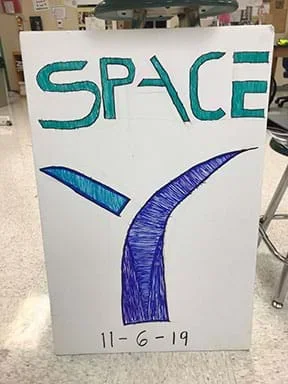 A student-created space agency logo.Copyright 2020 Wyoming NASA Space Grant Consortium, University of Wyoming, Trina Kelty
- The Engineer(s), Directors, and R&D Scientist(s) should come up with a payload design, sketched out on paper. They should consult with the Economic Advisor(s) on costs. Instructors will lightly guide them through development. Students can refer to examples as needed (payload manual attachment and photos).
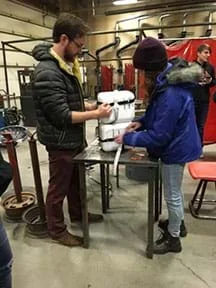 Assembling the payload for launch.Copyright 2020 Wyoming NASA Space Grant Consortium, University of Wyoming, Trina Kelty
- When students are ready to assemble their payloads, instructors will hand out the materials students purchased and new materials as appropriate. Please refer to the Payload Manual Guide (PDF) to gain an overall idea about how the payloads will look; the photos are just one example of what the payload could look like. There are many ways to assemble the payload, and discussion amongst students about payload assembly design, according to their ‘roles’, is encouraged. The overall constraint is that the payload (Geiger counter, SD card, shielding apparatus, etc.) fits into the Styrofoam box.
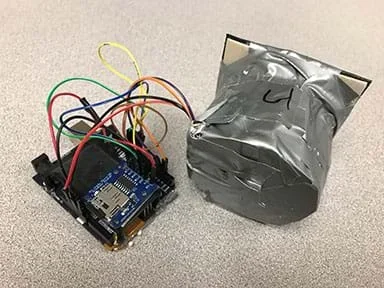 An Arduino (left) which is connected to a Geiger counter secured inside one of the student-built radiation shields (right)Copyright 2020 Wyoming NASA Space Grant Consortium, University of Wyoming, Trina Kelty
- Extra money the agencies have earned from social media and other platforms will be dispersed.
- arduino
- Microcontroller using open-source hardware/software that is a tool for controlling electronics.
- atmosphere
- A layer of gases that protects and surrounds the Earth.
- electromagnetic radiation
- ER composes the waves of the electromagnetic field, which includes visible light, x-rays, infrared, and gamma rays. Cosmic radiation includes gamma rays.
- geiger counter
- A device used to detect and measure ionizing radiation.
- particle radiation
- Particle radiation is made up of alpha and beta particles. An alpha particle is basically a highly ionized helium atom. A beta particle is just a free electron. Alpha is deadly but is stopped much more easily than beta. We are working with cosmic radiation, which is composed primarily of beta.
Pre-Activity Assessment
Memory Game: At the beginning of class, students engage in a memory activity with the chance of winning a material for their team. This activity helps students remember the concepts and keywords covered in the Shielding from Cosmic Radiation: Space Agency Scenario lesson. The concepts should cover the different types of radiation and the different roles of the space agency.
Activity Embedded (Formative) Assessment
During the activity, teacher can circulate among the students, answer questions, provide feedback, and give hints. Logistical questions can be answered outright by the teacher. However, students should be directed to resources such as their text or Internet when asking questions of a theoretical or scientific nature.
Post-Activity (Summative) Assessment
Payload Prep: Teacher should examine payloads to make sure they are ready for launch day. The Arduino systems must be wired up and working (i.e., recording radiation measurements from the Geiger counters). The radiation shielding apparatus must also be fully constructed and ready for the Geiger counter to be placed inside. The Arduinos and shielding do not have to be secured inside the Styrofoam payload boxes at this time.
Students should be careful when handling and applying certain metals to their payloads.
- To ensure student success, make sure everyone knows their roles. Each role should keep the student busy and requires cooperation as well as individual work from students. Refer to the Space Agency Roles and Responsibilities Sheet (PDF).
- Have a list of terms and concepts for students to reference.
To keep within budget, students may consult the current price of raw materials (steel, etc.) to gain appreciation for the impact of economic fluctuations.
- For lower grades, the social media feeds are optional.
- For higher grades, additional detail may be provided about economics.
Students may create social media feeds on platforms such as Instagram, Facebook, etc. All students may “follow” these sites. Agencies with high numbers of “followers” are eligible for extra funds.
- Shielding from Cosmic Radiation: Space Agency Scenario
- Shielding from Cosmic Radiation: Part 1 - Building the Payload
- Shielding from Cosmic Radiation: Part 2 - High-Altitude Balloon Launch Test
- Shielding from Cosmic Radiation: Part 3 - Post-Launch Analysis
Contributors
Jeff Bell; Mary Block; Garrett Burrows; Phil Bergmaier; Trina Kilty; Andrea Burrows; Kevin Kilty; Kate Muir-Welsh; Shawna McBride; Jim Stith
Supporting Program
Wyoming NASA Space Grant Consortium, University of Wyoming
Acknowledgements
Much of the equipment and training to develop the Wyoming NASA Space Grant balloon program were provided by StratoStar.
This material was developed based upon work supported by the National Science Foundation under grant no. 1821566—the LIFT (Learning to Integrate Fundamentals through Teaching) Project, Wyoming NASA Space Grant Consortium, University of Wyoming. Any opinions, findings and conclusions or recommendations expressed in this material are those of the authors and do not necessarily reflect the views of the National Science Foundation.
Copyright
2021 by Regents of the University of Colorado; original © 2019 University of Wyoming