
Making Model Microfluidic Devices Using JELL-O
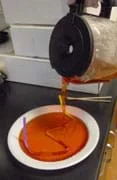 Students create microfluidic devicesCopyright 2011 Michelle Woods, Bioengineering RET Program, School of Engineering, Vanderbilt University
Students create large-scale models of microfluidic devices using a process similar to that of the PDMS and plasma bonding that is used in the creation of lab-on-a-chip devices. They use disposable foam plates, plastic bendable straws and gelatin dessert mix. After the molds have hardened overnight, they use plastic syringes to inject their model devices with colored fluid to test various flow rates. From what they learn, students are able to answer the challenge question presented in lesson 1 of this unit by writing individual explanation statements.
Biomedical, medical, chemical, electrical, mechanical, materials and computer engineers are all involved in assisting biologists and physicians in developing devices that enable us to more easily and efficiently observe and test microscopic cell interactions and reactions. Engineers design microfluidic devices to simulate how the body works and reacts. Microfluidic devices are made by making a master copy, from which an infinite number of copies can be made. Soft lithography is the most common method, and involves the replication of the master in polydimethylsiloxane (PDMS), which is then bonded to a glass microscope slide.
After this activity, students should be able to:
- Describe the method used to make a microfluidic device.
- Develop and create large-scale model "microfluidic" devices.
- Explain the importance and use of microfluidic devices.
- Students will develop an understanding of the relationships among technologies and the connections between technology and other fields of study.
Grades K-12
Do you agree with this alignment?
- HS-ETS1-2 Design a solution to a complex real-world problem by breaking it down into smaller, more manageable problems that can be solved through engineering.
Grades 9-12
This resource focuses on the following Three Dimensional Learning aspects of NGSS:
Science & Engineering Practices- Design a solution to a complex real-world problem, based on scientific knowledge, student-generated sources of evidence, prioritized criteria, and tradeoff considerations.Do you agree with this alignment?
Disciplinary Core Ideas- Criteria may need to be broken down into simpler ones that can be approached systematically, and decisions about the priority of certain criteria over others (trade-offs) may be needed.Do you agree with this alignment?
Do you agree with this alignment? - Design a solution to a complex real-world problem, based on scientific knowledge, student-generated sources of evidence, prioritized criteria, and tradeoff considerations.
- CLE 3231.Inq.2 Design and conduct scientific investigations to explore new phenomena, verify previous results, test how well a theory predicts, and compare opposing theories.
Grades 9-12
Do you agree with this alignment? - CLE 3231.Inq.6 Communicate and defend scientific findings.
Grades 9-12
Do you agree with this alignment?
 Copyright 2011 Michelle Woods, Bioengineering RET Program, School of Engineering, Vanderbilt University
Each student needs:
- 2 boxes of JELL-O (a powdered gelatin dessert mix), the 8-serving size; pale colors work best
- 5 bendable plastic drinking straws (cut away the straight parts of the straws from the bendable portions—which will be used)
- 1 Styrofoam plate
- scotch tape
- 1 aluminum plate or pan
- 1 plastic syringe
- colored liquid with small particles (such as a small amount of fine sand), for use in the syringe
- stop watch
Supplies for teacher to make JELL-O Jigglers mix (see instructions in Procedure section):
- large mixing bowl
- stirrer
- boiling water, 2.5 cups per box of JELL-O (using a Mr. Coffee-type machine works well)
- refrigerator, for cooling gelatin to solid form
As we have learned, biomedical engineers are constantly studying the effects of medicine, bacteria, and other microscopic occurrences in the body by performing observations on microfluidic devices. We are now going to make our own "microfluidic devices." While these will be on a much larger scale, the process we shall use is similar to the soft lithography method used by many engineers in developing these devices.
Legacy Cycle Information
This activity covers the Test Your Mettle and Go Public stages of the legacy cycle, during which students create models for testing, and write statements answering questions, including the challenge question that was initially presented in lesson 1 of this unit.
Background
The interdisciplinary field of microfluidics develops miniaturized technologies that are able to manipulate the flow and reaction of tiny amounts of fluids. By doing this, advances in biology and medicine can be made inexpensively because of the reduced amounts of materials and quickened time for testing and analysis. When an entire laboratory's worth of analytical instrumentation is placed on a single "chip," it is sometimes called a "lab-on-a-chip" system.
In this activity, students fabricate their own model microfluidic devices ("chips") using what is essentially a "soft lithography" method. They make molds using plastic straws, tape and shallow foam plates. The liquid form of JELL-O gelatin mix is poured into the molds and cures overnight. Then, once in solid form, the devices are peeled off, flipped over and placed on metal plates to seal—ready for experimentation
With the Students—Day 1
- Give students each a Styrofoam plate and direct them to create designs using the bendable parts of straws.
- Each design must have a beginning and ending point (it cannot be a circle).
- To make the design, tape together the straws, end-to-end, with a design that lies flat on the plate.
- Then tape the design to the plate, leaving no gaps between the plate, straws, and tape.
- Make sure that the straw ends do not touch the plate. Leave them pointing upwards.
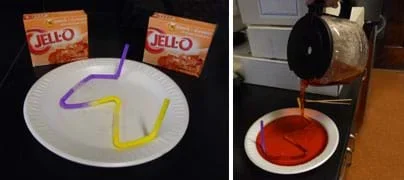 Figure 1. Activity set-up (left) and pouring the liquid gelatin mixture to make a mold (right).
- Pour the liquid JELL-O Jigglers mix onto the plate on top of the design. Do not use the directions on the JELL-O box, instead, follow these instructions to make the JELL-O Jigglers mix:
- In a large bowl, stir 2.5 cups boiling water (do not add cold water!) into the dry contents of one package (8-serving size) of JELL-O gelatin mix.
- Stir at least three minutes, until the powder is completely dissolved.
- Refrigerate at least three hours or until firm; place the plates in a refrigerator overnight.
With the Students—Day 2
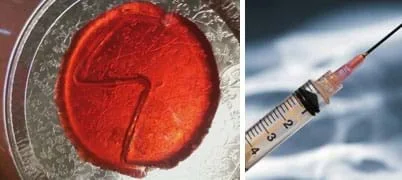 Figure 2. An example completed model microfluidic device.Copyright (right) 2004 Microsoft Corporation, One Microsoft Way, Redmond, WA 98052-6399 USA. All rights reserved.
- Once the plates of JELL-O have solidified, have students carefully peel off their Styrofoam plates and place each solid gelatin face down on an aluminum plate (so the channels are face down, creating a flat top surface).
- Have students test various flow rates and observe how particles are distributed. To test and view flow rate, use the syringes to inject the colored liquid with fine particles into the model microfluidic devices by puncturing each mold at the beginning point of its designed channel. When injecting, be careful not to break the seal from the aluminum plate. Either use stop watches to time different tests and compare rates, or observe at the same time multiple microfluidic devices injected at different rates. The pressure at which a student presses down on the syringe to release the liquid, acts as the velocity. Guide students to notice which speed fills the device the quickest, and if possible, where the particles collected at the bottom of the channels.
- Conclude by leading a class discussion to compare observations and draw conclusions.
- In terms of the microfluidics device, what is happening as channel size changes? (Answer: The flow rate increases or decreases.)
- What happens to particle distribution at the various flow rates? (Answer: If it is too slow, particles deposit at the beginning of the channel and do not move on. If it is too fast, particles do not have a chance to collect on the bottom of the channel and are pushed to the end where they collect.)
- What could we do to get medicine to work more quickly? (Answer: Somehow move the cells more quickly through the body.)
- What implications does this have for medicine travelling through a person's blood stream? (Answer: While a person wants his/her blood to be flowing at a quicker pace, s/he does not want to raise his/her heart rate too high.)
- Assign students to write short answers to the challenge question and other questions provided in the Assessment section, before wrapping up the associated lesson with a short video and math problems on flow rate.
- microfluidic device
- A device that deals with the behavior, precise control and manipulation of fluids that are geometrically constrained to a small, often sub-millimeter, scale.
- soft lithography
- A method for creating microfluidic devices, which involves replication of a structure on a master in a soft elastomer.
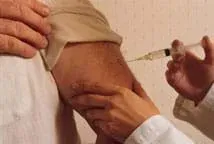 For antibiotics to work quickly, delivery via injection works fastest.Copyright 2004 Microsoft Corporation, One Microsoft Way, Redmond, WA 98052-6399 USA. All rights reserved.
Post-Activity Assessment
Short Answer: Have students write answers to the following questions, including the challenge question, in short answer format.
- Describe how a microfluidic device is made, how fluid/particles travel through it, and what this means in answering the challenge question. (Example answer: Microfluidic devices are made using a master mold. This mold is a mirror image of the the final product. For example, a channel in the final device is a raised part of the surface on the master copy. Once a solidifying liquid is poured over the master copy and allowed to harden, it is removed from the master copy, flipped, and placed on a surface that creates a bond, sealing the mold to the surface. A fluid containing particles is injected into the beginning of the channel so that scientists can observe the movement through the designed channels, which represent an environment similar to the body. It is important to understand how particles move through the body, and flow rate's effect on dispersion. Also, microfluidic devices can assist in proving theories: Instead of answering the challenge question based on how we feel after taking various forms of medication, we use facts to form a less subjective and more educated explanation of what happens.)
- Which method of medicine delivery (pills, liquids, shots) works the fastest? Why? (Answer: Medicine injected through a syringe [a shot] works fastest because it goes directly into a person's bloodstream. Pills and liquids take longer because they must travel to the stomach and work through the digestive system before being released into the blood stream.)
- What ideas to do you have about how to make medicine work more quickly once it is in the body? (Possible answers: In order to further reduce the time for medicine to take effect, it helps to increase the person's heart rate, which increases the "flow rate" through a body's blood stream.)
Yang, Cheng Wei T. and Eric Ouellet, and Eric T. Lagally (University of British Columbia, Canada). Using Inexpensive Jell-O Chips for Hands-On Microfluidics Education. Published July 1, 2010; published on web May 25, 2010. Feature, Analytical Chemistry, American Chemical Society. Vol. 82, No. 13, pp. 5408-5414. Accessed February 29, 2012. http://pubs.acs.org/doi/pdfplus/10.1021/ac902926x and supporting information at http://pubs.acs.org/doi/suppl/10.1021/ac902926x/suppl_file/ac902926x_si_001.pdf
- Feel Better Faster: All about Flow Rate
- How Antibiotics Work
- Microfluidic Devices and Flow Rate
- Making Model Microfluidic Devices Using JELL-O
Contributors
Michelle Woods
Supporting Program
VU Bioengineering RET Program, School of Engineering, Vanderbilt University
Acknowledgements
The contents of this digital library curriculum were developed under National Science Foundation RET grant nos. 0338092 and 0742871. However, these contents do not necessarily represent the policies of the NSF, and you should not assume endorsement by the federal government.
Copyright
2013 by Regents of the University of Colorado; original © 2011 Vanderbilt University