
Microfluidic Devices and Flow Rate
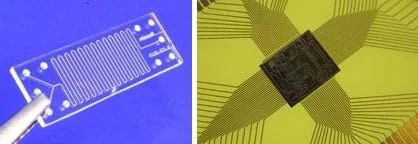 Figure 1. Example lab-on-chip microfluidic devices designed to simulate the behavior of new medicines in the body, with the eventual goal to help us diagnose a wide range of medical conditions.Copyright (left) Micronit, Wikimedia Commons. {PD}; (right) 2003 Maggie Bartlett, National Human Genome Research Institute {PD} http://en.wikipedia.org/wiki/File:Glass-microreactor-chip-micronit.jpg
http://www.genome.gov/pressDisplay.cfm?photoID=20017
Figure 1. Example lab-on-chip microfluidic devices designed to simulate the behavior of new medicines in the body, with the eventual goal to help us diagnose a wide range of medical conditions.Copyright (left) Micronit, Wikimedia Commons. {PD}; (right) 2003 Maggie Bartlett, National Human Genome Research Institute {PD} http://en.wikipedia.org/wiki/File:Glass-microreactor-chip-micronit.jpg
http://www.genome.gov/pressDisplay.cfm?photoID=20017
Students obtain a basic understanding of microfluidic devices, how they are developed and their uses in the medical field. After conducting the associated activity, they watch a video clip and learn about flow rate and how this relates to the speed at which medicine takes effect in the body. What they learn contributes to their ongoing objective to answer the challenge question presented in lesson 1 of this unit. They conclude by solving flow rate problems provided on a worksheet.
Biomedical, medical, chemical, electrical, mechanical, materials and computer engineers are all involved in assisting biologists and physicians in developing devices that enable us to observe microscopic cell interactions and reactions. Engineers design microfluidic devices to simulate how the body works and reacts. Engineers design artificial environments that simulate the body, and aid in the growth of cells. Other engineers create all sorts of devices and tools used in experiments.
After this lesson, students should be able to:
- Describe how microfluidic devices work.
- Determine flow rate.
- CCSS.Math.Content.HSA-CED.A.4 Rearrange formulas to highlight a quantity of interest, using the same reasoning as in solving equations.
Grades 9-12
Do you agree with this alignment? - CCSS.Math.Content.HSN-Q.A.1 Use units as a way to understand problems and to guide the solution of multi-step problems; choose and interpret units consistently in formulas; choose and interpret the scale and the origin in graphs and data displays.
Grades 9-12
Do you agree with this alignment?
- STEL-5F Analyze how an invention or innovation was influenced by its historical context.
Grades 6-8
Do you agree with this alignment? - STEL-7W Determine the best approach by evaluating the purpose of the design.
Grades 9-12
Do you agree with this alignment?
- CCSS.Math.Content.HSA-CED.A.4 Rearrange formulas to highlight a quantity of interest, using the same reasoning as in solving equations.
Grades 9-12
Do you agree with this alignment? - CCSS.Math.Content.HSN-Q.A.1 Use units as a way to understand problems and to guide the solution of multi-step problems; choose and interpret units consistently in formulas; choose and interpret the scale and the origin in graphs and data displays.
Grades 9-12
Do you agree with this alignment?
Students must be able to solve one- and two-step equations with variables (pre-algebra/algebra 1 level work).
Legacy Cycle Information: This lesson continues the Generate Ideas, Multiple Perspectives, Research and Revise stages of the legacy cycle. Students are reminded of the Challenge Question and learn about microfluidic devices and how they are used in the development of medicine, before beginning the associated activity. The next day, they complete the activity, watch the video and learn about flow rates, concluding with a worksheet of flow rate problems to solve.
Lecture Information: Microfluidic devices (see examples in Figure 1) are used in experiments called lab-on-a-chip experiments. In these experiments, the entire procedure is performed and viewed on a microscopic level. Lab-on-a-chip experiments usually take place on glass slides used with standard microscopes. The microfluidic device is irreversibly sealed to the glass slide.
Using this method enables us to understand what happens at the molecular level in the body and to any type of cell. For example, we can view how a disease affects cells in the body. In one instance, two groups of molecules were separated by a microscopic barrier. Then a scientist was able to collapse the barrier and observe how one group of molecules moved and was attracted to the other group. Then the scientist re-closed the barrier and observed the disease begin to take over (whether it killed the cells, attached to the cells, etc.). Because the molecules are in an environment similar to conditions in the body, we are able to view changes, often in real-time, as fluids, chemicals and/or cells pass through specially designed channels. These experiments are important because they enable testing of new medicines before using on animals and humans.
To design microfluidic devices, engineers must research how particles move in the body. Biologists describe what natural occurrences they wish to re-create for their experiments and the engineers develop channels, barriers and other passages that produce effects similar to those that occur in the body (a simulation). For instance, to see how molecules "mix" in the blood, we could design multiple channels that merge and then zigzag many times; the zigzagging route would cause the liquids to combine. If engineers have limited background in biology, they research the specific topic so they fully understand it. Microfluidic devices are often made using a soft-polymeric system that allows scientists and biomedical engineers to create a single master from which they can develop an infinite number of copies. This method is cost effective and allows for the simple and quick production of many devices. When exposed to oxidized plasma, the material used, polydimethylsiloxane (called PDMS), produces irreversible bonding to glass surfaces, such as microscope slides.
Example Problems: Students should be able to solve one- and two-step equations with variables. Go through a few examples with them:

where D is the inside diameter, and V is the velocity.
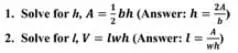
Also have students solve for variables when given information.
- The area of a triangle is 36 inches, with a base of 4 inches. Find the height, using the information from #1, above. (Answer: h = 18 inches)
- The volume of a rectangular box is 268 cm, with a length of 16 cm. The width is the same as the length. Find the height of the box. (Answer: h = 1.047 cm)
(In advance, prepare to show students a short video clip [attached; also available on the internet]. Make copies of the attached Flow Rate Worksheet (PDF), one per student.)
You have already identified which form of a medication works the fastest. Now we want to determine if anything else can be done to make the medicine work even faster once it has entered the body. I wonder what you'll predict will be the solution!
(Remind students of the Challenge Question that was introduced in lesson 1 of this unit.) One morning you don't feel very well, so your parents take you to see a doctor. The doctor suggests a generic antibiotic, and asks whether you would like to have the prescription filled in one of three ways: as a pill, in liquid form, or as a shot. Which delivery method should you choose? And, is there anything else you can do to feel better more quickly?
(Continue with a class discussion of microfluidic devices and how they are used in the development of medicine.) What is a microfluidic device? (Use lecture information provided in the Lesson Background section.)
(For the Test Your Mettle stage, lead in to the associated activity Making Model Microfluidic Devices Using JELL-O, in which students make model microfluidic devices at a larger than real-life scale.) While we do not have the materials necessary to create a true lab-on-a-chip device in the classroom, we can replicate the process using different materials on a much larger scale.
(After creating the devices, as described in the associated activity, continue on with the video and math worksheet.)
Now that we have created and tested our devices, let's watch a video of particles flowing through a microfluidic device. (For the Generating Ideas stage, show the attached 31-second video clip, Microfluidic Device Particle Flow Video (WMV). It shows particles moving through a lab-on-a-chip microfluidic device at various speeds, depending on the size of the channels.) Pay attention to what is occurring in each of the channels, and how that affects where the particles drop. (Then, ask the students:)
- What do you notice about the movement of the particles? (Possible answers: Slower particles fall to the bottom of the channel quickly, the faster particles all end up in the "pit" at the end.)
- How would these different flow rates affect the delivery of medicine? (Answer: Flow rate determines the amount of fluid that flows, and determines how particles are distributed.)
- What is the most effective flow rate (slow, medium, fast)? (Answer: A medium flow rate leaves the particles well dispersed on the bottom of the channel.)
- How is flow rate increased/decreased? (Answer: Flow rate is altered by the size of the channel and/or pressure of the fluid.)
- How can we increase/decrease the "flow rate" in a human body? (Answer: Increasing heart rate increases how fast blood moves through the veins.)
(Introduce students to the flow rate equation and how to determine flow rate. Solve several example problems, as provided in the Lesson Background section. Conclude by handing out the Flow Rate Worksheet (PDF) for students to complete as homework).
- flow rate
- The amount of fluid that flows in a given time.
- lab-on-a-chip (loc)
- A device that combines one or more laboratory functions on a single chip that is less than a few square cm in size and handles extremely small fluid volumes.
- microfluidic device
- A device that deals with the behavior, precise control and manipulation of fluids that are geometrically constrained to a small, often sub-millimeter, scale.
Pre-Lesson Assessment
Discussion Questions: Ask the students the following questions and discuss as a class.
- What do you do after you take medicine?
- What types of advice have your parents offered to help you feel better?
Post-Introduction Assessment
Discussion Questions: After conducting the first half of the associated activity, and then watching the video, ask the students the following questions and discuss as a class.
- How might flow rate be seen in the body? (Answer: In our blood streams, through veins and arteries.)
- How might flow rate be used in the body? (Answer: To measure blood flow.)
- How might the particles shown in the lab-on-a-chip video relate to medicine?
Lesson Summary Assessment or Homework
Worksheet: Have students complete the problems on the attached Flow Rate Worksheet (PDF). Review their answers to gauge their comprehension of the subject
The attached 31-second video clip, called "0.5microL_fast.avi," is also available on YouTube at http://youtu.be/YDD0WAAYw4s.
- Feel Better Faster: All about Flow Rate
- How Antibiotics Work
- Microfluidic Devices and Flow Rate
Contributors
Michelle Woods
Supporting Program
VU Bioengineering RET Program, School of Engineering, Vanderbilt University
Acknowledgements
The contents of this digital library curriculum were developed under National Science Foundation RET grant nos. 0338092 and 0742871. However, these contents do not necessarily represent the policies of the NSF, and you should not assume endorsement by the federal government.
Copyright
2013 by Regents of the University of Colorado; original © 2011 Vanderbilt University