
All Caught Up: Bycatching and Design
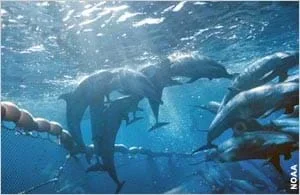 What can we learn about animals to help us design fishing methods that minimize bycatch?Copyright Mission of the US, Geneva, Switzerland http://geneva.usmission.gov/2013/07/16/u-s-implements-trade-ruling-on-dolphin-safe-labeling/
In the first lesson, Caught in the Net, students learn about bycatch—how commercial fishing nets trap large amounts of unintended and unprofitable animals while catching their target species. In the associated activity, All Caught Up, students learn about fishermen's challenge in trying to isolate a target species when a variety of animals are found in a marine habitat of interest. They discuss the large magnitude of the problem, practicing data acquisition and analysis skills by collecting and processing information to deduce target species distribution trends.
In the second lesson, Sound for Sight, the concept of echolocation is introduced as well as how dolphins use this sense to perceive environmental threats in their marine habitat, such as gillnets set by commercial fishing vessels. In the first associated activity, Can You Hear It?, students use marbles and a box made by the teacher to simulate echolocation and experience how much sound can tell us about an object. This helps to illustrate dolphins' use of echolocation, their difficulty in identifying nets, and resulting net entrapment. In the second associated activity, Your Ears Do the Walking, students play a modified game of "Marco polo" to understand the difficulty of using only the sense of sound to observe their environment. They experience an echolocation simulation by walking along a path while blindfolded. What students learn from these activities suggests the engineering approach of taking advantage of dolphins' echolocation ability in the design of bycatch avoidance methods.
Students study bycatch from an engineering perspective with the idea to design technological solutions to better address the problem. Many current devices and equipment designed by engineers, such as acoustic alarms, breakaway links, gear modification and time-area closures, are helpful but not enough to alleviate the problem. After learning how echolocation works, students discuss how net designs can be made easier for dolphins to "see" using echolocation and therefore less likely for dolphins become entangled.
- 4-LS1-2 Use a model to describe that animals' receive different types of information through their senses, process the information in their brain, and respond to the information in different ways.
Grade 4
This resource focuses on the following Three Dimensional Learning aspects of NGSS:
Science & Engineering Practices- Use a model to test interactions concerning the functioning of a natural system.Do you agree with this alignment?
Disciplinary Core Ideas- Different sense receptors are specialized for particular kinds of information, which may be then processed by the animal's brain. Animals are able to use their perceptions and memories to guide their actions.Do you agree with this alignment?
Crosscutting Concepts- A system can be described in terms of its components and their interactions.Do you agree with this alignment?
Do you agree with this alignment? - Use a model to test interactions concerning the functioning of a natural system.
- Day 1: Caught in the Net: Bycatch vs.Target Species in Ocean Fishing lesson
- Day 2: All Caught Up: Acting Out Bycatching Points of View activity
- Day 3: Radar: Using Sound for Sight lesson
- Day 4: Acting Out Echolocation: Let Your Ears Do the Walking activity
- Day 5: Echolocation Experimentation: Can You Hear It? activity
Contributors
Aruna Venkatesan; Matt Nusnbaum; Angela Jiang; Vicki Thayer; Amy Whitt
Supporting Program
Engineering K-Ph.D. Program, Pratt School of Engineering, Duke University
Acknowledgements
This content was developed by the MUSIC (Math Understanding through Science Integrated with Curriculum) Program in the Pratt School of Engineering at Duke University under National Science Foundation GK-12 grant no. DGE 0338262. However, these contents do not necessarily represent the policies of the NSF, and you should not assume endorsement by the federal government.
Copyright
2013 by Regents of the University of Colorado; original © 2004 Duke University