
Echolocation: Using Sound for Sight
Echolocation is the ability to orient by transmitting sound and receiving echoes from objects in the environment. As a result of a Marco-Polo type activity and subsequent lesson, students learn basic concepts of echolocation. They use these concepts to understand how dolphins use echolocation to locate prey, escape predators, navigate their environment, such as avoiding gillnets set by commercial fishing vessels. Students also learn that dolphin sounds are vibrations created by vocal organs, and that sound is a type of wave or signal that carries energy and information especially in the dolphin's case. Students learn that a dolphin's sense of hearing is highly enhanced and better than that of human hearing. Students are also introduced to the concept of bycatch. They learn what happens to animals who are unintentionally caught while fishing for other species.
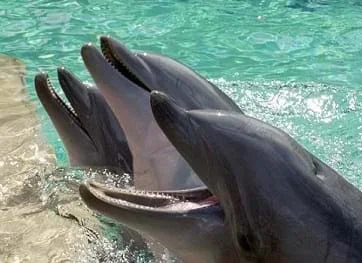 Three enthusiastic dolphins at Sea World!Copyright Paradise Dive Club
After learning how echolocation works, students discuss how net designs can be made easier for dolphins to "see" via echolocation and thus help them avoid getting tangled in nets. Engineers are also inspired by concepts observed in nature, such as echolocation; for instance, sonar on submarines is simply a type of echolocation.
After completing this lesson, students should be able to:
- Define "echolocation" and list three benefits for the dolphin species.
- Explain that dolphins have a better sense of hearing than humans
- Define all lesson key words and be able to make statements in a discussion that relate the keywords to dolphins and their behaviors in the ecosystem.
- Explain why dolphins need their echolocation abilities especially when hunting deep below the ocean's surface.
- Describe how dolphins are mammals and not fish, and give at least one reason why.
- Define bycatch and explain what happens to the animals affected.
- Explain how dolphins can use echolocation to avoid nets.
- Discuss how nets can be better engineered to protect dolphins from bycatch by taking advantage of echolocation.
- STEL-6E Verify how specialization of function has been at the heart of many technological improvements.
Grades 6-8
Do you agree with this alignment?
- 4-LS1-2 Use a model to describe that animals' receive different types of information through their senses, process the information in their brain, and respond to the information in different ways.
Grade 4
This resource focuses on the following Three Dimensional Learning aspects of NGSS:
Science & Engineering Practices- Use a model to test interactions concerning the functioning of a natural system.Do you agree with this alignment?
Disciplinary Core Ideas- Different sense receptors are specialized for particular kinds of information, which may be then processed by the animal's brain. Animals are able to use their perceptions and memories to guide their actions.Do you agree with this alignment?
Crosscutting Concepts- A system can be described in terms of its components and their interactions.Do you agree with this alignment?
Do you agree with this alignment? - Use a model to test interactions concerning the functioning of a natural system.
- MS-LS1-8 Gather and synthesize information that sensory receptors respond to stimuli by sending messages to the brain for immediate behavior or storage as memories.
Grades 6-8
This resource focuses on the following Three Dimensional Learning aspects of NGSS:
Science & Engineering Practices- Gather, read, and synthesize information from multiple appropriate sources and assess the credibility, accuracy, and possible bias of each publication and methods used, and describe how they are supported or not supported by evidence.Do you agree with this alignment?
Disciplinary Core Ideas- Each sense receptor responds to different inputs (electromagnetic, mechanical, chemical), transmitting them as signals that travel along nerve cells to the brain. The signals are then processed in the brain, resulting in immediate behaviors or memories.Do you agree with this alignment?
Crosscutting Concepts- Cause and effect relationships may be used to predict phenomena in natural systems.Do you agree with this alignment?
Do you agree with this alignment? - Gather, read, and synthesize information from multiple appropriate sources and assess the credibility, accuracy, and possible bias of each publication and methods used, and describe how they are supported or not supported by evidence.
- 4.L.1 Understand the effects of environmental changes, adaptations and behaviors that enable animals (including humans) to survive in changing habitats.
Grade 4
Do you agree with this alignment? - 4.L.1.2 Explain how animals meet their needs by using behaviors in response to information received from the environment.
Grade 4
Do you agree with this alignment?
- Knowledge from participating in the activity.
- Basic knowledge of a food chain and energy pyramid.
- (for 7th and 8th graders) Very basic knowledge about the human sense of hearing and the nervous system.
- Echolocation is the ability to orient by transmitting sound and receiving echoes from objects in the environment.
- Frequency (vibrations per second or Hz)
- Wavelength (lambda, meters)
- Sound pressure level (dB or decibels)
- Wavelength = speed of sound(meters/second) / frequency
- Humans can hear from 20 to 20,000 Hz
- Ultrasonic > 20 kHz
- Infrasonic < 20 Hz
- Attenuation is the dissipation of signal strength with distance (less sound intensity the further away)
- Effects of wavelength - high frequencies/short wavelengths attenuate rapidly in water.
- Low frequency/long wavelength sound waves travel farther in water with less attenuation.
- Echolocation is comprised of three distinct processes: 1) sound production, 2) sound reception, 3) signal processing
- The dolphin auditory nerve has twice the amount of nerve fibers as the human auditory nerve.
- Source of echolocation signals (controversial-need more experiments to confirm): 1) larynx (Purves & colleagues), 2) nasal sacs (Norris & colleagues).
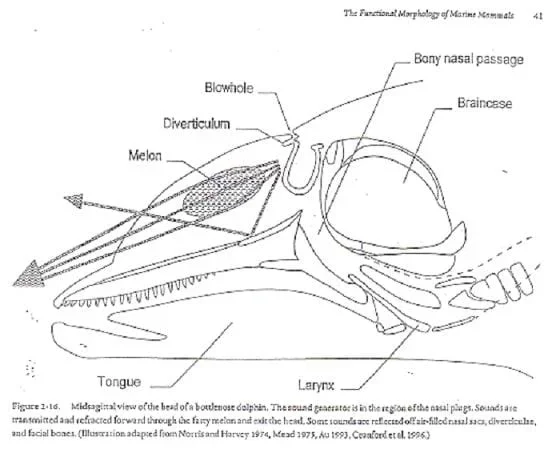 Anatomy of a dolphin's head.Copyright Cranford, T.W. et al. 1996. Functional morphology and homology in the odontocete nasal complex: implications for sound generation. Journal of Morphology 228: 223-285.
"The dolphin is able to generate sound in the form of clicks, within its nasal sacs, situated behind the melon. The frequency of this click is higher than that of the sounds used for communication and differs between species. The melon acts as a lens that focuses the sound into a narrow beam that is projected in front of the animal. Refer to the associated activity Let Your Ears Do the Walking for students to play a modified game of "Marco Polo" to understand the difficulty of using only the sense of sound to observe their environment - a simulation of how dolphins relate to their environment.
When the sound strikes an object, some of the energy of the sound wave is reflected back towards the dolphin. It would appear that the panbone in the dolphin's lower jaw receives the echo, and the fatty tissue behind it transmits the sound to the middle ear and hence to the brain. It has recently been suggested that the teeth of the dolphin, and the mandibular nerve that runs through the jawbone may transmit additional information to the dolphin's brain.
As soon as an echo is received, the dolphin generates another click. The time lapse between click and echo enables the dolphin to evaluate the distance between it and the object; the varying strength of the signal as it is received on the two sides of the dolphin's head enable it to evaluate direction. By continuously emitting clicks and receiving echoes in this way, dolphins can track objects and hone in on them.
The echolocation system of the dolphin is extremely sensitive and complex. Using only its acoustic senses, a bottlenose dolphin can discriminate between practically identical objects that differ by 10% or less in volume or surface area. It can do this in a noisy environment, can whistle and echolocate at the same time, and echolocate on near and distant targets simultaneously, feats that leave human sonar experts gasping." (May, John, ed. The Greenpeace Book of Dolphines. Sterling Publishing Company. 1991. pg 30.)
Click on the following link to see another diagram of a dolphin's anatomy. https://www.dolphins-world.com/dolphin-anatomy/
The sonar of dolphins may be the most sophisticated of all sonar systems, biological or human-made, in shallow waters and for short ranges. The Atlantic bottlenose dolphin emit short-duration (50--70 (microseconds), high-frequency (120--140 kHz), broadband (40--50 kHz) echolocation signals with peak-to-peak amplitudes up to 228 dB. The type of signals used by dolphins play a significant role in their sonar discrimination capabilities. They have been observed detecting, classifying, and retrieving prey that is buried in sandy bottom up to a depth of about 0.3 m. In addition, controlled echolocation experiments have shown that dolphins can discriminate wall thickness, material composition, shape and size of targets. Students can conduct their own experiment with the associated activity Echolocation Experimentation: Can You Hear It? where they use marbles and a box prepared by the teacher to experience how much sound can tell them about an unknown object.
Gillnets are fishing nets made of monofilament line, a translucent plastic material. Dolphins have trouble seeing these nets in the water and must use echolocation to detect them. Larger mesh nets (nets with bigger squares of monofilament) are more difficult to detect because there is less monofilament in the nets (larger holes). We don't know why dolphins become entangled. One hypothesis is that dolphins mistakenly blunder into these nets because they are not paying attention to where they are going; another hypothesis is that dolphins get fish out of the nets and become entangled in the process. In order to reduce bycatch (catching dolphins and other non-target species) in nets, fishery managers suggest the use of smaller mesh gillnets, gillnets with metal in the monofilament (reflective nets) or pingers (instruments that make noise attached to nets) to scare dolphins away from the fishing gear. The study of echolocation has enabled scientists to better understand and engineers to design modified equipment and approaches to better protect dolphins and other marine mammals.
If you have access to the PBS video, "In the Wild--Dolphins with Robin Williams," show it to the class as a great way to kick off the lesson on dolphins. The video is entertaining and informative; Robin Williams attempts to communicate with dolphins in captivity in the Bahamas and Hawaii. Also, you can motivate students by asking the question, "How do you think dolphins perceive nets?" and then follow up with a discussion of echolocation and how dolphins can track objects and their surfaces by using clicking sounds and hearing how they bounce off of other objects.
After the activity, perhaps some time later, have students discuss the activity. Use the Example Echolocation Discussion Questions (PDF) to transition from the activity to the lesson and help spur students' curiosity and their involvement in the discussion. Since students most likely enjoyed the activity, expect them to be excited and likely have a lot they want to share with the rest of the class. Use the questions as a guide to keep the discussion educational and related to the subject at hand. During the discussion, permit students to share their answers and theories without giving out the correct answers yet. Instead, respond to the students by asking related questions that get them thinking even more!
Body of Lesson
After the discussion (allow 15-20 min), clear up any misconceptions students made in their responses to discussion questions. Point out that the activity or game played was only a simulation of how echolocation works and does not directly show what happens in real life. For instance, in the game the dolphin sends a signal and the objects, perhaps a fish or rock, respond by sending a signal back to the dolphin. Students may get confused and think that the fish generated the signal that the dolphin receives and interprets, when in reality the sound wave simply bounces off the fish and the fish has no idea that it is on the dolphins "radar screen" at all. Be sure to clear up these misconceptions.
Next, show students the Dolphin Anatomy Transparency (PDF), which is a diagram of the anatomy of a dolphin's head with key features of its echolocation ability labeled. If possible (especially for a 7th grade class), compare this diagram with a human ear anatomy diagram and discuss differences in functions. Explain the functions of features like the Nasal sacs, Melon, Panbone (or lower jaw), etc. Also discuss how the swim bladder of fish and other aquatic creatures is a hollow organ that produces the main echo during echolocation. Following this explanation, ask students why they think it might be harder to receive an echo from a fishing net. Close this brief discussion by defining bycatch and talking about its negative implications for the dolphin species (possible endangerment/extinction). A misconception students may make during this discussion is that the nets do not catch fish but only dolphins (which is what happened in the game), which may confuse the essential concept of bycatch. Let them know that in reality the nets are meant to catch fish but also catch dolphins in the process.
Before handing out the worksheet, if time permits, lecture or discuss the following topics. Expect students to have some preliminary knowledge on topics such as food chains and the human senses:
- Predator-prey relationships. What eats what?
- Dolphin classification (mammal vs. fish)
- Other detection techniques of organisms (sight, smell, sound, taste, feel)
- Frequency (faster vibrations = higher frequency, vice versa); sounds with different frequencies come from different objects during echolocation.
- Density (dolphins can roughly determine the density of objects during echolocation; density=mass/volume).
Briefly review the following topics with students before handing out the worksheet.
- What is echolocation? (Answer: The ability to orient by transmitting sound and receiving echoes from objects in the environment.)
- Why is echolocation important to dolphins? (Answer: It is the method by which they locate and capture prey, escape predators and navigate in dark ocean environments.)
- How does attenuation, frequency, size of object, distance of object affect the effectiveness of echolocation?
- In looking at the various predator-prey relationships in the dolphin ecosystem, how is energy transferred through that ecosystem? Give an example of a food chain in the dolphin ecosystem.
- What is bycatch and what happens to the animals affected?
- Why is echolocation important? Why should we care whether or not dolphins can detect nets?
- Challenge students to think of new methods of technology to change the affects of bycatch.
- frequency
- The number of repetitions per unit of time (cycles per sec).
- wavelength
- The distance between the point on one wave and an identical point on the next wave.
- period
- The time between each repetition (seconds per cycle) or wavelength.
- signal
- A message containing information that is transmitted and received.
- echolocation
- The ability to orient by transmitting sound and receiving echoes from objects in the environment.
- sound
- Vibrations; a form of energy that travels in waves through a medium.
- attenuation
- The dissipation of signal strength with distance through a medium.
- food chain
- A simple way of showing how energy in the form of food passes from one organism to another.
- ecosystem
- A system involving the interactions between living organisms and the physical environment.
- biotic factors
- Living or once-living organisms in the environment.
- abiotic factors
- The non-living physical features of the environment (such as water, nets, boats).
- gillnet
- A single sheet of webbing that hangs between a floating line and a weighted lead line; an example of a stationary net (one that is not pulled through the water).
- bycatch
- The catching and killing of marine life, including sea turtles, birds and fish of the species not targeted by the fishery, or that are either of the wrong size or sex to be of optimal value to humans.
- To assess what students have learned in the lesson, have them complete the worksheet.
- Challenge students to apply what they have learned by writing about how bycatch affects dolphins and how we may prevent it.
Have students conduct research on human ears and hearing, contrasting with dolphin hearing. Discuss student findings as a class.
Au, W. W. L.The Sonar of Dolphins. New York, NY: Springer-Verlag.
Barrett-Leonard, L. G. et al. 1996. The mixed blessing of echolocation: differences in sonar use by fish-eating and mammal-eating killer whales. Animal Behavior 51: 553-565.
Cranford, T. W. et al. 1996. Functional morphology and homology in the odontocete nasal complex: implications for sound generation. Journal of Morphology 228: 223-285.
Deecke, V.B. et al. 2002. Selective habituation shapes acoustic predator recognition in harbour seals. Nature 420: 171-173.
Harrison, Sir Richard, et. al. Whales, Dolphins and Porpoises. New York, NY: Facts on File, Inc., 1994.
Mark Carwardine.The Book of Dolphins. Dragon's World Ltd, 1996.
May, John, ed. The Greenpeace Book of Dolphins. Sterling Publishing Company. 1991.
http://library.thinkquest.org/17963/head.html
"In the Wild with Robin Williams" video 1997. Available at amazon.com
Marine Mammal Biology, An Evolutionary Approach. 2002. Edited by: R. Hoelzel. Blackwell Science, Ltd., Oxford, UK.
Biology of Marine Mammals. 1999. Edited by: J. Reynolds III and S. Rommel. Smithsonian Institution, WDC, USA.
Contributors
Tom Rose; Billyde Brown; Neera Desai; Kim Goetze; Mina Innes; Angela Jiang; Matt Nusnbaum Aruna Venkatesan; Vicki Thayer; Amy Whitt
Supporting Program
Engineering K-PhD Program, Pratt School of Engineering, Duke University
Acknowledgements
This content was developed by the MUSIC (Math Understanding through Science Integrated with Curriculum) Program in the Pratt School of Engineering at Duke University under National Science Foundation GK-12 grant no. DGE 0338262. However, these contents do not necessarily represent the policies of the NSF, and you should not assume endorsement by the federal government.
Copyright
2013 by Regents of the University of Colorado; original © 2005 Duke University