
It's a Connected World: The Beauty of Network Science
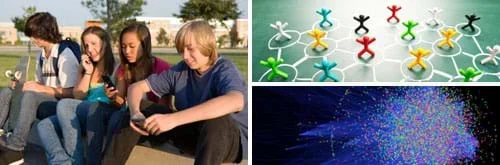 Complex networks are everywhere in our world. Engineers use mathematics to study and understand them.Copyright (kids) National Institute on Drug Abuse; (chalk diagram) Office of Adolescent Health, US Department of Health and Human Services; (human interactome) Keiono
http://teens.drugabuse.gov/blog/category/what-do-you-think/page/3/
http://www.hhs.gov/ash/oah/resources-and-publications/learning/coll-tk/index.html#chapter-2/section-2-0/
http://commons.wikimedia.org/wiki/File:Human_interactome.jpg
Complex networks are everywhere in our world. Engineers use mathematics to study and understand them.Copyright (kids) National Institute on Drug Abuse; (chalk diagram) Office of Adolescent Health, US Department of Health and Human Services; (human interactome) Keiono
http://teens.drugabuse.gov/blog/category/what-do-you-think/page/3/
http://www.hhs.gov/ash/oah/resources-and-publications/learning/coll-tk/index.html#chapter-2/section-2-0/
http://commons.wikimedia.org/wiki/File:Human_interactome.jpg
This unit is composed of two lessons, each with an associated activity, and requires four 45-minute class periods to conduct.
Lesson 1 introduces the topics of complex networks and graph theory by presenting information on set theory and graphs and by defining the degree of a node and the degree distribution of a graph. Students then interact with their classmates and document the interactions to create their own example of a social network. Then they apply what they learned about networks and graphs and make calculations to analyze the social network.
Lesson 2 introduces the topics of random processes on networks and modeling the spread of an infecting disease, using the SIR (susceptible, infectious, resistant) model of epidemiology. Students then use a free online simulation tool to interact with the graph of a social network and simulate the spread of a flu virus. They run multiple simulations, and then analyze the effectiveness of their vaccination strategies.
Investigators from diverse disciplines of science and engineering use graphs and random processes on graphs to effectively describe complex networked systems, such as the human brain or the internet. Networks composed of biochemical reactions in cells that keep humans alive (or cause diseases when they malfunction, such as cancer) are also studied by biomolecular engineers using graphs. The same is true for networks of interacting individuals in a social environment, such as Facebook friends, who are studied by software engineers. It turns out that understanding the mathematics behind graph theory can lead biomedical engineers to develop better cancer treatments, and electrical and computer engineers to create faster and more reliable communication networks among electronic devices. Moreover, it can help bioengineers and neuroscientists discover the secrets of how human consciousness arises from the complex interactions of billions of neurons in the human brain, help social engineers figure out how ideas are formed from social interactions, and public health scientists understand how contagious diseases, such as the flu, spread by social contact.
- CCSS.Math.Content.HSS-ID.A.1 Represent data with plots on the real number line (dot plots, histograms, and box plots).
Grades 9-12
Do you agree with this alignment?
- SC.912.N.4.1 Explain how scientific knowledge and reasoning provide an empirically-based perspective to inform society's decision making.
Grades 9-12
Do you agree with this alignment?
- Systems, which are the building blocks of technology, are embedded within larger technological, social, and environmental systems.
Grades 9-12
Do you agree with this alignment?
- use representations to model and interpret physical, social, and mathematical phenomena
Grades -1-12
Do you agree with this alignment?
- Day 1: Sets-Nodes-Edges: Representing Complex Networks in Graph Theory lesson
- Day 2: Start Networking! activity
- Day 3: Processes on Complex Networks lesson
- Day 4: Curb the Epidemic! activity
- It's a Connected World: The Beauty of Network Science
Contributors
Garrett Jenkinson; John Goutsias; Debbie Jenkinson; Susan Frennesson
Supporting Program
Complex Systems Science Laboratory, Whitaker Biomedical Engineering Institute, The Johns Hopkins University
Acknowledgements
The generous support of the National Science Foundation, Directorate for Computer and Information Science and Engineering (CISE), Division of Computing and Communication Foundations (CCF), is gratefully acknowledged.
Copyright
2013 by Regents of the University of Colorado; original © 2012 The Johns Hopkins University