
Neural Engineering in Action: Exploring Muscle Movement Through Data and Design
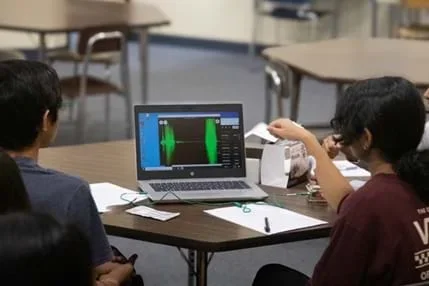 Students try to explore muscle movements to see if their actions reflect in the software application.Copyright Ashwin Mohan
The first activity introduces foundational neuroscience concepts, including neurons, synapses, and the pathways connecting neurons to muscles. Students use a micro:bit to interact with a simulated “beating heart” and observe how the rate of wrist or finger movements affects the animation. They are also encouraged to create their own animations. An optional extension introduces students to basic electromyography (EMG) recording. By the end of this activity, students will have gained introductory experience with neurobiology and microcontroller-based data collection.
In the second activity, students bridge neuroscience and engineering by designing an experimental protocol to collect EMG signals during a variety of hand movements—similar to those used in robotics and neuroprosthetics. Using surface electrodes and a dedicated microcontroller, they collect and visualize EMG signals, comparing coarse and fine motor movements. Through this process, students are introduced to both the engineering design process and the scientific method as they collect and analyze data to investigate how neural signals control muscle activity.
The third activity focuses on data transformation and organization. Students convert previously collected EMG recordings (in .wav format) into .csv files using Python libraries in Google Colab. They learn how to sample and clean the data for efficient visualization and analysis, building a collaborative dataset for class use.
In the final activity, students apply their data science skills to visualize EMG data using the graphics.py Python library. Working collaboratively, they analyze trends in neural activation and muscle movement, draw conclusions, and communicate their findings in a written report using a structured template.
This unit provides a rich, hands-on experience that highlights real-world applications of engineering in neuroscience—from brain-machine interfaces to prosthetics. It empowers students to explore how the brain and muscles work together and how engineers use data, coding, and design to model and support human movement.
Neuroengineers and biomedical engineers are at the forefront of adapting and reverse-engineering natural processes in the human body to better understand and address physiological challenges. As technologies such as artificial intelligence become more deeply embedded in healthcare, their work is increasingly essential to advancing medical diagnostics, treatments, and assistive devices.
Neuroengineers focus specifically on the nervous system—designing brain-computer interfaces, developing neuroprosthetics that restore lost movement, and creating systems for deep brain stimulation to treat neurological disorders. Their work bridges neuroscience and engineering, helping to decode how neural signals control muscles and movement.
Biomedical engineers design medical technologies that replicate or enhance the body’s natural functions. This includes creating artificial limbs with sensors that mimic muscle activity, as well as developing tools such as pacemakers, hearing aids, imaging systems, and surgical robotics. A strong understanding of the muscular and nervous systems is critical to designing solutions that respond effectively to the body’s complex signals.
Activity 1: Mapping the Brain: Neurons, Synapses, and Movement
Day 1: Basic neuroscience and pre-activity assessment
Day 2: Drawing a homunculus and getting familiar with the micro:bit
Day 3: Start the micro:bit experiment
Day 4: Continue the micro:bit experiment
Day 5: PowerPoint presentation by students
Day 6: Conclusions and reflection
Time required: 300 minutes
Activity 2: Decoding Muscle Movement: Analyzing Neuromuscular Signals With EMG
Day 1: Introduction and Pre-Activity Assessment
Day 2: Introduction to Muscle SpikerBox Bundle
Day 3: Set Up and Test the Muscle SpikerBox Bundle
Day 4: Introduction to Electromyography (EMG) and Experimental Design
Day 5: Experimental procedure and data collection
Day 6: Data Collection
Day 7: Post Assessment
Day 8: Project Report
Time required: 400 minutes
Activity 3: Collaborative Data Analysis: Building a Virtual Lab With Python
Day 1: Introduction and Objectives
Day 2: Data Conversion
Day 3: Data Analysis
Time required: 150 minutes
Activity 4: Visualizing Neural Signals: Interpreting Data to Understand Movement
Day 1: Introduction to Data Visualization and Basics of Python Graphics
Day 2: Advanced Visualization Techniques and Data Processing
Day 3: Data Interpretation and Reporting
Day 4: Presentation and Peer Review
Time required: 200 minutes
- Neural Engineering in Action: Exploring Muscle Movement Through Data and Design
Contributors
Dr. Ashwin Mohan (Computer Science Faculty, Illinois Mathematics and Science Academy (IMSA)); Dr. Sowmya Anjur (Emeritus Science Faculty, Illinois Mathematics and Science Academy (IMSA)); Mrs. Namrata Pandya (Retired Computer Science Faculty, Illinois Mathematics and Science Academy (IMSA)); Matthew Stroud (Pre-med Student, University of Missouri); Dr. David Bergin (Emeritus, College of Education & Human Development, University of Missouri); Dr. Satish Nair (Professor of Electrical Engineering and Computer Science, University of Missouri)
Supporting Program
Research Experience for Teachers (RET), University of Missouri Columbia and Illinois Mathematics and Science Academy, Aurora, IL
Acknowledgements
This work is based on work supported in part by the National Science Foundation under grant no. EEC-1801666—Research Experiences for Teachers at the University of Missouri. This activity was developed as part of the NSF RET grant in partnership with teachers from Illinois math and science academy. Any opinions, findings and conclusions or recommendations expressed in this material are those of the authors and do not necessarily reflect the views of the National Science Foundation.This endeavor would not have been possible without the guidance and support of Prof. Satish S. Nair, University of Missouri, Neural Engineering Laboratory, Columbia, Missouri (https://nairs.mufaculty.umsystem.edu/home).
We wish to thank the Illinois Mathematics and Science Academy (IMSA), Aurora, IL, where student testing was conducted.
Copyright
2025 by Regents of the University of Colorado; original © 2024 University of Missouri