
The Physics of Fluid Mechanics
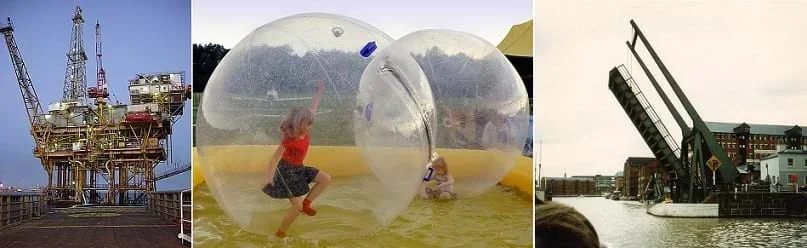 (left to right) An offshore oil production platform, inflatable walk-on-water balls and a hydraulic bridge.Copyright (left to right) 2004 FlickrLickr, Chad Teer, Wikimedia Commons; 2010 Alina Zienowicz, Wikimedia Commons; 1996 Keith Edkins, Wikimedia Commons http://commons.wikimedia.org/wiki/File:Gulf_Offshore_Platform.jpg http://commons.wikimedia.org/wiki/File:Goraszka_Air_Picnic_2010_%2822%29.jpg http://commons.wikimedia.org/wiki/File:Llanthony_Road_hydraulic_bridge_open_-_geograph.org.uk_-_1118455.jpg
Overview of topics by lesson: 1) Archimedes' principle, Pascal's law, Bernoulli's principle, 2) the concepts covered in the first lesson applied to the use and failure of above-ground storage tanks in the Houston Ship Channel.
Physics and fluid mechanics are integral parts of engineering, and both are typically presented as required courses at most universities for most engineering majors. Engineers apply Pascal's law, Archimedes' principle and Bernoulli's principle to design and construct various floating vessels, submersibles, airplanes, automobiles, pipelines and transport systems, hydraulic structures and even petrochemical storage tanks. Ocean and marine engineers study the offshore environment to design oil rigs and production platforms as well as floating vessels and subsea pipeline systems needed in the oil production process. Other engineers design different types of submersibles and remotely operated vehicles used to explore deep-water environments. Still other engineers apply these scientific concepts to become specialists in hydraulics—the use of liquid power to do work—and they design heavy machinery, water distribution systems, sewage networks, storm water management systems, bridges, dams, channels, canals and levees.
- CCSS.Math.Content.HSA-REI.B.3 Solve linear equations and inequalities in one variable, including equations with coefficients represented by letters.
Grades 9-12
Do you agree with this alignment?
- Technological innovation often results when ideas, knowledge, or skills are shared within a technology, among technologies, or across other fields.
Grades 9-12
Do you agree with this alignment?
- HS-ESS2-5 Plan and conduct an investigation of the properties of water and its effects on Earth materials and surface processes.
Grades 9-12
This resource focuses on the following Three Dimensional Learning aspects of NGSS:
Science & Engineering Practices- Plan and conduct an investigation individually and collaboratively to produce data to serve as the basis for evidence, and in the design: decide on types, how much, and accuracy of data needed to produce reliable measurements and consider limitations on the precision of the data (e.g., number of trials, cost, risk, time), and refine the design accordingly.Do you agree with this alignment?
Disciplinary Core Ideas- The abundance of liquid water on Earth's surface and its unique combination of physical and chemical properties are central to the planet's dynamics. These properties include water's exceptional capacity to absorb, store, and release large amounts of energy, transmit sunlight, expand upon freezing, dissolve and transport materials, and lower the viscosities and melting points of rocks.Do you agree with this alignment?
Crosscutting Concepts- The functions and properties of natural and designed objects and systems can be inferred from their overall structure, the way their components are shaped and used, and the molecular substructures of its various materials.Do you agree with this alignment?
Do you agree with this alignment? - Plan and conduct an investigation individually and collaboratively to produce data to serve as the basis for evidence, and in the design: decide on types, how much, and accuracy of data needed to produce reliable measurements and consider limitations on the precision of the data (e.g., number of trials, cost, risk, time), and refine the design accordingly.
- SEP.2.9-12 Asking questions and defining problems in grades 9–12 builds from grades K–8 experiences and progresses to formulating, refining, and evaluating empirically testable questions and design problems using models and simulations.
Grades 9-12
Do you agree with this alignment?
- know that scientific theories are based on natural and physical phenomena and are capable of being tested by multiple independent researchers. Unlike hypotheses, scientific theories are well-established and highly-reliable explanations, but may be subject to change as new areas of science and new technologies are developed;
Grades 9-12
Do you agree with this alignment? - express and manipulate relationships among physical variables quantitatively, including the use of graphs, charts, and equations.
Grades 9-12
Do you agree with this alignment? - express and interpret relationships symbolically in accordance with accepted theories to make predictions and solve problems mathematically, including problems requiring proportional reasoning and graphical vector addition.
Grades 9-12
Do you agree with this alignment?
Day 1 – Archimedes' Principle (lesson 1)
Day 2 – Pascal's Law (lesson 1)
Day 3 – Bernoulli's Principle (lesson 1)
Day 4 – Buoyancy & Pressure in Fluids: Soda Bottle Cartesian Diver activity
Day 5 – Rock and Boat: Density, Buoyancy & Archimedes’ Principle activity
(optional additional activity) – A Shot Under Pressure activity (120 minutes)
Day 6 – Above-Ground Storage Tanks in the Houston Ship Channel (lesson 2)
Days 7-10 – Students use class time to work on Above-Ground Storage Tank Design Project activity
Day 11 – Student presentations
- The Physics of Fluid Mechanics
Contributors
Emily Sappington; Mila Taylor
Supporting Program
National Science Foundation GK-12 and Research Experience for Teachers (RET) Programs, University of Houston
Acknowledgements
This digital library content was developed by the University of Houston's College of Engineering, based upon work supported by the National Science Foundation under GK-12 grant no. DGE 0840889. Any opinions, findings and conclusions or recommendations expressed in this material are those of the authors and do not necessarily reflect the views of the National Science Foundation.
Copyright
2014 by Regents of the University of Colorado; original © 2013 University of Houston