
Archimedes' Principle, Pascal's Law and Bernoulli's Principle
Students are introduced to Pascal's law, Archimedes' principle and Bernoulli's principle. Fundamental definitions, equations, practice problems and engineering applications are supplied. Students can use the associated activities to strengthen their understanding of relationships between the previous concepts and real-life examples. A PowerPoint® presentation, practice problems and grading rubric are provided.
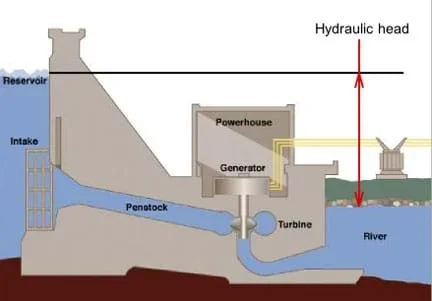 Engineers design hydraulic systems by applying their understanding of Bernoulli's principle and Pascal's law.Copyright 2004 Tennessee Valley Authority, Wikimedia Commons http://commons.wikimedia.org/wiki/File:Hydraulic_head.PNG
The concepts of Pascal's law, Archimedes' principle and Bernoulli's principle are important in engineering and technology applications, including aerodynamics and hydrodynamics, hydraulics, floating vessels, submersibles, airplanes, automobiles, aerospace guidance and control, pipelines and transport systems, as well as for many modern research topics such as ocean-related flows, turbulence, reacting flows, global climate, bio-fluid mechanics, flow over magnetic tapes and disks, geophysical flows, kinetics of combustion systems, and vortex dynamics.
After this lesson, students should be able to:
- Use Archimedes' principle to determine buoyancy forces.
- Solve problems involving pressure, density and Pascal's law.
- Solve problems using the Bernoulli equation and the continuity equation.
- Explain situations involving the Bernoulli Effect.
- CCSS.Math.Content.HSA-REI.B.3 Solve linear equations and inequalities in one variable, including equations with coefficients represented by letters.
Grades 9-12
Do you agree with this alignment? - CCSS.Math.Practice.MP2 Reason abstractly and quantitatively.
Grades K-12
Do you agree with this alignment? - CCSS.Math.Practice.MP4 Model with mathematics.
Grades K-12
Do you agree with this alignment?
- express and manipulate relationships among physical variables quantitatively, including the use of graphs, charts, and equations.
Grades 9-12
Do you agree with this alignment?
An understanding of basic algebra is required in order to solve and manipulate the equations in this lesson.
All concepts for this lesson are covered in the 22-slide Fluids Presentation (PPTX), a Microsoft PowerPoint® file. The suggested time to complete this presentation is three class periods, but increase or decrease the duration, as needed.
Fluid mechanics is an essential course at most universities and required for most engineering majors. It is an especially important area of study for hydraulic engineering and environmental engineering, which are both sub-disciplines of civil engineering. These types of engineers are responsible for water transport systems and sewage networks in urbanized areas as well as the design of bridges, dams, channels, canals, levees and pipe networks, both free-standing and in buildings.
The basic concepts behind fluid mechanics are presented in this lesson. Inform students that if they wish to pursue engineering in college, fluid mechanics can be modeled or explained using existing computer programs in the university classroom or laboratory. Some students may be familiar with certain modeling programs; ask them to give examples of modeling software and their applications. Examples of fluid mechanics modeling programs include:
Hydrologic Modeling System (HEC-HMS) was created and is used by the U.S. Army Corps of Engineers to simulate the hydrologic processes of watershed systems, which includes natural processes such as evaporation and infiltration, as well as human-made features such as reservoirs and retention ponds.
ModFlow was created and is used by the U.S. Geological Survey; it is a 3D groundwater modeling software used to simulate groundwater conditions and groundwater/surface water interactions, as well as for aquifer and land management.
Computation Fluid Dynamics (CFD) was created by ANSYS, Inc., an engineering simulation software company. This application predicts the impact of fluid flows on engineered products throughout the design and manufacturing process as well as during use.
SolidWorks Flow Simulation simulates fluid flow, heat transfer and fluid forces critical to successful engineering designs, and permits unlimited iterations in order to create the most efficient product designs.
A fluid is any matter that flows, which can either be a liquid or a gas. Archimedes' principle states that any object completely or partially submerged in a fluid experiences an upward force equal in magnitude to the weight of the fluid displaced by the object, as seen in Equation 1.
F B = m f g (Equation 1)
Where F B is the buoyant force, m f is the mass of the fluid displaced, and g is acceleration due to gravity.
All of us have experienced Archimedes' principle, even though we may not be aware of it. A common experience is realizing that it is rather easy to lift a person in a swimming pool. This is because the water provides partial support in the form of an upward force called the buoyant force. The buoyant force is equal to the weight of the fluid displaced. Refer to Buoyancy & Pressure in Fluids: Soda Bottle Cartesian Diver activity to have students observe these variables in action. Ships float in water because the weight of the water displaced by the ship's hull is greater than the ship's weight, and if the weight of the water displaced was less than that of the ship, it would sink. Engineers use fluid mechanics and dynamics modeling software to simulate different phenomena that occur, which is essential to create optimal ship designs. Engineers model hull form and appendage optimization to increase a ship's efficiency and propulsive power, reduce fuel consumption, and analyze resistance in calm water and irregular waves.
Earlier, it was mentioned that a fluid can be a liquid or a gas. Air is everywhere, and even the air surrounding us has a weight and exerts a pressure. We do not realize how heavy the air is, or feel the pressure it exerts upon us because we are accustomed to the "atmospheric pressure." Pressure is defined as a measure of force over a given area. Pascal's law states that a pressure applied to a fluid in a closed container is transmitted equally to every point of the fluid and the walls of the container, as seen in Equation 2.
P = F / A (Equation 2)
Where P is the pressure, F is the force, and A is the area. Note that a closed system may have two areas, so the force is different at the two locations, but the pressure remains the same, as stated by Pascal's law.
This pressure is transmitted equally in all directions and at right angles, and a change in pressure disperses equally throughout the fluid. Pascal's law is used by engineers when designing hydraulic systems that use liquid power to do work. Some examples are hydraulic jacks that lift cars up in repair shops and hydraulic brakes that apply a pressure to a large area to stop a large vehicle such as a train. Pascal's law is also used in water distribution systems and sewage systems to move water throughout a network of pipelines.
Primarily, two different types of fluid flow exist—laminar and turbulent. Laminar flow occurs when fluid particles move along a uniform, smooth path called a streamline and typically occurs in small pipes or other low-flow media. Turbulent flow occurs when fluid particles flow irregularly and cause a change in velocity and typically occurs in large pipes or other high-flow media. Bernoulli's principle states that pressure and velocity are inversely related, or that the pressure in a fluid decreases when the fluid's velocity increases, as seen in Equation 3.
P 1 + ½ρ v 1 2 + ρ g h 1 = P 2 + ½ρ v 2 2 + ρgh 2 (Equation 3)
Where P 1 is the pressure at point 1, ρ is the density of the fluid, v 1 is the velocity of the fluid at point 1, g is the acceleration due to gravity, h 1 is the elevation of point 1, P 2 is the pressure at point 2, v 2 is the velocity of the fluid at point 2, and h 2 is the elevation of point 2. Students can practice deriving these equations with the Rock and Boat: Density, Buoyancy & Archimedes’ Principle activity by working to solve a challenge question!
Bernoulli's equation remains equal at different points in a horizontal pipe. In a pipe that is not consistent in height, Bernoulli's equation still remains equal, but takes into account height differences at different points in a pipe, as noted by h in Equation 3. Engineers implement Bernoulli's equation in order to specify optimal and efficient pipe sizes when designing pipelines and transport systems. Bernoulli's equation is a main component in aerodynamics, which is applied in the design of automobiles, bridges, ventilation systems, gas piping, aircraft and spacecraft.
The concepts of Pascal's law, Archimedes' principle and Bernoulli's principle are important in engineering and technology applications such as aerodynamics and hydrodynamics, hydraulics, floating vessels, submersibles, airplanes, automobiles, aerospace guidance and control, pipelines and transport systems, as well as for many research topics such as ocean-related flows, turbulence, reacting flows, global climate, bio-fluid mechanics, flow over magnetic tapes and disks, geophysical flows, kinetics of combustion systems, vortex dynamics and many more. Refer to A Shot Under Pressure activity to have students utilize their new understanding towards investigating a real world application, water guns!
Aerodynamics is the study of the properties of moving air, which is a main component in the design of automobiles, bridges, heating and ventilation, gas piping, aircraft and spacecraft. Hydrodynamics is the study of forces exerted on or by fluids, which is the main component in naval architecture or ship design, and ocean engineering. Ocean and marine engineers are responsible study the offshore environment in order to design oil rigs and production platforms as well as floating vessels and subsea pipeline systems needed in the oil production process. Hydraulic engineers use hydraulics, or the use of liquid power to do work, to design heavy machinery, water distribution systems, sewage networks, storm water management systems, bridges, dams, channels, canals and levees. Various submersibles and remotely operated vehicles designed by engineers are widely used by government and scientific researchers and are essential in the discovery of deep-water communities and the exploration of the abysmal ocean because they can reach depths much greater than previous satellite and shipboard technologies.
(Ask students some preliminary questions to determine whether they have heard of Archimedes' principle, Pascal's law or Bernoulli's principle, or any of the physics concepts behind them.)
Who knows why ships float? (Listen to student answers.)
When you are swimming in a pool, do you feel lighter or heavier than when you are walking on the ground? How much lighter are you? (Listen to student answers.)
Who has heard of the term hydraulics? What are some examples of hydraulic devices? Who knows what this means or how it works? (Listen to student answers.)
(Move on and present to students the attached slide presentation and content in the Background section.)
Ask students the same discussion questions asked before the lesson, but this time expect them to answer with confidence and provide proof to their answers using equations, vocabulary words and specific laws/principles learned in this lesson.
Who knows why ships float? (Answer: The weight of the water displaced by the hull of the ship is greater than the weight of the ship. Ask students to think about small fishing boats vs. cruise ships.)
When you are swimming in a pool do you feel lighter or heavier than when you are walking on Earth? How much lighter are you? (Answer: You feel lighter in a pool because the apparent loss of weight is equal to the weight of the water displaced by your body.)
Who has heard of the term hydraulics? What are examples of hydraulic devices? Who knows what this means or how it works? (Answer: Hydraulic engineers use hydraulics, or the use of liquid power to do work, to design heavy machinery, water distribution systems, sewage networks, storm water management systems, bridges, dams, channels, canals and levees.)
What other examples of Archimedes' principle, Pascal's law, and Bernoulli's principle can you think of? Can you think of any engineering applications related to these concepts? (Answer: The concepts of Pascal's law, Archimedes' principle, and Bernoulli's principle, are important in engineering and technology applications such aerodynamics and hydrodynamics, hydraulics, floating vessels, submersibles, airplanes, automobiles, aerospace guidance and control, pipelines and transport systems, and many research topics such as ocean-related flows, turbulence, reacting flows, global climate, bio-fluid mechanics, flow over magnetic tapes and disks, geophysical flows, kinetics of combustion systems and vortex dynamics.)
- archimedes' principle
- Any object partially or completely submerged in a fluid experiences an upward force equal in magnitude to the weight of the fluid displaced by the object.
- bernoulli's principle
- The pressure in a fluid decreases as the fluid's velocity increases.
- buoyancy
- The ability of an object to float in a liquid.
- buoyant force
- The upward force on an object that is partially or completely submerged in a fluid (equal to the difference between the weight of an object in air and the weight of an object in fluid).
- density
- A measurement of the compactness of an object.
- fluid
- Matter that flows (can be either a liquid or a gas).
- laminar flow
- When fluid particles move along the same smooth path, which is called a streamline.
- mass
- A measurement of the amount of matter in an object.
- mass density
- Mass per unit volume of a substance
- pascal's law
- Pressure applied to a fluid in a closed container is transmitted equally to every point of the fluid and to the walls of the container.
- pressure
- A measurement of force per unit area.
- turbulent flow
- When fluid particles flow irregularly, causing changes in velocity, which can form eddy currents.
- volume
- A measurement of the amount of space an object occupies.
- weight
- A measurement of force on an object due to gravity.
Pre-Lesson Assessment
Discussion Questions: Ask students the following opening questions to gauge their base knowledge of the lesson topics. The same questions will be asked at lesson end.
- Who knows why ships float?
- When you are swimming in a pool do you feel lighter or heavier than when you are walking on Earth? How much lighter are you?
- Who has heard of the term hydraulics? What are examples of hydraulic devices? Who knows what this means or how it works?
Post-Introduction Assessment
Example Problems: Have students solve the example problems embedded within the Fluids Presentation (PDF), as described below. Review students' answers to assess their understanding of the lesson topics and determine which concepts and equations require further explanation.
- Slide 7: Re-draw the image on the board but change the numbers. For example, have the scale weight be 15 pounds, and the water weight in the bowl be 7 pounds. To verify students' understanding of the concept, ask students how heavy the weight is when submerged in the water. The answer is 8 pounds.
- Slide 10: Ask students to solve for the weight of the water displaced by the crown in the image. The answer is 1.3 kg. Then re-draw the same diagram on the board and label the weight on the left as 23.2 kg and ask students to determine the value of the scale on the right if the buoyant force is 3.7 kg. The answer is 22.5 kg.
- Slide 15: Ask students to solve for P 1 using the equation on Slide 13. The answer is P 1 = 10 Pa. Then, have students solve for P 2 and F 2 using the relationship P 1 = P 2 . The answer is P 2 = 10 Pa and F 2 = 100 N.
- Slide 18: Which drawing demonstrates laminar flow and turbulent flow? (A, the top drawing with straight arrows, represents laminar flow; B, the bottom drawing with curving arrows, represents turbulent flow.) What are some examples of each of the different types of flow? (Examples of laminar flow include slow flowing streams and water flowing out of sink faucets. Examples of turbulent flow include smoke from fires or other burning objects, currents and rough-flowing streams.)
- Slide 22: Provided example numbers for students to plug into Bernoulli's equation at varying heights so they can learn what cancels out (if anything) and how to apply the equation.
Lesson Summary Assessment
Answering Discussion Questions with Physics: Ask the same discussion questions asked before the lesson, but this time expect students to answer with confidence and proof including equations, vocabulary words and specific laws/principles learned in this lesson. See the Lesson Closure section for the answers.
Homework
Practice Problems: Assign students to complete the Practice Problems Worksheet (PDF) as a homework assignment. Use the Physics Problem Solving Rubric (PDF) to review students' answers and assess their understanding of the concepts.
Physics Guide (pre-publication).First Examinations 2016. International Baccalaureate Organization 2013, p 118. (Since fluid mechanics is not taught in public high schools, this IB guide for physics was used mainly for learning objectives in this lesson.) Accessed March 2013. http://tinyurl.com/msfpep9
- The Physics of Fluid Mechanics
- Archimedes' Principle, Pascal's Law and Bernoulli's Principle
- Above-Ground Storage Tanks in the Houston Ship Channel
Browse the NGSS Engineering-aligned Physics Curriculum hub for additional Physics and Physical Science curriculum featuring Engineering.
Contributors
Emily Sappington; Mila Taylor
Supporting Program
National Science Foundation GK-12 and Research Experience for Teachers (RET) Programs, University of Houston
Acknowledgements
This digital library content was developed by the University of Houston's College of Engineering, based upon work supported by the National Science Foundation under GK-12 grant no. DGE 0840889. Any opinions, findings and conclusions or recommendations expressed in this material are those of the authors and do not necessarily reflect the views of the National Science Foundation.
Copyright
2014 by Regents of the University of Colorado; original © 2013 University of Houston