
Waves and Wave Properties
Students learn about the types of waves and how they change direction, as well as basic wave properties such as wavelength, frequency, amplitude and speed. During the presentation of lecture information on wave characteristics and properties, students take notes using a handout. Then they label wave parts on a worksheet diagram and draw their own waves with specified properties (crest, trough and wavelength). They also make observations about the waves they drew to determine which has the highest and the lowest frequency. With this knowledge, students better understand waves and are a step closer to understanding how humans see color.
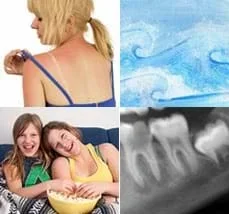 Sunlight that can cause sunburn. Ocean waves. Microwaves that pop popcorn. X-rays. Are these waves the same? How would you describe them?Copyright (top left) U.S. Department of Health and Human Services. (top right) 2004 Microsoft Corporation, One Microsoft Way, Redmond, WA 98052-6399 USA. (lower left) U.S. Department of Health and Human Services. (lower right) National Science Foundation. http://www.girlshealth.gov/environment/sun/effects.cfm http://www.foodsafety.gov/blog/snacking%20.html http://www.nsf.gov/od/lpa/news/03/tip030922.htm
Engineers apply their knowledge of waves to design an array of useful products and tools, many of which are evident in our everyday lives. For example: microwave ovens, x-ray machines, eyeglasses, tsunami prediction, radios and speakers. Engineers must understand all the properties of waves and how waves can differ from one another in order to design safe and effective products. To predict how tsunamis will travel after a ocean earthquake, engineers must understand wave properties and how they travel. Engineers also use their understanding of wave properties when designing electronics—to separate different types of waves so that radios tune in to the right stations, or so your cell phone only picks up the calls that you want. Before designing a solution to a challenge, engineers conduct research and gather information as a crucial part of the engineering design process. Through this legacy cycle lesson, students begin to gather the knowledge necessary to come up with a solution to the engineering challenge outlined in lesson 1 of this unit.
After this lesson, students should be able to:
- Explain that waves transfer energy, not matter.
- Distinguish between mechanical and electromagnetic waves.
- Summarize the major properties and behavior of waves, including (but not limited to) wavelength, frequency, amplitude, speed, refraction, reflection and diffraction.
- CCSS.Math.Practice.MP2 Reason abstractly and quantitatively.
Grades K-12
Do you agree with this alignment?
- Students will develop an understanding of the relationships among technologies and the connections between technology and other fields of study.
Grades K-12
Do you agree with this alignment?
- MS-PS4-1 Use mathematical representations to describe a simple model for waves that includes how the amplitude of a wave is related to the energy in a wave.
Grades 6-8
This resource focuses on the following Three Dimensional Learning aspects of NGSS:
Science & Engineering Practices- Use mathematical representations to describe and/or support scientific conclusions and design solutions.Do you agree with this alignment?
- Science knowledge is based upon logical and conceptual connections between evidence and explanations.Do you agree with this alignment?
Disciplinary Core Ideas- A simple wave has a repeating pattern with a specific wavelength, frequency, and amplitude.Do you agree with this alignment?
Crosscutting Concepts- Graphs and charts can be used to identify patterns in data.Do you agree with this alignment?
Do you agree with this alignment? - Use mathematical representations to describe and/or support scientific conclusions and design solutions.
- MS-PS4-2 Develop and use a model to describe that waves are reflected, absorbed, or transmitted through various materials.
Grades 6-8
This resource focuses on the following Three Dimensional Learning aspects of NGSS:
Science & Engineering Practices- Construct an explanation that includes qualitative or quantitative relationships between variables that describe phenomena.Do you agree with this alignment?
Disciplinary Core Ideas- A sound wave needs a medium through which it is transmitted.Do you agree with this alignment?
- When light shines on an object, it is reflected, absorbed, or transmitted through the object, depending on the object's material and the frequency (color) of the light.Do you agree with this alignment?
- The path that light travels can be traced as straight lines, except at surfaces between different transparent materials (e.g., air and water, air and glass) where the light path bends.Do you agree with this alignment?
- A wave model of light is useful for explaining brightness, color, and the frequency-dependent bending of light at a surface between media.Do you agree with this alignment?
- However, because light can travel through space, it cannot be a matter wave, like sound or water waves.Do you agree with this alignment?
Crosscutting Concepts- Structures can be designed to serve particular functions by taking into account properties of different materials, and how materials can be shaped and used.Do you agree with this alignment?
Do you agree with this alignment? - Construct an explanation that includes qualitative or quantitative relationships between variables that describe phenomena.
- 8-6.3 Summarize factors that influence the basic properties of waves (including frequency, amplitude, wavelength, and speed).
Grade 8
Do you agree with this alignment? - 8-6.4 Summarize the behaviors of waves (including refraction, reflection, transmission, and absorption).
Grade 8
Do you agree with this alignment? - 8.P.3 The student will demonstrate an understanding of the properties and behaviors of waves.
Grade 8
Do you agree with this alignment? - 8.P.3A Waves (including sound and seismic waves, waves on water, and light waves) have energy and transfer energy when they interact with matter. Waves are a repeating pattern of motion that transfers energy from place to place without overall displacement of matter. All types of waves have some features in common. When waves interact, they superimpose upon or interfere with each other resulting in changes to the amplitude. Major modern technologies are based on waves and their interactions with matter.
Grade 8
Do you agree with this alignment?
- Waves and Wave Properties Presentation (ppt)
- Waves and Wave Properties Presentation (pdf)
- All About Waves—Notes Outline (docx)
- All About Waves—Notes Outline (pdf)
- All About Waves—Notes Outline Answers (docx)
- All About Waves—Notes Outline Answers (pdf)
- Anatomy of a Wave Worksheet (doc)
- Anatomy of a Wave Worksheet (pdf)
- Anatomy of a Wave Worksheet Answers (doc)
- Anatomy of a Wave Worksheet Answers (pdf)
Legacy Cycle Information: This lesson falls into the research and revise phase of the legacy cycle. During this phase, students begin to learn the basic concepts required to design solutions to the engineering challenge presented in lesson 1 of this unit. After lesson 2, students should be able to revise their initial thoughts, forming new ones that will help solve the engineering challenge question. Ocean waves are mechanical waves.Copyright 2004 Microsoft Corporation, One Microsoft Way, Redmond, WA 98052-6399 USA. All rights reserved.
Waves and Wave Properties
(The following lecture material aligns with the slides.)
A wave is a disturbance that carries energy from one place to another. Matter is NOT carried with the wave! A wave can move through matter (called a "medium"), but some waves do not need a medium to be able to move. If a wave needs a medium, we call it a mechanical wave. If a wave can travel without a medium, (for example, through space), we call it an electromagnetic wave.
Wave Types
- Transverse waves: Waves in which the medium moves at right angles to the direction of the wave. Think about a "stadium wave:" the people are moving up and down, but the wave is going around the stadium. Parts of transverse waves:
- Crest: the highest point of the wave
- Trough: the lowest point of the wave
- Compressional (longitudinal) waves: Waves in which the medium moves back and forth in the same direction as the wave. Parts of compressional waves:
- Compression: where the particles are close together
- Rarefaction: where the particles are spread apart
Wave properties depend on what (type of energy) makes the wave. For example, you splashing in the ocean or an earthquakes creating a tsunami. Descriptive wave properties include:
- Wavelength: The distance between one point on a wave and the exact same place on the next wave.
- Frequency: How many waves go past a point in one second. The unit of measurement is hertz (Hz). The higher the frequency, the more energy in the wave.
- If 10 waves go past in 1 second, it is 10 Hz
- If 1,000 waves go past in 1 second, it is 1,000Hz
- If 1,000,000 waves go past, it is 1,000,000 Hz
- Amplitude: How far the medium (crests and troughs, or compressions and rarefactions) moves from rest position (the place the medium is when not moving). The more energy a wave carries, the larger its amplitude.
- The energy of a wave can be expressed by the equation E = CA2, where E is energy, C is a constant dependent upon the medium, and A is the amplitude.
- Wave speed: Depends on the medium in which the wave is traveling. It varies in solids, liquids and gases. A mathematical way to calculate wave speed is: wave speed = wavelength (in m) x frequency (in Hz). Or, v = f x λ. So, if a wave has a wavelength of 2 m and a frequency of 500 Hz, what is its speed? (Answer: wave speed = 2 m x 500Hz = 1000 m/s)
Changing Wave Direction
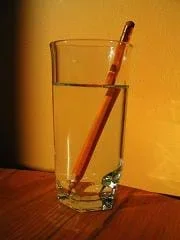 A demonstration of refraction.Copyright 2009 Denise W. Carlson, ITL Program, College of Engineering, University of Colorado Boulder
- Reflection: When waves bounce off a surface. If the surface is flat, the angle at which the wave hits the surface will be the same as the angle that the wave leaves the surface. In other words, the angle in equals the angle out. This is the law of reflection. (For example, when a pool ball strikes the side of a pool table, the angle at which it hits the bumper is the same angle at which it bounces off the bumper.)
- Refraction: Waves can bend. This happens when a wave enters a new medium and its speed changes. The amount of bending depends on the medium it is entering. (optional: To explain this phenomenon in more detail, search the Internet to find an interactive tutorial that shows light being bent as it travels through a medium.)
- Diffraction: The bending of waves around an object. The amount of bending depends on the size of the obstacle and the size of the waves. (optional: To explain this phenomenon in more detail, search the Internet to find an interactive tutorial that shows the diffraction of monochromatic light through slits of varying widths.)
- Large obstacle, small wavelength = low diffraction (bending)
- Small obstacle, large wavelength = large diffraction (bending)
(In advance, make copies of the All About Waves—Notes Outline (PDF) and Anatomy of a Wave Worksheet (PDF), one each per student, and have graph paper available for students. Also [optional], prepare to show students the attached 16-slide Waves and Wave Properties Presentation (PPT) to accompany the lesson introduction. The slides are "animated" so you can click to show the next item when ready.)
Returning to our three-color mystery, today we are going to develop an understanding of the fundamental concepts of waves. What we learn will move us one step closer to reaching our goal of creating a solution to our engineering challenge that I explained yesterday (lesson 1 of this unit).
Let's start with what we already know. Why are we able to see? (Because there is light.) What is light? (It is a wave.) So, what is a wave? Well, we will learn the answer to that question today!
I will pass out an outline that will help you keep track of the important concepts explained as we talk about waves and wave properties.
(At this point, hand out the notes outlines and present the lecture material provided in the Background section, in tandem with the slides.)
(Next, so students can apply what they just learned, divide the class into groups of two students each, and hand out copies of the worksheets and blank graph paper.)
Who has ever sunburned your skin? Who has used a microwave to make popcorn? Or had an x-ray taken? Or listened to the radio? What do these activities have in common? (Listen to student answers.) All of these require waves.
One difference between the waves that pop popcorn and the waves that tan your skin is wave frequency. As we have learned, the frequency of a wave is defined as the number of cycles that pass a single point in a given amount of time.
In the first part of the worksheet, label the parts of a wave using the definitions given. Then, draw four different waves given information about the waves' properties. Of these four waves, your challenge is to identify the ones with the highest and lowest frequencies.
Now that you're all experts in understanding the different types of waves, how they move and change direction, and how to describe their characteristics, tell me, what are some of the ways that you see waves used in your everyday lives? (Listen to student ideas.) Those are great examples. What about microwave ovens, medical and dental x-ray machines, eyeglasses and speakers? These are common examples in which engineers apply their knowledge of waves to design all types of useful products and tools that are evident in our everyday lives. To design these products, engineers must be well versed in all the properties of waves and how waves can differ from one another. For example, the waves emitted from a microwave are very different than those emitted from an x-ray machine that creates images of bones or teeth. Engineers need a complete understanding of wave properties in order to design safe and effective products!
But that's not all—engineers work to protect people and predict how tsunamis will travel after an earthquake in the ocean by using wave properties. To successfully predict where a tsunami will travel, engineers must understand how waves move and the properties associated with waves.
Another example of engineers using wave properties is when electrical engineers separate different types of waves so that the radio you are using tunes in to the right station, or your cell phone only picks up the calls that you want. If it were not for these engineers, you would constantly be getting calls from people you did not know. To accomplish this they must have a clear understanding of wave properties and know how to separate different types of waves.
Before designing and creating a solution to a challenge, engineers conduct research and gather information, just like you did today. This step is a crucial part of the engineering design process.
- amplitude
- How far the medium (crests and troughs, or compressions and rarefactions) moves from rest position (the place the medium is when not moving).
- compression
- When the particles of a longitudinal wave are close together.
- compressional (longitudinal) wave
- A wave in which the medium moves back and forth in the same direction as the wave.
- crest
- The highest point on a transverse wave.
- diffraction
- The bending of waves around an object.
- electromagnetic wave
- A wave that does not require a medium to travel, for example, it can travel through a vacuum. Also called an EM wave.
- energy
- The capacity to do work.
- frequency
- How many waves go past a point in one second. Measured in hertz (Hz).
- mechanical wave
- A wave that requires a medium to travel.
- rarefaction
- When the particles of a longitudinal wave are far apart.
- reflection
- When a wave bounces off a surface.
- refraction
- When a wave bends.
- transverse wave
- A wave in which the medium moves at right angles to the direction of the wave.
- trough
- The lowest point on a transverse wave.
- wave
- A disturbance that carries energy from one place to another.
- wavelength
- Distance between one point on a wave and the exact same place on the next wave.
Note Taking: During the lecture, have students complete the All About Waves—Notes Outline (PDF) and refer to it for visuals that supplement the lecture material. Then, with the notes turned over on their desks, ask students various questions that were covered in the lecture material. Evaluate students' answers to gauge their mastery of the subject.
Worksheet: After the lecture, have students complete the Anatomy of a Wave Worksheet (PDF) to see how well they apply what they learned.
Trade-n-Test: To conclude, have each student make up their own wave properties (that is, trough and crest height and wavelength) and write it down. Then have students trade the "invented properties" papers with other students and draw the new waves based on the given properties.
Davidson, Michael W. Diffraction of Light, Physics of Light and Color, Optical Microscopy Primer. Last modified June 15, 2006. Florida State University and the National High Magnetic Field Laboratory, Optical Microscopy, Molecular Expressions. Accessed February 7, 2012. http://micro.magnet.fsu.edu/primer/java/diffraction/basicdiffraction/index.html
Davidson, Michael W. Particle and Wave Refraction, Physics of Light and Color, Optical Microscopy Primer. Last modified June 15, 2006. Florida State University and the National High Magnetic Field Laboratory, Optical Microscopy, Molecular Expressions. Accessed February 7, 2012. http://micro.magnet.fsu.edu/primer/java/particleorwave/refraction/index.html
Lewis, Susan K. Anatomy of a Tsunami. Posted March 29, 2005. Nova beta, PBS Online by WGBH. Accessed February 7, 2012. http://www.pbs.org/wgbh/nova/tsunami/anatomy.html
Sound & Light: Chapter 1, Section 2 Properties of Waves. Quia, IXL Learning. Accessed February 7, 2012. http://www.quia.com/rr/221617.html
Browse the NGSS Engineering-aligned Physics Curriculum hub for additional Physics and Physical Science curriculum featuring Engineering.
Contributors
Ellen Zielinski; Courtney Faber; Marissa H. Forbes
Supporting Program
Research Experience for Teachers (RET) Program, Center of Advancement of Engineering Fibers and Films, Clemson University
Acknowledgements
This lesson was developed through Clemson University's "Engineering Fibers and Films Experience – EFF-X" Research Experience for Teachers program, funded by National Science Foundation grant no. EEC-0602040. However, these contents do not necessarily represent the policies of the National Science Foundation, and you should not assume endorsement by the federal government.
Copyright
2013 by Regents of the University of Colorado; original © 2010 Clemson University