
Exploring the Electromagnetic Spectrum
Students learn the basics of the electromagnetic spectrum and how various types of electromagnetic waves are related in terms of wavelength and energy. In addition, they are introduced to the various types of waves that make up the electromagnetic spectrum including, radio waves, ultraviolet waves, visible light and infrared waves. These topics help inform students before they turn to designing solutions to an overarching engineering challenge question.
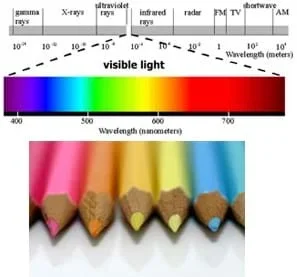 Engineers design many products that use various types of waves found in the electromagnetic spectrum.Copyright (top) 2004 Microsoft Corporation, One Microsoft Way, Redmond, WA 98052-6399 USA. All rights reserved. (bottom) South Carolina Algal Ecology Lab, SC Department of Natural Resources http://www.dnr.sc.gov/ael/personals/pjpb/lecture/lecture.html
Engineers have designed many devices and instruments that use various types of waves found in the electromagnetic spectrum, including the radio, x-ray instruments, CT scans and sterilization techniques. These devices use electromagnetic waves in different ways. To successfully design these instruments and make them safe for people to use, engineers must understand every aspect of the electromagnetic spectrum.
Through this legacy cycle lesson, students continue to gather the knowledge necessary to come up with a solution to the engineering challenge outlined in lesson 1 of this unit. Before designing a solution to a problem, engineers must conduct research and gather information—an important step of the engineering design process.
After this lesson, students should be able to:
- Explain the relationship between the size of a wave and frequency.
- Explain the relationship between a wave's energy and wavelength.
- Compare all EM waves in terms of their energy and wavelengths.
- Students will develop an understanding of the role of troubleshooting, research and development, invention and innovation, and experimentation in problem solving.
Grades K-12
Do you agree with this alignment?
- MS-PS4-1 Use mathematical representations to describe a simple model for waves that includes how the amplitude of a wave is related to the energy in a wave.
Grades 6-8
This resource focuses on the following Three Dimensional Learning aspects of NGSS:
Science & Engineering Practices- Use mathematical representations to describe and/or support scientific conclusions and design solutions.Do you agree with this alignment?
- Science knowledge is based upon logical and conceptual connections between evidence and explanations.Do you agree with this alignment?
Disciplinary Core Ideas- A simple wave has a repeating pattern with a specific wavelength, frequency, and amplitude.Do you agree with this alignment?
Crosscutting Concepts- Graphs and charts can be used to identify patterns in data.Do you agree with this alignment?
Do you agree with this alignment? - Use mathematical representations to describe and/or support scientific conclusions and design solutions.
- 8-6.3 Summarize factors that influence the basic properties of waves (including frequency, amplitude, wavelength, and speed).
Grade 8
Do you agree with this alignment? - 8-6.8 Compare the wavelength and energy of waves in various parts of the electromagnetic spectrum (including visible light, infrared, and ultraviolet radiation).
Grade 8
Do you agree with this alignment? - 8.P.3A Waves (including sound and seismic waves, waves on water, and light waves) have energy and transfer energy when they interact with matter. Waves are a repeating pattern of motion that transfers energy from place to place without overall displacement of matter. All types of waves have some features in common. When waves interact, they superimpose upon or interfere with each other resulting in changes to the amplitude. Major modern technologies are based on waves and their interactions with matter.
Grade 8
Do you agree with this alignment?
Legacy Cycle Information: This lesson falls into the research and revise phase of the legacy cycle. During this phase, students begin to learn the basic concepts required to design solutions to the engineering challenge presented in lesson 1 of this unit. After lesson 4, students should be able to revise their initial thoughts, forming new ones that will help solve the engineering challenge.
The Electromagnetic Spectrum
(The following lecture material aligns with the slides.)
The EM Spectrum is the complete (entire) range of EM waves in order of increasing frequency and decreasing wavelength. This means as you look from left to right on a diagram of the spectrum, the wavelengths get smaller and the frequency gets larger. An inverse relationship exists between size of the wave and frequency. Remember: all EM waves travel at the same speed: 300,000km/s. If you remember the formula for speed, it is the wavelength times the frequency. For the answer to always be 300,000km/s, as one number goes up, the other must go down. All EM waves are radiation. It is just that the longer wavelengths do not carry enough energy in them to damage cells. Remember: the higher the frequency, the more energy in the wave!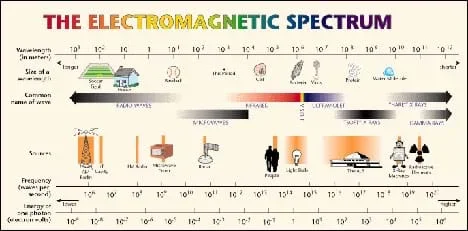 A diagram of the electromagnetic spectrum.Copyright Lawrence Berkeley National Laboratory http://www.lbl.gov/MicroWorlds/ALSTool/EMSpec/EMSpec2.html
Waves in the Spectrum
Radio waves have the longest wavelengths and lowest frequencies; wavelengths range from 1000s of meters to 0.001 m. (The shortest radio waves are microwaves.) Radio waves are used in RADAR (radio detection and ranging), sending sound, pictures (TV), cell phones, cooking and satellite transmissions.
Infrared waves (heat) have shorter wavelengths, from 0.001 m to 700 nm and higher frequencies (a nm is one billionth of a meter). Infrared is used to find people in the dark and in TV remotes.
Visible light is what we can see in the EM spectrum. Wavelengths of visible light range from about 700 nm (red light) to 400 nm (violet light). Visible light frequencies are higher than the frequencies of infrared waves. Notice how visible light is such a small portion of the entire spectrum.
Ultraviolet wavelengths range from about 400 nm to 10 nm; the frequency (and therefore the energy) is high enough with UV rays to penetrate living cells and cause them damage. We need UV rays to produce vitamin D in our bodies. Even though too much can lead to sunburn and skin cancer, UV rays are easily stopped by clothing. UV rays are used for sterilization of materials because they kill bacteria in high enough concentrations. Although humans cannot see UV light, bees, butterflies, some small rodents, and some birds can.
X-rays have wavelengths from 10 nm to 0.001 nm. They have enough energy to penetrate deep into tissues, but are stopped by dense materials, such as bones. Used for examining solid structures (such as looking for cracks in bones and bridges), and for cancer treatments.
Gamma rays have the shortest wavelengths (less than one trillionth of a meter: 10 to the negative 12), therefore the highest frequencies, therefore carry the most energy. These are the most damaging to tissues and can penetrate the deepest. They are hard to stop! You would need a 3–4 foot thick concrete wall to stop them. Gamma rays are released in nuclear power plants, by nuclear bombs, and by naturally occurring elements on Earth. They are sometimes used in the treatment of cancer.
(In advance, make copies of the All About EM—Notes Outline (PDF), one per student. Also [optional], prepare to show students the attached 11-slide Electromagnetic Spectrum Presentation (PDF) to accompany the lesson introduction. The slides are "animated" so you can click to show the next item when ready.)
We have already discussed the properties of light and how light interacts with objects. Today, we are going to move on and begin talking about the electromagnetic spectrum. (Show students a diagram of the electromagnetic spectrum.)
It turns out that the only type of electromagnetic radiation that we can see is visible light, which makes up only a fraction of the electromagnetic spectrum. We will begin by introducing you all to the EM spectrum and how it is organized and then we will look at the different types of waves that can be found in this spectrum, many of which will be familiar to you.
Have the students stand up with their feet close together. As they oscillate side to side have them take small steps sideways so that they stand wider. They will not be able to sway side to side as fast, as their stance gets wider. This can help relate wave size and frequency. Show the following equation on the board:
v = λ * f
Where:
v = speed of wave (distance/time)
λ = wavelength (distance)
f = frequency of wave (1/time)
The speed of a wave depends on the material it is traveling through. The speed of an electromagnetic wave (including light) through a vacuum is always the same (300,000,000 meters per second...or 670,000,000 miles per hour! This is represented by c). Through other materials the speed varies! To find the speed of an electromagnetic wave, you only have to divide c (speed through vacuum) by the "refractive index" shown in Table 1.
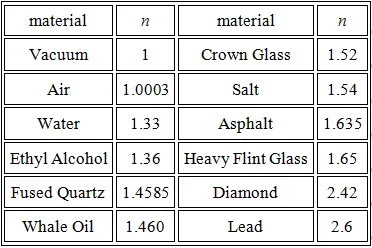 Table 1. Refractive Index (n) for Variety of Materials
(Next, hand out the notes outlines and present the lecture material provided in the Background section, in tandem with the slides.)
As we continue to gather information—an important step of the engineering design process—we now know a lot about the electromagnetic spectrum. Tell me what you know. (Listen to student responses, adding and correcting as necessary.) What is the relationship between the size of a wave and frequency? And what about the relationship between a wave's energy and wavelength?
What do you think that engineers have done with their understanding of EM? (Listen to student ideas.) Well, engineers have designed many devices and instruments that use various types of waves found in the electromagnetic spectrum. Some examples are: radios, x-ray instruments, CT scanners and sterilization techniques. These devices use electromagnetic waves in different ways. And since, as we have learned, some waves can be powerful and dangerous, engineers must understand every aspect of the electromagnetic spectrum to make the instruments and tools safe for people to use.
- electromagnetic radiation
- A phenomenon that takes the form of self-propagating waves in a vacuum or matter. It is comprised of electric and magnetic field components that oscillate in phase perpendicular to each other and the direction of energy propagation. All travel the speed of light.
- electromagnetic spectrum
- The range of all possible frequencies of electromagnetic radiation.
Note Taking: During the lecture, have students complete the All About EM—Notes Outline (PDF) and refer to it for visuals that supplement the lecture material. Then, with the notes turned over on their desks, ask students various questions that were covered in the lecture material. Evaluate students' answers to gauge their mastery of the subject.
Math Worksheet: Hand out the attached Math Worksheet (PDF).
Browse the NGSS Engineering-aligned Physics Curriculum hub for additional Physics and Physical Science curriculum featuring Engineering.
Contributors
Ellen Zielinski; Courtney Faber
Supporting Program
Research Experience for Teachers (RET) Program, Center of Advancement of Engineering Fibers and Films, Clemson University
Acknowledgements
This lesson was developed through Clemson University's "Engineering Fibers and Films Experience – EFF-X" Research Experience for Teachers program, funded by National Science Foundation grant no. EEC-0602040. However, these contents do not necessarily represent the policies of the National Science Foundation, and you should not assume endorsement by the federal government.
Copyright
2013 by Regents of the University of Colorado; original © 2010 Clemson University