
Get Charged! Introduction to Electrical Energy
 Get charged!Copyright 2004 Microsoft Corporation, One Microsoft Way, Redmond, WA 98052-6399 USA. All rights reserved. http://office.microsoft.com/en-us/images/results.aspx?qu=electrical&ex=1#ai:MP900382822|mt:2|
Students are introduced to the idea of electrical energy. They learn about the relationships between charge, voltage, current and resistance. They discover that electrical energy is the form of energy that powers most of their household appliances and toys. In the associated activities, students learn how a circuit works and test materials to see if they conduct electricity. Building upon a general understanding of electrical energy, they design their own potato power experiment. In two literacy activities, students learn about the electrical power grid and blackouts.
Engineers are continually devising new ways to store, transport and create electricity. They develop new types of batteries, safer transmission lines and power plants. Examples include solar power, small compact batteries and rubber-insulated power lines. Electrical and computer engineers design the systems that produce electricity and transport it to your home. Electrical engineers work with electricity in all its forms, from tiny electrons to large-scale magnetic fields to everyday appliances. Teams of engineers develop complex devices such as lasers used in medical treatments, or robots that perform complex operations in space.
After this lesson, students should be able to:
- Explain from where electricity comes and how we use it.
- Define electrical energy in terms of charge, voltage, current and resistance.
- Identify the types of engineering careers that work primarily with electrical energy.
- Show that electricity in circuits requires a complete loop through which current can pass
Grade 4
Do you agree with this alignment? - Describe the energy transformation that takes place in electrical circuits where light, heat, sound, and magnetic effects are produced
Grade 4
Do you agree with this alignment?
- Energy comes in different forms.
Grades 3-5
Do you agree with this alignment? - STEL-3D Explain how various relationships can exist between technology and engineering and other content areas.
Grades 3-5
Do you agree with this alignment?
- 4-PS3-2 Make observations to provide evidence that energy can be transferred from place to place by sound, light, heat, and electric currents.
Grade 4
This resource focuses on the following Three Dimensional Learning aspects of NGSS:
Science & Engineering Practices- Use evidence (e.g., measurements, observations, patterns) to construct an explanation.Do you agree with this alignment?
Disciplinary Core Ideas- Energy can be moved from place to place by moving objects or through sound, light, or electric currents.Do you agree with this alignment?
- Energy can also be transferred from place to place by electric currents, which can then be used locally to produce motion, sound, heat, or light. The currents may have been produced to begin with by transforming the energy of motion into electrical energy.Do you agree with this alignment?
Crosscutting Concepts- Energy can be transferred in various ways and between objects.Do you agree with this alignment?
Do you agree with this alignment? - Use evidence (e.g., measurements, observations, patterns) to construct an explanation.
What is the difference between DC and AC electricity?
In direct current, or DC, all the electrons move in the same direction while the electricity flows. This type of current is produced by batteries in flashlights, cars and similar devices. In alternating current, or AC, the direction of the electron movement changes many times each second. The electrons move one way, then the other, and so on. Refer to the activities: The Path of Electrons and Potato Power for a hands-on introduction of how simple circuits work. Students can expand upon these pricipal concepts by learning about conductivity with the Conductivity activity.
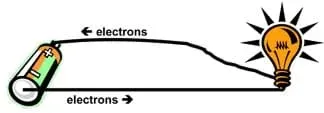 Diagram of electricity flow and usage in an electric circuit.Copyright (clipart) 2004 Microsoft Corporation, One Microsoft Way, Redmond, WA 98052-6399 USA. All rights reserved.
Saving energy for tomorrow: Will we have enough?
The U.S. produces about 10% of the world's energy, more than any other country, but it uses 25% of the world's energy. In 1998, most of the energy used in the U.S. came from fossil fuels (coal, petroleum and natural gas). The rest came mostly from hydropower (water power, such as dams) and nuclear energy. Fossil fuels are nonrenewable, which means that the amount available for use is limited and will someday be used up.
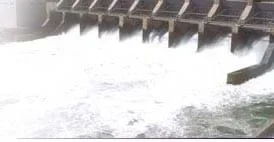 Hydroelectricity is a renewable form of electricity generation.Copyright U.S. Environmental Protection Agency http://www.epa.gov/
We can help by recycling, since it reduces the number of new products that take energy to make; riding buses and bikes to reduce the use of fossil fuels; and using less heat, hot water, and air-conditioning. Refer to the associated activities: Blackout! and The Grid: Technical Writing via Task Force Research & Reporting for students to expand their understanding to real world examples.
Today we are going to talk about electrical energy, or electricity. Who can describe electricity to me? What are some examples of electrical energy in our world? Can we feel electrical energy? (Answer: Yes, for example, static shocks, jolts from wall sockets and lightning.)
What exactly is electrical energy? Well, electricity is an invisible form of energy based on tiny, charged particles inside atoms. Atoms are what make up everything around us. In an atom's center or nucleus, are tiny particles. Some of these particles, called protons, have a positive charge. Whizzing around the atom's nucleus are other tiny particles called electrons. Electrons have a negative charge. If an atom does not have the same amount of positive and negative charges (are not balanced), then an electrical force results. This electrical force may stay in one place, as static electricity, or move from place to place, as electric current.
Electrical energy is all about charge. Three vocabulary words are important to understanding electrical energy. Current is the flow of charge, or how charge moves from place to place. The potential of current to flow is called voltage and when we prevent the flow of charge, it is called resistance. Let's try an example. Think about a hose of water from a water tank. The voltage is how much water is inside the tank to use with the hose, or the pressure pushing the water out of the tank. When we turn the hose on and pour the water onto the ground, the stream of water is the current. If we put a sprayer on the hose, the sprayer can reduce the current to a trickle and create resistance. This is similar to how electrical energy (or electricity) works.
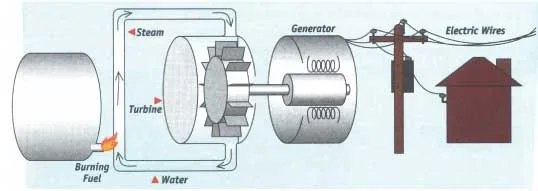 The energy conversion process of fossil fuels to electricity. From The World Almanac for Kids 2001.Copyright 2001 World Almanac Education Group. All Rights Reserved.
So, how does energy reach our homes? In most cases, fossil fuels (such as coal and oil; primarily coal in the U.S.) are taken to a power plant where they are burned in a furnace. The heat energy (thermal energy, which we will talk about another time) from the burning fuel heats up water that flows through a pipe. When the water boils, it becomes steam, which is sent to a turbine (a wheel with blades). The steam pushes against the blades of the turbine and causes it to spin. A long, round bar (shaft) attached to the turbine turns a generator (a spinning magnet) that unbalances the charges in nearby atoms and produces a current of electricity in coiled wires nearby. The electrical current flows through other wires to homes, schools and businesses; there, it flows through various resistors (resistance) for lighting, heating, cooling and powering appliances.
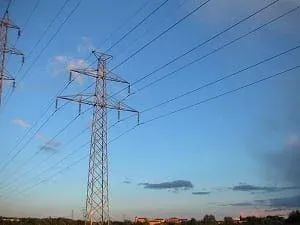 Transmission lines move electricity from power plants to our homes and schools.Copyright 2004, Nixdorf, Wikimedia Commons https://commons.wikimedia.org/wiki/File:Electric_transmission_lines.jpg
Although most types of engineers use electrical energy in the things they do, it is electrical and computer engineers who design the systems that produce electrical energy current and transport it to your home. Electrical engineers work with electrical energy in all its forms, from tiny charges to large-scale magnetic fields to the appliances that you use every day. They apply their scientific knowledge of electricity, magnetism and light to solving real-world problems that relate to cell phones, computer software, electronic music, radio and television broadcasting, the electrical energy grid, air and space travel, and a wide range of other areas. Mechanical and other engineers work in teams with electrical and computer engineers to develop devices such as lasers used in medical treatments, or robots that perform operations in space. Other engineers are working to design ways to take advantage of renewable energy sources. Many of the breakthroughs in technology in recent years are due to the work of electrical and computer engineers. Electrical and computer engineering are important in helping us learn more about the cool ways we can get electrical energy to work for us.
Today, we learned that electrical energy is all about ________. What? That's right, charge! Who can define our three most important vocabulary words? What is voltage? (Answer: The amount of charge or electrical energy that is able to flow.) What is current? (Answer: The flow of charge or electrical energy.) What is resistance? (Answer: Something that keeps the charge or electrical energy from flowing.) What type of engineers work mostly with electrical energy? (Answer: Computer and electrical engineers.) When you go home tonight notice all of the things in your house powered by electricity. Is there any thing you can do to help save some of that energy?
- alternating current
- Electrical current in which the direction of the electron movement changes many times each second. The electrons move one way, then the other, and so on. Abbreviated as AC.
- direct current
- Current in which all the electrons move in the same direction while the electricity flows. Used in batteries and cars. Abbreviated as DC.
- conductor
- An object that allows the transfer of electrons.
- current
- Movement of electrons.
- electrical and computer engineer
- Engineer who specializes in the technology of electricity, especially the design and application of circuitry and equipment for power generation and distribution, machine control and communications.
- electrical energy
- Energy produced through the movement of electrons (voltage X current).
- electron
- Very small, negatively-charged particle.
- energy
- The ability to do work.
- insulator
- An object that inhibits the transfer of electrons.
- nonrenewable energy
- Energy from sources that are used faster than they can be created. Sources include oil [petroleum], natural gas, coal and uranium [nuclear].
- renewable energy
- Energy that is made from sources that can be regenerated. Sources include solar, wind, geothermal, biomass, ocean and hydro (water).
- resistance
- Objects or substances that prevent the passage of a steady electric current.
- voltage
- Amount of energy produced.
Pre-Lesson Assessment
Brainstorming: As a class, have students engage in open discussion. Remind them that in brainstorming, no idea or suggestion is "silly." All ideas should be respectfully heard. Take an uncritical position, encourage wild ideas and discourage criticism of ideas. Have students raise their hands to respond. Write their ideas on the board. Ask the students:
- What are examples of electrical energy in our world?
- How do we feel electrical energy? (For example, static shocks, wall sockets, lightning.)
Know / Want to Know / Learn (KWL) Chart: Before the lesson, ask students to write down in the top left corner of a piece of paper (or as a group on the board) under the title, Know, all the things they know about electricity and electrical energy. Next, in the top right corner under the title, Want to Know, ask students to write down anything they want to know about electricity and electrical energy. After the lesson, ask students to list in the bottom half of the page under the title, Learned, all of the things that they have learned about electricity and electrical energy.
Post-Introduction Assessment
Class Definitions: Write the electrical energy vocabulary words from the Introduction / Motivation section on the classroom board: electrical energy, charge, voltage, current, resistance. As a class, develop one-sentence definitions for each term using students' own words. This helps to reinforce the meaning of the words.
Lesson Summary Assessment
Concept Juggle: Have students stand in a circle and toss a ball to each other. Each time they toss the ball, have them name something that uses electrical energy. One round can be "name an appliance," the next round can be "name a toy," and so on.
KWL Chart (Conclusion): After the lesson, ask students to list in the bottom half of the page under the title, Learned (or on the board), all of the things that they have learned about electricity and electrical energy.
Roundtable: Form the class into teams of 3-5 students each. Ask the teams a question with several possible answers. Have the students on each team make a list of answers by taking turns writing down ideas on a piece of paper. Students pass the list around the group until all ideas are exhausted. Have the teams read aloud their answers and write them on the board. Ask the students:
- How do engineers use electrical energy? (A few of the many possible answers: Light bulbs and lighting, appliances [refrigerators, washing machines, toasters, etc.], computers, radios, televisions, radio and television broadcasting, telephones, medical equipment, robots and robotic equipment, games, automobiles and other transportation, etc.)
Friction Boggle!: Repeat the Roundtable assessment activity as above, except when the teams read aloud their answers and write them on the board, ask if any other teams came up with the same idea. If any other teams have the same answer on their sheet, they must cross out that answer on their list. The team that ends up with the most "unique" ideas, wins!
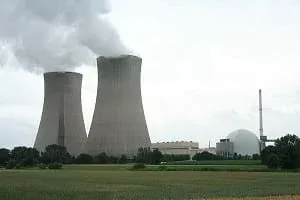 Power plants supply our daily electricity needs.Copyright 2009 Heinz-Josef Lücking, Wikimedia Commons https://commons.wikimedia.org/wiki/File:Nuclear_Power_Plant_-_Grohnde_-_Germany_-_1-2.JPG
For a discussion the next day, have students investigate where in their homes electricity might be excessively used.
Have students calculate how much energy (kWh) is consumed daily in their homes (compare with utility bills).
Students can learn more about electricity with electrical fleas. See: Electrical Fleas, Start Your Own Electric Flea Circus! Snacks, Exploratorium, San Francisco, CA.
Experiencing Engineering through Design: design and discovery curriculum puts students in the role of engineer (ages 11-14). Intel.com/education, Intel Innovation in Education, Intel Corporation. Accessed September 18, 2006. http://www.intel.com/education/projects/news/vol_03/article1.htm
How Smart Are You about Electricity, Batteries and Conductors? Updated August 12, 2005. Science and Mathematics Initiative for Learning Enhancement (SMILE) Program, IIT Department of Biological, Chemical and Physical Sciences, Chicago, IL. Accessed September 28, 2005. http://mypages.iit.edu/~smile/ph9306.html
Israel, Elaine (Ed.). The World Almanac for Kids. New York, NY: WRC Media Company, 2001, p.62-66.
Welcome to the IEEE. Modified July 1, 2004. Institute of Electrical and Electronics Engineers (IEEE). Accessed September 28, 2005. http://www.ieee.org
- Electrical Energy
- Get Charged! Introduction to Electrical Energy
Contributors
Sharon D. Perez-Suarez; Jeff Lyng; Malinda Schaefer Zarske; Denise W. Carlson
Supporting Program
Integrated Teaching and Learning Program, College of Engineering, University of Colorado Boulder
Acknowledgements
The contents of this digital library curriculum were developed under grants from the Fund for the Improvement of Postsecondary Education (FIPSE), U.S. Department of Education and National Science Foundation (GK-12 grant no. DGE 0338326). However, these contents do not necessarily represent the policies of the Department of Education or National Science Foundation, and you should not assume endorsement by the federal government.
Copyright
2005 by Regents of the University of Colorado