
Imagine Life without Friction in Hockey
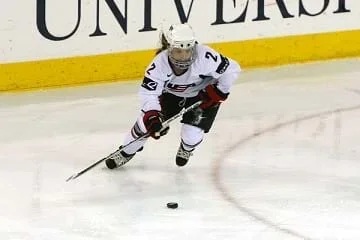 What would life be like without friction?Copyright https://en.wikipedia.org/wiki/List_of_Olympic_women's_ice_hockey_players_for_the_United_States#/media/File:2_Erika_Lawler.jpg
Students are introduced to the concept of inertia and its application to a world without the force of friction acting on moving objects. When an object is in motion, friction tends to be the force that acts on this object to slow it down and eventually come to a stop. By severely limiting friction through the use of hover pucks, students learn that the energy of one moving puck is transferred directly to another puck at rest when they collide. Students learn the concept of the conservation of energy via a "collision," and come to realize that with friction, energy is converted primarily to heat to slow and stop an object in motion. In the associated activity, "The Puck Stops Here," students investigate the frictional force of an object when different materials are placed between the object and the ground. They apply this understanding to the challenge to design a new hockey puck for the National Hockey League.
Engineers often try to limit the loss of energy to heat to create the most efficient systems possible. By limiting friction and creating more efficient systems, less energy is required to obtain the same result. When friction converts energy into heat, it is almost always considered "wasted" in a system.
- Identify the frictional force and how it acts to slow an object in motion.
- Explain the conservation of energy both when friction is present and when it is limited by the hover pucks.
- Explain the concept of inertia and how it relates to a puck sliding on the floor.
- Explain that friction slows down motion, because of the transfer of kinetic to heat energy.
- Explain why engineers must understand friction when designing a hockey puck.
- Energy is the capacity to do work.
Grades 6-8
Do you agree with this alignment? - Energy can be used to do work, using many processes.
Grades 6-8
Do you agree with this alignment?
- MS-PS3-5 Construct, use, and present arguments to support the claim that when the kinetic energy of an object changes, energy is transferred to or from the object.
Grades 6-8
This resource focuses on the following Three Dimensional Learning aspects of NGSS:
Science & Engineering Practices- Science knowledge is based upon logical and conceptual connections between evidence and explanations.Do you agree with this alignment?
- Apply scientific ideas to construct an explanation for real-world phenomena, examples, or events.Do you agree with this alignment?
Disciplinary Core Ideas- When the motion energy of an object changes, there is inevitably some other change in energy at the same time.Do you agree with this alignment?
Crosscutting Concepts- Energy may take different forms (e.g. energy in fields, thermal energy, energy of motion).Do you agree with this alignment?
Do you agree with this alignment? - Science knowledge is based upon logical and conceptual connections between evidence and explanations.
- 7.P.1 Understand motion, the effects of forces on motion and the graphical representations of motion.
Grade 7
Do you agree with this alignment? - 7.P.1.2 Explain the effects of balanced and unbalanced forces acting on an object (including friction, gravity and magnets).
Grade 7
Do you agree with this alignment?
A frictional force exists when two objects come in contact with each other. It opposes motion, meaning if something is sliding on the floor, friction is the force that makes it eventually come to a stop. In a world without friction, the object would continue to slide forever, if not acted on by another force. Some surfaces have inherently less friction. This is the reason a puck slides a greater distance across an ice hockey rink than a rink made of concrete.
Inertia is the common definition for Newton's first law of motion. It states that an object at rest will stay at rest unless acted on by another force, and an object in motion will stay in motion unless acted on by another force. Using the hockey puck example, the only force that slows it down is friction, so if no friction was present, the object would never slow down. The hover pucks used in this lesson can demonstrate Newton's first law of motion, or the law of inertia, as it is often called.
The last concept this lesson demonstrates is the conservation of energy. This concept states that the total amount of energy in an isolated system remains constant, although this energy may change forms. A rolling object has a certain amount of kinetic energy, or energy of motion. If the "isolated system" is, for example, a concrete parking lot and a bowling ball, as the ball rolls across the parking lot, the amount of energy the system has when the ball first starts rolling is the same as the amount of energy the system has when it comes to a stop. At the beginning, the thermal energy, or heat energy, is related to the ambient temperature, and the other energy in the system is the initial kinetic energy you provide by rolling the ball. In the end, no more kinetic energy exists in the system because the ball is at rest, but the thermal energy has increased. All the kinetic energy is converted to the increased thermal energy, so the total energy is the same as it was at the beginning.
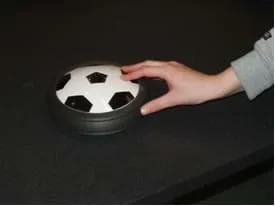 A hover puck.Copyright 2007 Engineering K-PhD Program, Duke University
(In advance, obtain two battery-operated hover pucks for the class demonstration. They are available from Pasco Scientific [SE-7335A; $29] and Amazon.com.)
Have you ever tried to run as fast as you can on a track? Pretty easy, huh? Now think about trying to run that fast on a frozen pond, or a hockey rink. Not so easy, huh? Friction is the force between our shoes and the ground that helps us run, whether it is on the track or on the rink. Which surface do you think has the higher frictional force? If you are thinking the track, you are absolutely correct! The larger frictional force helps our shoes stay in contact with the track longer, allowing us to use our muscles to push off the track and run fast. The smaller frictional force on the hockey rink does not allow our feet to stick to the rink, making us slip and, most likely, fall on the ice.
A good way to think about friction is that it is the force that impedes motion. When you roll a ball on the ground, the force that makes it eventually come to a stop is friction. When the ball is in contact with the ground, the kinetic energy of the ball in motion is transferred to heat. Now that seems kind of odd doesn't it, we can make heat just by rolling a ball on the ground. Why don't people in Alaska just roll balls on the ground to keep their houses warm? The reason is that the heat produced is hardly enough to detect, although it is present.
To demonstrate this, I want everyone to rub his/her hands together. As your hands move back and forth, they have kinetic energy. Because your hands are touching, there is also some frictional force between them. This friction converts the kinetic energy of your moving hands to heat. Are you still rubbing? Can you feel your hands warming up? Now touch your hands to your face, the heat you feel was created by the force of friction! Students can also illustruate this concept with the hands-on associated activity Frictional Force in Hockey: The Puck Stops Here.
Can you imagine a world without friction? While we cannot eliminate friction, we can limit its power significantly. Remember the rolling balls in Alaska? What if those balls were rolling on a waxed floor? Now the energy you put into the system by rolling the ball will not be lost to friction on the floor, and can be transferred to the pins at the end of the alley. Yes! Bowling is based on this principle; in this case, we do not want the ball to slow down on the lane so that it can knock over the most pins at the end of the lane.
We can also simulate a frictionless world with the use of these two hover pucks. (Show the hover pucks to the class and then proceed with a demonstration.)
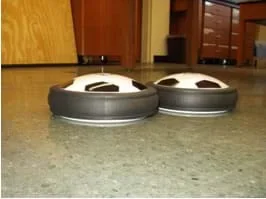 Hover pucks.Copyright 2007 Engineering K-PhD Program, Duke University
These pucks shoot air towards the ground, so that they hover above the ground, and the frictional force between the ground and the puck is limited. Observe the two pucks, one is in the "on" position and one is in the "off" position. As I slide the pucks parallel to each other you notice that the one in the "off" position does not travel as far. The energy I put into the system from pushing the puck was converted to heat through friction! When I turn both pucks on and slide one into the other at rest, almost all of the energy of the first puck is transferred to the second puck. This demonstrates the conservation of energy in the system. The energy I put into the system with my muscles sliding the puck is transferred to the second puck so that it starts moving.
Now let's try the same experiment with the hover pucks turned off and sitting on the ground. What happened? The first puck slid to the second puck, but less energy was able to be transferred, where did it all go? It was converted to the same place the kinetic energy of our hands was converted, to heat! As the first puck was sliding toward the second, it lost energy due to friction. It transferred its smaller amount of energy to the second puck, and as the second puck slid, it also lost energy to friction. So energy was once again conserved, but the majority of the energy was converted to heat.
A good way to think about this is that ENERGY IS ALWAYS CONSERVED. The amount of energy in a closed system never changes, and if you cannot see the energy at the end, you may be able to feel its heat.
- conservation of energy
- The total amount of energy in an isolated system remains constant although it may change form.
- friction
- A force that resists motion when two surfaces are in contact.
- inertia
- The property of an object to remain at a constant velocity unless acted upon by an outside force.
- kinetic energy
- The energy an object possesses due to its motion.
Post-Introduction Assessment: Ask students the following questions to gauge their comprehension of the material just presented.
- Which surface has more friction: the ice in a hockey rink or the floor of a basketball court? (Answer: The basketball court floor.)
- If two objects are pushed with the same force, which will travel further: an object with no friction or an object with a lot of friction? (Answer: The object with no friction.)
Lesson Summary Assessment: After students have completed the associated activity, ask them to each explain one way the force of friction is demonstrated in their favorite sports.
- Imagine Life without Friction in Hockey
Contributors
Greg Larkin; Anne Vanderschueren
Supporting Program
Engineering K-PhD Program, Pratt School of Engineering, Duke University
Acknowledgements
This content was developed by the MUSIC (Math Understanding through Science Integrated with Curriculum) Program in the Pratt School of Engineering at Duke University under National Science Foundation GK-12 grant no. DGE 0338262. However, these contents do not necessarily represent the policies of the NSF, and you should not assume endorsement by the federal government.
Copyright
2013 by Regents of the University of Colorado; original © 2007 Duke University