
Visual Art and Writing in Science and Engineering
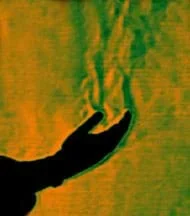 A color schlieren image reveals thermal convection from a human hand to the surrounding still atmosphere.Copyright 2013 Gary Settles, Wikimedia Commons http://commons.wikimedia.org/wiki/File:Thermal-plume-from-human-hand.jpg
Students learn the value of writing and art in science and engineering. They acquire vocabulary that is appropriate for explaining visual art and learn about visual design principles (contrast, alignment, repetition and proximity) and elements (lines, color, texture, shape, size, value and space) that are helpful when making visual aids. A PowerPoint® presentation heightens students' awareness of the connection between art and engineering in order to improve the presentation of results, findings, concepts, information and prototype designs. Students also learn about the science and engineering research funding process that relies on effective proposal presentations, as well as some thermal conductivity / heat flow basics including the real-world example of a heat sink—which prepares them for the associated activity in which they focus on creating diagrams to communicate their own collected experimental data.
In order to secure funding and communicate their findings to the greater science, technology, engineering and math (STEM) community, engineers develop skills to be able to write clearly and provide multiple avenues to express their findings. While using clear vocabulary and a logical flow of information are very important, many ideas and messages are easier to show than they are to say. Thus, visual art plays a vital role in explaining information, as seen by the graphs, tables, charts, pictures, diagrams, photographs and other visual aids used regularly in STEM proposals, reports and other publications. The appropriate and clear use of visual representations enables audiences that are unfamiliar with the topic to easily understand the presented information without requiring advanced knowledge of the subject.
After this lesson, students should be able to:
- Explain the connection between art and engineering.
- Explain how research funding happens in the sciences and engineering.
- Explain the importance of clear communication and how art can help accomplish this.
- Describe images using art vocabulary.
- Explain how thermal conductivity affects heat flow.
- CCSS.Math.Practice.MP2 Reason abstractly and quantitatively.
Grades K-12
Do you agree with this alignment?
- SCSh8.b Scientific researchers are expected to critically assess the quality of data including possible sources of bias in their investigations' hypotheses, observations, data analyses, and interpretations.
Grades 9-12
Do you agree with this alignment?
- STEL-7AA Illustrate principles, elements, and factors of design.
Grades 9-12
Do you agree with this alignment? - STEL-7CC Apply a broad range of design skills to their design process.
Grades 9-12
Do you agree with this alignment? - STEL-7W Determine the best approach by evaluating the purpose of the design.
Grades 9-12
Do you agree with this alignment?
- SEP.11.7 Models, mechanisms, and explanations collectively serve as tools in the development of a scientific theory.
Grades 9-12
Do you agree with this alignment? - SEP.5.9-12.5 Construct an oral and written argument or counter-arguments based on data and evidence.
Grades 9-12
Do you agree with this alignment?
The Research Funding Process
How does the scientific and engineering community decide what to research and how does this research work in the real world? It starts with the U.S. National Academies, created by President Abraham Lincoln in 1863, which is further comprised of four organizations: the National Academy of Sciences, the National Academy of Engineering, the Institute of Medicine and the National Research Council. These organizations do not perform original research, rather they engage committees of top scientists, engineers, health professionals and other experts to determine important questions and subject areas that address the scientific and technical aspects of some of society's problems and concerns. Through surveys of a wide variety of subject areas every 10 years, these experts see what has been accomplished since the last survey and what the community believes should be the focus of the next 10 years, which become the topics considered worthy of government research funding.
The government takes this information into consideration as it makes budgets for the next year and gives grant distributing groups, such as the National Science Foundation (NSF), the money to distribute in order to accomplish the goals uncovered from the surveys. To decide who gets the money for certain projects, the NSF puts out a call for proposals on a topic that needs to be researched. They review the proposals that they receive and the top few are granted some funding to conduct research and/or make prototypes of their design ideas. Next, they evaluate the results and designs and sometimes give additional funding to whom they feel has the best approach. Research can also be funded by private philanthropic foundations as well as private and public corporations.
In all these cases, it is important for scientists and engineers to make sure that their presentations of information (in both writing and visual representations) are clear and easy to understand. If an organization offers 10 million dollars to research a topic and they receive two proposals, one from an engineer who is an expert in his field, but cannot explain his work and one from someone who is new to the field, but his ideas are clear, easy to understand, and are valid, who would they fund? You wouldn't pay a doctor to perform a procedure on you if s/he cannot even explain it, would you? What about a bridge builder or a dentist or a fireman, or anyone for that matter? How successful you are in your field depends on how well you communicate your ideas to other people.
Principles of Visual Design
- Unique elements in a visual design are best if they stand apart from one another. One way to do this is to use contrast. Good contrast, which can be achieved using elements like color, tone, value, size and shape, helps the viewer's eyes to flow naturally in visual presentations.
- Effective alignment in a visual design means that every element in it is visually connected to another element. Alignment creates cohesiveness. When alignment has been handled well, nothing feels out of place or disconnected.
- Repetition breeds cohesiveness. Once a design pattern has been established, for example a dotted border or a specific typographic styling, repeat this pattern to establish consistency. The bottom line is to establish a style for each element in a visual presentation and use it on similar elements.
- Proximity creates visual unity. If two elements are related to each other, place them in close proximity to one another. This minimizes visual clutter, emphasizes organization and increases viewer comprehension.
Elements of Visual Design
- A line is a mark between two points. All sorts of line types exist, from straight to squiggly to curved and dashed. Lines can be used for a wide range of purposes: stressing a word or phrase, connecting content to one another, creating patterns and much more.
- Color is used to generate emotions, define importance, create visual interest and more. Some colors are warm and active (orange, red); some are cool and passive (blue, purple). Effective use of color includes an understanding of color types and color relationships.
- Texture relates to the surface of an object—the look or feel of it. For example, concrete often has a rough texture while drywall has a smooth and subtle texture. Using texture in design is a great way to add depth and visual interest. Printed material has tactile texture (you can feel it) while digital screen material has implied texture (it looks like it has texture).
- Everyone is familiar with basic shapes: triangles, squares, circles and rectangles. In a general sense, shape = height + width. The three basic types of shape are geometric (triangles, squares, circles, etc.), natural (leaves, animals, trees, people) and abstracted (icons, stylizations, graphic representations, etc.). Use odd or less-frequently used shapes to attract attention.
- Size is how small or large something is, such as a small shirt or an extra-large shirt. Use size to define importance, create visual interest (via contrasting sizes), and attract or minimize attention.
- Value is how light or how dark an area looks. Think of a gradient as a great way to visualize value—everything from dark to white, all the shades in-between—each has a value. Use value to create depth and light, create a pattern, lead the eye or emphasize.
- Space is the area around or between elements. It can be used to separate or group information. Use it to give the eye a rest, define importance and lead the eye through a visual presentation.
Visualizing Heat Flow
(Heat flow is an easy topic for which students can design experiments and then use art to communicate the data results. Students need not know specific background mathematics to start the associated activity experimental lab, but conclude at the end with the equation of heat flow so they can see the connection between their data and the math. The lab is designed to be open inquiry, but it can be made more structured if students need more guidance.)
Thermal control is a vital topic in science and engineering. Humans can only survive in narrow temperature ranges, food cannot grow in certain temperatures, our mechanical and electrical equipment do not function if it is too hot or too cold, and many more challenges occur if we do not control heat flow. One common application of controlling heat flow is the use of heat sinks in electronics.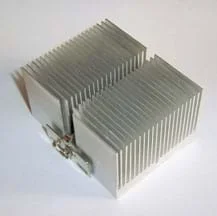 Figure 1. A heat sink provides a large surface area for convection to efficiently carry away heat.Copyright 2007 FxJ, Wikimedia Commons http://commons.wikimedia.org/wiki/File:Radiator_FxJ_v2.JPG
As they perform their tasks, computer chips generate a large amount of heat. If they are not kept cool, they overheat and sometimes melt. To prevent this, engineers use heat sinks (see Figures 1 and 2) to give off excess heat to the air faster than would usually happen. These heat sinks have very high rates of heat flow and so give off heat before it can build up on the chip.
Here is how it works. Heat flow can be modeled by the equation ΔQ/Δt = (-kAΔT)/x, where ΔQ/ Δt is the rate of heat flow in joules per second, k is the thermal conductivity of the material, A is the surface area of contact between two surfaces, ΔT is the difference in temperature between two objects, and x is the thickness of your material. If you want heat to flow out of your system faster, either increase k by changing the materials, increase surface area between two objects (A) or increase the difference in temperature between the objects (ΔT). If you want to slow it down, just make the material thicker (increase x).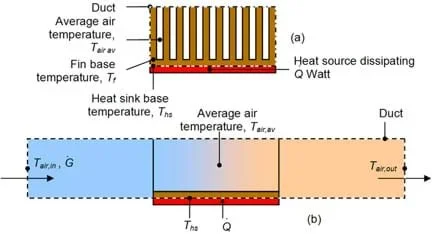 Figure 2. A cross-section diagram of a heat sink.Copyright 2010 Dtc5341, Wikimedia Commons https://commons.wikimedia.org/wiki/File:Heat_sink_control_volume.png
In Figure 2, the chip is generating the heat. The thermal interface material has a high k value, typically ~200 W/(m*K) (watts per meter Kelvin), and it increases the surface area between the chip and the chip cap. The chip cap is thicker and builds up most of the heat, increasing ΔT, and increasing the surface area to the cooling medium, usually air.
(Be ready to show the class the nine-slide Using Visual Art to Communicate Presentation (PPTX). This PowerPoint® file provides example images to get students thinking about how images can show action. In advance, review the Teacher's Slide Guide (PDF) for descriptions of each slide, suggested questions to ask and possible answers. Also make copies of the Principles and Elements of Design Handout (PDF), one per student, which is also provided as the last two slides.)
How many of you have had to draw an image of something happening? Have you ever looked at a picture and been able to tell what was going on at the time even though the image is just a still frame? Do you think being able to make images like this may be useful to us in science and engineering?
Engineers use art regularly to explain their ideas and findings to others. The way engineers get funding for their research is often through grants, and the people deciding who gets the grant money rarely have in-depth background knowledge of the engineering topic. For example, if your proposed research or project has never been done before, you may be the only one in the world who even knows about it! Thus, it is important that you are able to communicate your ideas to your audience and art is a fantastic way to do that. It is so useful, in fact, that many engineering colleges offer drawing classes and CAD (computer aided design) courses so that students can become prepared and skilled to visually present ideas and concepts in the form of diagrams, schematics and prototypes.
(Next, pass out the design handout and show the class the PowerPoint® slides. The handout provides fundamental art vocabulary and examples of methods used in art. Encourage students to use the correct terms to describe images in the presentation. At each slide, give students two or three minutes to answer the questions and as they are working, ask your own to prompt them to think of new ideas. After each image, have students share their findings and what they saw. As a recap on slide 7, explain the importance of each image and how each might be used in illustrating scientific and engineering work. Note that the slides are "animated," so each click [mouse or keyboard] brings up the next image, text or slide.)
(Continue on to provide students with the content in the Lesson Background section on the research funding process, the principles and elements of visual design [slides 8 and 9] and visualizing heat flow including the real-world example of a heat sink, which prepares them to conduct the associated activity Heat Flow and Diagrams Lab .)
After the associated activity is completed and students have made diagrams, show them the mathematical equation ΔQ/Δt = (-kAΔT)/x and explain the variables they measured and what variables matter to heat flow. If this is being used as an introductory lesson, help students realize that equations are also another method for describing data. The equation is just another way to describe what has been observed with heat flow.
To end the lesson, discuss the desired format for writing in the classroom and give examples of how to write equations in papers and how to include and reference diagrams. At this point, expect students to feel comfortable creating write-ups of the associated activity's lab that they just performed that would be clear to the average reader. As always, remind them to write as if the reader has never heard of the experiment, not to the teacher.
- alignment
- How visually connected elements of an image are. If every element is visually connected then nothing feels out of place or disjointed. Creates a sense of balance.
- chip cap
- A thick material, usually metal, that spreads out the heat given off by a computer chip.
- color
- An element of art derived from reflected light. Color has hue, value and intensity.
- contrast
- The difference in values, colors, textures, shapes and other elements. Contrast creates visual excitement.
- heat flow rate
- The rate at which thermal energy is transferred from one location to another, either from one material to another, or from a hot end to a cold end of the same material.
- heat sink
- A device that absorbs large quantities of heat and distributes this heat into the air or surrounding medium.
- heat spreader
- Another term for chip cap. Some devices use a heat spreader and then a separate attachment for the fins, unlike a chip cap, which is one unit.
- line
- The path of a moving point in space. A line provides something for the eye to follow and can create movement.
- proximity
- How close one object is to another. Can create depth of field or give an appearance that one object is larger or smaller than expected.
- repetition
- Recreation of the same or similar elements in a visual art piece. Creates cohesiveness in an image when a pattern is repeated multiple times.
- shape
- A two-dimensional area that is defined in some way. Geometric shapes look human-made and organic shapes are more free form.
- size
- How large or small an object is. Can be used to create focus and give the illusion of depth.
- texture
- In art, the visual and tactile quality of a surface resulting from the way in which the materials are used. The imitation of the tactile quality of represented objects.
- thermal interface material
- A material with a high thermal conductivity (k value), usually a paste or adhesive (sometimes a film or pad), that increases surface area between two points of contact by filling in all gaps between the two surfaces, thereby increasing heat flow.
- value
- In terms of color, the darkness or lightness of an object or color.
Pre-Lesson Assessment
Discussion Questions: Before showing the class the introductory Using Visual Art to Communicate Presentation (PPTX), discuss the lesson topics, which are woven into the following questions. Listen to students' answers and comments to determine their current thinking and familiarity with the concepts as well as to foreshadow the lesson topics.
- How can we show motion in images?
- Can art give us information?
- How do you communicate with art?
- Where do you use art to get information in your daily life?
- What are some words we can use to describe art?
- How might scientists and engineers use art to communicate ideas and information?
Lesson Summary Assessment
Evaluation of Lab Data: After completing the associated activity lab, have students discuss their findings and draw conclusions based on their data. Get students to think about ways to model their data, how to test other variables and other ways to design their own experiments. For AP students, have them write short responses to their labs similar to the paragraph-length free response to questions approach. Example questions include:
- What do you think affected your variables?
- How do different materials transfer heat differently? How do we account for that in the heat flow rate math equation?
- How would you test thickness? Temperature difference? Explain your setup.
- How could you do a mathematical model for your data?
Homework
Lab Write-Up: Students practice the writing skills discussed by creating lab write-ups that include diagrams using the "diagram design requirements" method that the class agreed to be the best (during the associated activity's Procedure section). Grade their lab write-ups based on writing clarity, formatting, logic and organization/neatness, as well as the effectiveness of all visual presentation elements.
A website that focuses on arts integration research, Harvard's Project Zero: http://www.pz.harvard.edu/
Archibald, Jeff. Principles of Design Quick Reference Poster. October 15, 2012. Free Friday Wallpaper, Paper Leaf Design. Accessed June 17, 2015. http://paper-leaf.com/blog/2012/10/principles-of-design-quick-reference-poster/
Archibald, Jeff. Elements of Design Quick Reference Sheet. February 7, 2011. Free Friday Wallpaper, Paper Leaf Design. http://paper-leaf.com/blog/2011/02/elements-of-design-quick-reference-sheet/
- Visual Art and Writing in Science and Engineering
Contributors
Andrew Carnes; Satish Kumar; Jamila Cola; Baratunde Cola; ARTSNow; PRIME 2014 Fellows
Supporting Program
Partnerships for Research, Innovation and Multi-Scale Engineering (PRIME) RET, Georgia Tech
Acknowledgements
This activity was developed by the Partnerships for Research, Innovation and Multi-Scale Engineering (PRIME) Research Experience for Teachers (RET) Program at Georgia Institute of Technology, funded by National Science Foundation RET grant no. EEC 140718. However, these contents do not necessarily represent the policies of the NSF, and you should not assume endorsement by the federal government.
Thank you to all the contributors for their knowledge, time and patience working with someone who is new to arts integration.
Thank you to Georgia Institute of Technology for the use of its facilities, faculty and staff in helping to develop this lesson plan.
Copyright
2015 by Regents of the University of Colorado; original © 2014 Georgia Institute of Technology