
The Heart of Our Cardiovascular System
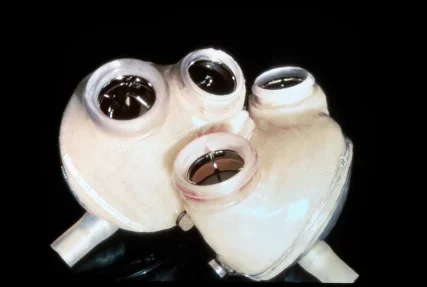 The Jarvik-7 artificial heart in 2007.Copyright 2007 NIH Photographic Archives via Wikimedia Commons http://commons.wikimedia.org/wiki/File:JARVIK_7_artificial_heart.jpg
Students learn about the heart and its role at the center of the human cardiovascular system. In the associated activity, students play out a scenario in which they are biomedical engineers asked to design artificial hearts. They learn about the path of blood flow through the heart and use that knowledge to evaluate designs of artificial hearts on the market.
The design of a fully-functional artificial heart was a major engineering accomplishment, one that is still being modified and improved. Biomedical, mechanical and electrical engineers work together, following the steps of the engineering design process, to engage in a structured thought process to find better and better solutions to the challenge of replicating the amazing and intricate functionality of the human heart.
After this lesson, students should be able to:
- Trace the path of blood through the human heart.
- Describe the general size, location and function of the heart, and compare that to artificial heart models.
- Discuss their opinions of how the invention of the artificial heart impacts society.
- Describe the engineering design process and give an example of each step.
- Technological problems must be researched before they can be solved.
Grades 9-12
Do you agree with this alignment? - STEL-1Q Conduct research to inform intentional inventions and innovations that address specific needs and wants.
Grades 9-12
Do you agree with this alignment? - STEL-7AA Illustrate principles, elements, and factors of design.
Grades 9-12
Do you agree with this alignment?
- B1.2k Analyze how science and society interact from a historical, political, economic, or social perspective.
Grades 9-12
Do you agree with this alignment? - B2.3d Identify the general functions of the major systems of the human body (digestion, respiration, reproduction, circulation, excretion, protection from disease, and movement, control, and coordination) and describe ways that these systems interact with each other.
Grades 9-12
Do you agree with this alignment? - B2.3g Compare the structure and function of a human body system or subsystem to a nonliving system (e.g., human joints to hinges, enzyme and substrate to interlocking puzzle pieces).
Grades 9-12
Do you agree with this alignment? - B2.r6e Analyze the body's response to medical interventions such as organ transplants, medicines, and inoculations. (recommended)
Grades 9-12
Do you agree with this alignment?
Ability to read and comprehend written information at a ninth-grade reading level.
The human heart is a vital muscular organ that provides a continuous circulation of blood through the body. It is usually about the size of a human fist and is located in the thoracic cavity above the diaphragm and in between the lungs. The heart beats rhythmically based on electrical impulses from the brain to the heart muscle; each heartbeat pumps blood throughout the entire body. Blood is composed of water, proteins, plasma and blood cells, and its purpose is to transport gases, delivering oxygen off to vital organs and picking up waste carbon dioxide to drop of in the lungs for disposal during expiration. The organ itself is divided into four main chambers, called the right and left atrium and ventricles. A thick muscle wall separates the right and left sides of the heart. With each heartbeat, the right ventricle pumps blood into the lungs and the left ventricle pumps blood out to the organs and tissues of the body.
Blood is carried throughout the body by blood vessels called veins and arteries. These vessels are flexible and contain smooth muscle tissue. They are dynamic in that they can expand or constrict, and also remodel, based on changes in the body. As people age, their blood vessels lose some elasticity, which can lead to blood vessel shrinkage or expansion and weakening. Sometimes areas of the vessel walls develop calcifications that further stiffen the vessel walls. Certain factors that speed up the process of aging in the body also speed up the stiffening process in our veins and arteries, which can cause serious health complications and diseases. These factors are smoking, poor diet, obesity and lack of exercise.
The first total artificial heart heart was implanted into a human by Drs. Liotta and Cooley. They implanted an artificial heart into a dying man who lived for 64 hours until a donor heart arrived. The man died upon implantation of the donor heart due to an infection of the heart and lungs caused by a fungus. If they had left the artificial heart in longer, he may have survived longer. Animal testing began in 1973 by Dr. Kolff and his team who implanted calves with prototype artificial hearts, such as the Kolff Heart and the Jarvik-5. In 1973 a calf implanted with the Kolff Heart lived 30 days, in 1976 a calf implanted with the Jarvik-5 lived 184 days. A turning point came in 1982 when a calf implanted with the Jarvik-5 lived 268 days; at that time, engineers applied to test the artificial heart on humans. The 1980s and 1990s were marked with great successes in using the artificial heart during heart surgeries and as bridges to donor transplantation. Further design iterations included the Jarvik-7, and the AbioCor, made of titanium and medical-grade plastics. Today, most models are used for surgeries and bridges; no permanent artificial heart is currently available that can produce the effectiveness of human donor hearts. Until 2009, the Jarvik-7 required a 400-pound pump assist device, making it impossible for patients with it to live a life outside of the hospital.
Current life expectancy of patients is patient dependent, and innovation continues in this high-tech field with the hopes of creating permanent artificial hearts with great success. New models have become small enough for women, and even some children to accept implantation.
The engineering design process is used universally by all engineers. In general, its steps include: identifying a problem, researching, imagining possible solutions, planning by selecting the most possible solution, creating a prototype, testing and evaluating the design, and improving the design. The brainstorming process focuses on teamwork, and encourages students to respect other opinions and ideas (no wrong ideas at this stage). The open-ended nature of the process provides for the exploration of many ideas, with the best one selected for further development and testing. Working through the design process is a fun way for students to explore existing designs through reverse engineering, or by creating and developing brand new ideas.
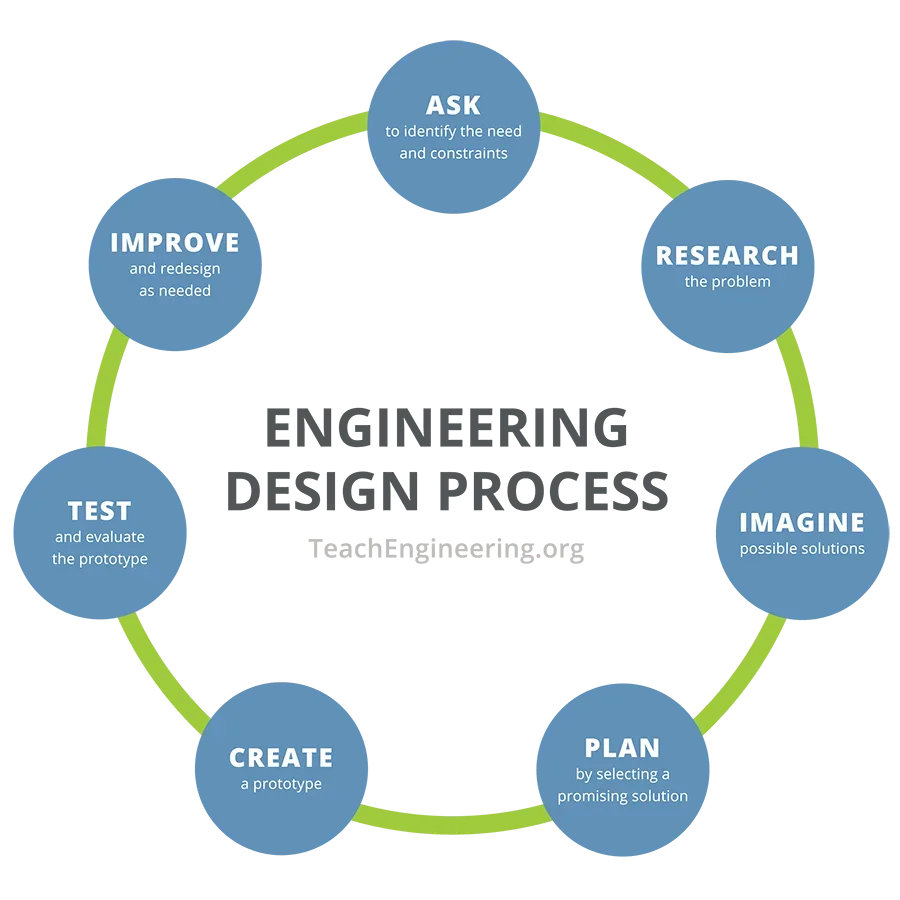
The design process varies from the scientific method. The steps of the design process guide the open exploration of many different design ideas with the final solution being the one that best solves the original challenge. The scientific method starts with a theory that is researched and tested to prove it right or wrong.
Scientific Method |
Challenge: "How can we prove this theory right or wrong?" |
Background and research |
Hypothesis |
Describe procedure |
Observation |
Conclusion |
versus
Engineering Design Process |
Challenge: "What can we create to solve this?" |
Ask: Identify the Need & Constraints |
Research the Problem |
Imagine: Develop Possible Solutions |
Plan: Select a Promising Solution |
Create: Build a Prototype |
Test and Evaluate Prototype |
Improve: Redesign as Needed |
Before students participate in the brainstorming stage of the engineering design process, remind them of the following suggested guidelines to help them get the most out of it:
- No negative comments allowed.
- Encourage wild ideas.
- Record all ideas.
- Build on the ideas of others.
- Stay focused on the topic.
- Allow only one conversation at a time.
Note: For more information on the vocabulary words, refer to the Diagram of the Human Heart (PDF).
Everyone, make a fist with your hand and hold it out if front of you. Which organ in your body is about this size? (Listen to student responses.) That's right, your heart.
Do you know anyone with heart troubles? Have you heard of heart disease? (Listen to student responses.) Heart disease, also known as coronary artery disease, is a narrowing of the small blood vessels that supply blood and oxygen to the heart.
What do you think are some risk factors for heart disease? (Listen to student ideas.) Those are great suggestions. Risk factors also include smoking, poor diet, high blood pressure, diabetes, substance abuse and obesity. Heart disease is the leading cause of death in the U.S. for men and women.
Many people suffer from heart attacks and heart failure and are in the predicament of having their major life-giving organ not working for them! What are their options? (Listen to student ideas.) Yes – organ donation is a good solution, but not enough donor organs are available to meet the demand. How can we help people who need hearts when none are available? (See if students suggest the use of animal hearts or artificial hearts.) Yes, we could make an artificial heart, which is why the National Institute of Health started the Artificial Heart Program in 1964 with the goal of making a total artificial heart within 10 years. Engineers and doctors at the University of Utah and the Texas Heart Institute have been working on and perfecting the artificial heart ever since. We are going to follow in their footsteps and explore how they did it!
(Next, conduct the associated Artificial Heart Design Challenge activity. Return to the lesson for background information, as necessary, and the Lesson Closure.)
(To conclude the associated activity and this lesson, have students listen to a six-minute National Public Radio podcast called, Heart with No Beat Offers Hope of New Lease on Life, before proceeding with the the lesson closure and assigning students to write concluding essays. This lesson closure guides students to conclude engineering design process Steps 10 [refining the design] and 11 [communicating results] of the associated activity.)
Now that we have heard the podcast on the pump-less artificial heart, let's think back for a minute to the early models of the human heart that we talked about, such as the Jarvik-7 and the freedom pack. How do you think this new design was modified to be different than those models? (Listen to student ideas.) Very good, the main difference is that the newer design was made to function without a pump. Do you think that this is a good idea or not? Well from an engineering standpoint, it is a good idea. Do you know why? (Listen to student ideas.) Simple designs with the least amount of moving parts possible are usually the most solid, and break down less than more complex designs.
From listening to the podcast, do you think this model was successful? Why or why not? (Listen to student ideas.) The pump-less artificial heart is considered successful even though Craig Lewis died because even at the time of death the heart was working perfectly. It was also successful because it gave him some time that he would not have had without the surgery.
In the podcast, do you remember when they compared the evolution of the human heart to that of the airplane? Does anyone remember what they said about it? (Listen to student ideas.) The first airplanes had flapping wings like birds because we thought it was necessary to mimic flight. But once we thought beyond that complex limitation, we discovered that flapping wings were not needed for flight. The same happened with human heart designs. It may be that the pump-less artificial heart, a simpler design with no heartbeat, evolves as the concept we use for years to come.
Before you start your essays, imagine a world in which a total functioning artificial human heart exists, but is so expensive that it is not affordable for everyone. Think about how this invention would impact our culture, focusing on health, economics and people's attitudes. Take the rest of the hour to work on your essays; they are due at the end of class (or if assigned as homework, due first thing tomorrow).
- aorta
- The biggest and longest artery. It carries oxygen-rich blood from the left ventricle of the heart to the body.
- aortic valve
- The flaps between the left ventricle and aorta. When the ventricle contracts, the valve opens, causing blood to rush into the aorta. When the ventricle relaxes, the valves close.
- artery
- A blood vessel carrying blood away from the heart.
- brainstorming
- A method of shared problem solving in which all members of a group quickly and spontaneously contribute many ideas.
- coronary artery
- The arteries that are the first to branch off the aorta and supply blood to the heart tissue.
- engineering design process
- A decision-making process used by engineers. Combines an understanding of basic sciences, mathematics and engineering sciences to use available resources to meet a desired goal, usually resulting in a product.
- inferior vena cava
- A large vein that carries oxygen-poor blood to the right atrium from the lower half of the body.
- left atrium
- The left upper chamber of the heart. It receives oxygen-rich blood from the lungs via the pulmonary vein.
- left ventricle
- The left lower chamber of the heart. It pumps the blood through the aortic valve into the aorta.
- mitral valve
- The valve between the left atrium and the left ventricle. It prevents the back-flow of blood from the ventricle to the atrium.
- prototype
- A first attempt or early model of a new product or creation. Used to test aspects of it. May be revised many times.
- pulmonary artery
- The blood vessel that carries oxygen-poor blood from the right ventricle of the heart to the lungs.
- pulmonary valve
- The flaps between the right ventricle and pulmonary artery. When the ventricle contracts, the valve opens, causing blood to rush into the pulmonary artery. When the ventricle relaxes, the valves close.
- pulmonary vein
- The blood vessel that carries oxygen-rich blood from the lungs to the left atrium of the heart.
- right atrium
- The right upper chamber of the heart. It pumps the blood into the pulmonary artery.
- right ventricle
- The right lower chamber of the heart. It pumps the blood into the pulmonary artery.
- superior vena cava
- A large vein that carries oxygen-poor blood to the right atrium from the upper parts of the body.
- tricuspid valve
- The flaps between the right atrium and the right ventricle. It is composed of three leaf-like parts and prevents the back-flow of blood from the ventricle to the atrium.
- vein
- A blood vessel carrying blood to the heart.
Quiz: Verify students' comprehension by asking concluding questions, such as:
Which one of the following series represents the correct path of blood circulation through the heart?
- left atrium, left ventricle, lungs, right atrium, right ventricle, body
- right atrium, right ventricle, lungs, left atrium, left ventricle, body
- left atrium, left ventricle, right atrium, right ventricle, lungs, body
- right atrium, lungs, right ventricle, left atrium, body, left ventricle
Oxygenated blood leaves the human heart through the...
- pulmonary artery
- pulmonary vein
- superior vena cava
- the aorta
Concluding Essay: After listening to a short podcast, assign students to write an essay, as presented and described in the Lesson Closure section. Review their writing to gauge their comprehension of the material.
Introduce students to different artificial heart models by showing them recent news articles related to artificial hearts or websites describing the most current versions. Start by searching online for the "Jarvik Heart."
Podcast for Lesson Closure (6:20 min): Heart With No Beat Offers Hope of New Lease on Life by Carrie Feibel, June 13, 2011 on KUHF, National Public Radio, at: https://www.npr.org/2011/06/13/137029208/heart-with-no-beat-offers-hope-of-new-lease-on-life. As an alternative, print out copies of the article associated with the NPR podcast.
Short artificial heart breakthrough video for students (3:55 min): For CBS, Dr. Jennifer Ashton reports artificial heart recipient Charles Okeke has regained his freedom by carrying around a remarkable new device, May 21, 2010 on YouTube at: https://www.youtube.com/watch?v=Gv9xB9HQsww
Mayo Patient on Artificial Heart Receives Heart Transplant: Charles Okeke was first in U.S. to go home with artificial heart. Published February 4, 2011. Mayo Foundation for Medical Education and Research. Accessed July 25, 2011. http://www.mayoclinic.org/news2011-sct/6166.html
Heart Assist Devices. April 2006. The Texas Heart Institute. Accessed July 25, 2011. http://texasheart.org/Research/Devices/
Chapter 4: Blood Vessels and Aging: The Rest of The Journey. Published April 2005. Last updated November 22, 2011. Aging Hearts and Arteries: A Scientific Quest, Health & Aging, National Institute on Aging, National Institutes of Health, U.S. Department of Health & Human Services. Accessed July 25, 2011. http://www.nia.nih.gov/health/publication/aging-hearts-and-arteries-scientific-quest/chapter-4-blood-vessels-and-aging-rest
It's All about Engineering! Engineering Context Suggestions for Teach Engineering Lessons and Activities. Posted 2011. Teach Engineering - Resources for K-12. Accessed July 21, 2011. (diagram comparing scientific method to engineering design process) https://www.teachengineering.org/documents/ItsAllAboutEngineering3.pdf
- The Heart of Our Cardiovascular System
The steps of the engineering design process outlined in the associated activity are:
1) Ask: Identify the Need & Constraints
2) Research the Problem
3) Imagine: Develop Possible Solutions
4) Plan: Select a Promising Solution
5) Create: Build a Prototype
6) Test and Evaluate Prototype
7) Improve: Redesign as Needed
Contributors
Angela D. Kolonich
Supporting Program
Bio-Inspired Technology and Systems (BITS) RET, College of Engineering, Michigan State University
Acknowledgements
The contents of this digital library curriculum were developed through the Bio-Inspired Technology and Systems (BITS) research experience for teachers under National Science Foundation RET grant no. EEG 0908810. However, these contents do not necessarily represent the policies of the NSF and you should not assume endorsement by the federal government.
Special thanks to the NSF for supporting this research, Dr. Kim and Dr. Tan for developing and supporting the program for teachers, and Dr. Seungik Baek and Alexander Dupay for guiding my research throughout the summer.
Copyright
2013 by Regents of the University of Colorado; original © 2012 Michigan State University