
Scaling, Go Figure!
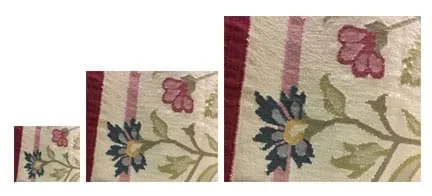 Students see what happens to lengths, perimeters and areas when scaling. This scaling example shows doubling and tripling.
Students learn how different characteristics of shapes—side lengths, perimeter and area—change when the shapes are scaled, either enlarged or reduced. Student pairs conduct a “scaling investigation” to measure and calculate shape dimensions (rectangle, quarter circle, triangle; lengths, perimeters, areas) from a bedroom floorplan provided at three scales. They analyze their data to notice the mathematical relationships that hold true during the scaling process. They see how this can be useful in real-world situations like when engineers design wearable or implantable biosensors. This prepares students for the associated activity in which they use this knowledge to help them reduce or enlarge their drawings as part of the process of designing their own wearables products. Pre/post-activity quizzes, a worksheet and wrap-up concepts handout are provided.
A hot engineering trend is the design of “wearables”—smart electronic devices and sensors that are embedded into clothing, accessories and implants to detect physical activity, blood sugar levels, sweat composition and/or other quantifiables. At Michigan State University, mechanical engineer Peter Lillehoj’s lab is creating a self-powered sewn sensor patch to provide ways for diabetics to monitor blood sugar (glucose) without finger pricks and for other purposes such as monitoring wound healing. To do this, robust, flexible electrochemical sensors are embroidered onto medical-grade gauze and placed on wounds to make quick biomarker measurements. In tandem, materials engineers research and invent new materials, even tissues, fabrics and threads, with the desired properties for specific applications. In this activity, students learn about dimensions and scale, which they apply in the associated activity when they draw their designs for prototype wearables.
After this lesson, students should be able to:
- Explain how the perimeters and areas of shapes change when they are enlarged and reduced.
- Enlarge or reduce the sizes of shapes given specific scale factors.
- Solve problems involving perimeter and area.
- CCSS.Math.Content.7.G.A.1 Solve problems involving scale drawings of geometric figures, including computing actual lengths and areas from a scale drawing and reproducing a scale drawing at a different scale.
Grade 7
Do you agree with this alignment? - CCSS.Math.Content.7.G.B.6 Solve real-world and mathematical problems involving area, volume and surface area of two- and three-dimensional objects composed of triangles, quadrilaterals, polygons, cubes, and right prisms.
Grade 7
Do you agree with this alignment?
- Students will develop an understanding of the characteristics and scope of technology.
Grades K-12
Do you agree with this alignment?
- CCSS.Math.Content.7.G.A.1 Solve problems involving scale drawings of geometric figures, including computing actual lengths and areas from a scale drawing and reproducing a scale drawing at a different scale.
Grade 7
Do you agree with this alignment? - CCSS.Math.Content.7.G.B.6 Solve real-world and mathematical problems involving area, volume and surface area of two- and three-dimensional objects composed of triangles, quadrilaterals, polygons, cubes, and right prisms.
Grade 7
Do you agree with this alignment?
- Scaling a Figure Pre-Quiz (docx)
- Scaling a Figure Pre-Quiz (pdf)
- Scaling a Figure Pre-Quiz Answer Key (docx)
- Scaling a Figure Pre-Quiz Answer Key (pdf)
- Scaling a Figure Worksheet (docx)
- Scaling a Figure Worksheet (pdf)
- Scaling a Figure Worksheet Answer Key (docx)
- Scaling a Figure Worksheet Answer Key (pdf)
- Scaling a Figure Wrap-Up (docx)
- Scaling a Figure Wrap-Up (pdf)
- Scaling a Figure Wrap-Up Answer Key (docx)
- Scaling a Figure Wrap-Up Answer Key (pdf)
- Scaling a Figure Post-Quiz (docx)
- Scaling a Figure Post-Quiz (pdf)
- Scaling a Figure Post-Quiz Answer Key (docx)
- Scaling a Figure Post-Quiz Answer Key (pdf)
An understanding of the concepts of perimeter and area and how to calculate each for basic geometric shapes such as rectangles, circles and triangles. An understanding of enlarging and reducing of geometric figures and the term “scale factor.”
As a shape is enlarged or reduced, its side lengths or circumference is scaled up or down by the scale factor. The perimeter change is equivalent to the scale factor. In other words, if a figure is enlarged by a factor of 4, the perimeter is increased by 4 times the size. However, the area changes by the square of the scale factor. For example, if a figure is enlarged by a scale factor of 2, the area changes by 4.
(In advance, make copies of the Scaling a Figure Pre-Quiz (PDF) and Scaling a Figure Worksheet (PDF), one each per student. First, have all students complete the pre-quiz. Then review their results as a class—but do not provide the answers. Provide students with protractors, rulers and calculators to complete the worksheet.)
Quite often, engineers need to understand how their designs may change as they are enlarged or reduced. Or they need to scale up or scale down their designs to fit different end users. That’s what we’ll be investigating today. And you will apply what you learn from this investigation to help you reduce or enlarge your designs during the activity that follows this lesson.
In today’s investigation, you are given a blueprint for a bedroom. As you measure different parts of the bedroom’s floorplan during the investigation, think about how different characteristics of the design are changing or not changing. For example, how are the angles changing? How is the area changing? How is the room changing?
(Divide the class into student pairs and hand out the worksheet along with calculators, rulers and protractors.) Work together with your partner to come up with ideas. Do the measurements and answer the questions. (Give students time to complete the measurements and answer the questions in their groups. Before discussing the questions as a class, group a couple pairs together to compare answers so all students have something to talk about.)
As a class, we are going to talk about your observations and answers to the questions. Please take notes on anything you learn from your classmates as we go through the questions. This work will help you in our next activity—to design wearable electronic products. (As a class, go through worksheet questions 1-4, recording student responses. Refer to the Scaling a Figure Worksheet Answer Key (PDF) for examples.) Following the lesson, students are encouraged to create their own wearable technology with the hands-on associated activity Wear’s the Technology?
(Hand out copies of the Scaling a Figure Wrap-Up (PDF).) Let’s look at another example to help us visualize the patterns we have found. (With the class, read through the handout. Then give students time to individually answer the question at the end and share their responses with a neighbor. Then, discuss as a class.)
How might what you have learned about scaling be useful in the real world? For what products might engineers apply their understanding of dimensions, area, perimeter and scaling? (Listen to student examples. Then make the connection to the associated activity and wearables technology. As makes sense, refer to some examples described in the Engineering Connection section.) Tomorrow, we will apply our understanding of how scaling changes shapes to help us design wearable electronic devices that you imagine.
- area
- The space inside a shape.
- perimeter
- The distance around a shape.
- scale
- The relationship, or proportional ratio, of a linear dimension of some feature of a model, prototype, map or drawing of an object to the same feature of the original object.
- wearable technology
- Smart electronic devices that can be worn on the body as clothing, accessories or implants, often incorporating practical functions and features such as communications or physiological data. Examples: Bluetooth headset, watch that monitors miles walked, implanted or applied medical devices and biosensors.
Pre-Lesson Assessment
Pre-Quiz: Before beginning the lesson, administer the five-question, multiple-choice Scaling a Figure Pre-Quiz (PDF) to determine students’ baseline understanding of the lesson topics. Ideally, assign it as homework the night before the lesson (perhaps as a Google form), so you can review each student’s answers before beginning the lesson. Then review students’ answers as a class without giving them the correct answers. The post-quiz covers the same concepts with a different scaling factor.
Post-Introduction Assessment
Worksheet: Have student pairs complete a “scaling investigation,” as guided by the Scaling a Figure Worksheet (PDF), which provides a bedroom floorplan plus reduced and enlarged versions. Students collect data by measuring and recording dimensions of parts of the bedroom design (bedroom-rectangle, door swing-quarter circle, TV-triangle), and then calculating the perimeters and areas, too. They answer four questions that prompt them to notice the mathematical relationships during the scaling process. Review students’ measurements, calculations and answers to gauge their understanding of the lesson topics.
Lesson Summary Assessment
Wrap-Up: As part of the Lesson Closure, go through the Scaling a Figure Wrap-Up (PDF) as a class, reading through the handout and giving students time to individually answer the question at the end: Why does the area change by the square of the scale factor? Direct students to share their responses with a neighbor, and then discuss the answer as a class to confirm that students recognize the patterns. Also discuss some real-world engineering applications in which scaling factors might be used.
Post-Quiz: Administer the five-question, multiple-choice Scaling a Figure Post-Quiz (PDF) to gauge each student’s concluding comprehension of the lesson concepts. The post-quiz covers the same mathematical relationships as the pre-quiz, but with a different scaling factor. If time is short, assign the post-quiz as homework.
Technical Program. MEMS 2017 Technical Program. 30th IEEE International Conference on Micro Electro Mechanical Systems, Las Vegas, NV. January 22-26, 2017. (short descriptions of state-of-the art biosensor implants and wearables in development worldwide) http://www.mems17.org/program/MEMS2017_PreliminaryProgram.pdf
- Scaling, Go Figure!
Contributors
Evelynne Pyne; Lauchlin Blue; Denise W. Carlson
Supporting Program
Robotics Engineering for Better Life and Sustainable Future RET, College of Engineering, Michigan State University
Acknowledgements
The contents of this digital library curriculum were developed through the Robotics Engineering for Better Life and Sustainable Future research experience for teachers under National Science Foundation RET grant number CNS 1300794. However, these contents do not necessarily represent the policies of the NSF and you should not assume endorsement by the federal government.
Copyright
2016 by Regents of the University of Colorado; original © 2015 Michigan State University