
Are We Like Robots?
Legacy Curriculum
Hey there! This curriculum is no longer being curated or supported. It may contain materials that are no longer available or outdated information. Please use this document for reference.
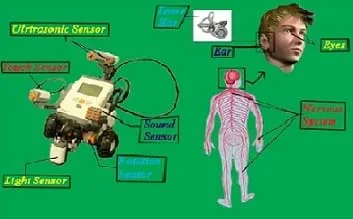 Are we like robots?
Students explore the similarities between how humans move and walk and how robots move, so they come to see the human body as a system from an engineering point-of-view. Students work with LEGO robots in the Associated Activity to replicate the process of movements resulting from decision making (deciding to walk and move) and the implementation of these decisions by communicating them to muscles (human) or motors (robot).
An important aspect of biological engineering and neuroscience is seeing human bodies as functioning, controlled systems, similar to robots. Research findings are showing that mathematical principles similar to those used in robotics are extremely useful or even necessary for a complete understanding of the human body. In the biological engineering and systems neurobiology fields, engineers are engaged in research involving the human body and efforts to replicate the functioning of many of its systems.
After this lesson, students should be able to:
- Describe the components (bones, muscles, tendons) of the human body that are involved in movement, and their interactions in achieving the objective of movement.
- Describe the corresponding components of a robot involved in moving the robot.
- List the steps involved in a person hearing a sound, then walking towards it.
- List the steps involved for a robot to sense a sound, then move toward it.
- Compare the functions of the components involved in movement in both a human body and a robot.
- STEL-2F Describe how a subsystem is a system that operates as part of another, larger system.
Grades 3-5
Do you agree with this alignment? - STEL-3D Explain how various relationships can exist between technology and engineering and other content areas.
Grades 3-5
Do you agree with this alignment?
- Explain the interactions between the nervous and muscular systems when an organism responds to a stimulus
Grade 8
Do you agree with this alignment?
- 4-LS1-2 Use a model to describe that animals' receive different types of information through their senses, process the information in their brain, and respond to the information in different ways.
Grade 4
This resource focuses on the following Three Dimensional Learning aspects of NGSS:
Science & Engineering Practices- Use a model to test interactions concerning the functioning of a natural system.Do you agree with this alignment?
Disciplinary Core Ideas- Different sense receptors are specialized for particular kinds of information, which may be then processed by the animal's brain. Animals are able to use their perceptions and memories to guide their actions.Do you agree with this alignment?
Crosscutting Concepts- A system can be described in terms of its components and their interactions.Do you agree with this alignment?
Do you agree with this alignment? - Use a model to test interactions concerning the functioning of a natural system.
- MS-LS1-8 Gather and synthesize information that sensory receptors respond to stimuli by sending messages to the brain for immediate behavior or storage as memories.
Grades 6-8
This resource focuses on the following Three Dimensional Learning aspects of NGSS:
Science & Engineering Practices- Gather, read, and synthesize information from multiple appropriate sources and assess the credibility, accuracy, and possible bias of each publication and methods used, and describe how they are supported or not supported by evidence.Do you agree with this alignment?
Disciplinary Core Ideas- Each sense receptor responds to different inputs (electromagnetic, mechanical, chemical), transmitting them as signals that travel along nerve cells to the brain. The signals are then processed in the brain, resulting in immediate behaviors or memories.Do you agree with this alignment?
Crosscutting Concepts- Cause and effect relationships may be used to predict phenomena in natural systems.Do you agree with this alignment?
Do you agree with this alignment? - Gather, read, and synthesize information from multiple appropriate sources and assess the credibility, accuracy, and possible bias of each publication and methods used, and describe how they are supported or not supported by evidence.
- Are We Like Robots? Presentation (lesson) (EV3 version) (ppt)
- Are We Like Robots? Presentation (lesson) (EV3 version) (pdf)
- Are We Like Robots? Presentation (lesson) (NXT version) (ppt)
- Are We Like Robots? Presentation (lesson) (NXT version) (pdf)
- Understanding Movement in Humans and Robots Presentation (activity) (EV3 version) (ppt)
- Understanding Movement in Humans and Robots Presentation (activity) (EV3 version) (pdf)
- Understanding Movement in Humans and Robots (NXT version) (ppt)
- Understanding Movement in Robots and Humans Presentation (activity) (NXT version) (pdf)
- Pre-Assessment Worksheet (pdf)
- Understanding Human Movement Worksheet (lesson presentation slides 14-16) (pdf)
- Slide 24 - Student Post-Activity Worksheet (pdf)
Students should know the five human senses.
Schedule
Day 1 - Are we like robots? (lesson) Use the Are We Like Robots? Presentation to teach the lesson. Refer to slide-by-slide details below to present the lesson and activity content.
Day 2 - Understanding Movement in Humans and Robots (lesson and activity) Start with a review of what students learned on Day 1 and then describe the robot equivalent of humans involved in movement. Use the Understanding Movement in Humans and Robots Presentation to aid in conducting the associated activity in which students build and program a taskbot.
Day 3 - Understanding Movement in Humans and Robots (Jeopardy activity assessment) Use Jeopardy-Understanding Movement in Humans and Robots Presentation to play jeopardy as described in the activity assessment.
Day 1: Are we like Robots? How does the human body move? (lesson presentation)
- (Before slide 3) Hand out the three-question pre-assessment quiz. Answers are provided on slide 3.
- (Slide 4) Say: Today we will be talking about four parts of the human body and how they work together to make our bodies move. The parts are the senses, muscles, brain and nervous system.
- (Slides 5-8) Use the next few slides as a starting point to describe the different human senses, talk about the human muscles, introduce the human brain and introduce the nervous system.
- (Before slide 9) Ask: What happens when you see a snake? Write student responses on the classroom board, without giving them any help. Then, move to slide 9 so they can see how well they detailed the human response.
- (Before slide 10) Ask: What happens when you smell cinnamon rolls in another room? Write student responses on the board, without giving them any help. Expect them to do better this time. Once you have a list of steps that the class agrees on, show them the steps on slide 10. As necessary, go through additional examples until the class can correctly explain the process of the body sensing using each of the five senses, interpreting that sense with the brain, and the brain telling the muscles to move with all communication with the brain occuring via the nervous system.
- (Slide 11) Review the definitions of tendon, bicep and tricep to prepare students to study arm movement.
- (Slide 12) Explain how people move their muscles by using the example of bending the elbow.
- (Slides 13-16) Divide the class into groups of two or three students each and hand out worksheet 1 (slides 14-16). Give students 15 minutes to complete the worksheet in their groups.
- (Before slide 17) Ask: What are your answers to the first question on the last page of the worksheet (slide 16) that asks you to explain how the quadriceps and hamstring muscles aid in bending and straightening the knee. After some class discussion, show the answer on slide 17.
Day 2: Understanding Movement in Humans and Robots (activity presentation)
- (Slide 2) Provide an overview of what was learned in the previous class about muscles involved in movement, and what part is involved in making the decision to move. Ask the class to identify a muscle in the human body.
- (Slide 3) Indicate the key questions addressed in this session, that is, understanding how robots move and how that compares to human movement.
- (Slide 4) Provide a quick review of the human body before comparing them to robots.
- (Slide 5) Talk about robotic sensors and provide examples.
- (Slides 6-12) Conduct the associated activity, Understanding Movement in Humans and Robots.
Use the Are We Like Robots? Presentation (PPT) (a PowerPoint file) to present the lesson content to students. The Lesson Background information provides slide-by-slide guidance.
Begin by introducing students to the concepts of the human body that are relevant to movement: senses, muscles, brain and the nervous system, and then show how they work together to generate movement.
Then, do the same for the robot, and show how sensors, motors, computer, and wires work together to make the robot move.
(After students have completed the associated activity, conclude the lesson and activity by reviewing the following four parts of the human body.) Describe the functions of each of these human body parts in your own words. What does each one do? (Example answers are below.)
- Senses: This is how the body determines what is going on around it.
- Nervous system: Delivers signals between the brain and the senses as well as the brain and the muscles.
- Brain: Interprets the information it receives from the senses and uses that information to decide what it should tell the muscles to do.
- Muscles: Receives signals from the brain that cause the muscles to move.
As we learned, the parts of a robot are similar to parts of the human body. For each of these LEGO EV3 robot sensors, which human body parts are they similar to? (Example answers are below.)
- Ultrasonic and colorsensors: These are like are eyes.
- Touch sensors: These provide the robot with a sense of touch, similar to our hands and feet.
Engineers are always trying to develop sensors to be more like the senses in our bodies. Additional types of sensors measure other qualities, such as temperature and pressure, similar to how we feel with our skin. Engineers often get design ideas for computers and robots from how human brains and bodies work. One might say that the human body is like a very complex robot and the brain is like a very speedy and intelligent computer.
Pre-Lesson Assessment
Before starting the lesson, administer the three-question pre-assessment worksheet to help students begin thinking about how human senses are related to movement. Review their answers to assess their base level of understanding of the subject matter.
Post-Lesson Assessment
Ask students about what they learned during the lesson. Ask for other examples of similarities between the brain and computers. Ask students what they might now want to learn about the brain and computers beyond the lesson.
Administer the four-question post-assessment. The only common question between the pre and post assessment is, "What sensors or senses do we have in the human body?" Compare students' pre and post answers to this question to assess their progress.
Provide students with another example of a person sensing something and moving based on how the brain interprets that sense. Ask students to write down how the human body interprets this and grade their responses based on their level of detail. Review their answers to gauge their comprehension of the lesson concepts.
As a discussion topic, ask: What is an example of a situation in which a human could sense and react to something, but it would difficult for a robot to sense and react to the same thing? Example answers include situations that involve emotions, such as hearing your mom cry..
Barnard, Tommy Michael. Kids Online. Accessed March 3, 2009. http://www.kids-online.net/learn/c_n_l.html
Brain Structures and Their Functions. By Serendip. Last Modified June 3, 2005. Accessed March 3, 2009. http://serendip.brynmawr.edu/bb/kinser/Structure1.html
Contributors
Ajay Nair; Charlie Franklin; Ashwin Mohan; Satish Nair
Supporting Program
GK-12 Program, Computational Neurobiology Center, College of Engineering, University of Missouri
Acknowledgements
This curriculum was developed under National Science Foundation GK-12 grant no. DGE 0440524. However, these contents do not necessarily represent the policies of the National Science Foundation, and you should not assume endorsement by the federal government.
Copyright
2013 by Regents of the University of Colorado; original © 2009 Curators of the University of Missouri