
How Do Human Sensors Work?
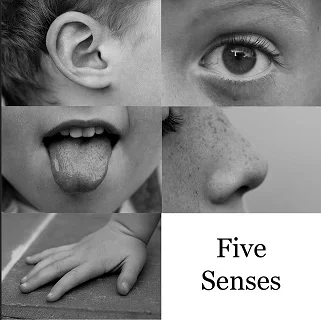 The five human senses.Copyright flickr https://www.flickr.com/photos/thenickster/3667839998/
This lesson highlights the similarities between human sensors and their engineering counterparts. Taking this approach enables students to view the human body as a system, that is, from the perspective of an engineer. Humans have recreated most human sensors in robots – eyes, ears and sensors for temperature, touch and smell. The lesson includes a PowerPoint file that is programmed to run a Jeopardy-style game as a fun assessment tool.
Biological engineers and neuroscientists perceive the human body as a functioning, controlled system, similar to a robot. Research findings show that mathematical principles similar to those used in robotics are extremely useful or even necessary for a complete understanding of the human body. Through this lesson, students understand the function of each of the human senses by relating them to the different sensors used in robots. This comparison enables them to better understand the functioning of sensors in both applications.
After this lesson, students should be able to:
- Describe how the five human senses work.
- Compare the human senses to the electronic sensors in a robot.
- Program the robot with sensors to navigate a maze and compare that to a human walking by following instructions.
- STEL-2M Differentiate between inputs, processes, outputs, and feedback in technological systems.
Grades 6-8
Do you agree with this alignment?
- Describe how new technologies have helped scientists make better observations and measurements for investigations (e.g., telescopes, electronic balances, electronic microscopes, x-ray technology, computers, ultrasounds, computer probes such as thermometers)
Grade 5
Do you agree with this alignment? - Identify receivers of visible light energy (e.g., eye, photocell)
Grade 6
Do you agree with this alignment? - Explain the interactions between the nervous and muscular systems when an organism responds to a stimulus
Grade 8
Do you agree with this alignment? - Make qualitative observations using the five senses
Grade 6
Do you agree with this alignment?
- MS-LS1-8 Gather and synthesize information that sensory receptors respond to stimuli by sending messages to the brain for immediate behavior or storage as memories.
Grades 6-8
This resource focuses on the following Three Dimensional Learning aspects of NGSS:
Science & Engineering Practices- Gather, read, and synthesize information from multiple appropriate sources and assess the credibility, accuracy, and possible bias of each publication and methods used, and describe how they are supported or not supported by evidence.Do you agree with this alignment?
Disciplinary Core Ideas- Each sense receptor responds to different inputs (electromagnetic, mechanical, chemical), transmitting them as signals that travel along nerve cells to the brain. The signals are then processed in the brain, resulting in immediate behaviors or memories.Do you agree with this alignment?
Do you agree with this alignment? - Gather, read, and synthesize information from multiple appropriate sources and assess the credibility, accuracy, and possible bias of each publication and methods used, and describe how they are supported or not supported by evidence.
- How Do Human Sensors Work? Presentation (lesson) (EV3 version) (ppt)
- Are We Like Robots? Presentation (lesson) (EV3 version) (pdf)
- How Do Human Sensors Work? Presentation (lesson) (NXT version) (pdf)
- How Do Human Sensors Work? Presentation (lesson) (NXT version) (pdf)
- Pre/Post Assessment Worksheet (slides 2 and 25) (pdf)
- Pre/Post Assessment Worksheet Answers (slide 26) (pdf)
- Jeopardy Assessment Game (EV3 version) (ppt)
- Jeopardy Assessment Game (EV3 version) (pdf)
- Post-Activity Assessment Jeopardy Game (ppt)
- Jeopardy Assessment Game (NXT version) (pdf)
Students should have completed the first lesson in the unit, What Is a Robot?, which introduces them to the EV3 robot and the basics of its programming.
Taste Activity Materials List
For the taste activity (slide 9):
- candy with similar texture, in multiple flavors, such as Starburst or Skittles
- paper towels
How do human sensors work? (presentation)
Use the How Do Human Sensors Work? Presentation (PPT) to teach the lesson concepts, along with the suggested slide-by-slide guidance below. Another PowerPoint file, Understanding How We Use Sensors vs. How a Robot Uses Sensors Presentation (PPT) is provided for the activity. The worksheets and pre-/post-assessment sheets are slides in the lesson PowerPoint file, as well as attached PDF files. Use the Human and Robot Sensors Assessment (PPT) PowerPoint file to play the fun Jeopardy game activity as a post-lesson assessment.
- (Before slide 3) Hand out the pre-assessment sheets and give students time to answer the three questions. Answers are provided on slide 3.
- Inform the students that this lesson is about the five human senses and how they work, and then about comparing them with similar sensors in robots.
- (Slides 4-5) Describe what is meant by a sensor. A type I example sensor is one used on an automatic door that detects the presence of a person or object. It does not detect how many people are present, just whether or not something is there, in order to determine whether or not to open the door. A type II example sensor is a scale that tells exactly how much a person weighs or a car's speedometer that determines exactly how fast a car is moving. A garage door sensor usually a sensor that sends an infrared beam across the garage opening; one side is a transmitter and one is a receiver. If the beam is broken, the door is not permitted to close, as a safety feature.
- (Slides 6-7) Provide an overview of human sensors and what they do.
- (Slide 8) Introduce the sense of touch and human touch sensors.
- (Before slide 9) Ask: What location in your arm is most sensitive to touch and why? Write student responses on the classroom board, without giving them any help. Then, do the activity described in slide 9 so that students can answer the question themselves. After the activity, repeat the question and discuss it as a class. Explain that the particular area in their arms is more sensitive because it has more nerve endings.
- (Before slides 10-12) Ask: How do your eyes works as a sensor? Again, write student responses on the board, without giving them any help. Expect them to be able to get the idea of a sensing element, and then the transmission of the signal to the brain. Then explain the components of the eye using slides 10-12. Hand out copies of slide 13 and ask students to label the parts of the eye on the worksheet.
- (Slides 14-16) Explain the ear sensor in a similar way.
- (Slide 17) Describe how the human nose works. Play the How Smell Works video to explain how dogs can smell much better than humans.
- (Slides 18-19) Explain the sense of taste, followed by an interesting five-minute activity described on slide 19. Be prepared with a supply of candy that has similar texture in multiple flavors, such as Starburst or Skittles.
- Summarize the human senses and how they work.
- (Before slides 20-23) Ask: How many human senses do you think have been duplicated in robots? Explain all about robot sensors and how they work. The answer to the question at the bottom of slide 23 is: Certain animals like bats and dolphins have senses that are similar to ultrasonic sensors; we call their ability to sense in this way a process called echolocation.
- (Slide 24) Summarize the comparison of human and robot sensors.
- Next, conduct the associated activity.
- (Slides 25-26) After the associated activity is done, administer post-assessment questions, with answers on slide 26.
Supplementary Background Material
It is helpful to have photographs and schematic diagrams to show students how each of the five senses works, and then do the same for the engineering/robotic counterparts.
1. How do our eyes work?
https://www.aoa.org/news/inside-optometry/infantsee-program-heartens-aspiring-ods
http://www.cyh.com/HealthTopics/HealthTopicDetailsKids.aspx?p=335&np=152&id=1730
- Light is refracted or made to change directions by the cornea, the outermost part of the eye.
- This light is directed through the pupil, which is a hole through which it can pass. The surrounding muscular tissue contained in the iris (the colored part of the eye) controls the pupil size.
- The light that enters the back of the eye through the pupil is redirected by the eye's lens, which directs the light to nerves in the back of the eye that convert light into electrical signals. Two main types of such nerves are cones, which are concentrated in the middle of the eye, detect details and colors in good light., and rods, which are concentrated in the sides of the eye, and detect the presence of objects in low light.
- Cones and rods send electrical signals through the optic nerve to the brain.
2. How do our ears work?
http://www.cyh.com/HealthTopics/HealthTopicDetailsKids.aspx?p=335&np=152&id=1463
- Sounds that you hear are made of sound waves, which are disturbances in the air that vibrate. These vibrations travel through the air, since vibrating air causes air next to it to vibrate.
- Sound waves enter your ear canal and cause your eardrum to vibrate.
- The vibration of your eardrum is passed on through three structures called the hammer, anvil and stirrup, to a fluid-filled structure called the cochlea.
- Different pitches of sound cause different parts of the cochlea to vibrate.
- When the fluid in the cochlea vibrates, it moves little hairs that connect to nerve cells and send electrical signals to the brain.
3. How do we feel using our skin?
https://www.medindia.net/know_ur_body/anatomy-of-skin.asp
- Your skin contains millions of highly sensitive nerve endings that are able to detect several different types of stimulation, including pressure, temperature and pain.
- When these specialized receptors are stimulated, they send signals through the nervous system to the brain, which interprets them.
4. How do we smell using our noses?
https://health.howstuffworks.com/mental-health/human-nature/perception/question139.htm
https://health.howstuffworks.com/mental-health/human-nature/perception/smell.htm
- Small particles of almost everything around us are present in the air. For example, when you open a pizza box, particles of the pizza enter the air around you, and enter your nose when you breathe in.
- These particles come into contact with a set of nerve endings in your upper nasal passage. These nerve endings send signals through other nerves to your brain, which is able to make sense of the smell.
- You are able to distinguish between hundreds of different smells, while dogs can distinguish thousands.
5. How do we taste using our tongues?
https://health.howstuffworks.com/mental-health/human-nature/perception/taste.htm
- Your tongue has several sensory receptors called taste buds that are able to detect one of five different flavors: sweet, salty, bitter, sour and umami.
- Umami is a flavor that is detected in many high-protein foods, such as meats, cheeses, tomatoes and mushrooms, and is generally described as being a savory, meaty taste.
- These receptors are comprised of cells called gustatory receptor cells. These cells have hairs that detect taste from the food that you eat. Then these cells send information through the nervous system to the brain, which detects the information as taste.
- Flavor is much more than just taste. It comprises taste, smell, texture of food and even other sensations such as pain when you eat something spicy. Eating food with your nose blocked shows a marked decrease in flavor, even though the taste is the same.
Human body systems: http://ssec.si.edu/stc-program-human-body-systems-unit-kit
Parts of the brain: http://serendip.brynmawr.edu/bb/kinser/Structure1.html
Use the How Do Human Sensors Work? Presentation (PPT) (a PowerPoint file) to present students with the lesson content. Use the Lesson Background information to guide your presentation of the concepts, slide-by-slide.
Start the lesson with an introduction to the human senses and how they work: eyes, ears, skin, nose and touch. Then, introduce robot sensors and how they work.
Sum it all up by conducting the Movement Task Using Sensors-Humans and Robots associated activity to implement the concept of how humans use their five senses to perform a certain task compared to how a robot uses its sensors to do the same task.
To test students' understanding, play the How do Human Sensors Work? (PPT) Jeopardy game during the last 10 minutes.
Review the sensors in the human body and the corresponding robot sensors.
Ask students which body sensors are similar to the following LEGO robot sensors:
- Ultrasonic and color sensors: These are like our eyes.
- Touch sensors: These provide robots with a sense of touch, somewhat like our hands and feet.
We use our senses to make decisions about movement and actions in much the same manner as a robot uses its sensors to make decision and corresponding actions. Engineers are always trying to develop sensors to be more like the senses in our bodies. Additional robotic sensors measure temperature and pressure, similar to what we sense via our skin. Engineers often get ideas for the design of sensors and robots from the amazing capabilities of the human body and brain, and the result is that they have a lot of similarities. So, the human is in some sense similar to a robot! (This was the topic of lesson 3 of the unit.)
Pre/Post Lesson Assessment
Before starting the lesson, administer the pre-/post-assessment worksheet (slide 2 in lesson PowerPoint) to help students begin thinking about human senses and their robotic parallels. Do not tell them the answers. Then, after the lesson, administer the same worksheet. Compare pre/post answers to assess their learning. Alternatively, just ask them if they would change any of their pre-lesson worksheet answers; ask them to explain which ones and why.
Jeopardy Game Post-Assessment
Allow 10 minutes for a fun post-lesson assessment in the form of a Jeopardy Assessment Game (PPT). The PowerPoint presentation is programmed to run the entire game starting on slide 2 so all you have to do is click on the boxes and keep score. The game provides the answer, and as usual in Jeopardy, students need to come up with the question.
Contributors
Ajay Nair; Charlie Franklin; Ashwin Mohan; Satish Nair
Supporting Program
GK-12 Program, Computational Neurobiology Center, College of Engineering, University of Missouri
Acknowledgements
This curriculum was developed under National Science Foundation GK-12 grant no. DGE 0440524. However, these contents do not necessarily represent the policies of the National Science Foundation, and you should not assume endorsement by the federal government.
Copyright
2013 by Regents of the University of Colorado; original © 2010 Curators of the University of Missouri