
Passing the Bug
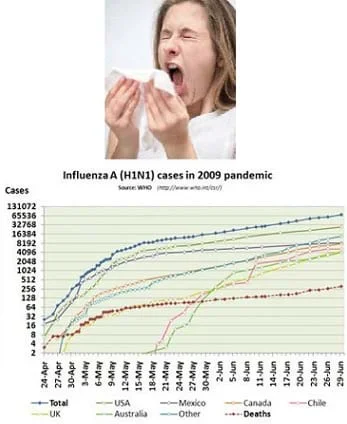 Development of H1N1 influenza cases during two months in 2009.Copyright (top) National Institutes of Health, (bottom) 2009 World Health Organization via Wikimedia Commons http://www.nih.gov/researchmatters/april2009/04272009influenza.htm http://commons.wikimedia.org/wiki/File:Influenza-2009-cases-logarithmic.png
Students apply concepts of disease transmission to analyze infection data, either provided or created using Bluetooth-enabled Android devices. This data collection may include several cases, such as small static groups (representing historically rural areas), several roaming students (representing world-travelers), or one large, tightly knit group (representing urban populations). To explore the algorithms to a deeper degree, students may also design their own diseases using the App Inventor framework.
Biomedical engineers work with doctors to find engineering solutions that model and affect the spread of disease. Software engineers use their expertise to generate models to help predict the spread, potency and likely carriers of diseases. Engineers use their knowledge of biology, computers, software and design to create simulations to model disease transmission. These models help physicians and public health officials develop the best approaches for allocation of resources and treatment.
After this lesson, students should be able to:
- Describe how diseases are transmitted.
- Explain how different characteristics of a disease, such as transmission speed and symptom severity, affect its global spread and survival.
- Use computers and calculators to access, retrieve, organize, process, maintain, interpret, and evaluate data and information in order to communicate.
Grades 9-12
Do you agree with this alignment? - Medical technologies include prevention and rehabilitation, vaccines and pharmaceuticals, medical and surgical procedures, genetic engineering, and the systems within which health is protected and maintained.
Grades 9-12
Do you agree with this alignment? - STEL-8N Use various approaches to communicate processes and procedures for using, maintaining, and assessing technological products and systems.
Grades 9-12
Do you agree with this alignment?
- evaluate published reports that are based on data by examining the design of the study, the appropriateness of the data analysis, and the validity of conclusions
Grades 9-12
Do you agree with this alignment?
- Identify questions and concepts that guide scientific investigations. Students should formulate a testable hypothesis and demonstrate the logical connections between the scientific concepts guiding a hypothesis and the design of an experiment. They should demonstrate appropriate procedures, a knowledge base, and conceptual understanding of scientific investigations.
Grades 9-12
Do you agree with this alignment? - Use technology and mathematics to improve investigations and communications. A variety of technologies, such as hand tools, measuring instruments, and calculators, should be an integral component of scientific investigations. The use of computers for the collection, analysis, and display of data is also a part of this standard. Mathematics plays an essential role in all aspects of an inquiry. For example, measurement is used for posing questions, formulas are used for developing explanations, and charts and graphs are used for communicating results.
Grades 9-12
Do you agree with this alignment?
- MA.12.4.2.a Make inferences and justify conclusions from sample surveys, experiments, and observational studies.
Grade 12
Do you agree with this alignment?
- 12.1.1.e Use tools and technology to make detailed qualitative and quantitative observations
Grades 9-12
Do you agree with this alignment? - 12.3.3.d Analyze factors which may influence environmental quality
Grades 9-12
Do you agree with this alignment?
Students should have a basic knowledge of disease from biology class. The teacher and students should know how to load an Android app (provided) and run basic simulations. If experience with MIT's App Inventor is needed, start with the Program Analysis with App Inventor lesson. Find other App Inventor lessons in the Teach Engineering collection by searching for lessons with the keyword "App Inventor."
Disease Transmission: Disease transmission is the passing of a communicable disease from one infected host to another person who may be uninfected or previously infected. The transmission of disease can happen through physical contact, air, water, orally, sexually or other mediums. The host does not have to have disease symptoms in order to transmit it to another person.
Modeling and Simulation: Engineers are on the forefront of helping to predict and stop the spread of disease. Software engineers create models that simulate the spread of disease with different infection rates, travel patterns and lethality calculations. These simulations are critical to understanding where diseases come from and how they might progress. Biomedical engineers collaborate with doctors to understand how diseases interact with the human body, understand how they are transmitted and develop cures.
Trends: The general trend in disease transmission has been investigated. We know that isolated rural areas typically have a suite of pathogens that the community is well-exposed to and immunity to infection has reduced the disease to a low level or the disease has saturated the community. In cases in which a few migrant individuals are present, a regular influx of new pathogens will keep spreading through the population. In densely populated urban areas, disease often spreads through its members at an almost exponential rate in early stages due to the high number of contact events.
Infectious vs. Non-Infectious: The two major classifications of disease are non-infectious and infectious. Non-infectious diseases include those that are either related to genetics (such as sickle-cell anemia or ALS) or environment (such as allergies or obesity). Infectious diseases are those that are caused by pathogens that are typically organisms such as bacteria (such as the common cold), fungi (such as athlete's foot), protists (such as malaria) or viruses (such as AIDS) in a host organism. Infectious diseases may be passed from one organism to another much more quickly than non-infectious genetic diseases that can only be passed to offspring.
Disease Transmission Factors: Diseases employ many strategies to be transmitted from hosts. Several factors that contribute to transmission include:
- Method of transmission: air, water, direct contact, vectors and others
- Infectiousness: how easily the pathogen is transmitted
- Incubation time: how long the disease takes to develop or become communicable
- Symptoms: may spread the disease or keep others away
- Course of infection: how long the disease is communicable
Example Disease Strategies: Diseases may exhibit strategies from "slow to spread with minor symptoms" (such as cold sores) or "fast to spread with severe symptoms" (such as Ebola). Generally, the most successful diseases are "quick to spread with minor symptoms." Influenza is an excellent example of this, with millions of cases per year throughout the planet. Even though Ebola has only a 30% survival rate, its extreme symptoms and quick course of infection keep the disease from becoming a worldwide epidemic.
Lesson Simulation: This simulation uses Bluetooth discovery between devices as a vector to disease. All contact events are logged in chronological order. Later analysis allows users to assign "infectiousness" settings that use a pseudorandom number generator to create a number between zero and 100. If the number generated is less than the "infectiousness" level, the transmission succeeds and the uninfected individual is tagged as infected. If the number generated is greater than the "infectiousness" level, the uninfected individual remains uninfected. For additional resources, refer to the website listed in the Additional Multimedia Support section.
(Be ready to show students the 36-slide Flu Trends Presentation (PPTX), a PowerPoint file. In addition, each group needs a computer with Internet access and an Android device that is Bluetooth capable. In advance, make copies of the Disease Transmission Tracking Worksheet (PDF) and Disease Transmission Tracking Results (PDF) for each group.)
How are diseases transmitted? How can we use what we know about biology, human behavior and software programming to analyze the spread of diseases so we better understand their sources, carriers and methods of transmission, and help us predict the spread and strength of diseases so we can develop effective treatments? In this lesson, you will explore how a disease is transmitted and then modify software code to design your own diseases that you will track to see if they respond the way that you expect.
Engineers play an important role in the tracking and modeling of diseases. Biomedical engineers work with doctors to exploit weaknesses in diseases and develop treatments. This might occur by discovering how a disease is transmitted, how a particular disease originated, and how a disease affects the body. Software engineers model how diseases are transmitted. These software models produce simulations with different infection rates and travel patterns to help us understand how a disease might spread.
To begin, you will work in groups to discuss and record information that you know about getting sick.
(Divide the class into groups and provide each group with a topic such as duration, symptoms, who they got it from, number in household who are sick, etc. After several minutes of discussion, give each group its turn to contribute towards building a class knowledge base of disease transmission, so as to compile this information for future reference.)
Next, let's look at some actual influenza data from the U.S. Centers for Disease Control and Prevention (CDC) by week to see how the flu progressed. This presentation contains 33 images for consecutive weeks that show the progression of the geographic disease spread.
(Show students the PowerPoint presentation. After looking at the CDC data, ask students the following questions to help guide a class discussion on disease transmission and whether any other data or information needs to be added to the list.)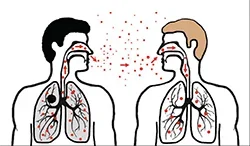 Airborne disease transmission via sneezing.Copyright 2013 U.S. Centers for Disease Control, Wikimedia Commons {PD} http://commons.wikimedia.org/wiki/File:Disease_transmission_sneezing.png
- What patterns do you see in getting sick? (Expected answers and observations: Contact is important, one person is sick first, then others follow, proximity is a factor, etc. The data show how adjacent states become infected, indicating that the disease is being transmitted from person to person.)
- How do diseases spread? (Answers: Droplet contact - coughing or sneezing on another person; direct physical contact - by touching an infected person, including sexual contact; indirect contact - by touching contaminated soil or a contaminated surface; airborne transmission - when microorganism remains suspended in the air for long periods of time; fecal-oral route - from contaminated food or water; vector borne transmission - carried by insects or infected animals.)
- What might you do to keep from getting sick? (Possible answer: Minimize contact, wash hands, keep your hands away from your face, etc.)
Next, you will investigate how infectious disease strategies are affected by various movement patterns in a population using a pre-made Android application, Passing the Bug Disease Transmission (APK) (apk file), and stock movement information. Then, from the tab marked "Analyze" at the top of the screen, select one of the sample simulations or another simulation, as directed. You may then select a given user to be infected and change the level of infectiousness. A level of 0% means a disease is not communicable and infectiousness of 100% means each contact will result in passing the disease.
You may work individually or in small groups and run the given simulations for a particular set of contacts and record the results and note any patterns. Each group will receive two worksheets to help track the information. You will use the data collected on these worksheets to look at the transmission algorithm in a stepwise fashion followed by analysis of results.
To conclude, you will be given a new disease with different characteristics (infectiousness) and you will predict the new results before running the simulations. Refer to the associated activity Simulating the Bug for more extension learning and design cycle applications.
- communicable
- Able to be passed from one organism to another.
- epidemiology
- The study of the patterns involving health events such as disease.
- host
- An organism that is infected with a pathogen.
- immunity
- The ability of an organism to resist infection.
- infectious disease
- A disease that is caused by an organism such as bacteria or viruses invading another organism.
- pathogen
- An organism that causes a disease.
- transmission
- The process of transferring a pathogen from one host to another.
- vector
- A different species of organism that can move a pathogen between hosts.
Formative Assessment
Observations: As students are engaged in learning activities, ask yourself (or students) questions such as the following:
- Do students understand the individual factors that help or impede disease transmission?
- Can students state in what circumstances a particular trait would be beneficial to transmission / disease survival?
- Can students explain the meanings of the disease transmission vocabulary?
Summative Assessment
Essay Questions: Assign students to individually complete one or more of the following essay questions about disease transmission. Review their answers to gauge their mastery of the subject matter.
- Given a particular movement pattern for a population, what strategies might a disease employ to best infect the population? (Example answer: A disease that is highly infective will be more successful in a rapidly moving population, whereas a disease in a population with slower moving members may be successful with a less-aggressive transmission.)
- Find information on the characteristics of a real disease and describe how well it would do in the different population movements. Report your findings. (Example answer: Ebola is a highly infectious disease transmitted through contact with infected bodily fluids. It has a short infectivity cycle and high mortality rates in humans; along with this is a suite of very noticeable symptoms. In a slow-moving population, the epidemic burns out very quickly. In populations in which members move more rapidly, it may spread more than in an isolated population, but the symptoms readily lead to the avoidance of infected persons, leading to a slowing/ending of the epidemic.)
- Describe how to best stop the spread of a disease given a certain population movement case. (Example answer: In highly mobile populations, it is easier to identify and isolate members of the population that are infected. In less-mobile populations, preventing contact with uninfected persons entering the area may control a disease.)
- Consider the Android app you used in the lesson. Explain how software engineers can be involved in understanding and preventing the spread of disease. (Example answer: Software engineers take existing information about a known disease and use it to develop models that can be used to predict future disease behavior. Different parameters are developed [likelihood of transmission, mode of transmission, travel patterns, lethality, etc.] that can be varied to see different mutations of the disease and make predictions about the future of the disease.)
Google App Engine - database for simulations - use the default server (data remains for 15 days) located at http://ret2012btdb.appspot.com/. All source code and applications are available here, too.
- Passing the Bug
Contributors
Douglas Bertelsen
Supporting Program
IMPART RET Program, College of Information Science & Technology, University of Nebraska-Omaha
Acknowledgements
The contents of this digital library curriculum were developed as a part of the RET in Engineering and Computer Science Site on Infusing Mobile Platform Applied Research into Teaching (IMPART) Program at the University of Nebraska-Omaha under National Science Foundation RET grant number CNS 1201136. However, these contents do not necessarily represent the policies of the National Science Foundation, and you should not assume endorsement by the federal government.
Copyright
2013 by Regents of the University of Colorado; original © 2012 Board of Regents, University of Nebraska