
Walk This Way: Studying Human Movement
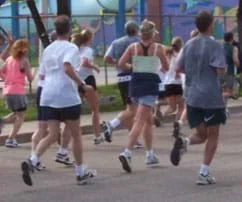 Human gaits are the various ways in which people move their bodies forward using their limbs.Copyright 2002 Denise W. Carlson. Used with permission.
After students have completed the associated activity to collect and graph acceleration data from walking human subjects, they learn more about gait analysis---the study of human motion, which is used as biometric data for human medical diagnostics and (non-human) comparative biomechanics. They learn about the steps that comprise the universal process of engineering analysis—data collection, data analysis, mathematical modeling and reporting—and consider how these steps could be applied to analyze a person's gait, which prepares them to conduct the second associated activity.
Engineers apply scientific principles and processes to learn how systems function; this process is called engineering analysis. For example, mechanical and electrical engineers analyze the electrical usage and losses in systems to determine the amount of electricity available components at any given time. Computer engineers analyze how integrated circuit components interact with each other physically, chemically and electrically to determine the optimal component orientations. Environmental engineers analyze living systems to determine how they function. Biomechanical engineers perform gait analysis—the systematic study of human motion, using visual observations and movement measurements for the purpose of helping people with conditions affecting their ability to walk. Skill in engineering analysis is attained through practice, which is what this lesson and its associated activities provides for students.
After this lesson, students should be able to:
- Define gait and gait analysis.
- Describe the engineering analysis process.
- CCSS.Math.Content.HSN-Q.A Reason quantitatively and use units to solve problems.
Grades 9-12
Do you agree with this alignment? - CCSS.Math.Content.HSS-ID.A Summarize, represent, and interpret data on a single count or measurement variable
Grades 9-12
Do you agree with this alignment? - CCSS.Math.Content.HSS-ID.B.6 Represent data on two quantitative variables on a scatter plot, and describe how the variables are related.
Grades 9-12
Do you agree with this alignment?
- CCSS.Math.Content.HSS-ID.A Summarize, represent, and interpret data on a single count or measurement variable
Grades 9-12
Do you agree with this alignment? - CCSS.Math.Content.HSS-ID.B.6 Represent data on two quantitative variables on a scatter plot, and describe how the variables are related.
Grades 9-12
Do you agree with this alignment?
- STEL-7AA Illustrate principles, elements, and factors of design.
Grades 9-12
Do you agree with this alignment? - STEL-7Y Optimize a design by addressing desired qualities within criteria and constraints.
Grades 9-12
Do you agree with this alignment?
- Process data and report results.
Grades K-12
Do you agree with this alignment? - Collect and analyze data to identify solutions and/or make informed decisions.
Grades K-12
Do you agree with this alignment?
- CCSS.Math.Content.HSN-Q.A Reason quantitatively and use units to solve problems.
Grades 9-12
Do you agree with this alignment? - CCSS.Math.Content.HSS-ID.A Summarize, represent, and interpret data on a single count or measurement variable
Grades 9-12
Do you agree with this alignment? - CCSS.Math.Content.HSS-ID.B.6 Represent data on two quantitative variables on a scatter plot, and describe how the variables are related.
Grades 9-12
Do you agree with this alignment?
- SEP.2.9-12.2 Ask questions that arise from examining models or a theory to clarify relationships.
Grades 9-12
Do you agree with this alignment?
It is helpful if students have practice with data analysis methods. While the concept of looking for and modeling characteristics that identify individual gaits will be foreign to most students, standard data analysis techniques will apply to this application, as in any other.
In addition, it is recommended that students first complete the associated activity, Identifying Gait Metrics, before being presented with the engineering analysis information in this lesson.
Overview
This gait analysis lesson and its associated activities are hands-on data analysis activities framed as engineering analysis. The problems and process are intentionally left vague to make them more real-world in nature since most problems do not have clearly defined parameters and guidelines. The open-ended nature puts the responsibility to devise solid approaches and processes in the hands of the students (engineers). It may be frustrating for some students who have not experienced this type of problem, however, the experiences and skills gained through this type of exercise are well worth it.
Gait Analysis
Gait analysis is the study of human motion that can be utilized as biometric information or identification, for medical diagnostics or for comparative biomechanics The graph shown in Figure 1 is an example of anterior acceleration data collected by an accelerometer worn on a person's lower trunk. Examination of the graph suggests a walking gait with fairly consistent step durations. The minimum acceleration values vary more than the maximum acceleration values, which may indicate more step-to-step variability in the force as the heel strikes the ground and less step-to-step variability in the force as the toe pushes off the ground.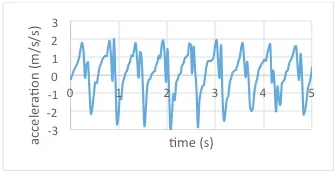 Figure 1. An example acceleration vs. time graph. Anterior acceleration data collected by an accelerometer worn on the lower trunk of a walking person.Copyright 2014 Jeremy Scheffler, University of Nebraska Omaha
Analyzing acceleration vs. time graphs such as the one shown in Figure 1 reveals the repetitive nature of the gait data, making it evident that metrics can be derived from the data. Figure 2 provides an example of how features of the acceleration vs. time graph corresponded to step characteristics.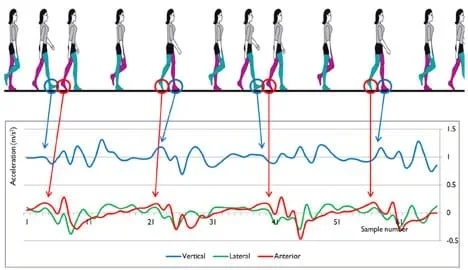 Figure 2. The repetitive nature of the acceleration vs. time graph line corresponds to gait cycle step characteristics.Copyright 2013 I.-K. Youn, S. Choi, J. Youn, K. Bastola, H. Ali, "Human Feature Tracking by Gait Signature Metrics," Microsoft PowerPoint® file, University of Nebraska Omaha
Various metrics can be developed for analyzing a person's gait. Some of the quantities used by Dr. Jon Youn's lab group at University of Nebraska Omaha to characterize gaits include:
- Gap: the difference between maximum and minimum values of acceleration within a step
- Jerk: the instantaneous value of jerk at heel strike index for a step
- APA: the standard deviation of acceleration values within acceleration phase of a step
- DPA: the standard deviation of acceleration values within deceleration phase of a step
- APJ: the standard deviation of jerk values within acceleration phase of a step
- DPJ: the standard deviation of jerk values within deceleration phase of a step
Engineering Analysis
Engineering analysis is the process of collecting, analyzing, modeling data and making predictions. The reasons for this process are many, but typically the most important are: 1) to find useful information, 2) to make predictions about possible outcomes, and 3) to support and provide evidence for the decision-making process.
Data Collection—The process starts with data collection using any number of strategies. Data collection might take the form of an experiment in which you conduct trials to measure the effect of one variable on another by controlling all other possible variables. The collection might be a survey of something by sampling to gather information. It is important that the survey be unbiased, random and representative of the group you are sampling. Data may already exist, eliminating the need to collect something new. In the business world, it might be historic sales, production or costs. In academia, it might be test scores. In engineering, data is collected on production processes, historical usage or environmental factors, and stress or strength measurements. Data is everywhere and often the challenge is not so much finding data as limiting it to what is relevant to study.
Data Analysis—The analysis of the collected data is a critical step. To do this, you carefully look at the collected data in an organized way, such as a table, spreadsheet or other computer application. You probably want to graph the data because trends are easier to notice in graphical format. This step is really about identifying patterns that might be present. It is possible that no strong trends are present in the data. Finding no trend is not necessarily bad; it just tells you that the variables are not related.
Mathematical Modeling—Modeling the data that was collected and analyzed is where mathematics occurs in this process. You might use a graphing calculator, computer spreadsheet or other software application to generate an equation that represents the data. These uses of technology also provide statistical measurements such as variance and correlation that can help you understand the effectiveness of your equation (model).
Reporting—The final step in this process is to report the data and model that represent it and then make predictions using the model to support decisions. If you have a model that statistically represents the data accurately, it should be possible to make fairly reliable predictions. You can present the results in tabular or graphical form, or a combination of both. Indicate your prediction by showing an extrapolation using your model and present that information as support for a decision. Be aware that any predictions made are only that—predictions. If the trend changes, your prediction will not be correct. The process of data analysis is a tool to make an educated guess about the future and not a guarantee that predictions come true.
Now that you've made careful observations of human walking gaits, and collected and graphed human gait acceleration data (during the associated activity conducted prior to presenting this lesson), what have you learned about the realities of in-the-field data collection with human subjects? About the graphing of that data? And about human motion? (Listen to some student responses.)
In the course of the activity, you gathered gait data from several human subjects (one from each student group) and thought about what characteristics of a walking gait could be utilized to identify different types of people and what possible measures related to the human gait could be utilized to quantify that gait. Now, how might we proceed to learn more from our collected data?
As you know, some engineers study the way human subjects walk. Gait analysis is the systematic study of human motion, using visual observations and movement measurements for the purpose of helping people with conditions affecting their ability to walk. Gait analysis is important for some medical diagnostics and the area of biomechanics, so engineers develop ways to analyze and learn from the way people walk. Biotechnology researchers continue to create and evolve the techniques to capture data easily and accurately, and then interpret it through engineering analysis, with the intent that the process becomes more routine and helpful.
What is engineering analysis? It is the application of scientific and analytic principles to reveal the state and properties of a system. This type of analysis is critical for engineers to begin to understand how and why systems behave the way they do. Engineers of all disciplines—such as mechanical, computer, environmental, biomechanical, structural and electrical—perform engineering analysis. (See the Engineering Connection section for some examples.)
As this lesson continues, you will perform engineering analysis on the gait data from several human subjects to understand what properties of a walking gait could be utilized to identify different types of people and what possible measures related to the human gait could be utilized to quantify that gait.
So, how do we go about evaluating a person's walking pattern? First, let's learn more about what we mean by engineering analysis. (Proceed to present to students the content provided in the Lesson Background section.)
- accelerometer
- A device that measures the physical acceleration experienced by an object.
- dynamicity
- In terms of gait analysis, the quantification of variations in kinematic or kinetic parameters within a step.
- gait
- The stride of a human as s/he moves his/her limbs.
- metric
- A quantitative indicator of a characteristic or attribute.
- symmetry
- In terms of gait analysis, the quantification of differences between left-foot and right-foot steps.
- variability
- In terms of gait analysis, the quantification of fluctuations from one stride to the next.
Pre-Lesson Assessment: Ask students the following questions to gauge their prior knowledge and transition to the lesson topic:
- Do all people walk the same? If not, can you identify someone you know by the way they walk?
- Think of someone you know with a distinct way of walking. Can you describe it?
- We can analyze how someone walks (his/her gait) following the same process as engineers follow when they engage in engineering analysis. What are some steps we might follow to analyze a person's gait?
Lesson Summary Assessment: At lesson end, hold a class discussion on the four aspects of engineering analysis presented during the lesson: data collection, data analysis, mathematical modeling and reporting. Have students brainstorm and share ideas on how they can incorporate all these aspects of the engineering analysis process in analyzing the gait of various human subjects. Ask students to brainstorm and identify gait metrics that they might use in analyzing a person's gait.
- Walk This Way: Studying Human Movement
Contributors
Jeremy Scheffler; Brian Sandall
Supporting Program
IMPART RET Program, College of Information Science & Technology, University of Nebraska Omaha
Acknowledgements
The contents of this digital library curriculum were developed as a part of the RET in Engineering and Computer Science Site on Infusing Mobile Platform Applied Research into Teaching (IMPART) Program at the University of Nebraska Omaha under National Science Foundation RET grant number CNS 1201136. However, these contents do not necessarily represent the policies of the National Science Foundation, and you should not assume endorsement by the federal government.
Copyright
2015 by Regents of the University of Colorado; original © 2014 Board of Regents, University of Nebraska