
Projectile Magic
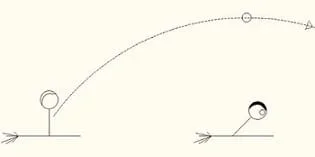 Projectile motion of the remembrall, a device from the Harry Potter wizardry world.Copyright 2011 Rachel Howser, GK-12 Program, University of Houston
Students watch video clips from October Sky and Harry Potter and the Sorcerer's Stone to learn about projectile motion. They explore the relationships between displacement, velocity and acceleration and calculate simple projectile motion. The objective of this activity is to articulate concepts related to force and motion through direct immersive interaction based on the theme, The Science Behind Harry Potter. Students' interest is piqued by the use of popular culture in the classroom.
Engineers from many different disciplines use the concepts of force and motion. Mechanical engineers design all sorts of engines that transport goods and people, machines and tools such as vacuum cleaners and factory assembly equipment that make our ways of life possible, as well as many other types of devices. Structural engineers design houses, bridges and skyscrapers that can withstand everyday forces as well as extraordinary forces, such as earthquakes, monsoons and hurricanes to keep us safe. Aerospace engineers design aircraft, rockets and spacecraft, which includes predicting projectile motion.
After this lesson, students should be able to:
- Describe displacement, velocity and acceleration.
- Describe gravity.
- Describe projectile motion and relate it to real-life engineering problems.
- Students will develop an understanding of the role of society in the development and use of technology.
Grades K-12
Do you agree with this alignment?
- MS-PS2-2 Plan an investigation to provide evidence that the change in an object's motion depends on the sum of the forces on the object and the mass of the object.
Grades 6-8
This resource focuses on the following Three Dimensional Learning aspects of NGSS:
Science & Engineering Practices- Plan an investigation individually and collaboratively, and in the design: identify independent and dependent variables and controls, what tools are needed to do the gathering, how measurements will be recorded, and how many data are needed to support a claim.Do you agree with this alignment?
- Science knowledge is based upon logical and conceptual connections between evidence and explanations.Do you agree with this alignment?
Disciplinary Core Ideas- The motion of an object is determined by the sum of the forces acting on it; if the total force on the object is not zero, its motion will change. The greater the mass of the object, the greater the force needed to achieve the same change in motion. For any given object, a larger force causes a larger change in motion.Do you agree with this alignment?
- All positions of objects and the directions of forces and motions must be described in an arbitrarily chosen reference frame and arbitrarily chosen units of size. In order to share information with other people, these choices must also be shared.Do you agree with this alignment?
Crosscutting Concepts- Explanations of stability and change in natural or designed systems can be constructed by examining the changes over time and forces at different scales.Do you agree with this alignment?
Do you agree with this alignment? - Plan an investigation individually and collaboratively, and in the design: identify independent and dependent variables and controls, what tools are needed to do the gathering, how measurements will be recorded, and how many data are needed to support a claim.
- compare and contrast potential and kinetic energy;
Grade 6
Do you agree with this alignment? - identify and describe the changes in position, direction, and speed of an object when acted upon by unbalanced forces;
Grade 6
Do you agree with this alignment? - calculate average speed using distance and time measurements;
Grade 6
Do you agree with this alignment? - measure and graph changes in motion; and
Grade 6
Do you agree with this alignment? - investigate how inclined planes and pulleys can be used to change the amount of force to move an object.
Grade 6
Do you agree with this alignment?
Some familiarity with displacement, velocity and acceleration.
Classic Equations of Linear Motion
The equations of linear motion describe the behavior of a system as a function of time. The classic equations of linear motion are:
Classic Equations of Linear Motion
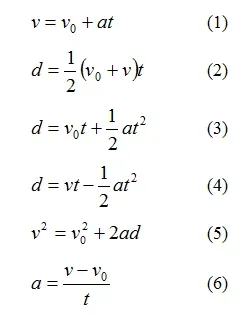
Where:
- t is the amount of time the object was in motion
- d is displacement or the distance between the initial and final positions of the object
- v0 is the initial velocity of the object
- v is the final velocity of the object
- a is the constant acceleration of the object
Using these six equations and given any three of the five parameters, the other two parameters can easily be calculated.
Derivation of Equations
These six equations can be derived from the definitions of acceleration and velocity. Acceleration is the rate of change of velocity over time.
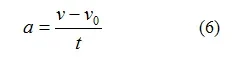
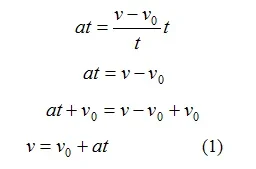
If this equation is rearranged, it becomes Equation 1.
The definition of average velocity is the rate of change of position with respect to time.
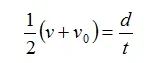
If this equation is rearranged, it becomes Equation 2.
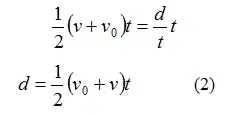
Equation 1 can be substituted into Equation 2 to create Equations 3.
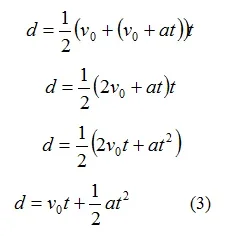
Equation 1 can be rearranged and substitute into Equation 3 to create Equation 4.
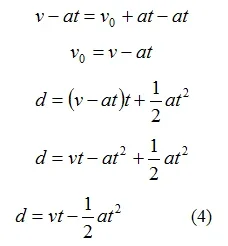
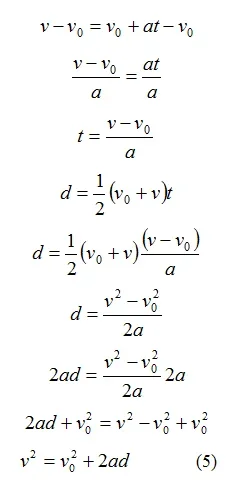
Equation 1 can also be rearranged and substituted into Equation 2 to create Equation 5.
Simple Applications of Equations
These equations can be used to describe the motion of bodies moving in one dimension with constant acceleration. One of the most common applications for these equations is projectile motion, such as a ball being thrown in the air. If one knows either the initial velocity of the ball as it was thrown or the amount of time the ball traveled, one can calculate all five variables. It is also common to calculate the motion of various vehicles and animals using these equations.
Engineering Applications of Equations
Force and motion play a large part in mechanical and structural engineering. Mechanical engineers typically use heat and mechanical power for the design and operation of machines and tools. Mechanical power is directly related to the motion of an object. Mechanical engineers design all sorts of mechanical systems from the vacuum cleaners to cars to machines in factories that mass produce our everyday goods. All of this design is dependent upon being able to calculate motion. Structural engineers design structures that we see all around us including buildings, bridges and dams. While one usually does not consider there structures to be moving (usually they are at equilibrium), they do vibrate due to forces caused by vehicles, wind, earthquakes and severe weather events. This vibration is a motion and must be calculated to ensure that the structures around us are safe.
(Begin by showing a video clip from October Sky. In the clip, the main character, Homer Hickam, calculates the trajectory of a homemade rocket in front of his science class.)
What happened in that video clip? (Expect students to say that Homer calculated the rocket's trajectory.) How might an engineer's knowledge of how something moves help people? (Expect answers to vary greatly. Possible examples: Engineers use their knowledge of force and motion to make sure that airplanes land in the right places, to design better cars [or other vehicles], to design earthquake-resistant buildings.)
Do you think it is difficult to calculate the projected motion of an object? (Expect students to say yes, because the movie made it look difficult.) It is actually not as difficult as it looks, we are going to do the exact same calculations shown in October Sky today in class. (Proceed to conducting the associated activity Magical Motion.)
- acceleration
- The rate of change of velocity with respect to time.
- displacement
- The difference between the first position of an object and any later position.
- velocity
- The rate of change of position with respect to time.
Written Reflection: At lesson end, assign students to write descriptions of how engineers might use their understanding of force and motion to the application of devices, products, tools and processes for people. Examples: To make sure that airplanes land in the right place, to design a car or any kind of moving vehible, to design earthquake-resistant structures. Review their descriptions to gauge their levels of understanding.
Borrow from your school or public library DVDs of the October Sky and Harry Potter and the Sorcerer's Stone movies, so you can show students the invisible ink clips. If not available, describe the scenes, since most students are familiar with the movies and will be able to recall the scenes and describe them more fully to other classmates.
Dictionary .com. Lexico Publishing Group, LLC. Accessed March 25, 2011. http://www.dictionary.com
Contributors
Rachel Howser; Christine Hawthorne
Supporting Program
National Science Foundation GK-12 and Research Experience for Teachers (RET) Programs, University of Houston
Acknowledgements
This digital library content was developed by the University of Houston's College of Engineering under National Science Foundation GK-12 grant number DGE-0840889. However, these contents do not necessarily represent the policies of the NSF and you should not assume endorsement by the federal government.
Copyright
2013 by Regents of the University of Colorado; original © 2011 University of Houston