
Sustainable Resource & Waste Management: Dome It Challenge
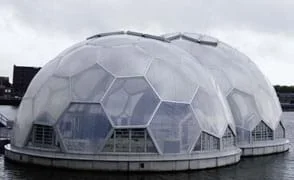 What would happen if your neighborhood was suddenly cut off from local infrastructure? (The Floating Pavilion in Rotterdam, Netherlands)Copyright 2013 Caryssa Joustra, University of South Florida
How does infrastructure meet our needs? What happens when we are cut off from that supporting infrastructure? As a class, students brainstorm, identify and explore the pathways where their food, water and energy originate, and where wastewater and solid waste go. After creating a diagram that maps a neighborhood's inputs and waste outputs, closed and open system concepts are introduced by imagining the neighborhood enclosed in a giant dome, cut off from its infrastructure systems. Students consider the implications and the importance of sustainable resource and waste management. They learn that resources are interdependent and that recycling wastes into resources is key to sustain a closed system.
The established water, food, energy, wastewater and solid waste infrastructure typical of most U.S. communities is designed by engineers and often taken for granted, its importance in our everyday lives unrecognized. Civil and environmental engineers, inspired by the balance seen in nature, are continually challenged to find better ways to sustainably manage the resources and wastes generated by a large population through designing improved infrastructure and creating new technologies.
After this lesson, students should be able to:
- Identify and map water, food, energy, wastewater and solid waste infrastructure designed by engineers.
- Define what is meant by open and closed systems.
- Describe how recycling can be used to sustain a closed system.
- Provide examples of how resources are interdependent.
- SC.7.E.6.6 Identify the impact that humans have had on Earth, such as deforestation, urbanization, desertification, erosion, air and water quality, changing the flow of water.
Grade 7
Do you agree with this alignment? - SC.7.L.17.3 Describe and investigate various limiting factors in the local ecosystem and their impact on native populations, including food, shelter, water, space, disease, parasitism, predation, and nesting sites.
Grade 7
Do you agree with this alignment?
- Students will develop an understanding of the effects of technology on the environment.
Grades K-12
Do you agree with this alignment? - Students will develop an understanding of the role of society in the development and use of technology.
Grades K-12
Do you agree with this alignment?
- MS-ESS2-1 Develop a model to describe the cycling of Earth's materials and the flow of energy that drives this process.
Grades 6-8
This resource focuses on the following Three Dimensional Learning aspects of NGSS:
Science & Engineering Practices- Develop and use a model to describe phenomena.Do you agree with this alignment?
Disciplinary Core Ideas- All Earth processes are the result of energy flowing and matter cycling within and among the planet's systems. This energy is derived from the sun and Earth's hot interior. The energy that flows and matter that cycles produce chemical and physical changes in Earth's materials and living organisms.Do you agree with this alignment?
Crosscutting Concepts- Explanations of stability and change in natural or designed systems can be constructed by examining the changes over time and processes at different scales, including the atomic scale.Do you agree with this alignment?
Do you agree with this alignment? - Develop and use a model to describe phenomena.
- MS-ESS3-3 Apply scientific principles to design a method for monitoring and minimizing a human impact on the environment.
Grades 6-8
This resource focuses on the following Three Dimensional Learning aspects of NGSS:
Science & Engineering Practices- Apply scientific principles to design an object, tool, process or system.Do you agree with this alignment?
Disciplinary Core Ideas- Human activities have significantly altered the biosphere, sometimes damaging or destroying natural habitats and causing the extinction of other species. But changes to Earth's environments can have different impacts (negative and positive) for different living things.Do you agree with this alignment?
Crosscutting Concepts- The uses of technologies and any limitations on their use are driven by individual or societal needs, desires, and values; by the findings of scientific research; and by differences in such factors as climate, natural resources, and economic conditions. Thus technology use varies from region to region and over time.Do you agree with this alignment?
- Relationships can be classified as causal or correlational, and correlation does not necessarily imply causation.Do you agree with this alignment?
Do you agree with this alignment? - Apply scientific principles to design an object, tool, process or system.
Our communities are supported by a number of infrastructure systems that handle water, food, energy, wastewater and solid waste (and more). Often, we take these systems for granted and ignore the impacts we have on the originating resources and the waste by-products. Strategies that recycle wastes in order to create resources are necessary to sustainably support our communities.
Typical Infrastructure Systems
- Drinking Water: The clean water that comes out of a tap originates at a natural source, such as an aquifer, river, lake or glacier. The source depends on the region. That water is pumped to a municipal water treatment plant where it is cleaned and disinfected before being distributed to homes and businesses throughout a community.
- Food: The food supply is grown on farm properties before being shipped to distribution centers. After processing, food supplies are transported to points of sale, such as supermarkets. From there, people purchase food to bring home.
- Energy: Sources of energy, such as fossil fuels, are mined or drilled from the Earth and then transported to power plants. In the case of renewable energy facilities such as for wind or solar radiation, the energy sources are harvested onsite. At the plants, the source energy is turned into electricity or heat and then distributed via power networks to homes.
- Wastewater: After leaving the house, wastewater travels through pipes to pumping stations before arriving at municipal wastewater treatment plants. The water is treated (cleaned) and discharged to natural water bodies. In some cases, the water is redirected to homes and businesses and used as reclaimed water.
- Solid Waste: Trash items, including food waste, are usually discarded into home garbage cans and collected by trucks. Trucks transport the solid waste to municipal facilities that landfill the materials. In some regions where land is scarce, solid waste is burned.
(Have ready a whiteboard or other large classroom writing surface for a class brainstorming exercise. Draw a house or block of houses near the center of the board and then draw connections from that point as components of the water, food and energy infrastructure are discussed.)
Think about your neighborhood (as represented by the houses drawn on the board). From where does the water you drink come? (Draw and connect student answers backwards from the faucet, pipes, water treatment facility, towards the natural water source[s] such aquifers, rivers, lakes or other local water sources.) Where did your breakfast come from? (Expect students to say a supermarket, kitchen or restaurant.) Where does a grocery store get its food? (Expect students to trace the food back to a farm.) What do you need in order to turn on the television, lights or other electronics? How do we power cars? (While the general answer is energy, ask students to be more specific such as electricity, gasoline, fossil fuels, batteries or alternative sources.) Where is this power generated? (Possible answers: Power plants, hydroelectric dams, solar farms, waste-to-energy plants.)
All these structures and connections provide us with water, food and energy and are examples of infrastructure that support our communities. The water supply infrastructure includes all pipes, pumps, and treatment plants that create and move water from its source to your house. The food infrastructure includes farms, supermarkets and vehicles that transport food from farms to stores. The energy infrastructure includes coal mines, power plants, power lines, wires and switches.
Civil engineers design the infrastructure that meets our needs. Can you think of other types of infrastructure? (Possible answers: Roads/transportation, hospitals/medical care, parks/public spaces, housing, schools/education, sewer/wastewater, garbage/solid waste. No need to add these additional infrastructure systems to the board drawing, however, wastewater and solid waste will be discussed and added next.)
We discussed where we get some of the resources we need to live, such as water, food and energy; but what happens after we use these resources? Do you eat an entire apple? What do you do with the apple core? (Expect students to say that you throw it away.) Where does it go? (Possible answers: The dump or landfill. Add food waste to the class drawing, noting that it is part of the solid waste infrastructure, if not already mentioned.) Refer to the associated activity Achieving Sustainability: Dome It Challenge Scenario Cards to challenge students to design sustainable solutions to survive assigned hypothetical scenarios with unique limitations, such as: under the dome, space exploration, underground dilemma, recolonize Earth, and life at sea. They diagram and recap their biorecycling engineering solutions in poster and presentation format.
Who has seen a landfill? What is it like? Would you want to live near one? (Expect students to associate landfills with garbage and not want to be near one. For many people, "out of sight is out of mind," but we want students to acknowledge these places.) After you use the bathroom and wash your hands, where does the water go? (Get students to again follow the path of the water from the house to the pipes, wastewater treatment plant, and final discharge to a water source.) What would happen if all our wastewater went directly into the ocean/lake/river? Would you want to swim there?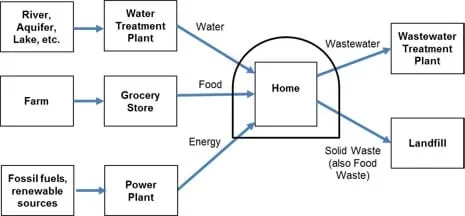 Figure 1. Diagram of infrastructure components linked to a home or neighborhood.Copyright 2013 Caryssa Joustra, University of South Florida
(By now the class drawing should include inputs into the house/neighborhood for water, food and energy, and outputs for solid waste and wastewater. Draw a circle or dome shape around the house/neighborhood that includes the direct inputs and outputs, but leaves out the support suppliers and receivers of the resources and wastes, such as the supermarket, treatment plants, landfill and power plant. See Figure 1 as an example.) What would happen if a dome was put over our neighborhood so that nothing could go in or out of the barrier? (Expect initial responses that resources would run out and wastes would build up.) The dome creates a closed system. What are some other examples of closed systems? (Possible answers: A closed jar/container, space station, planet Earth, terrarium.) Can you think of some examples of an open system? (Possible answers: The neighborhood before the dome was added because people and items could move freely in and out, an open drink, the ocean.) How could we survive in a domed neighborhood? What would we have to do? (Expect students to recognize that recycling is necessary. By creating a cycle, resources are renewed and wastes are minimized or hopefully reused entirely. Being forced into a smaller space also means that large infrastructure facilities will no longer fit and need to be redesigned.) Civil and environmental engineers find solutions to these challenges by designing improved infrastructure and creating new technologies that manage and recycle water, food, energy and waste.
- closed system
- A system in which process outputs, or "wastes," can be used as system inputs, or "resources."
- infrastructure
- The structures, connections and operations that provide basic community needs, including water, food, energy, wastewater, solid waste and transport.
- open system
- A system in which outputs, or "wastes," are not brought back into the process as inputs, or "resources."
- renewable energy
- Energy sources that cannot be depleted, such as solar and wind.
- solid waste
- Trash items including food wastes that are thrown away.
- sustainable
- Being able to use resources without depleting or damaging them over time; enduring over time; self-sustaining.
Pre-Lesson Assessment
Brainstorming: As a class, have students brainstorm about their daily needs (food, water, energy), tracing them through their infrastructure pathways and systems back to their sources. Make a drawing and/or list on the classroom board. Include suggestions that are outside of the infrastructure systems covered in this lesson.
Post-Introduction Assessment
Question/Answer: Ask students and discuss as a class:
- What kind of system is the Earth? (Answer: A closed system.)
- In the dome scenario, what happens to resources and waste if nothing changes? (Answer: Resources are used up and wastes pile up.)
- In the dome scenario, what can you do to manage the resources you need and wastes produced? (Answer: Recycle wastes so they become resources. Reducing consumption and reusing resources helps to limit the overall use of resources and associated waste outputs, but does not keep the dome resources from eventually being depleted. Complete recycling is needed to replenish resource supplies.)
- How is recycling sustainable? (Answer: Waste is essentially eliminated because it becomes a usable resource. A cycle is formed that is sustainable.)
Lesson Summary Assessment
Verbal Quiz: Conclude the lesson and review students' understanding by asking them to:
- Describe an open system and provide an example. (Answer: An open system does not use recycled wastes as resources; in an open system, resources are used and discarded as "waste"; resources move freely in and out of the system. Examples: Individual neighborhood or city [infrastructure transports resources in and out of these systems]; an open drink container or body of water [gases and water vapor transfer in and out of these volumes—any segment of the water cycle is an open system when considered alone, such as the atmosphere, ocean, lakes, etc.])
- Describe a closed system and provide an example. (Answer: A closed system does not allow resources to exit or enter the system; everything remains within the system and "wastes" are recycled as resource inputs. Examples: Earth, the water cycle, space station, closed jar, terrarium.)
- List five types of engineered infrastructure. (Answers: Water, energy, transportation, wastewater, solid waste, food.)
- Sustainable Resource & Waste Management: Dome It Challenge
Contributors
Caryssa Joustra; Ivy Drexler; Jorge Calabria; George Dick; Onur Ozcan; Stephanie Quintero; Emanuel Burch; Erin Morrison; Robert Bair; Daniel Yeh
Supporting Program
Membrane Biotechnology Laboratory, College of Engineering, University of South Florida, Tampa
Acknowledgements
This curriculum was developed under National Science Foundation grant numbers 1236746, 1200682, 0965743 and 1243510, which includes the Water Awareness Research and Education (WARE) - Research Experience for Teachers (RET). However, the contents do not necessarily represent the policies of the National Science Foundation or the U.S. Department of Education, and should not be assumed an endorsement by the federal government.
The authors gratefully acknowledge funding from the Department of Education Graduate Assistants in Areas of National Need (GAANN) Fellowship, and the Bill and Melinda Gates Foundation, as well as classroom support from Learning Gate Community School (Lutz, FL), the Science and Technology Education and Innovation Center (St. Petersburg, FL), and Meghan Heintz.
Copyright
2014 by Regents of the University of Colorado; original © 2013 University of South Florida