
Achieving Sustainability: Dome It Challenge Scenario Cards
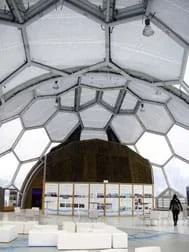 What might it be like to live under a dome with nothing coming in and nothing going out?Copyright 2013 Caryssa Joustra, University of South Florida
Student teams find solutions to hypothetical challenge scenarios that require them to sustainably manage both resources and wastes. They begin by creating a card representing themselves and the resources (inputs) they need and wastes (outputs) they produce. Then they incorporate additional cards for food and energy components and associated necessary resources and waste products. They draw connections between outputs that provide inputs for other needs, and explore the problem of using linear solutions in resource-limited environments. Then students incorporate cards based on biorecycling technologies, such as algae photobioreactors and anaerobic digesters in order to make circular connections. Finally, the student teams present their complete biorecycling engineering solutions to their scenarios—in poster format—by connecting outputs to inputs, and showing the cycles of how wastes become resources.
Sustainability is important in all engineering disciplines in order to efficiently maintain products and services. This activity implements environmental engineering technologies that enable sustainable food growth, energy production and waste management. Students mirror the real-world work of engineers by collaborating together in design teams to consider limitations and find solutions to challenges.
After this activity, students should be able to:
- Match resource inputs and "waste" outputs to create recycling loops, thereby turning wastes into resources.
- Map energy, water and nutrient flows within and between biorecycling systems.
- Map relationships between food waste and food production.
- Explain the difference between a sustainable (circular) and non-sustainable (linear) practice.
- SC.7.E.6.6 Identify the impact that humans have had on Earth, such as deforestation, urbanization, desertification, erosion, air and water quality, changing the flow of water.
Grade 7
Do you agree with this alignment? - SC.7.L.17.3 Describe and investigate various limiting factors in the local ecosystem and their impact on native populations, including food, shelter, water, space, disease, parasitism, predation, and nesting sites.
Grade 7
Do you agree with this alignment?
- Students will develop an understanding of the effects of technology on the environment.
Grades K-12
Do you agree with this alignment? - Students will develop an understanding of the role of society in the development and use of technology.
Grades K-12
Do you agree with this alignment? - Students will develop an understanding of and be able to select and use agricultural and related biotechnologies.
Grades K-12
Do you agree with this alignment? - Students will develop an understanding of the relationships among technologies and the connections between technology and other fields of study.
Grades K-12
Do you agree with this alignment?
- MS-ESS2-1 Develop a model to describe the cycling of Earth's materials and the flow of energy that drives this process.
Grades 6-8
This resource focuses on the following Three Dimensional Learning aspects of NGSS:
Science & Engineering Practices- Develop and use a model to describe phenomena.Do you agree with this alignment?
Disciplinary Core Ideas- All Earth processes are the result of energy flowing and matter cycling within and among the planet's systems. This energy is derived from the sun and Earth's hot interior. The energy that flows and matter that cycles produce chemical and physical changes in Earth's materials and living organisms.Do you agree with this alignment?
Crosscutting Concepts- Explanations of stability and change in natural or designed systems can be constructed by examining the changes over time and processes at different scales, including the atomic scale.Do you agree with this alignment?
Do you agree with this alignment? - Develop and use a model to describe phenomena.
- MS-ESS3-3 Apply scientific principles to design a method for monitoring and minimizing a human impact on the environment.
Grades 6-8
This resource focuses on the following Three Dimensional Learning aspects of NGSS:
Science & Engineering Practices- Apply scientific principles to design an object, tool, process or system.Do you agree with this alignment?
Disciplinary Core Ideas- Human activities have significantly altered the biosphere, sometimes damaging or destroying natural habitats and causing the extinction of other species. But changes to Earth's environments can have different impacts (negative and positive) for different living things.Do you agree with this alignment?
Crosscutting Concepts- The uses of technologies and any limitations on their use are driven by individual or societal needs, desires, and values; by the findings of scientific research; and by differences in such factors as climate, natural resources, and economic conditions. Thus technology use varies from region to region and over time.Do you agree with this alignment?
- Relationships can be classified as causal or correlational, and correlation does not necessarily imply causation.Do you agree with this alignment?
Do you agree with this alignment? - Apply scientific principles to design an object, tool, process or system.
Each group needs:
- card set, made from Dome It Challenge Cards & Cycles (PPTX), a Microsoft® PowerPoint® file; slides 1-4 are pre-made cards; print and cut them out, making one card set per group; alternative for more advanced students: provide blank index cards to have them make some or all of their own cards
- Internet access or some other way to research three biorecycling technologies: algae photobioreactors, anaerobic digesters and composting
- paper and pencil for research note-taking
- markers and/or colored pencils
- large sheet of paper, such as poster board or butcher paper
- tape or glue, to attach cards to large sheet of paper
- Dome It Challenge Worksheet (PDF)
Students require a basic understanding of biorecycling concepts, including composting, photosynthesis, and anaerobic digestion. The Biorecycling: Using Nature to Make Resources from Waste lesson provides an overview to all these concepts as well as the three biorecycling technologies introduced in this activity.
Does nature produce waste? What happens to an apple that falls on the ground? (It rots and decomposes.) The apple waste breaks down into nutrients, which are resources that plants need to grow. A tree uses the nutrients to produce more apples, completing the cycle. In this example, what are the wastes? (Answer: No wastes; everything is reused.) Environmental engineers create technologies that mimic the recycling done by natural organisms. By biorecycling, the nutrients and resources in organic wastes, like those from plants and animals, can be used again.
Why is biorecycling important? Why would we want to biorecycle? (Biorecycling greatly reduces or eliminates waste by turning wastes back into resources, and resources are limited.) Is biorecycling sustainable? (Yes!) Why? (Answer: In the apple example, a cycle is formed so that resources are always available and waste does not build up.) Sustainable practices create circular loops or cycles.
Imagine this: If your neighborhood was suddenly trapped under a giant dome, what would happen to all of your waste? (Answer: Waste would pile up.) Where would you get water to drink, food to eat, or electricity? (Answers will vary, but expect students to recognize that they need to find these resources elsewhere if the infrastructure they usually depend upon was taken away.) Is this sustainable? (No.) Why? (Answer: This is an example of a linear system. Resources are used then discarded as waste; they only go one way.)
What if you were on a space station, desert island or underground cavern? In this activity, you are going to work together to survive in a given location. As a group, you will design ways to meet your needs and manage your waste sustainably by using biorecycling systems.
Before the Activity
- Gather materials and make copies of the Dome It Challenge Worksheet (PDF), one per group.
- Choose whether to use one, some or all of the Dome It Challenge scenarios, as listed in Table 2. Then print the slides that contain the cards you choose to use from the Dome It Challenge Cards & Cycles (PPTX), making enough copies for each group. Cut apart the cards to prepare one set per group. Slides 5-8 provide example connections (recycling loop solutions) made with the cards. Note: It is the teacher's discretion whether to have the class use the pre-made cards, or whether students are prepared and advanced enough to make some or all of their own.
- Set out large sheets of paper for each group to work on.
With the Students
- Divide the class into engineering groups of three or four students each.
- Tell students that this activity considers three biorecycling technologies: algae photobioreactors, anaerobic digesters and composting.
- Use the board to write down each technology as the heading for a three-column table, as shown Table 1.
- Choose whether to have each team research all three technologies or assign one technology per team.
- Have student teams research the three technologies and take notes. Direct students to find descriptions, inputs, outputs, applications and images for their assigned technology(ies).
- As a class, discuss student findings and fill in the table columns on the board (see Table 1 example answers).
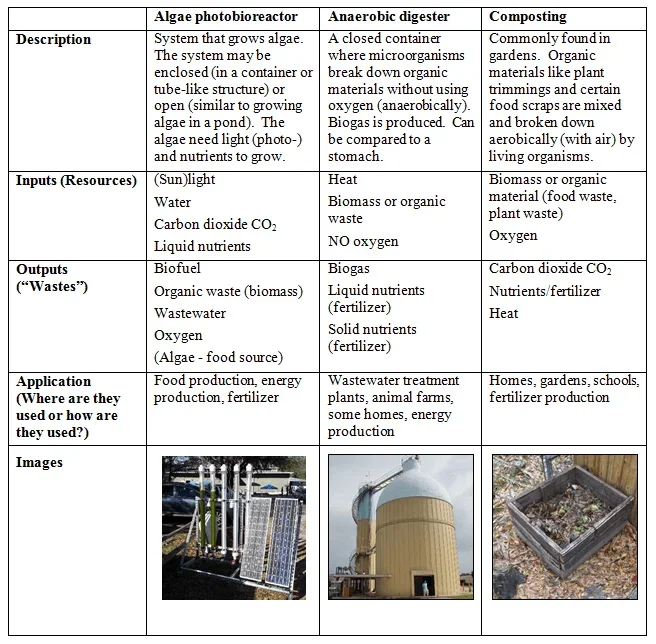 Table 1. Three biorecycling technologies: algae photobioreactors, anaerobic digesters and composting.Copyright 2013 Robert Bair and Caryssa Joustra, University of South Florida
 - As a class, discuss and document a typical person's needs. After the needs are addressed, discuss and record the typical wastes a person produces. (At this point, if you want students to make their own "person" cards from scratch [instead of using the pre-made "person" card], use the classroom board to suggest how to draw the needs and wastes for this card by referring to the slide 2 "person" card as a template. Students' finished "person" cards represent themselves and the resources [inputs] they need and wastes [outputs] they produce.)
- Tell students that they will apply the biorecycling technologies to meet their needs and manage waste.
- Assign each group a hypothetical Dome It Challenge scenario (see Table 2):
- Under the dome: Your community has been trapped under a large clear dome.
- Space exploration: Your group is about to embark on a decade-long journey to a distant planet.
- Underground dilemma: Your group has been pushed underground.
- Recolonize Earth: Earth has become a wasteland, but is now showing signs of new vegetation. Your group is in charge of recolonizing the planet.
- Life at sea: Your group is adrift on the open ocean.
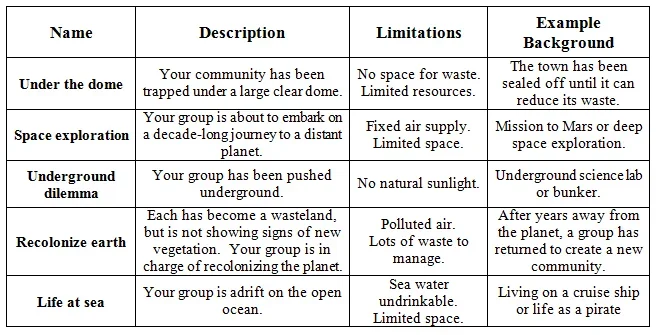 Table 2. Dome It Challenge scenarios and limitations.Copyright 2013 Caryssa Joustra, University of South Florida
- Remind students that they must meet the needs of their "persons" and minimize wastes for their specific scenarios. Have student groups create short backgrounds for their scenarios and discuss the limitations of their scenarios. Have them record their answers on the worksheet.
- As a class, review the limitations of each group's scenario. (If one scenario is used for all groups, the class can answer as a whole. If more than one scenario is used, have each group describe its scenario-specific background story and limitations.)
- Next, give each group a pre-made card set. (If students are creating some or all of their own card sets, they should already have done this using blank index cards.)
- Have groups pull out the three reservoir cards: atmosphere, sunlight and water. Tell students that these are potential resources that they have access to in their scenarios, but not all resources are available for each scenario. Have groups determine which sources they have access to and which they do not, based on their scenario limitations. Have groups cross out resources they cannot access directly. (For example, the underground group does not have access to direct sunlight. The life at sea group does not have access to most of the water sources. Refer to the example limitations in Table 2.) Mention that it is a typical step of the engineering design process to get a good understanding of available resources and limitations before starting to create a solution.
- Direct groups to spread out the cards on their large sheets of paper, leaving space between the cards.
- Tell the groups that their challenge is to use the cards to design solutions for their scenarios. Like the "person" card, the other cards each have resource inputs and waste outputs. Advise them to look for where waste outputs can be matched to waste inputs so they can meet their needs. Challenge students to eliminate all waste.
- Direct student groups to use markers/colored pencils (as well as tape and glue) to draw and label connections among the cards and identify circular biorecycling loops, ending up with engineering design posters that show their scenario solutions. Also have students answer the worksheet questions as they develop their solutions.
- After groups have come up with their solutions, have each group present its design, as described in the Assessment section.
- Conclude with a class discussion about the application of biorecycling techniques, as described in the Assessment section.
- algae photobioreactor
- A system that grows algae using water and light.
- anaerobic digester
- A bioreactor or container that is designed to prevent oxygen from entering and in which anaerobic digestion occurs.
- anaerobic digestion
- A process that uses microorganisms to break down organic waste in the absence of oxygen.
- biofuel
- Renewable plant-based fuel made from biomass, such as corn, sugarcane or microalgae.
- biogas
- A gas mixture produced when organic matter is broken down in the absence of oxygen, such as in anaerobic digestion. The gas contains methane and carbon dioxide and can be burned as an energy source.
- biomass
- Material that came from living organisms; generally plant material.
- biorecycling
- A process in which organisms break down "waste" materials and make new materials from them, using biological processes such as anaerobic digestion or photosynthesis.
- closed loop system
- A system in which process outputs, or "wastes," are used as system inputs, or "resources." An example is algae biofuel production, in which carbon dioxide that is produced in combusting the fuel is used again in photosynthesis.
- compost
- Organic matter (biomass) that has been decomposed into a fertilizer.
- open loop system
- A system in which outputs, or "wastes," are not brought back into the process as inputs, or "resources." For example, burning fossil fuels releases carbon dioxide into the atmosphere, but the carbon dioxide is not biorecycled back to organic carbon in this process.
- sustainable
- Being able to use resources without depleting or damaging them over time; enduring over time; self-sustaining.
Pre-Activity Assessment
Discussion Questions: Ask the students and discuss as a class:
- Does nature produce waste? (Answer: No. Nature recycles "wastes" outputs as resource inputs; everything is balanced so waste does not accumulate.)
- Can we use waste as a resource? (Answer: Yes. Recycling glass, paper, metal and plastic products turns waste back into usable resources. Food waste and lawn clippings can be recycled as nutrients for food crops and yard plants.)
- What is biorecycling? (Answer: Biorecycling means biological recycling—a process in which living organisms break down and reform "waste" materials into new materials using biological processes such as anaerobic digestion and photosynthesis. Recycling glass, paper and plastic products at home is not biorecycling because living organisms are not used; instead, it is usually done by a mechanical process. Recycling in nature is considered biorecycling because it is accomplished through biological processes.)
Activity Embedded Assessment
Engineering Design Poster: Have each student group work together to design its scenario solution by drawing connections between cards. Have students label connections and/or identify circular loops.
Worksheet: Have students use the Dome It Challenge Worksheet (PDF) to guide the activity, recording the connections made on their group posters and describing where they have chosen to get food, create energy and minimize waste. Review their worksheet answers to gauge their level of comprehension.
Post-Activity Assessment
Presentation/Performance: Have each group present its scenario solution. Require them to explain: 1) why they made certain connection choices, 2) where they implemented biorecycling, and 3) how their designs are sustainable (indicate circular biorecycling loops). As necessary, ask the groups: Did you have any remaining waste outputs? From where do you get your energy? Did you make any circular connections? If so, what are they? Do you think you will survive your scenario?
Class Discussion: As a class, discuss and record how the biorecycling techniques used in the scenario solutions can be applied at home and in the community. Ask students to describe where they have seen biorecycling examples in practice.
For students familiar with aquaponics, add the optional aquaponics cards to expand the activity.
To further evolve the design solutions, have student groups research and explain in more detail how each of the biorecycling technologies used will be designed and adapted to work to their scenarios.
- What materials are needed ? (Example answers: Algae photobioreactors need a container to hold the water, algae and nutrients. The system could be enclosed, such as the one in the Table 1 example photograph, or open, like a pond. An enclosed system is best for the space team due to space limitations. The underground team must design an artificial light source. The enclosed containers must be made of a clear material, such as plastic or glass. Tubing and pumps are needed to move inputs and outputs throughout the system. The pumps require an energy source, which also may vary by scenario. For composting, two systems can be used so that one pile can decompose while another collects incoming fresh organic matter, although it is possible to continuously produce compost from continuous organic inputs by use of an "in-vessel composting system.")
- How will each system be maintained? (Example answers: The algae in the photobioreactors require a specific temperature range for growth, around 20-24°C. Gentle mixing of the algae evenly distributes the nutrients, while mixing that is too harsh hurts the algae. For composting, the temperature, moisture and air within the pile must be monitored and tended. The piles must be kept moist and aerated by turning or pumping in oxygen.)
- For lower grades, provide each student group with a pre-made card set, but explain the cards and make connections together as a class. Focus on food waste connections and biorecycling, linking food waste to food production. Conclude with a class discussion.
- For upper grades, give student groups additional blank cards to add other features to their engineering design posters, or require them to entirely make their own card sets. Challenge students to create additional food products or appliances that require energy.
The University of Arizona. Biosphere 2. Accessed September 13, 2013. (Real-world example of a project that aims to mimic the closed system of Earth on a small-scale) http://www.b2science.org/
National Aeronautics and Space Administration [NASA]. Waste Limitation Management and Recycling Design Challenge. Accessed September 13, 2013. (Lessons and activities about the water challenges in space and use of biological treatment) http://www.nasa.gov/pdf/396719main_WLMR_Educator_Guide.pdf
- Sustainable Resource & Waste Management: Dome It Challenge
- Achieving Sustainability: Dome It Challenge Scenario Cards
Contributors
Caryssa Joustra; Ivy Drexler; Jorge Calabria; George Dick; Onur Ozcan; Stephanie Quintero; Emanuel Burch; Erin Morrison; Robert Bair; Daniel Yeh
Supporting Program
Membrane Biotechnology Laboratory, College of Engineering, University of South Florida, Tampa
Acknowledgements
This curriculum was developed under National Science Foundation grant numbers 1236746, 1200682, 0965743 and 1243510, which includes the Water Awareness Research and Education (WARE) - Research Experience for Teachers (RET). However, the contents do not necessarily represent the policies of the National Science Foundation or the U.S. Department of Education, and should not be assumed an endorsement by the federal government.
The authors gratefully acknowledge funding from the Department of Education Graduate Assistants in Areas of National Need (GAANN) Fellowship, and the Bill and Melinda Gates Foundation, as well as classroom support from Learning Gate Community School (Lutz, FL), the Science and Technology Education and Innovation Center (St. Petersburg, FL), and Meghan Heintz.
Copyright
2014 by Regents of the University of Colorado; original © 2013 University of South Florida