
Intro to 3D Bioprinting: Design, Applications and Limitations
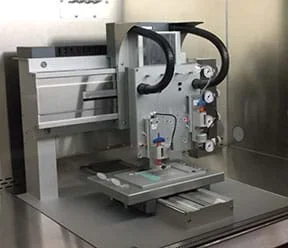 The heavily used $200,000 bioprinter in the Peirce-Cottler Lab at the University of Virginia’s Department of Biomedical Engineering.Copyright 2017 Hunter Sheldon, Department of Biomedical Engineering, University of Virginia
Students learn about the current applications and limitations of 3D bioprinting, as well as its amazing future potential. This lesson, and its fun associated activity, provides a unique way to review and explore concepts such as differing cell functions, multicellular organism complexity, and engineering design steps. As introduced through a PowerPoint® presentation, students learn about three different types of bioprinters, with a focus on the extrusion model. Then they learn the basics of tissue engineering and the steps to design printed tissues. This background information prepares students to conduct the associated activity in which they use mock-3D bioprinters composed of a desktop setup that uses bags of icing to “bioprint” replacement skin, bone and muscle for a fictitious trauma patient, Bill. A pre/post-quiz is also provided.
3D bioprinting is a novel engineer-created technology that enables scientists and researchers to print functional tissues, layer by layer. This printed tissue contains two parts: the cells and the unique mixture of fibers that form the structure and shape. While 3D bioprinting cannot yet provide “organs at the push of a button,” engineers and researchers at the forefront of this new technology are making progress in optimizing printing parameters and machine components. The challenge is in fully understanding and then replicating—at the micro scale—intricate and functional features such as blood vessels and complex shapes. It will be future engineers who continue to improve the technology for human application.
After this lesson, students should be able to:
- Explain what 3D bioprinting is and the importance of the technology.
- Name the different parts of an extrusion 3D bioprinter and describe their functions.
- Describe the current applications and limitations of 3D bioprinting.
- Identify key characteristics that make certain types of cells and extracellular matrix components suitable for specific 3D bioprinting applications.
- Explain how engineers currently apply what they know about tissue engineering to the design of functional printed tissues.
- STEL-7AA Illustrate principles, elements, and factors of design.
Grades 9-12
Do you agree with this alignment?
- DCI.LS1.A.9-12.6 Systems of specialized cells within organisms help them perform the essential functions of life.
Grades 9-12
Do you agree with this alignment? - DCI.LS1.A.9-12.8 Multicellular organisms have a hierarchical structural organization, in which any one system is made up of numerous parts and is itself a component of the next level.
Grades 9-12
Do you agree with this alignment? - DCI.LS1.A.9-12.9 Feedback mechanisms maintain a living system's internal conditions within certain limits and mediate behaviors, allowing it to remain alive and functional even as external conditions change within some range. Feedback mechanisms can encourage (through positive feedback) or discourage (negative feedback) what is going on inside the living system.
Grades 9-12
Do you agree with this alignment?
- The student will investigate and understand relationships between cell structure and function. Key concepts include
Grades 9-12
Do you agree with this alignment?
A basic understanding of cell theory and the hierarchical structure of the body (cells make up tissues, tissues make up organs, etc.) and a basic conceptual understanding that different body tissues have different physical properties (for example, skin is more elastic than bone, bone is harder than muscle).
3D bioprinting is the process of printing biological material in layers to create 3D structures.
The three types of 3D bioprinters are inkjet, laser-assisted and extrusion. Inkjet bioprinters work similarly to home/office inkjet printers. Using different types of cells, inkjet bioprinters release layer cells and support material in order to build up a designed structure. Laser-assisted bioprinters use a system of lasers and mirrors to place cells precisely onto desired locations. Extrusion bioprinters work similarly to squeezing ketchup out of a bottle. By applying pressure, biological material is pushed out an end tip. By making multiple passes, layers accumulate, resulting in a 3D biological structure. Diagrams of each bioprinter type are included in the slide presentation.
Tissue Engineering: According to the National Institute of Biomedical Imaging and Bioengineering, “tissue engineering evolved from the field of biomaterials development and refers to the practice of combining scaffolds, cells, and biologically active molecules into functional tissues. The goal of tissue engineering is to assemble functional constructs that restore, maintain, or improve damaged tissues or entire organs.” In short, tissue engineering is the design and creation of functional biological tissues.
Applications: Currently, one application of 3D bioprinting is the creation of model tissue for drug testing purposes. Doing this reduces the necessity for animal research. Engineers also use 3D bioprinters to construct blood vessels, heart valves and cartilage. However, these have not yet been tested in clinical applications.
Research Areas: The ultimate goal is to use 3D bioprinting to create organs and transplantable tissues that can be safely placed in humans. Several key challenges exist: vascularization, immune rejection, and biocompatibility:
- Vascularization: Engineers and researchers are exploring how to incorporate complex blood vessel systems into 3D bioprinted designs. Since many blood vessels are incredibly small and intricate, vascularizing large tissues is a formidable problem with no obvious solution. This is especially troubling, considering that human cells need blood vessels to be nearby—no farther than 100 microns away—to effectively gather nutrients and dispose of waste; 100 microns is about the diameter of a single human hair!
- Immune Rejection: According to the National Kidney Foundation, about 7% of kidney transplants in the US fail within a year and more than 17% fail within three years. As indicated by these statistics, even using donated human organs can result in failure. One common reason why transplants fail is due to immune rejection, which is when peoples’ immune systems react to transplanted tissue as a dangerous, foreign substance. Immune cells proceed to invade the transplant and eventually kill it. Engineers and researchers are working to reduce the chance of immune rejection, which includes a host of contributing factors, most from donor mismatching and body trauma from surgery.
- Biocompatibility: Engineers and researchers are figuring out how to print organs and tissues that have the same functionality and mechanical properties as body organs. Organs and tissues that do not have the same structure (shape, density, depth) and function of native material are harmful to patients. Additionally, it is import that new organs do not degrade faster than diseased tissues. Although not organs, artificial shoulder and knee replacements are good examples of the decreased functionality and lifespan of certain artificial replacements compared to their natural counterparts. According to the American Association of Hip and Knee Surgeons, replacement joints have a 90-95% chance to last 10 years and an 80-85% to last 20 years. This degradation decreases functionality and increases the introduction of free plastics from the artificial joint into the body.
Biomedical Engineering: Biomedical engineers apply traditional engineering practices (electrical, mechanical, chemical, etc.) to health and medical problems. They design medical devices, create synthetic tissues, synthesize drugs, and manage hospital equipment—to name just a few examples of what they do!
(Be ready to show the class the 27-slide An Introduction to 3D Bioprinting Presentation (PPTX), a PowerPoint® file. The slides are animated, so a mouse or keyboard click brings up the next text, image or slide. The slides are strongly interconnected to the associated activity Help Bill! Bioprinting Skin, Muscle and Bone; if not continuing directly on to conduct the activity, minor slide editing and deletion is necessary.)
How many of you know someone who has broken a bone? How about anyone who has suffered a burn? How about someone who needs an organ transplant?
Imagine a world in which organs and tissues are printed at the touch of a button. Whenever someone suffers a severe injury or needs an organ transplant, technicians harvest cells from the patient, multiply them in a lab, and use 3D bioprinting to create a replica of the injured tissue. Then surgeons replace the old or damaged tissue with new and healthy tissue.
If this was possible, organ transplant waiting lists would dwindle to nothing. Severe burn wounds would heal much more quickly and effectively with multi-layered skin grafts printed from patients’ own tissues. Many medications with harmful side effects would no longer be necessary if injured tissue was replaced instead of treated.
Although these applications are not yet a reality, researchers and engineers are currently advancing the field so that one day humans will accomplish these amazing goals.
(Show the presentation, using the detailed “script” information provided in each slide note.)
Now that you know how to design and print tissues using a 3D bioprinter, let’s help Bill by printing some of these replacement tissues ourselves, using our own mock-3D bioprinters. (Move on to conduct the associated activity.
- 3d bioprinting
- A way of printing tissues, layer by layer. This printed tissue contains two parts: the cells and the unique mixture of fibers that compose its structure and shape.
- biocompatibility
- Compatibility with living tissue or a living system by not being toxic, injurious, or physiologically reactive, and not causing immunological rejection.
- bio-ink
- Cells in a medium that makes them suitable for printing in an inkjet bioprinter. This liquid substance solidifies after printing.
- cellular viability
- The percentage of cells that survive printing and retain function. Informally: The amount of “useful” cells after printing.
- extracellular matrix
- The non-cellular matrix of fibrous biomaterials. This matrix gives body tissues support as well as various mechanical properties. Abbreviated as ECM.
- in vitro
- Performed or taking place in a test tube, culture dish or elsewhere outside a living organism. Literally means “in the glass.”
- natural biomaterial
- A fibrous material found and/or produced naturally in the body.
- transplant rejection
- When transplanted tissue is rejected by a recipient’s immune system. A negative feedback mechanism of the body. Immune cells sense an implanted substance as foreign and invade it, attempting to destroy or remove it. Also called immune rejection.
- skin graft
- Transplanted skin tissue.
- synthetic biomaterial
- A fibrous material created outside of and not found in the body.
- tissue engineering
- The design and creation of functional biological tissues for replacement or improvement. Also called regenerative medicine.
- vascularization
- The formation of blood vessels, either naturally or synthetically.
- viscosity
- A measure of a fluid’s resistance to flow due to internal friction. A measure of a fluid’s “thickness.”
Pre-Lesson Assessment
Pre-Quiz: Before starting the lesson, administer the five-question, multiple-choice 3D Bioprinting Pre/Post-Quiz (PDF). Review students’ answers to gauge their base understanding of bioprinting. Administer the same quiz at lesson end to gauge student learning gains.
Lesson Summary Assessment
Post-Quiz: After the lesson, administer the 3D Bioprinting Pre/Post-Quiz (PDF) again. Compare students’ pre/post-answers to determine their learning gains and how ready they are to conduct the associated activity.
Good background information about tissue engineering and regenerative medicine (including a two-minute introductory video) at the National Institutes of Health website at https://www.nibib.nih.gov/science-education/science-topics/tissue-engineering-and-regenerative-medicine.
For a great overview of biomedical engineering, career options, and more, visit the US Bureau of Labor Statistics’ BME page at https://www.bls.gov/ooh/architecture-and-engineering/biomedical-engineers.htm#tab-1.
For more information about current biomedical engineering research projects at UVA, visit the University of Virginia’s Department of Biomedical Engineering website at http://bme.virginia.edu/.
See the website of Organovo, a company that designs and creates functional human tissues using 3D bioprinting technology: http://organovo.com/.
“3D-Airway Printed Splint.” Last updated 2017. School of Medicine, University of Michigan. Accessed September 09, 2016. https://medicine.umich.edu/dept/otolaryngology/3d-airway-printed-splint
“3D-Airway Printed Splint.” Last updated 2017. School of Medicine, University of Michigan. Accessed September 09, 2016. https://medicine.umich.edu/dept/otolaryngology/3d-airway-printed-splint
Ball, Philip. “Material witness: Body painting,” Nature Materials. (2005) Vol. 4, p. 582. https://www.nature.com/nmat/journal/v4/n8/full/nmat1439.html
Lovett, Michael, Lee, Kyongbum., Edwards, Aurelie & Kaplan, David L. (2009) “Vascularization Strategies for Tissue Engineering,” Tissue Engineering. Part B, Reviews, Vol. 15, No. 3, pp. 353–370. http://online.liebertpub.com/doi/abs/10.1089/ten.teb.2009.0085
Michael, Stephanie, et al. Published March 4, 2013. “Tissue Engineered Skin Substitutes Created by Laser-Assisted Bioprinting Form Skin-Like Structures in the Dorsal Skin Fold Chamber in Mice.” PLoS ONE, Vol. 8, No. 3, http://journals.plos.org/plosone/article?id=10.1371/journal.pone.0057741
Murphy, Sean V. & Atala, Anthony. Published August 5, 2014. “3D bioprinting of tissues and organs.” (2014) Nature Biotechnology. Vol. 32, pp. 773–85. DOI: doi:10.1038/nbt.2958 http://www.nature.com/nbt/journal/v32/n8/full/nbt.2958.html
“Printing Skin Cells on Burn Wounds.” Last Updated January 04, 2016. School of Medicine, Wake Forest Baptist Medical Center, Winston-Salem, NC. Accessed September 09, 2016. http://www.wakehealth.edu/Research/WFIRM/Research/Military-Applications/Printing-Skin-Cells-On-Burn-Wounds.htm
“Tissue Engineering and Regenerative Medicine.” National Institute of Biomedical Imaging and Bioengineering, National Institutes of Health, U.S. Department of Health & Human Services. Accessed February 12, 2017. (quoted text) https://www.nibib.nih.gov/science-education/science-topics/tissue-engineering-and-regenerative-medicine
“Total Knee Replacement.” American Association of Hip and Knee Surgeons, Rosemont, IL. Accessed February 24, 2017. (quoted statistics) http://www.aahks.org/care-for-hips-and-knees/do-i-need-a-joint-replacement/total-knee-replacement/
Tushla, Lara E. Published August 12, 2014. “When a Transplant Fails.” National Kidney Foundation, NY, NY. (quoted statistics) Accessed February 24, 2017. https://www.kidney.org/transplantation/transaction/TC/summer09/TCsm09_TransplantFails
Yu, Yin, Moncal, Kazim K., Li, Jianqiang, et al. Published June 27, 2016. “Three-dimensional bioprinting using self-assembling scalable scaffold-free ‘tissue strands’ as a new bioink.” Scientific Reports. Vol. 6. https://www.ncbi.nlm.nih.gov/pmc/articles/PMC4921918/
Zhang, Jin, Yin, Hua-Mo, Hsiao, Benjamin S., et al. Published February 2014. “Biodegradable poly(lactic acid)/hydroxyl apatite 3D porous scaffolds using high-pressure molding and salt leaching.” Journal of Materials Science. Vol. 49, No. 4 pp. 1648–58. http://connection.ebscohost.com/c/articles/92888616/biodegradable-poly-lactic-acid-hydroxyl-apatite-3d-porous-scaffolds-using-high-pressure-molding-salt-leaching
Zhu, Wei, Ma, Zuanyi, Gou, Maling, et al. Published August 2016. “3D printing of functional biomaterials for tissue engineering.” Current Opinion in Biotechnology. Vol. 40, pp. 103–12. https://www.ncbi.nlm.nih.gov/pubmed/27043763
- Intro to 3D Bioprinting: Design, Applications and Limitations
Contributors
Nicholas Asby; Angela Sickels; Hunter Sheldon; Ryan Tasker-Benson; Timothy Allen; Shayn M. Peirce; A. L. Peirce Starling
Supporting Program
Department of Biomedical Engineering, School of Engineering and Applied Sciences, University of Virginia
Acknowledgements
This digital library curriculum—an engineering tool kit (ETK) for high school students—was developed under a grant from The Jefferson Trust. Special thanks to Michaela Rikard and Vi Tran of the UVa Department of Biomedical Engineering for their assistance throughout the project.
Copyright
2017 by Regents of the University of Colorado; original © 2016 University of Virginia