
Earthquakes Living Lab: Geology and Earthquakes in Japan
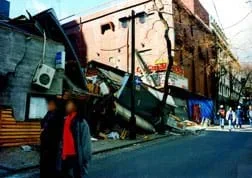 Destruction caused by the 1995 Kobe earthquake.Copyright 1995 Yanagida Kunio, Wikimedia Commons http://commons.wikimedia.org/wiki/File:Hanshin-Awaji_earthquake_1995_Chuo-ku_Kobe_city_Hyogo_prefecture_001.jpg
Students study how geology relates to the frequency of large-magnitude earthquakes in Japan. Using the online resources provided through the Earthquakes Living Lab, students investigate reasons why large earthquakes occur in this region, drawing conclusions from tectonic plate structures and the locations of fault lines. Working in pairs, students explore the 1995 Kobe earthquake, why it happened and the destruction it caused. Students also think like engineers to predict where other earthquakes are likely to occur and what precautions might be taken. A worksheet serves as a student guide for the activity.
Every year, thousands of people die in earthquakes, and many more lose their homes and communities. Many of these catastrophes may be mitigated, however, by creative engineering. The first step is to determine where earthquakes are likely to occur, and how severe they might be. Large-magnitude earthquakes usually occur near tectonic plate boundaries. Japan is located at the intersection of three tectonic plates, and consequently experiences many high-magnitude earthquakes. Use of the Earthquakes Living Lab gives students the chance to act as engineers, using Japan's geology and its historical 1995 Kobe earthquake to relate earthquakes to engineering.
Scientists and engineers around the globe gather data through observation and experimentation and use it to describe and understand how the world works. The Earthquakes Living Lab gives students the chance to track earthquakes across the planet and examine where, why and how they are occurring. Using the real-world data in the living lab enables students and teachers to practice analyzing data to solve problems and answer questions, in much the same way that scientists and engineers do every day.
After this activity, students should be able to:
- Relate how earthquakes and the intersections of tectonic plates correlate.
- Navigate online resources to retrieve information and data.
- Describe the function of geology in predicting earthquakes.
- Explain how engineers use geological and earthquake data.
- Analyze and interpret data about natural hazards using direct and indirect evidence
Grades 9-12
Do you agree with this alignment?
- STEL-4P Evaluate ways that technology can impact individuals, society, and the environment.
Grades 9-12
Do you agree with this alignment? - STEL-4R Assess a technology that minimizes resource use and resulting waste to achieve a goal.
Grades 9-12
Do you agree with this alignment?
- MS-ESS3-2 Analyze and interpret data on natural hazards to forecast future catastrophic events and inform the development of technologies to mitigate their effects.
Grades 6-8
This resource focuses on the following Three Dimensional Learning aspects of NGSS:
Science & Engineering Practices- Construct an oral and written argument supported by empirical evidence and scientific reasoning to support or refute an explanation or a model for a phenomenon or a solution to a problem.Do you agree with this alignment?
Disciplinary Core Ideas- Mapping the history of natural hazards in a region, combined with an understanding of related geologic forces can help forecast the locations and likelihoods of future events.Do you agree with this alignment?
Crosscutting Concepts- The uses of technologies and any limitations on their use are driven by individual or societal needs, desires, and values; by the findings of scientific research; and by differences in such factors as climate, natural resources, and economic conditions. Thus technology use varies from region to region and over time.Do you agree with this alignment?
- Graphs, charts, and images can be used to identify patterns in data.Do you agree with this alignment?
Do you agree with this alignment? - Construct an oral and written argument supported by empirical evidence and scientific reasoning to support or refute an explanation or a model for a phenomenon or a solution to a problem.
Each group needs:
- computer or other device with Internet access
- journal or writing paper for each student
- pen or pencil, one per student
- Geology and Earthquakes in Japan Worksheet (PDF), one per group
Have you ever wondered why earthquakes always seem to happen in the same locations? Why, for example, are California and Alaska so susceptible to earthquakes, while Virginia and Florida are not? Some places never have earthquakes, while the country of Japan has dealt with a major earthquake at least once every century! (Listen to student ideas.) The reason is that large-magnitude earthquakes tend to occur near the intersection of tectonic plates, along fault lines.
In this activity, we focus on Japan, studying its geology and the motion of the tectonic plates in the region. We investigate the devastating 1995 earthquake that happened in the Kobe region, looking at the geological and engineering connections. Acting like engineers, we predict where other earthquakes are likely to occur and think of ways to possibly mitigate earthquake damage.
Before the Activity
- Make copies of the Geology and Earthquakes in Japan Worksheet (PDF), one per group. The worksheet serves as a student guide for the activity.
- Make arrangements so that each student group has a computer with Internet access.
With the Students
- Divide the class into groups of two students each and have pairs assemble at their computers with journals/paper and writing utensils.
- Hand the worksheets to the groups and direct them to read through the instructions. Encourage them to explore all of the Earthquakes Living Lab as they work through the worksheet and if they need more information for the worksheet.
- Before looking at the Earthquakes Living Lab, have pairs complete the Engage section of the worksheet: Take a moment to think about what you already know about Japan.
- Where is Japan located?
- What do you know about the geology of this country?
- Have you heard of earthquakes in the Japan area?
- Get the teams started by guiding them to the Earthquakes Living Lab via the living lab website at http://www.teachengineering.org/livinglabs/index.php. Have them scroll down to the Earthquakes Living Lab section (see Figure 1). Tell students that this activity is designed around the Earthquakes Living Lab, a resource and online interface that uses real-time, real-world seismic data gathered from around the world.
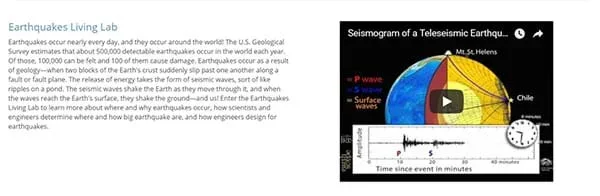 Figure 1. The entry web page for the Earthquakes Living Lab.
 - Have students click on the Earthquakes living lab hyperlink in the top left in the earthquakes section. Then, on the main page of the Earthquakes Living Lab website (see Figure 2), notice the focus on four active seismic areas and historic earthquakes in those areas: Chile, Southern California, Japan and San Francisco. For this activity, select the third option, the "Japan" box. Then follow the link on the right side of the page: “Why did the earthquake happen at Kobe? What were the short- and long-term effects of the earthquake?”
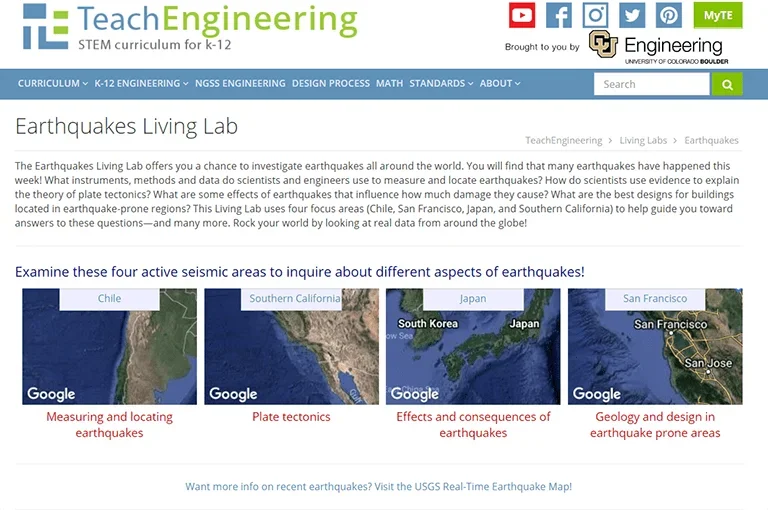 Figure 2. The main page of the Earthquakes Living Lab website. Note the Japan box.
 - Direct students to complete the Explore, Explain and Elaborate worksheet sections. Answers can be found in the living lab information and are provided for the teacher in the Geology and Earthquakes in Japan Worksheet Example Answers (PDF).
- Explore: Record the following information in your journals:
- Read the information on the screen about "Why did the earthquake happen here?"
- Explain: Record the following information in your journals:
- Draw a labeled sketch of the plate tectonics present in the Kobe region. Include the names of the fault, crusts and plates. Make the sketch large enough to add additional information to it later.
- Describe the motion of each tectonic plate relative to the other plates. (Hint: Look at the arrows.)
- Plot the epicenter of the Kobe earthquake on your sketch. (Hint: Look for the red line.)
- Elaborate: Reading through the given information:
- Identify which two plates likely caused the 1995 Kobe earthquake.
- Consider the movement of all three plates in the region. Identify two other potential locations that similar earthquakes might occur (or may have occurred in the past).
- Describe the short-term and long-term effects of the earthquake.
- Guide students to follow the provided links to complete the research required for the Evaluate and Extra Elaboration worksheet sections.
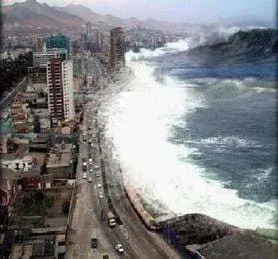 A tsunami caused by the 2011 Sendai earthquake in Japan.Copyright Sendai6, Wikispaces http://sendai6.wikispaces.com/sendai+tsunami
 - Evaluate: Another significant earthquake occurred in this same region in 2011. Complete some quick research to find out the location of the epicenter of the 2011 Sendai earthquake near Japan. Start with this link https://en.wikipedia.org/wiki/2011_T%C5%8Dhoku_earthquake_and_tsunami or do your own search:
- Was the epicenter associated with any tectonic plates?
- Was this earthquake associated with a fault or trench?
- Were the "experts" surprised by the location of the Sendai earthquake, the size of the Sendai earthquake, or both? Answer the question using specific information from the following article written by Devin Powell, originally published in Science News, March 17, 2011: https://www.wired.com/2011/03/japan-earthquake-surpise/
- How does predicting where earthquakes might occur relate to engineering? For what instances in the 1995 earthquake could the engineering have been improved?
- Extra Exploration: Let's see how many earthquakes occurred this week near Japan and what magnitude they were. In your journals, include a sketch of the locations and magnitudes of earthquakes for the last seven days in the Japan region. Use the following link to get current earthquake data near Japan and anywhere in the world (you may have to zoom in on the Japan area to get details): https://earthquake.usgs.gov/earthquakes/map/.
- fault plane
- The surface where tectonic plates slip past one another.
- geology
- The scientific study of the origin, history and structure of the Earth or a specific region of the Earth's crust.
- magnitude
- A measurement to describe the relative amount of energy released in an earthquake. Based on the maximum seismic wave motion recorded by a seismograph. Typically measured on the Richter magnitude scale or moment magnitude scale.
- tectonic plates
- Large sections of the Earth's crust (lithosphere) that move, float and sometimes fracture and whose interaction causes much of the planet's seismic activity as well as continental drift, earthquakes, volcanoes, mountains and oceanic trenches.
Pre-Activity Assessment
Introduction: For the Engage section of the Geology and Earthquakes in Japan Worksheet (PDF), have students take a moment to think about what they already know about Japan. Where is Japan located? What do you know about the geology? Have you heard of earthquakes in the Japan area? Review their answers to gauge their base knowledge of the subject matter.
Activity Embedded Assessment
Exploring Japan: Have students complete the worksheet (PDF) using the online Earthquakes Living Lab, exploring geological effects and engineering considerations. Have students (or groups) turn in their journals at class end. Be sure each group includes a sketch. Review their Explore, Explain and Elaborate answers for thoughtfulness and completeness.
Post-Activity Assessment
Extra Exploration: In the Evaluate and Extra Exploration worksheet (PDF) sections, students are asked to find the location of the epicenter of the 2011 Sendai earthquake and where other earthquakes have occurred in Japan. Have students share where they think the next earthquakes are likely to occur, and have the class vote on or debate the predictions. Also have students share or note one connection to engineering they discovered or one thing they learned from the overall activity.
Have students explore the other two regions in the Earthquakes Living Lab (Southern California and Chile).
Assign students to explore other historical earthquakes or other earthquakes that happened in Japan.
Because Japan has suffered so many large-magnitude earthquakes and expects more in the future, it has invested in creative engineering efforts to predict, warn and withstand them. Assign students to each investigate and report back to the class on one of the many earthquake engineering projects. Examples include earthquake-resistant construction, seismic vibration control, seismic design, earthquake building codes, advanced monitoring systems (hundreds of sensors space 15 miles apart across the Japanese islands), analysis of aftershock patterns, embedded strain sensors directly inside subduction zones, earthquake early warning systems (20-60 second advance notice). Start with the Science News article listed in the References section, and a search for "earthquake engineering."
- For lower grades, complete only the Explore, Explain and Elaborate worksheet sections, eliminating the Evaluate and Extra Exploration sections.
- For lower grades, conduct the worksheet activity as a class, instead of in student groups.
- For upper grades, have students work individually.
- For more advanced students, consider having them conduct the Earthquakes Living Lab: Earthquake Locations or Earthquakes Living Lab: Finding Epicenters and Measuring Magnitudes activities instead. These assignments are more technical and in-depth, and require students to do more of their own research.
Powell, Devin. "Japan Quake Epicenter Was in Unexpected Location." Published March 17, 2011. Science News. Accessed January 8, 2014. https://www.wired.com/2011/03/japan-earthquake-surpise/
This activity is designed around the Earthquakes Living Lab, a resource and online interface that uses real-time U.S. Geological Survey seismic data from around the world. The living lab presents earthquake information through a focus on four active seismic areas and historic earthquakes in those areas. The real-world earthquake data is viewable via a graphical interface using a scaling map.
Contributors
Mike Mooney; Minal Parekh; Scott Schankweiler; Jessica Noffsinger; Karen Johnson; Jonathan Knudtsen
Supporting Program
Civil and Environmental Engineering Department, Colorado School of Mines
Acknowledgements
This curriculum was created with the support of National Science Foundation grant no. DUE 0532684. However, these contents do not necessarily represent the policies of the National Science Foundation, and you should not assume endorsement by the federal government.
Copyright
2013 by Regents of the University of Colorado; original 2013 Colorado School of Mines