
Global Environment: Dangerous Air
By tracing the movement of radiation released during an accident at the Chernobyl nuclear power plant, students see how air pollution, like particulate matter, can become a global issue.
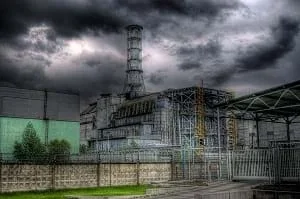 Students investigate the Chernobyl accident and the air pollution that resultedCopyright Piotr Andryszczak. Wikimedia Commons http://commons.wikimedia.org/wiki/File:Chernobyl_HDR.JPG
As they observed the pollution transport of the radiation release from Chernobyl, engineers and scientists worldwide compared measurements and predictions. Today, engineers analyze weather patterns to determine where air pollution is headed and to predict pollution concentrations in specific areas. Understanding the weather and water cycles helps environmental engineers explore the human impact from pollutant transport and issue warnings and evacuations. Engineers also learn ways to make nuclear power plants safer for the people living near them.
After this activity, students should be able to:
- Describe how air pollution travels from one area to another.
- Chronologically sequence the progress of radiation transport from the Chernobyl nuclear power plant disaster.
- Use division to convert units of speed to discover how fast pollution can travel.
- Recognize that environmental engineers must understand water and weather cycles in order to help issue warnings and evacuations in the event of a pollutant spill.
- 5.1.2.c Add, subtract, multiply, and divide decimals to hundredths.
Grade 5
Do you agree with this alignment?
- Develop, communicate, and justify an evidence-based explanation about how ecosystems interact with and impact the global environment
Grade 6
Do you agree with this alignment? - Examine, evaluate, question, and ethically use information from a variety of sources and media to investigate how environmental conditions affect the survival of individual organisms
Grade 6
Do you agree with this alignment?
- STEL-5F Analyze how an invention or innovation was influenced by its historical context.
Grades 6-8
Do you agree with this alignment?
- 4-ESS3-1 Obtain and combine information to describe that energy and fuels are derived from natural resources and their uses affect the environment.
Grade 4
This resource focuses on the following Three Dimensional Learning aspects of NGSS:
Science & Engineering Practices- Obtain and combine information from books and other reliable media to explain phenomena.Do you agree with this alignment?
Disciplinary Core Ideas- Energy and fuels that humans use are derived from natural sources, and their use affects the environment in multiple ways. Some resources are renewable over time, and others are not.Do you agree with this alignment?
Crosscutting Concepts- Cause and effect relationships are routinely identified and used to explain change.Do you agree with this alignment?
- Knowledge of relevant scientific concepts and research findings is important in engineering.Do you agree with this alignment?
- Over time, people's needs and wants change, as do their demands for new and improved technologies.Do you agree with this alignment?
Do you agree with this alignment? - Obtain and combine information from books and other reliable media to explain phenomena.
Each student needs:
- Explosion at Chernobyl Reading (PDF)
- Pollution Points Information Sheet (PDF) (copy on back side of Explosion at Chernobyl Reading)
- World Map Worksheet (PDF) for plotting data points
For the entire class to share:
- Colored pencils — a different color for each day — and to number the points. (Or, if students do this as a group, use sticky dots/stickers to mark the map, 1 per city per group.)
- World maps, atlases, globes, etc., for reference
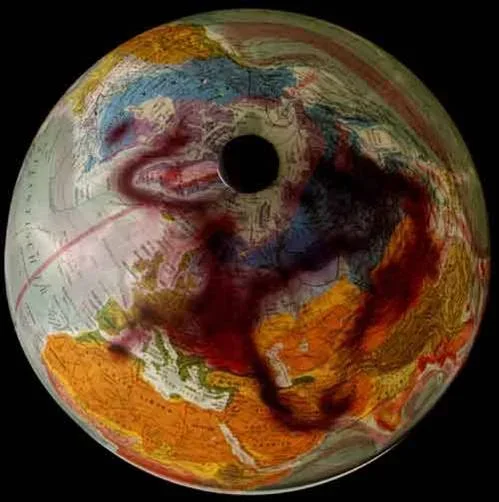 Figure 1. The spread of radiation from Chernobyl.Copyright 1988 - 2005 by Ingo Gunther. http://www.worldprocessor.com/images/chernobyl.jpg
Air does not abide by local, state, national or international boundaries. Wind carries pollutants hundreds of miles from their origins. The distance air pollutants travel depends on how high in the atmosphere they go. If the pollutants do not rise very high, they are generally deposited close to their source. However, pollutants that are lifted high into the atmosphere may travel thousands of miles before they drop back to Earth (see Figure 1).
On April 26, 1986, at 1:23 a.m., Chernobyl became the site of the world's worst nuclear power plant accident. Radiation from the explosion entered air currents and traveled three miles up into the sky. Fires burned around the area for 10 days, releasing harmful pollutants into the air. These types of radiation pollutants, even at low levels, can increase the incidence of cancer.
Engineers looked at weather patterns to determine where the radiation was headed and predict pollution concentrations in various areas. They used this information to decide whether or not certain areas should be evacuated. From this experience, engineers also learned ways to make nuclear power plants safer for the people living near them.
Before the Activity
- Gather materials and make copies of the three handouts.
- Gather reference materials (atlases, globes, etc.) for student use.
With the Students
- Ask students for suggestions about how air pollution travels. Do they think all types travel? If not, what kinds do and how do they travel?
- Pass out the Explosion at Chernobyl Reading (PDF).
- Read and discuss the article (as a class, unless you have advanced readers).
- Pass out the Pollution Points Information Sheet (PDF) and World Map Worksheet (PDF).
- Ask the students to plot the course of the radiation. The points should be plotted numerically and in chronological order. Make reference materials available to help locate the cities and countries. (If doing this on a class map, have student volunteers use sticky dots to track the path of pollution. You could also do this using an overhead projector transparency and colored transparency pens.)
- It took the pollutant 18 days to travel almost 10,000 miles from Chernobyl to Richland, WA in the U.S. Ask the students how they would go about finding how fast the pollutant traveled in miles per hour. Either as a class or individually, find the speed of the pollutant. (Answer: 10,000 miles /18 days = 555.55 miles per day. 555.55 miles /24 hours = 23.1 miles per hour.)
- See the Activity Extensions section for a more team-oriented variation of this activity.
Pre-Activity Assessment
Brainstorming: As a class, have the students engage in open discussion. Remind them that in brainstorming, no idea or suggestion is "silly." All ideas should be respectfully heard. Encourage wild ideas and discourage criticism of ideas. Have them raise their hands to respond. Write ideas on the board. Ask the students:
- How does air pollution travel? Do all types of air pollution travel? If not, what kinds do and how do they travel?
Activity Embedded Assessment
Discussion Question: Solicit student reactions to the Explosion at Chernobyl Reading (PDF). Why was the explosion a big issue? How does it make you feel?
Post-Activity Assessment
Global Issue Boggle!: Have the class form teams of 3–5 students each. Have the students on each team make a list of all the people, animals or situations that could have been affected by the Chernobyl blast by each person taking turns writing down ideas. For each item on their list, the students must describe one way in which it was affected. Students pass the list around the group until all ideas are exhausted. Have teams read aloud the ideas and write them on the board. Ask if any other teams came up with the same idea. If any other teams have the same idea on their sheet, they have to cross that item out on their list. The team that ends up with the most "unique" ideas, wins! (Possible ideas: 1. People [worsened health, become very sick with radiation cancer], 2. Farmers, milk and crops [spoiled], 3) Animals [could die], 4. Buildings [start deteriorating], 5. Water supply [become polluted], 6. Rain [contaminated]. At the end of the game, ask the students to reflect on whether a nuclear blast is a global issue.)
Depending on the ability of the students, you may want to write the cities in on the map for the plots in advance.
Split the class into two teams. Have each team work together to map the pollution points. Mark Chernobyl's location with a sticker. The mapping starts with someone from the first team reading pollution point location number 1 aloud. S/he has 40 seconds to find that city on the map and mark it with a sticker. Team members can help the player by giving directional tips, but they cannot point to any specific location. If the team member finds the location point within 40 seconds, that team gets one point. If not, the other team gets a chance to find the correct location. Teams take turns locating the points until all points are mapped.
Research other places where pollution is transported away from its source. This is not limited to air pollution. Pollution is transported in many ways, for example, by rivers and streams.
Have students read about the people affected by the Chernobyl disaster. Does anyone know someone who was affected by it? Invite a guest speaker to the class.
- For upper grades, give the students latitude and longitude coordinates in addition to city names.
- For lower grades, make one large class map. Have each student locate one city. Use different colored stickers for each day and number the stickers. Put the map on display in your school's media center or common area.
Chernobyl: A Nuclear Disaster. Updated 1996. Oracle ThinkQuest Education Foundation. Accessed July 23, 2004. Originally found at: http://library.thinkquest.org/3426/
Gunther, Ingo. Globe image showing radiation spread from Chernobyl. Updated February 15, 2000. World Processor, World Space Corporation. Accessed July 23, 2004.
The Path of Pollution. Last updated July 28, 2004. Lesson Plans for Teachers, TCEQ, Texas Natural Resource Conservation Commission. Accessed September 18, 2006. (Activity source; modified from Ranger Rick's Nature Scope Series: Pollution: Problems and Solutions, 1990. Originally found at: http://www.tceq.state.tx.us/assets/public/assistance/education/air/path_pollution.pdf
The Physics of Chernobyl. Updated 2000. Oracle ThinkQuest Education Foundation. Accessed July 23, 2004. Originally found at: http://library.thinkquest.org/C002190F/
Pollution: Problems and Solutions. National Wildlife Federation, Ranger Rick's Nature Scope Series, 1990.
World Map. Printables. TeacherVision.com. Accessed July 23, 2004. http://www.teachervision.com/lesson-plans/lesson-4022.html
Contributors
Amy Kolenbrander; Janet Yowell; Natalie Mach; Tyman Stephens; Malinda Schaefer Zarske; Denise Carlson
Supporting Program
Integrated Teaching and Learning Program, College of Engineering, University of Colorado Boulder
Acknowledgements
The contents of this digital library curriculum were developed under a grant from the Fund for the Improvement of Postsecondary Education (FIPSE), U.S. Department of Education and National Science Foundation GK-12 grant no. 0338326. However, these contents do not necessarily represent the policies of the Department of Education or National Science Foundation, and you should not assume endorsement by the federal government.
Copyright
2004 by Regents of the University of Colorado.