
Cleaning Air with Balloons
 How can balloons clean air?Copyright Microsoft Corporation, 1983-2001.
Students observe and discuss a simple balloon model of an electrostatic precipitator to better understand how this pollutant recovery method functions in cleaning industrial air pollution.
Environmental and mechanical engineers invent new techniques to prevent industrial air pollution. In an electrostatic precipitator, a static charge attracts pollution particles to electrified plates of metal, similar to how static electricity in clothing attracts bits of lint. This technique works very well on emissions from power plants, steel or paper mills, smelters and cement plants. And, engineers design small versions to keep the air in your home cleaner to breathe.
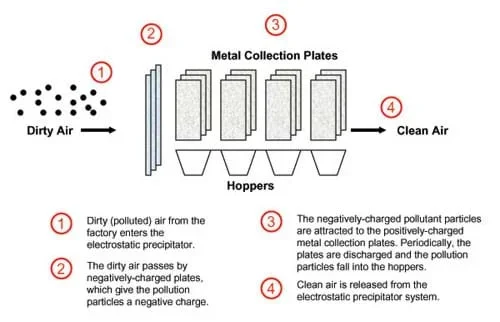 Figure 1. How an electrostatic precipitator cleans polluted air.Copyright Natalie Mach, Graduate Fellow, Integrated Teaching and Learning Program, College of Engineering, University of Colorado at Boulder, 2004.
After this activity, students should be able to:
- Describe and explain how an electrostatic precipitator works as a pollutant recovery method.
- Describe how engineers create technology to help industry clean up their air pollution.
- Apply knowledge of percentages to understand technological efficiency.
- Students will develop an understanding of the effects of technology on the environment.
Grades K-12
Do you agree with this alignment? - STEL-4I Explain why responsible use of technology requires sustainable management of resources.
Grades 3-5
Do you agree with this alignment?
- 5-ESS3-1 Obtain and combine information about ways individual communities use science ideas to protect the Earth's resources and environment.
Grade 5
This resource focuses on the following Three Dimensional Learning aspects of NGSS:
Science & Engineering Practices- Obtain and combine information from books and/or other reliable media to explain phenomena or solutions to a design problem.Do you agree with this alignment?
Disciplinary Core Ideas- Human activities in agriculture, industry, and everyday life have had major effects on the land, vegetation, streams, ocean, air, and even outer space. But individuals and communities are doing things to help protect Earth's resources and environments.Do you agree with this alignment?
Crosscutting Concepts- A system can be described in terms of its components and their interactions.Do you agree with this alignment?
- Science findings are limited to questions that can be answered with empirical evidence.Do you agree with this alignment?
Do you agree with this alignment? - Obtain and combine information from books and/or other reliable media to explain phenomena or solutions to a design problem.
For the student activity, each student needs:
- ½ teaspoon ground black pepper (or small bits of paper)
- 1 balloon
- 1 sheet of white paper
For the class demonstration:
- Ground black pepper
- 1 piece of plastic (PVC) tubing, 3-5 ft. long, 2.5 in. diameter
- 1 plastic shopping bag
- 1 sheet of white paper
Industry is a large contributor to air pollution. Environmental and mechanical engineers create new techniques to prevent industrial air pollution. The type of technology we are going to examine today is the electrostatic precipitator. An electrostatic precipitator uses static charges to clean pollutants out of the air. Can you give an example of static electricity? Have you ever had a sock stick to your shirt or pants when it came out of the dryer?
In an electrostatic precipitator, a static charge makes the pollution particles stick to electrified plates of metal. Refer to Figure 1 or the attached How an Electrostatic Precipitator Cleans Polluted Air Diagram (PDF). This is similar to how static electricity in clothing attracts small bits of dust and lint. Then, the collected dirt is knocked loose, collected and removed. Electrostatic precipitators are 99.9% efficient. They are often used, instead of other technologies, in situations in which the particles are suspended in very hot gases, such as in emissions from power plants, steel or paper mills, smelters and cement plants.
Can you picture how this works? Today, we are going to model electrostatic precipitator technology in class.
Before the Activity
Student Activity
- Ask the students: What is static electricity? Explain and give an example (e.g., clothes sticking together in the dryer). Ask students to brainstorm ways static electricity can be used to clean air pollution.
- Give each student a balloon and some black pepper on a sheet of paper.
- Ask the students to blow up their balloons and rub them on their hair or a piece of cloth.
- Hold the balloon over the pepper on the paper. What happens to the pepper? See Figure 2.
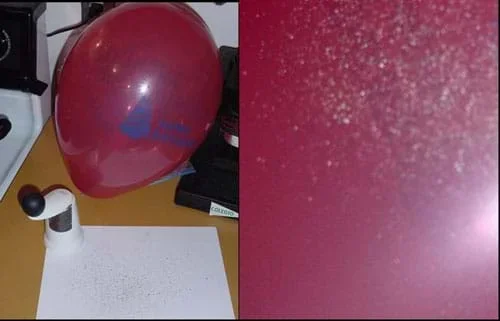 Figure 2. Materials required for the balloon model electrostatic precipitator. Close-up of pepper grains on the balloon surface.Copyright Sharon Perez, Graduate Fellow, Integrated Teaching and Learning Program, College of Engineering, University of Colorado at Boulder, 2003.
Class Demonstration
- Ask the students to record their observations of the class demonstration. Instruct them to record anything that seems important.
- Pull the plastic grocery bag through the PVC tube so that the inside edge of it becomes charged with static electricity.
- Gently pour some pepper through the tube while holding it over a piece of white paper. Some pepper should stick to the inside of the tube (in the same way that it was attracted to the balloon).
- Discuss student observations. Explain that electrostatic precipitators capture small particles (called particulate matter) from the polluted air before the air is released into the atmosphere. Describe the purposes for which we use an electrostatic precipitator.
- In conclusion, ask the students the following questions and discuss as a class:
- Does the electrostatic precipitator remove all of the particulates? (Answer: No, not all of them. Electrostatic precipitators are about 99.9% efficient.)
- How does this compare to the efficiency of a wet scrubber? Which one is better? (Answer: A wet scrubber is 95% efficient, so precipitators are more efficient).
- If the precipitators are more efficient, why would you ever want to use a wet scrubber? (Answer: Wet scrubbers work better on gases.)
Pre-Activity Assessment
Discussion and Brainstorming: As a class, have the students engage in open discussion. Remind students that in brainstorming, no idea or suggestion is "silly." All ideas should be respectfully heard. Take an uncritical position, encourage wild ideas and discourage criticism of ideas. Have them raise their hands to respond. Write their ideas on the board. Ask the students:
- What is static electricity? (Explain and give an example, e.g., clothes sticking together in the dryer.)
- How might static electricity be used to clean air pollution? (This will be shown in the student activity and class demonstration.)
Activity Embedded Assessment
Observations: Ask students to pay close attention and record their observations of the class demonstration, explaining to them that this is what real scientists and engineers do. Instruct them to record anything that seems important.
Post-Activity Assessment
Observations: Discuss student observations.
Drawing/Journaling: Depending on the students' age, have them draw a picture or write in their own words a description of how an electrostatic precipitator works to clean polluted air. Ask for volunteers to share their descriptions with the class.
- Keep the pepper away from your eyes!
- A 2.5 inch diameter PVC pipe is wide enough for students to see the pepper inside the tube.
- While the pepper usually only sticks to the top end of the tube, it still demonstrates the concept effectively.
Find local examples of electrostatic precipitators and arrange a field trip. What pollutants does their electrostatic precipitator remove? What do they do with the particulates collected?
Much smaller than industrial electrostatic precipitators, electrostatic air cleaners designed for the home use an electrostatic force to move air molecules and trap small airborne particles (0.05 – 30 microns in size, such as pet dander or other allergens) as they circulate past an array of electrically-charged stainless steel blades. Have students research air cleaners, air purifiers, copy machines and printers that use similar technology to the industrial electrostatic precipitators.
- Although this activity is appropriate for all age levels, younger students may need assistance blowing up balloons.
- For upper grades, add a math component. Give students a number of particulates, and have them calculate how many are cleaned from the air using electrostatic precipitators with 98% efficiency. For example, if 100,000 particulates went through this electrostatic precipitator, about 100,000 x .98 = 98,000 would be removed, and 2,000 would remain.
Markle, Sandra. The Kids' Earth Handbook. Atheneum, NY: John Wiley & Sons, Inc, 1991.
- Air Pollution & Air Quality
- Got Dirty Air?
- What Color is Your Air Today?
- Cleaning Air with Balloons
- Washing Air: Wet Scrubber Pollutant Recovery Method
- I've Gotta Get Some Air
- Visible Air Pollution: You've Got to See It to Believe It!
- Invisible Air Pollution: I Don't Believe My Eyes!
- The No Zone of Ozone
- On the Move: Pollution Transport & Weather
- Got Dirty Air?
Contributors
Amy Kolenbrander; Sharon Perez; Janet Yowell; Natalie Mach; Gwendolyn Frank; Malinda Schaefer Zarske; Denise Carlson
Supporting Program
Integrated Teaching and Learning Program, College of Engineering, University of Colorado Boulder
Acknowledgements
The contents of this digital library curriculum were developed under a grant from the Fund for the Improvement of Postsecondary Education (FIPSE), U.S. Department of Education and National Science Foundation GK-12 grant no. 0338326. However, these contents do not necessarily represent the policies of the Department of Education or National Science Foundation, and you should not assume endorsement by the federal government.
Copyright
2004 by Regents of the University of Colorado.