
A Merry-Go-Round for Dirty Air
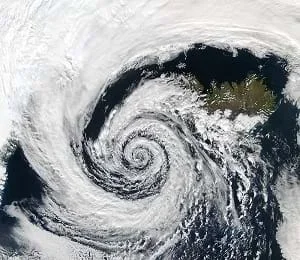 Students learn how cyclones workCopyright NASA's Aqua/MODIS satellite http://visibleearth.nasa.gov/view_rec.php?id=6204
Students observe and discuss a cup and pencil model of a cyclone to better understand the science behind how this pollutant recovery method functions in cleaning industrial air pollution.
As environmental engineers are faced with more types of industrial pollution, they must design even more innovative techniques to prevent it. In the cyclone method of pollution recovery, dust-laden gas is whirled very rapidly inside a collector shaped like a cylinder. Flying dust particles (as well as all matter) like to travel in straight lines unless an external force acts upon them (see Newton's first law). Because of this, pollutant particles with inertia in a cyclone tend to leave the circular path of the cyclone, collect on the wall, and then slide down the wall into a collection chamber. Cyclones can remove up to 95% of solid pollutants from cotton gins, rock crushers and many other industrial processes.
After this activity, students should be able to:
- Describe and explain the cyclone method of pollution recovery.
- Describe how engineers create technology to help industry minimize air pollution.
- Apply knowledge of percentages to understand technological efficiency.
- 5.3.1.a Represent and interpret data.
Grade 5
Do you agree with this alignment?
- Develop, communicate, and justify a procedure to separate simple mixtures based on physical properties
Grade 5
Do you agree with this alignment?
- CCSS.Math.Content.5.MD.B Represent and interpret data.
Grade 5
Do you agree with this alignment?
- Students will develop an understanding of the effects of technology on the environment.
Grades K-12
Do you agree with this alignment?
- SEP.7.3-5.6 Make observations and measurements to produce data to serve as the basis for evidence for an explanation of a phenomenon.
Grade 5
Do you agree with this alignment? - CCC.8.6-8.9 The uses of technologies and any limitations on their use are driven by individual or societal needs, desires, and values; by the findings of scientific research; and by differences in such factors as climate, natural resources, and economic conditions. Thus technology use varies from region to region and over time.
Grades 6-8
Do you agree with this alignment? - DCI.ESS3.C.6-8.3 Human activities have significantly altered the biosphere, sometimes damaging or destroying natural habitats and causing the extinction of other species. But changes to Earth's environments can have different impacts (negative and positive) for different living things.
Grades 6-8
Do you agree with this alignment?
Each student needs:
- 1 small paper cup (or Dixie cup)
- a dab of petroleum jelly (Vaseline)
- 1 teaspoon black pepper
- 1 pencil or pen
- paper towels (for cleaning petroleum jelly from fingers)
Industry is a large contributor to air pollution. As environmental engineers are faced with more types of industrial pollution, they must design even more new techniques to prevent it. The type of technology we are going to examine today is called a cyclone. A cyclone uses rapid circular motion to clean pollutants out of the air. Refer to Figure 1 or the attached How a Cyclone Cleans Polluted Air Diagram (PDF)). Have you ever been on a merry-go-round or another fun ride that spins in a circle? What happens to your body? Can you picture a cyclone or a tornado? What happens to particles in those types of storms?
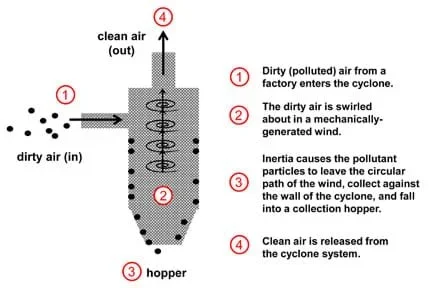 Figure 1: How a cyclone system cleans polluted air.Copyright 2004 and 2011 Natalie Mach and Ben Terry, ITL Program, College of Engineering, University of Colorado BoulderIn the cyclone method of pollution recovery, dust-laden gas is whirled very rapidly inside a collector shaped like a cylinder. Flying dust particles (as well as all matter) like to travel in straight lines unless an external force acts upon them (see Newton's first law). Because of this, dust particles with inertia in a cyclone tend to leave the circular path of the cyclone, collect on the wall, and then slide down the wall into a collection chamber. Cyclones are used for controlling pollutants from cotton gins, rock crushers and many other industrial processes; they can remove up to 95% of solid pollutants.
Does this sound like a good technology for removing particles from air? Today, we are going to model cyclone technology in class.
Before the Activity
- Gather materials.
- For younger students or to reduce the messiness of the activity, smear the inside walls of the paper cups with petroleum jelly and poke holes in the center of the base of the cups in advance.
With the Students
- Ask the students what it feels like to ride a merry-go-round. Do they feel any forces acting on their bodies? Explain to them that as they grip the rails of a merry-go-round, the force that pulls them inward and keeps them from falling off is called centripetal force. The force that they feel pulling them outward is a fictitious force referred to as "centrifugal force." In reality, there is no outward force. What feels like an outward force is, in reality, the inertia of the mass of your body attempting to travel in a straight line rather than along the curved path of the merry-go-round.
- Ask students to suggest ways to clean polluted air using what they know about inertia from the introduction. Record their brainstorm ideas on the chalkboard.
- Distribute to each student a cup, a small amount of petroleum jelly (in the cup), and a small amount of pepper (about 1 teaspoon).
- Ask students to record their observations during the activity, explaining to them that this is what real scientists and engineers do. Tell them to record anything about the activity that seems important to them.
- Have students smear the inside walls (not the bottom!) of the paper cups with the petroleum jelly. (To prevent a mess, you may want to do this in advance, for each cup.)
- Ask students to poke their pencil through the center of the bottom of the cups. (Remind them to be careful!)
- Pour the pepper into the cups. Try to place the pepper only on the bottom of the cup, not on the sides.
- Have the students spin the cups on their pencils as fast as they can, like a party favor. It helps if the hole is slightly bigger than the pencil diameter so the cup spins freely.
- What should happen: The pepper should move and adhere to the sticky sides.
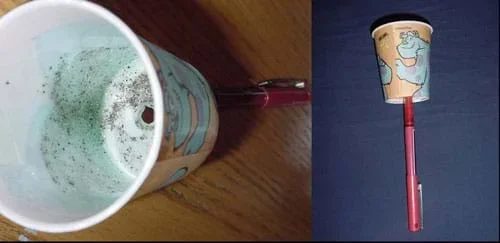 Figure 2. Cyclone model results and set-up.Copyright 2004 Natalie Mach, ITL Program, College of Engineering, University of Colorado Boulder
- Discuss student observations.
Explain to students that this is how a cyclone works. Dirty air enters a spinning cylinder. The pollutants are forced to the side and drop into a hopper below the cylinder.
- In conclusion, ask the students the following questions, and discuss as a class:
- Does the cyclone remove all of the particulates? (Answer: No, not all. Cyclones are 95% efficient.)
- Electrostatic precipitators are 99.9% efficient, wet scrubbers are 95% efficient and cyclones are 95% efficient. Which one is better? (Answer: The precipitators are most efficient).
- If the precipitators are the most efficient, why would you ever want to use a wet scrubber or cyclone? (Answer: It depends on the type of air pollutant(s). Electrostatic precipitators are ideal at removing particulates suspended in very hot gases. Wet scrubbers work better on acidic, basic or corrosive gases with high water solubility. Cyclones are best at removing solid pollutants from dust-laden gases.)
Pre-Activity Assessment
Discussion Question: Ask the students what it feels like to ride a merry-go-round. Do they feel any forces acting on their bodies? Explain to them that the force that keeps them from falling off is called centripetal force. Explain that the inertia of their bodies tries to keep them moving in a straight line, thus pulling them off the merry-go-round. This is a fictitious force referred to as "centrifugal force."
Brainstorming: As a class, have the students engage in open discussion. Remind students that in brainstorming, no idea or suggestion is "silly." All ideas should be respectfully heard. Take an uncritical position, encourage wild ideas and discourage criticism of ideas. Have them raise their hands to respond. Write their ideas on the board. Ask the students:
- How might you use what you know about cyclones to suggest a way to clean polluted air?
Activity Embedded Assessment
Observations: Have students pay close attention and record their observations of the activity, explaining to them that this is what real scientists and engineers do. Instruct them to record anything about the activity that seems important.
Post-Activity Assessment
Observations: Discuss student observations.
Drawing/Journaling: Depending on the students' age, have them draw a picture or write in their own words a description of how a cyclone works to clean polluted air. Ask for volunteers to share their descriptions with the class.
- Remind student to take extra precautions when poking their sharp pencil through the cup.
The cup spins more freely if the hole is slightly bigger than the pencil diameter.
To reduce the messiness of the activity or for younger students, you may want to smear the inside walls of the paper cups with petroleum jelly and poke holes in the center of the base of the cups in advance.
This activity also works well for teams of two students.
Find local examples of cyclones and arrange a field trip. What pollutants does this cyclone remove? What do they do with the collected particulates?
Ask the students: What would need to happen to the cyclone to catch larger particulates? (Answer: The larger the particulate, the faster the cyclone would need to spin.)
- Although this activity is appropriate for any age level, for younger students, prepare the cups with petroleum jelly and holes before the activity. They may also lack the coordination to skillfully twirl the cup around, but they will still get the idea.
- For upper grades, add a math component. Give students a number of particulates and have them calculate how many are cleaned out of the air using cyclones with 95% efficiency. For example, if 100,000 particulates went through a cyclone, about 100,000 x .95 = 95,000 would be removed, and 5,000 would remain.
Markle, Sandra. The Kids' Earth Handbook. Atheneum, NY: John Wiley & Sons, Inc., 1991.
Contributors
Amy Kolenbrander; Janet Yowell; Natalie Mach; Malinda Schaefer Zarske; Benjamin S. Terry; Denise W. Carlson
Supporting Program
Integrated Teaching and Learning Program, College of Engineering, University of Colorado Boulder
Acknowledgements
The contents of this digital library curriculum were developed under a grant from the Fund for the Improvement of Postsecondary Education (FIPSE), U.S. Department of Education and National Science Foundation GK-12 grant no. 0338326. However, these contents do not necessarily represent the policies of the Department of Education or National Science Foundation, and you should not assume endorsement by the federal government.
Copyright
2004 by Regents of the University of Colorado