
Environmental History Timeline
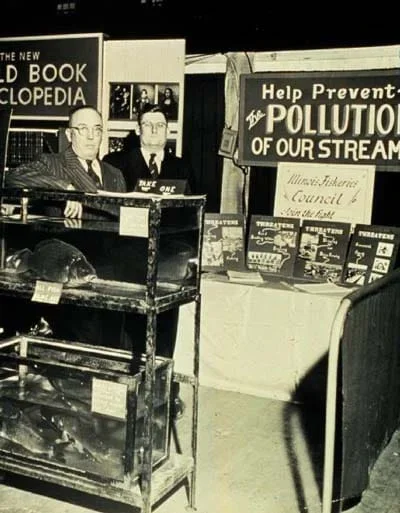 1940s pollution exhibit at the Illinois State Fair.Copyright http://www.museum.state.il.us/RiverWeb/harvesting/ archives/images/?RollID=roll1&FrameID=cs_03_337
Students develop critical thinking skills by interviewing a person who has perspective on environmental history. Students explore the concept of a timeline, including historical milestones, and develop a sense of the context of events.
Historically, human activity often creates environments and situations unfit for healthful living, for example, urban air pollution, unsafe cars at high speeds, ozone holes, toxic rivers and beaches. Once these situations are realized, the work of many scientists and engineers results in changes in design, manufacturing processes, regulations and practices, which clean up many problems and make our living environment safer. The modern engineer always keeps long-term sustainability in mind when s/he designs new structures, products and systems.
After this activity, students should be able to:
- Learn about environmental history by conducting an interview.
- Incorporate source materials into their speaking and writing (for example, interviews, news articles, encyclopedia information).
- Write and speak in the content areas using the technical vocabulary of the subject accurately.
- Recognize an author or speaker's point of view and purpose, separating fact from opinion.
- Students will develop an understanding of the effects of technology on the environment.
Grades K-12
Do you agree with this alignment? - STEL-5F Analyze how an invention or innovation was influenced by its historical context.
Grades 6-8
Do you agree with this alignment?
- SEP.2.6-8.1 Ask questions that can be investigated within the scope of the classroom, outdoor environment, and museums and other public facilities with available resources and, when appropriate, frame a hypothesis based on observations and scientific principles.
Grades 6-8
Do you agree with this alignment? - CCC.8.6-8.12 All human activity draws on natural resources and has both short and long-term consequences, positive as well as negative, for the health of people and the natural environment.
Grades 6-8
Do you agree with this alignment?
Paper, pencils, notebook
Have you ever seen the cartoon Peabody? It's a featured segment of the original Rocky and Bullwinkle Show, now seen on Cartoon Network. Mr. Peabody, historian and time-traveling dog, and his pet boy, Sherman, use Peabody's Wayback Machine to visit an episode in history in which things are in the process of going seriously off track. Their job is to set history back on course. The episodes always end with a really bad pun.
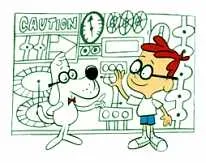 Mr. Peabody, Sherman and the Wayback Machine.Copyright http://www.thedenverchannel.com/technology/ 1145643/detail.html
Until recently, there was little historical perspective about environmental history even though environmental issues had become an important part of the global social fabric. In the late 20th century, we often saw issues emerge in the mass media without context and then disappear with little more than symbolic resolution. Dangerous myths emerged... calling us like sirens, telling us that environmental issues can be safely ignored. Nothing could be further from the truth.
Source: Environmental History Timeline at: http://www.radford.edu/~wkovarik/envhist
Imagine you have a Wayback Machine and can go back in history to see what life was like before you were born. Imagine what the world would be like if certain events had not occurred.
Your mission is to go back as far as you can in the 20th century to relive the days before seat belts and four-lane highways, when gas was cheap and littering was commonplace. See what you can learn about times when air pollution was so bad that temperature inversions caused thousands of deaths in major cities owing to the buildup of air pollutants; when beaches were frequently closed in the summer because of pollution alerts; when so much toxic waste was freely dumped into rivers that one river spontaneously burst into flames; and when London buses needed a walker to guide them through the streets at ten in the morning on a bad smog day.
To guide your journey, interview a person who was alive at the time you want to visit and old enough to remember the way things were. Or, interview someone knowledgeable about environmental issues or an environmental activist.
Before the Activity
When young students learn about the effects of pollution and hear negative news reports about looming environmental catastrophes such as global warming, they can become frightened (without necessarily admitting it) and feel powerless. One way to overcome those feelings is to learn how to take action to help solve the problem. Another way is to gain perspective from people who have lived long enough to know that taking action can have positive results.
Older people may remember the years leading up to the Clean Air Act of 1970 when smog and air pollution inversions caused thousands of deaths in major cities. They may remember when raw sewage was freely dumped into rivers, when beaches frequently had to be closed because of pollution alerts, when people thought nothing of throwing litter from their cars and when no one considered "adopting" a highway or river for cleanup.
Students learned in the lesson What's Air Got to Do with it?, that King Edward I of England (1272 – 1307) imposed a death penalty on anyone found burning soft coal, because it created an "intolerable smell." Though legislators no longer resort to such extreme measures, environmental cleanup initiatives have had a positive impact on the environment.
In this activity, students gain perspective in two ways: they prepare a timeline of milestones in environmental history and then interview someone born before 1950 to learn what things were like environmentally "wayback when." As an extended activity, students can use the perspective they gain from the interview to write a skit that describes what the world might have been like if certain anti-pollution initiatives had not been taken... what an excursion to the beach might have been like or a camping trip.
With the Students
Observing — To prepare for your interview, do some background reading and research to get an overview of environmental history. Create a timeline of significant milestones. Illustrate your timeline with drawings you make yourself or graphic images you download from the Internet. (See the Finding and Downloading an Image from the Internet Worksheet (PDF).)
Consult environmental websites on facts and important dates dealing with air pollution. In your web browser, you can search for the following websites:
- Radford University, Environmental History Timeline, http://environmentalhistory.org/
- American Lung Association, Clean Air Timeline, https://www.lung.org/policy-advocacy/healthy-air-campaign/about-healthy-air-campaign/clean-air-timeline
- NEA, Environmental History Resources, http://www.nea.org/tools/lessons/63302.htm
- Timeline of environmental history, https://www.eh-resources.org/ and https://www.eh-resources.org/timeline/
Observe how events unfold and how crisis points frequently trigger action. Notice how events in the history of air pollution fit within the context of environmental history.
Thinking — Prepare for your interview using the journalist's questions as a guide. The Paradigm Online Writing Assistant (found accessible via the internet; search through your web browser) lists a number of subtopics under the main journalist's questions that can help you generate appropriate questions. If you are able to interview someone who is especially knowledgeable about environmental issues or an environmental activist, you should prepare special questions to bring out that knowledge. Keep in mind that interests and personal history influences one's perspective on environmental issues.
Writing — To develop critical thinking skills, assign a writing activity. For example, write a skit that dramatizes how things might have been if certain environmental initiatives had not been taken. Additional writing activity suggestions are provided in the Activity Extensions section.
- context
- That which surrounds, and gives meaning to, something else. The circumstances or setting in which an event occurs.
- milestone
- An important event, as in a person's career, the history of a nation, or the advancement of knowledge in a field; a turning point.
- perspective
- The ability to perceive things in their actual interrelations or comparative importance: tried to keep my perspective throughout the crisis.
- temperature inversion
- An atmospheric condition in which the air temperature rises with increasing altitude, holding surface air down and preventing dispersion of pollutants.
- timeline
- A representation of key events within a particular historical period, often using visual material accompanied by written commentary, arranged chronologically.
Pre-Activity Assessment
Preparation of the environmental history timeline provides many opportunities for discussion. The emphasis is on gaining perspective and recognizing the importance of historical milestones. These concepts can be brought forward through call-out questions or a short quiz.
Activity Embedded Assessment
Review interview questions for appropriateness.
Post-Activity Assessment
Use any of the activities in the Activity Extensions section to assess students' understanding of what they learned from the environmental timeline and interview.
This activity is an individual or team activity with groups of two or three students each.
Write an episode of Peabody and perform it for the class, focusing on a milestone event in environmental history. You might want to focus on air pollution history. In keeping with the cartoon show, make sure that you get history back on course and don't forget the pun at the end!
Enlarge your environmental history timeline to use as a backdrop for a dramatic presentation of milestone events in environmental history. Write the script for your play.
Prepare a timeline of your own life (or your parents' or grandparents' lives or the life of the person you interviewed) noting important personal milestones as well as historical landmarks.
Read about the Great London Smog of 1952 and and report to the class.
- Students can work in teams of two or three to develop the timeline and interview questions. If desired, they can also partner to conduct the interview, with both partners asking questions.
Albert, Toni. Ecoprints: A Complete Kit for Writing about Nature. Mechanicsburg, PA: Trickle Creek Books, 1997.
Crawford, Leslie, et al. Energy Conservation. White Plains, NY: Dale Seymour Publications, 1997.
Crawford, Leslie, et al. Water Conservation. White Plains, NY: Dale Seymour Publications, 1997.
Dictionary.com. Lexico Publishing Group, LLC. Accessed May 5, 2004. (Source of vocabulary definitions, with some adaptation.)
Environmental History Timeline. Updated 2001. Formerly available at: Wildglobe.com. [Detailed, provides good links for additional background.]
Guilford, Chuck. The Journalist's Questions. Updated June 27, 2004. Paradigm Online Writing Assistant. [Highly recommended; an excellent, award-winning website.]
Kovarik, William. Environmental History Timeline. Radford University, Radford, VA. [Highly recommended. Interactive.]
Leuzzi, Linda. To the Young Environmentalist: Lives Dedicated to Preserving the Natural World. Danbury, CT: Franklin Watts, 1997.
American Lung Association, Clean Air Timeline, https://www.lung.org/policy-advocacy/healthy-air-campaign/about-healthy-air-campaign/clean-air-timeline
Prentice Hall. Science Explorer: Environmental Science. Upper Saddle River, NJ: Pearson Prentice Hall, 2000.
Suzuki, David and Vanderlinden, Kathy. Eco-Fun: Great Projects, Experiments and Games for a Greener Earth. Toronto and Vancouver, Canada: Douglas & McIntyre, 2001.
Weiss, Don. Environmental Movement Timeline: A History of the American Environmental Movement. June 17, 2003. Ecology Hall of Fame. [Detailed, provides good links for additional background.]
Contributors
Jane Evenson; Malinda Schaefer Zarske; Denise Carlson
Supporting Program
Integrated Teaching and Learning Program, College of Engineering, University of Colorado Boulder
Acknowledgements
The contents of this digital library curriculum were developed under a grant from the Fund for the Improvement of Postsecondary Education (FIPSE), U.S. Department of Education and National Science Foundation GK-12 grant no. 0338326. However, these contents do not necessarily represent the policies of the Department of Education or National Science Foundation, and you should not assume endorsement by the federal government.
Copyright
2004 by Regents of the University of Colorado.